3.36
continued.
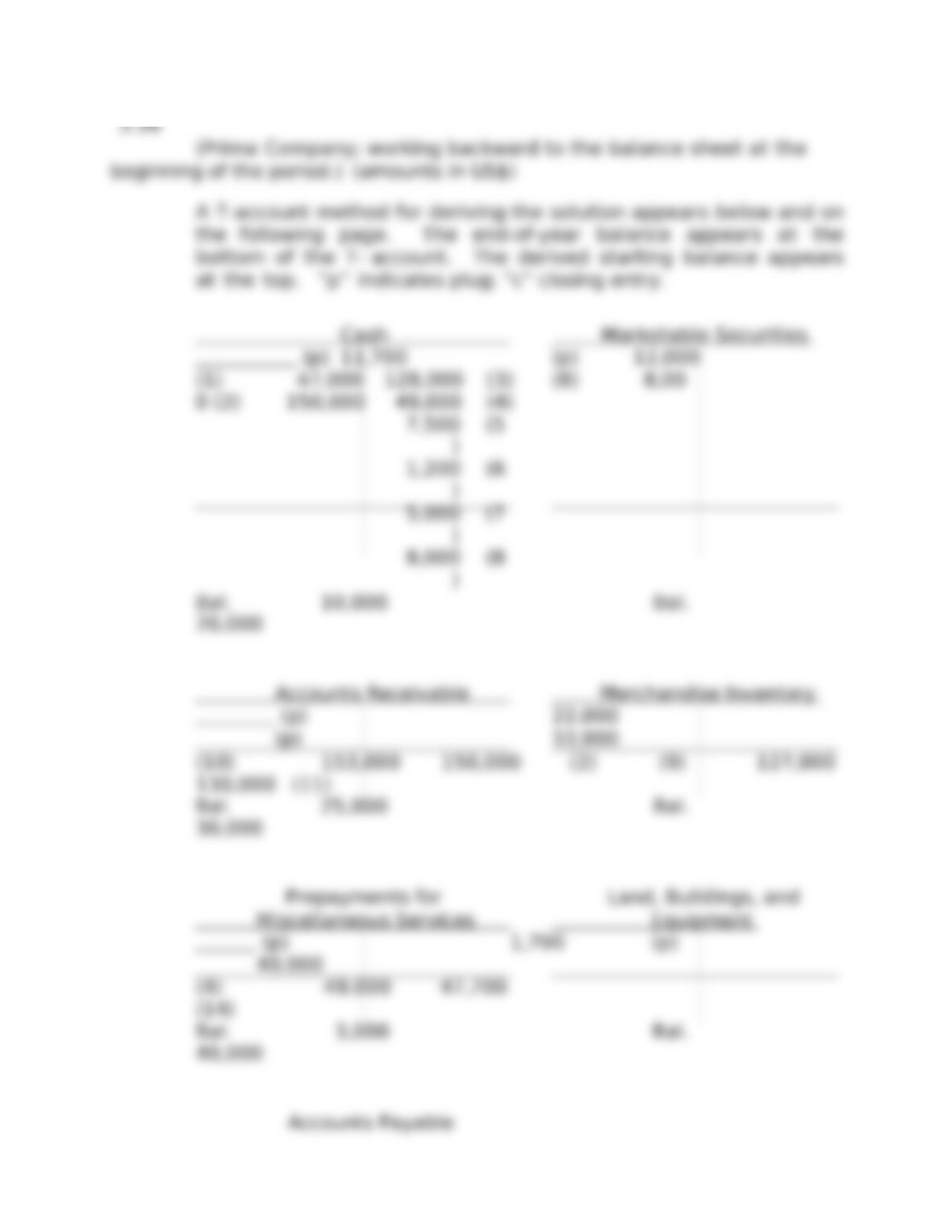
(Prima Company; working backward to the balance sheet at the
beginning of the period.) (amounts in US$)
A T-account method for deriving the solution appears below and on
the following page. The end-of-year balance appears at the
bottom of the T- account. The derived starting balance appears
at the top. “p” indicates plug; “c” closing entry.
C
a
s
h
M
a
r
k
e
t
ab
l
e
S
e
c
u
r
i
t
i
e
s
(p) 11,700 (p) 12,000
(1) 47,000 128,000 (3) (8) 8,00
0 (2) 150,000 49,000 (4)
7,500 (5
)
1,200 (6
)
5,000 (7
)
8,000 (8
)
Bal. 10,000 Bal.
20,000
A
cc
o
u
n
t
s
Re
c
e
iva
b
l
e
M
e
r
c
h
a
n
d
i
s
e
I
n
v
e
n
t
o
r
y
(p) 22,000
(p) 33,000
(10) 153,000 150,000 (2) (9) 127,000
130,000 (11)
Bal. 25,000 Bal.
30,000
Prepayments for Land, Buildings, and
M
i
sc
e
ll
a
n
e
o
u
s
S
e
r
v
i
c
es
E
q
u
i
p
m
e n
t
(p) 1,700 (p)
40,000
(4) 49,000 47,700
(14)
Bal. 3,000 Bal.
40,000
Accounts Payable
3.36
continued.
(f
o
r M e rc h
a
n
d
i
s
e)
I
n
t
e
r e s
t
P
ay
a
b
l
e
26,000 (p) 300 (p
) (3) 128,000 127,000 (9) (6) 1,200 1,200
(15)
25,000 Bal. 300 Bal.
Solutions 3-54
T
ax
es P
ay
a
b
l
e
N
o
t
e
P
ay
a
b
l
e
3,500 (p) 20,000 (
p) (5) 7,500 8,000 (13)
4,000 Bal. 20,000
Ba
l.
A
c c u
m
u
l
a
t
ed
D
e
p
r
e
c i
a
t
i
on
C
o
m
m
on S
t
o c k
12,000 (p) 50,000 (
p)
4,000 (1
2)
16,000 Bal. 50,000
Ba
l.
R
e
t
a
i
n
ed
E
a
r n
i n
g
s
S
a
l
e
s
8,600 (p)
47,000
(1) (7) 5,000 9,100 (16c) 153,000
(10p)
12,700 Bal. 200,000 Bal.
befor
e
Closi
ng
(16c) 200,000
0
C
o
s
t
of
G
oo
d
s
S
o
l
d
D
e
p
r
e
c
i
a
t
i
on
E
x
p
e
n
s
e
(11)
130,000 130,000 (16c) (12)
4,000 4,000 (16c)
T
a
x
E
x
p
e
n
s
e
O
t
h
e
r
O
p
e
r
a
t
i
n
g
E x p e
n
s
e
(13) 8,000 8,000 (16c) (14)
47,700 47,700 (16c)

3.36
continued.
I
n
t
e
r
e
s
t
E
x
p
e
n
s
e
(15)
1,200 1,200
(16c)
3-55 Solutions
PRIMA
C
O
MPA
NY
Balance
S
hee
t
As of December 31,
Year 7
A
sse
t
s
Ca
sh
……………………………………………………..
……..
$
11,700
Marketable Securities
…………………………………..
12,00
0
Accounts
Receivable
………………………………………
22,00
0
Merchandise
Inventory…………………………………..
33,00
0
Prepayments…………………………………………..
…….
1
, 70
Total Current A
ss
et
s
……………………………….
$
80,400
Land, Buildings, and Eq
ui
pm
en
t
…………………….
$ 40,000
Less Accumulated
Depreciation
……………………..
(
1
2
,
00
0
)
2
8
, 00
Total A
ss
et
s
$
Liabilities and Shareholders’ Equity
Accounts Payable
………………………………………….
$
26,000
Interest Payable
……………………………………………
300
Taxes
Payable……………………………………………….
3
, 50
Total Current
Liabilities………………………….
$
29,800
Notes Payable (6%)
……………………………………….
2
0
, 00
Total
Liabilities………………………………………
$
4
9
, 80
0
Common
Stock………………………………………………
$
50,000
Retained
Earnings…………………………………………
8
, 60
Total Shareholders’
Equity……………………….
$
5
8
, 60
0
Total Liabilities and Shareholders’ Eq
ui
ty
..
$
10
8
, 40
0
3.36
continued.
3.35 (The Secunda Company; working backward to cash receipts an
d disbursements.) (amounts in US$)
A T-account method for deriving the solution appears below and on
the following page. After Entry (6), we have explained all revenue
and expense account changes. Plugging for the unknown amounts
determines the remaining, unexplained changes in balance sheet
accounts. A “p” next to the entry number designates these
entries. Note that the revenue and expense accounts are not yet
closed to retained earnings, so dividends account for the decrease
in the Retained Earnings account during the year of $10,000.
Solutions 3-56
C
a
s
h
A
cc
o
u
n
t
s
R
e c e i
va
b
l
e
Ba
l.
20,000 Bal. 36,000
(7) 85,000 (1) 100,000 85,000
(7p)
2,000 (9)
81,000 (10)
3,000 (11)
10,000 (12)
Bal. 9,000 Bal. 51,000
M
e
r
c
h
a
n
d
i
s
e
I
n
v
e
n
t
o
r
y
P r
e
p
a
y
m
e n
t
s
Ba
l.
45,000 Bal.
2,000
(8p) 65,000 50,000 (2) 1,000 (5)
Bal. 60,000 Bal. 1,000
Land, Buildings, and
E
q
u
ip
m
e
n
t
C
o
s
t
of
G
oo
d
s
S
o
l
d
Ba
l.
40,000 Bal. 0
(2) 50
,
000
Bal. 40,000 Bal. 50,000
I
n
t
e
r
e
s
t
E
x
p
e
n
s
e
O
t
h
e
r
O
p
e
r
a
t
i
n
g
E
x
p
e
n
s
e
s
Ba
l.
0 Bal. 0
(3) 3,000 (4)
2,000 (5)
1,000 (6p)
26,000
Bal. 3,000 Bal. 29,000
3.36
continued.
A
c c u
m
u
l
a
t
ed
D
e
p
r
e
c i
a
t
i
on
I
n
t
e
r e s
t
P
ay
a
b
l
e
16,000 Bal. 1,000
Ba
l.
2,000 (4) (9p) 2,000 3,000 (3)
18,000 Bal. 2,000
Ba
l.
3-57
A
cc
o
u n
t
s P
ay
a
b
l
e
M
o r
t
gag
e
P
a
ya
b
l
e
30,000 Bal. 20,000
Bal. (10p) 81,000 26,000 (6) (11p) 3,000
65,000 (8
)
40,000 Bal. 17,000 Bal.
C
o
m
m
on S
t
o c k
R
e
t
a
i
n
ed
E
a
r n
i n
g
s
50,000 Bal. 26,000
Bal. (12p) 10,000
50,000 Bal. 16,000 Bal.
S
a
l
e
s
0 Ba
l
.
100,000 (1
)
100,000 Ba
l
.
SECUNDA
C
O
MPA
NY
Cash Receipts and Disbursements
S
che
d
ule
Receipts:
Collections from C
us
tom
ers
…………………….. $
85,000
Disbursements:
Suppliers of Merchandise and Other
Services
…………………………………………
……
$81,000
3.36
continued.
Mor
tgage …………………………………………..
……
3,000
Dividends ………………………………………….
……
10,000
I
n
te
res
t ……………………………………………..
……
2
,
00
0
Total
Dis
b
urs
em
en
t
s
……………………………
9
6
, 00
0
Change (Decrease) in Cash
…………………………….
$
(11,000)
Cash Balance, December 31, Year 7
………………..
2
0
, 00
0
Cash Balance, December 31, Year 8
………………..
$
9
, 00
0
Solutions 3-58
3.36 (Tertia Company; working backward to the income statement.)
(amounts in US$)
A T-account method for deriving the solution appears below and on
the following two pages. Transactions (1)–(9) correspond to the
numbered cash transactions information. In Transactions (10)–(25),
“p” indicates that the figure was derived by a “plug” and “c”
indicates a closing entry. The final check is that the debit to close
Income Summary in Transaction (25) matches the plug in the
Retained Earnings account.
Accounts a
n
d
C
a
s
h
N
o
t
e
s
R
e c e i
va
b
l
e
Ba
l.
40,000 Bal.
36,000
(1) 144,000 114,000 (4) (10p) 149,000 144,000 (1
) (2) 63,000 5,000 (5)
(3) 1,000 500
(6)
57,500 (7
)
1,200 (8
)
2,000 (9
)
Bal. 67,800 Bal.
41,000
M
e
r
c
h
a
n
d
i
s
e
I
n
v
e
n
t
o
r
y
I
n
t
e
r
e
s
t
R
e c e i
va
b
l
e
Ba
l.
55,000
Bal. 1,000
(14) 121,000 126,500 (15p) (11p) 700
1,000 (3)
Bal. 49,500 Bal.
700
3.36
continued.
Building,
M
a
chin
e
r
y
,
P
r
e
pai
d
M
i
sc
e
ll
a
n
e
o
u
s
S
e
r
v
i
c
es
a
n
d
E
q
u
i
p
m
e n
t
Ba
l.
4,000 Bal. 47,000
(7) 57,500 56,300
(12p)
Bal. 5,200 Bal.
47,000
Accounts Payable Accounts Payable
(
M
i
sc
e
l
l
a
n
e
o
u
s
S e r
v
i c e s
)
(
M
e rc h
a
n
d
i
s
e)
2,000 Bal. 34,000 Bal.
500 (13p) (4) 114,000 121,000
(14p)
2,500 Bal. 41,000 Bal.
3-59 Solutions
P r
o
p
e
r
t
y
T
a
x
P
a
ya
b
l
e
A
c c u
m
u
l
a
t
ed
D
e
p
r
e
c i
a
t
i
on
1,000 Bal. 10,000
Bal. (8) 1,200 1,700 (16p) 2,000
(17p)
1,500 Bal. 12,000
Ba
l.
M
o r
t
gag
e
P
a
ya
b
l
e
C
o
m
m
on S
t
o c k
35,000 Bal. 25,000
Ba
l.
© 2013 Cengage Learning. All
r
ights reserved. No
d
is
t
r
ibution allowed without express
a
u
t
hor
ization.
S
a
l
e
s
……………………………………………….
……..
$ 212,000
Interest Reve
nu
e
……………………………………..
Total Revenues
70
0
$
212,700
Cost of Goods
S
o
l
d
…………………………………..
$ 126,500
Property Tax Expe
ns
e
………………………………
1,700
Depreciation Expense
………………………………
2,000
Interest Expense
……………………………………..
500
Miscellaneous Expe
ns
e
s
…………………………..
Total
5
6
,
80
0
18
7
, 50
0
Net I
nc
ome
……………………………………………………
$
25,200
Less Dividends
……………………………………………..
(
2
, 00
0
Increase in Retained Ea
rnin
g
s
………………………..
$
23,200
Retained Earnings, Beginning of
Year……………..
7
6
,
00
0
Retained Earnings, End of
Year………………………
$
9
9
, 20
0
3.37 (Preparing adjusting entries.) (amounts in
US$)
(5) 5,000
30,000 Bal. 25,000 Ba
R
e
t
a
i
n
ed
E
a
r n
i n
g
s
S
a
l
e
s
76,000 Bal.
63,000 (2)
(9) 2,000 25,200 (18p) (18c) 212,000 149,000
(10)
99,200 Ba
l.
C
o
s
t
of
G
oo
d
s
S
o
l
d
I
n
t
e
r
e
s
t
E
x
p
e
n
s
e
(15)
126,500 126,500 (18c) (6) 500 500 (18c)
I
n
t
e
r
e
s
t
Re
v
e
nu
e
M
i
sc
e
ll
a
n
e
o
u
s
E
x
p
e
n
s
e
s
(18
c
) 700 700 (11) (12) 56,300
(13) 500 56,800 (18c)
P
r
o
p
e
r
t
y
T
a
x
E
x
p
e
n
s
e
D
e
p
r
e
c
i
a
t
i
on
E
x
p
e
n
s
e
(16) 1,700 1,700 (18c) (17) 2,000 2,000 (18c)
Solutions 3-60
TERTIA
C
O
MPA
NY
Statement of Income and Retained Earnings for
Year 8
Revenues:
Expenses:
© 2013 Cengage Learning. All
r
ights reserved. No
d
is
t
r
ibution allowed without express
a
u
t
hor
ization.
a. The Prepaid Rent account on the year-end balance sheet should represent
eight months of prepayments. The rent per month is $2,000 (= $24,000/12),
so the balance required in the Prepaid Rent account is
$16,000 (= 8 X $2,000). Rent Expense for Year 6 is $8,000 (= 4 X
$2,000
= $24,000 – $16,000).
Prepaid R
en
t …………………………………………………… 16,000
Rent Expense ……………………………………………….
16
,
00
0
Assets = Liabilities +
Shareholders’
Equity (Class.)
+16,000 +16,000
IncSt
RE
To increase the balance in the Prepaid Rent
account,
reducing the amount in the Rent
Expense
account.
3-61Solutions
b. The Prepaid Rent account on the balance sheet for the end of
Year 7 should represent eight months of prepayments. The rent
per month is
$2,500 (= $30,000/12), so the required balance in the Prepaid
Rent
account is $20,000 (= 8 X $2,500). The balance in that
account is already $16,000, so the adjusting entry must
increase it by $4,000 (=
$20,000 – $16,000).
Prepaid R
en
t …………………………………………………… 4,000
Rent Expense ………………………………………………. 4
,
000
Assets = Liabilities +
Shareholders’
Equity (Class.)
+4,000 +4,000
IncSt
RE
To increase the balance in the Prepaid Rent
account,
reducing the amount in the Rent Expense
account.
The Rent Expense account will have a balance at the end of
Year 7 before closing entries of $26,000 (= $30,000 – $4,000).
This amount comprises $16,000 (= $2,000 X 8) for rent from
January through August and $10,000 (= $2,500 X 4) for rent from
September through December.
© 2013 Cengage Learning. All
r
ights reserved. No
d
is
t
r
ibution allowed without express
a
u
t
hor
ization.
c. The Prepaid Rent account on the balance sheet at the end of
Year 8 should represent two months of prepayments. The rent
per month is
$3,000 (= $18,000/6), so the required balance in the
Prepaid Rent
account is $6,000 (= 2 X $3,000). The balance in that
account is
$20,000, so the adjusting entry must reduce it by $14,000 (=
$20,000 –
$6,000)
.
Rent Expense …………………………………………………..
14,000
Prepaid Rent……………………………………………….14
,
000
Assets = Liabilities +
Shareholders’
Equity (Class.)
–14,000 –14,000
IncSt
RE
To decrease the balance in the Prepaid Rent
account,
increasing the amount in the Rent
Expense
account.
Solutions 3-62
3.37 c. continued.
The Rent Expense account will have a balance at the end of
Year 8 before closing entries of $32,000 (= $18,000 +
$14,000). This amount comprises $20,000 (= $2,500 X 8) for
rent from January through August and $12,000 (= $3,000 X 4) for
rent from September through December.
d. The Wages Payable account should have a credit balance of
$4,000 at the end of April, but it has a balance of $5,000
carried over from the end of March. The adjusting entry must
reduce the balance by $1,000, which requires a debit to the
Wages Payable account.
Wages Payable…………………………………………………
1,000
Wage
Expense
……………………………………………… 1,000
Assets = Liabilities +
Shareholders’
Equity (Class.)
–1,000 +1,000
IncSt
RE
To reduce the balance in the Wages Payable
account,
reducing the amount in the Wage
Expense
account.
Wage Expense is $29,000 (= $30,000 – $1,000).
e. The Prepaid Insurance account balance of $3,000
represents four months of coverage. Thus, the cost of insurance
© 2013 Cengage Learning. All
r
ights reserved. No
d
is
t
r
ibution allowed without express
a
u
t
hor
ization.
is $750 (= $3,000/4) per month. The adjusting entry for a single
month is as follows:
Insurance Expense …………………………………………… 750
Prepaid Insurance ………………………………………. 750
Assets = Liabilities +
Shareholders’
Equity (Class.)
–750 –750
IncSt
RE
To recognize cost of one month’s insurance
cost
as
expense of the
month.
f. The Advances from Tenants account has a balance of $25,000
carried over from the start of the year. At the end of Year 7, it
should have a balance of $30,000. Thus, the adjusting entry
must increase the balance by $5,000, which requires a credit to
the liability account.
3-63Solutions
3.37 f. continued.
Rent Reve
nu
e ………………………………………………….. 5,000
Advance from Tenants ………………………………… 5,000
Assets = Liabilities +
Shareholders’
Equity (Class.)
+5,000 –5,000
IncSt
RE
To increase the balance in the Advances from
Tenants
account, reducing the amount in the Rent
Revenue account.
Rent Revenue for Year 7 is $245,000 (= $250,000 –
$5,000).
g. The Depreciation Expense for the year should be $2,000 (=
$10,000/5).
The balance in the Accumulated Depreciation account should
also be
$2,000; thus, the firm must credit Retained Earnings
(Depreciation Expense) by $8,000 (= $10,000 – $2,000). The
adjusting entry not only reduces recorded depreciation for the
period but also sets up the asset account and its accumulated
depreciation contra account.
Equipment ………………………………………………………
10,000
Accumulated
Depreciation
…………………………….2
,
000
Depreciation Expense ……………………………………8
,
000
Assets = Liabilities +
Shareholders’
Equity (Class.)

© 2013 Cengage Learning. All
r
ights reserved. No
d
is
t
r
ibution allowed without express
a
u
t
hor
ization.
+10,000 +8,000
IncSt
RE
–2,000
To reduce the recorded amount in
Depreciation
Expense from $10,000 to $2,000,
setting up the
asset
and its contra
account.
Solutions3-64
3.36
continued.
(f
o
r M e rc h
a
n
d
i
s
e)
I
n
t
e
r e s
t
P
ay
a
b
l
e
26,000 (p) 300 (p
) (3) 128,000 127,000 (9) (6) 1,200 1,200
(15)
25,000 Bal. 300 Bal.
Solutions 3-54
T
ax
es P
ay
a
b
l
e
N
o
t
e
P
ay
a
b
l
e
3,500 (p) 20,000 (
p) (5) 7,500 8,000 (13)
4,000 Bal. 20,000
Ba
l.
A
c c u
m
u
l
a
t
ed
D
e
p
r
e
c i
a
t
i
on
C
o
m
m
on S
t
o c k
12,000 (p) 50,000 (
p)
4,000 (1
2)
16,000 Bal. 50,000
Ba
l.
R
e
t
a
i
n
ed
E
a
r n
i n
g
s
S
a
l
e
s
8,600 (p)
47,000
(1) (7) 5,000 9,100 (16c) 153,000
(10p)
12,700 Bal. 200,000 Bal.
befor
e
Closi
ng
(16c) 200,000
0
C
o
s
t
of
G
oo
d
s
S
o
l
d
D
e
p
r
e
c
i
a
t
i
on
E
x
p
e
n
s
e
(11)
130,000 130,000 (16c) (12)
4,000 4,000 (16c)
T
a
x
E
x
p
e
n
s
e
O
t
h
e
r
O
p
e
r
a
t
i
n
g
E x p e
n
s
e
(13) 8,000 8,000 (16c) (14)
47,700 47,700 (16c)
3.36
continued.
I
n
t
e
r
e
s
t
E
x
p
e
n
s
e
(15)
1,200 1,200
(16c)
3-55 Solutions
PRIMA
C
O
MPA
NY
Balance
S
hee
t
As of December 31,
Year 7
A
sse
t
s
Ca
sh
……………………………………………………..
……..
$
11,700
Marketable Securities
…………………………………..
12,00
0
Accounts
Receivable
………………………………………
22,00
0
Merchandise
Inventory…………………………………..
33,00
0
Prepayments…………………………………………..
…….
1
, 70
Total Current A
ss
et
s
……………………………….
$
80,400
Land, Buildings, and Eq
ui
pm
en
t
…………………….
$ 40,000
Less Accumulated
Depreciation
……………………..
(
1
2
,
00
0
)
2
8
, 00
Total A
ss
et
s
$
Liabilities and Shareholders’ Equity
Accounts Payable
………………………………………….
$
26,000
Interest Payable
……………………………………………
300
Taxes
Payable……………………………………………….
3
, 50
Total Current
Liabilities………………………….
$
29,800
Notes Payable (6%)
……………………………………….
2
0
, 00
Total
Liabilities………………………………………
$
4
9
, 80
0
Common
Stock………………………………………………
$
50,000
Retained
Earnings…………………………………………
8
, 60
Total Shareholders’
Equity……………………….
$
5
8
, 60
0
Total Liabilities and Shareholders’ Eq
ui
ty
..
$
10
8
, 40
0
3.36
continued.
3.35 (The Secunda Company; working backward to cash receipts an
d disbursements.) (amounts in US$)
A T-account method for deriving the solution appears below and on
the following page. After Entry (6), we have explained all revenue
and expense account changes. Plugging for the unknown amounts
determines the remaining, unexplained changes in balance sheet
accounts. A “p” next to the entry number designates these
entries. Note that the revenue and expense accounts are not yet
closed to retained earnings, so dividends account for the decrease
in the Retained Earnings account during the year of $10,000.
Solutions 3-56
C
a
s
h
A
cc
o
u
n
t
s
R
e c e i
va
b
l
e
Ba
l.
20,000 Bal. 36,000
(7) 85,000 (1) 100,000 85,000
(7p)
2,000 (9)
81,000 (10)
3,000 (11)
10,000 (12)
Bal. 9,000 Bal. 51,000
M
e
r
c
h
a
n
d
i
s
e
I
n
v
e
n
t
o
r
y
P r
e
p
a
y
m
e n
t
s
Ba
l.
45,000 Bal.
2,000
(8p) 65,000 50,000 (2) 1,000 (5)
Bal. 60,000 Bal. 1,000
Land, Buildings, and
E
q
u
ip
m
e
n
t
C
o
s
t
of
G
oo
d
s
S
o
l
d
Ba
l.
40,000 Bal. 0
(2) 50
,
000
Bal. 40,000 Bal. 50,000
I
n
t
e
r
e
s
t
E
x
p
e
n
s
e
O
t
h
e
r
O
p
e
r
a
t
i
n
g
E
x
p
e
n
s
e
s
Ba
l.
0 Bal. 0
(3) 3,000 (4)
2,000 (5)
1,000 (6p)
26,000
Bal. 3,000 Bal. 29,000
3.36
continued.
A
c c u
m
u
l
a
t
ed
D
e
p
r
e
c i
a
t
i
on
I
n
t
e
r e s
t
P
ay
a
b
l
e
16,000 Bal. 1,000
Ba
l.
2,000 (4) (9p) 2,000 3,000 (3)
18,000 Bal. 2,000
Ba
l.
3-57
A
cc
o
u n
t
s P
ay
a
b
l
e
M
o r
t
gag
e
P
a
ya
b
l
e
30,000 Bal. 20,000
Bal. (10p) 81,000 26,000 (6) (11p) 3,000
65,000 (8
)
40,000 Bal. 17,000 Bal.
C
o
m
m
on S
t
o c k
R
e
t
a
i
n
ed
E
a
r n
i n
g
s
50,000 Bal. 26,000
Bal. (12p) 10,000
50,000 Bal. 16,000 Bal.
S
a
l
e
s
0 Ba
l
.
100,000 (1
)
100,000 Ba
l
.
SECUNDA
C
O
MPA
NY
Cash Receipts and Disbursements
S
che
d
ule
Receipts:
Collections from C
us
tom
ers
…………………….. $
85,000
Disbursements:
Suppliers of Merchandise and Other
Services
…………………………………………
……
$81,000
3.36
continued.
Mor
tgage …………………………………………..
……
3,000
Dividends ………………………………………….
……
10,000
I
n
te
res
t ……………………………………………..
……
2
,
00
0
Total
Dis
b
urs
em
en
t
s
……………………………
9
6
, 00
0
Change (Decrease) in Cash
…………………………….
$
(11,000)
Cash Balance, December 31, Year 7
………………..
2
0
, 00
0
Cash Balance, December 31, Year 8
………………..
$
9
, 00
0
Solutions 3-58
3.36 (Tertia Company; working backward to the income statement.)
(amounts in US$)
A T-account method for deriving the solution appears below and on
the following two pages. Transactions (1)–(9) correspond to the
numbered cash transactions information. In Transactions (10)–(25),
“p” indicates that the figure was derived by a “plug” and “c”
indicates a closing entry. The final check is that the debit to close
Income Summary in Transaction (25) matches the plug in the
Retained Earnings account.
Accounts a
n
d
C
a
s
h
N
o
t
e
s
R
e c e i
va
b
l
e
Ba
l.
40,000 Bal.
36,000
(1) 144,000 114,000 (4) (10p) 149,000 144,000 (1
) (2) 63,000 5,000 (5)
(3) 1,000 500
(6)
57,500 (7
)
1,200 (8
)
2,000 (9
)
Bal. 67,800 Bal.
41,000
M
e
r
c
h
a
n
d
i
s
e
I
n
v
e
n
t
o
r
y
I
n
t
e
r
e
s
t
R
e c e i
va
b
l
e
Ba
l.
55,000
Bal. 1,000
(14) 121,000 126,500 (15p) (11p) 700
1,000 (3)
Bal. 49,500 Bal.
700
3.36
continued.
Building,
M
a
chin
e
r
y
,
P
r
e
pai
d
M
i
sc
e
ll
a
n
e
o
u
s
S
e
r
v
i
c
es
a
n
d
E
q
u
i
p
m
e n
t
Ba
l.
4,000 Bal. 47,000
(7) 57,500 56,300
(12p)
Bal. 5,200 Bal.
47,000
Accounts Payable Accounts Payable
(
M
i
sc
e
l
l
a
n
e
o
u
s
S e r
v
i c e s
)
(
M
e rc h
a
n
d
i
s
e)
2,000 Bal. 34,000 Bal.
500 (13p) (4) 114,000 121,000
(14p)
2,500 Bal. 41,000 Bal.
3-59 Solutions
P r
o
p
e
r
t
y
T
a
x
P
a
ya
b
l
e
A
c c u
m
u
l
a
t
ed
D
e
p
r
e
c i
a
t
i
on
1,000 Bal. 10,000
Bal. (8) 1,200 1,700 (16p) 2,000
(17p)
1,500 Bal. 12,000
Ba
l.
M
o r
t
gag
e
P
a
ya
b
l
e
C
o
m
m
on S
t
o c k
35,000 Bal. 25,000
Ba
l.
© 2013 Cengage Learning. All
r
ights reserved. No
d
is
t
r
ibution allowed without express
a
u
t
hor
ization.
S
a
l
e
s
……………………………………………….
……..
$ 212,000
Interest Reve
nu
e
……………………………………..
Total Revenues
70
0
$
212,700
Cost of Goods
S
o
l
d
…………………………………..
$ 126,500
Property Tax Expe
ns
e
………………………………
1,700
Depreciation Expense
………………………………
2,000
Interest Expense
……………………………………..
500
Miscellaneous Expe
ns
e
s
…………………………..
Total
5
6
,
80
0
18
7
, 50
0
Net I
nc
ome
……………………………………………………
$
25,200
Less Dividends
……………………………………………..
(
2
, 00
0
Increase in Retained Ea
rnin
g
s
………………………..
$
23,200
Retained Earnings, Beginning of
Year……………..
7
6
,
00
0
Retained Earnings, End of
Year………………………
$
9
9
, 20
0
3.37 (Preparing adjusting entries.) (amounts in
US$)
(5) 5,000
30,000 Bal. 25,000 Ba
R
e
t
a
i
n
ed
E
a
r n
i n
g
s
S
a
l
e
s
76,000 Bal.
63,000 (2)
(9) 2,000 25,200 (18p) (18c) 212,000 149,000
(10)
99,200 Ba
l.
C
o
s
t
of
G
oo
d
s
S
o
l
d
I
n
t
e
r
e
s
t
E
x
p
e
n
s
e
(15)
126,500 126,500 (18c) (6) 500 500 (18c)
I
n
t
e
r
e
s
t
Re
v
e
nu
e
M
i
sc
e
ll
a
n
e
o
u
s
E
x
p
e
n
s
e
s
(18
c
) 700 700 (11) (12) 56,300
(13) 500 56,800 (18c)
P
r
o
p
e
r
t
y
T
a
x
E
x
p
e
n
s
e
D
e
p
r
e
c
i
a
t
i
on
E
x
p
e
n
s
e
(16) 1,700 1,700 (18c) (17) 2,000 2,000 (18c)
Solutions 3-60
TERTIA
C
O
MPA
NY
Statement of Income and Retained Earnings for
Year 8
Revenues:
Expenses:
© 2013 Cengage Learning. All
r
ights reserved. No
d
is
t
r
ibution allowed without express
a
u
t
hor
ization.
a. The Prepaid Rent account on the year-end balance sheet should represent
eight months of prepayments. The rent per month is $2,000 (= $24,000/12),
so the balance required in the Prepaid Rent account is
$16,000 (= 8 X $2,000). Rent Expense for Year 6 is $8,000 (= 4 X
$2,000
= $24,000 – $16,000).
Prepaid R
en
t …………………………………………………… 16,000
Rent Expense ……………………………………………….
16
,
00
0
Assets = Liabilities +
Shareholders’
Equity (Class.)
+16,000 +16,000
IncSt
RE
To increase the balance in the Prepaid Rent
account,
reducing the amount in the Rent
Expense
account.
3-61Solutions
b. The Prepaid Rent account on the balance sheet for the end of
Year 7 should represent eight months of prepayments. The rent
per month is
$2,500 (= $30,000/12), so the required balance in the Prepaid
Rent
account is $20,000 (= 8 X $2,500). The balance in that
account is already $16,000, so the adjusting entry must
increase it by $4,000 (=
$20,000 – $16,000).
Prepaid R
en
t …………………………………………………… 4,000
Rent Expense ………………………………………………. 4
,
000
Assets = Liabilities +
Shareholders’
Equity (Class.)
+4,000 +4,000
IncSt
RE
To increase the balance in the Prepaid Rent
account,
reducing the amount in the Rent Expense
account.
The Rent Expense account will have a balance at the end of
Year 7 before closing entries of $26,000 (= $30,000 – $4,000).
This amount comprises $16,000 (= $2,000 X 8) for rent from
January through August and $10,000 (= $2,500 X 4) for rent from
September through December.
© 2013 Cengage Learning. All
r
ights reserved. No
d
is
t
r
ibution allowed without express
a
u
t
hor
ization.
c. The Prepaid Rent account on the balance sheet at the end of
Year 8 should represent two months of prepayments. The rent
per month is
$3,000 (= $18,000/6), so the required balance in the
Prepaid Rent
account is $6,000 (= 2 X $3,000). The balance in that
account is
$20,000, so the adjusting entry must reduce it by $14,000 (=
$20,000 –
$6,000)
.
Rent Expense …………………………………………………..
14,000
Prepaid Rent……………………………………………….14
,
000
Assets = Liabilities +
Shareholders’
Equity (Class.)
–14,000 –14,000
IncSt
RE
To decrease the balance in the Prepaid Rent
account,
increasing the amount in the Rent
Expense
account.
Solutions 3-62
3.37 c. continued.
The Rent Expense account will have a balance at the end of
Year 8 before closing entries of $32,000 (= $18,000 +
$14,000). This amount comprises $20,000 (= $2,500 X 8) for
rent from January through August and $12,000 (= $3,000 X 4) for
rent from September through December.
d. The Wages Payable account should have a credit balance of
$4,000 at the end of April, but it has a balance of $5,000
carried over from the end of March. The adjusting entry must
reduce the balance by $1,000, which requires a debit to the
Wages Payable account.
Wages Payable…………………………………………………
1,000
Wage
Expense
……………………………………………… 1,000
Assets = Liabilities +
Shareholders’
Equity (Class.)
–1,000 +1,000
IncSt
RE
To reduce the balance in the Wages Payable
account,
reducing the amount in the Wage
Expense
account.
Wage Expense is $29,000 (= $30,000 – $1,000).
e. The Prepaid Insurance account balance of $3,000
represents four months of coverage. Thus, the cost of insurance
© 2013 Cengage Learning. All
r
ights reserved. No
d
is
t
r
ibution allowed without express
a
u
t
hor
ization.
is $750 (= $3,000/4) per month. The adjusting entry for a single
month is as follows:
Insurance Expense …………………………………………… 750
Prepaid Insurance ………………………………………. 750
Assets = Liabilities +
Shareholders’
Equity (Class.)
–750 –750
IncSt
RE
To recognize cost of one month’s insurance
cost
as
expense of the
month.
f. The Advances from Tenants account has a balance of $25,000
carried over from the start of the year. At the end of Year 7, it
should have a balance of $30,000. Thus, the adjusting entry
must increase the balance by $5,000, which requires a credit to
the liability account.
3-63Solutions
3.37 f. continued.
Rent Reve
nu
e ………………………………………………….. 5,000
Advance from Tenants ………………………………… 5,000
Assets = Liabilities +
Shareholders’
Equity (Class.)
+5,000 –5,000
IncSt
RE
To increase the balance in the Advances from
Tenants
account, reducing the amount in the Rent
Revenue account.
Rent Revenue for Year 7 is $245,000 (= $250,000 –
$5,000).
g. The Depreciation Expense for the year should be $2,000 (=
$10,000/5).
The balance in the Accumulated Depreciation account should
also be
$2,000; thus, the firm must credit Retained Earnings
(Depreciation Expense) by $8,000 (= $10,000 – $2,000). The
adjusting entry not only reduces recorded depreciation for the
period but also sets up the asset account and its accumulated
depreciation contra account.
Equipment ………………………………………………………
10,000
Accumulated
Depreciation
…………………………….2
,
000
Depreciation Expense ……………………………………8
,
000
Assets = Liabilities +
Shareholders’
Equity (Class.)
© 2013 Cengage Learning. All
r
ights reserved. No
d
is
t
r
ibution allowed without express
a
u
t
hor
ization.
+10,000 +8,000
IncSt
RE
–2,000
To reduce the recorded amount in
Depreciation
Expense from $10,000 to $2,000,
setting up the
asset
and its contra
account.
Solutions3-64