CHAPTER
13
MARKETABLE SECURITIES AND D
ERIVA
T
IVES
Questions, Exercises, and Problems: Answers and
S
ol
u
tio
ns
13.1 See the text or the glossary at the end of the book.
13.2 a. Debt securities that a firm intends to hold to maturity and has the
ability to hold to maturity appear as “held to maturity debt securities.”
b. The classification “trading securities” implies a firm’s active
involvement in buying and selling securities for profit. The
c. Amortized cost equals the purchase price of debt securities plus
or minus amortization of any diference between acquisition cost
d. Unrealized gains and losses occur when the fair value of a
security changes while the firm holds the security. The unrealized
13.2 continued.
e. Realized gains and losses appear in the income statement when a
firm sells a security. The realized gain or loss on trading securities
equals the selling price minus the fair value of the security on the
most recent balance sheet. The realized gain or loss on
available-for-sale securities equals the selling price minus the
acquisition cost of the security.
13.3 Firms acquire trading securities primarily for their short-term profit
potential. Including the unrealized gain or loss in income provides the
13.4 The required accounting does appear inconsistent. One explanation for
this inconsistency is that the balance sheet and income statement
serve diferent purposes. The balance sheet displays the resources of a
Solutions13-2
13.5 A derivative is an accounting hedge when the firm bears a risk
(a variability in outcomes) such that the change in the value of the
derivative ofsets the change in the value of the hedged item as time
13.6 A fair value hedge is a hedge of an exposure to changes in the fair value
of a recognized asset or liability or of an unrecognized firm commitment.
13.7 Firms do not recognize the fair value of the commitment except to
the extent that they recognize the fair value of the derivative that is
13.8 The reason relates to matching. Under a fair value hedge, firms
report recognized assets and liabilities at fair value and include
unrealized gains and losses in net income. Firms also report associated
derivatives at fair value and include unrealized gains and losses in net
13-3Solutions
13.9 To qualify for hedge accounting, there must be an expectation that
the derivative will be efective in hedging a particular risk. Obtaining a
13.10 This statement is correct. Firms would report all financial assets and
financial liabilities at fair value and include unrealized gains and losses
in net income.
13.11 (Classifying securities.)
a. Available-for-sale securities; current asset.
13.12 (Accounting principles for marketable securities and derivatives).
a. (4) The firm has option to use hedge accounting, deferring
Solutions13-4
c. (1) Because not both ability and intent to hold to maturity are
d. (3)
Standard treatment for available-for-sale securities.
13.13 (Murray Company; accounting for bonds held to maturity.) (amounts in
US$)
a. Present Value of Periodic Payments: $3,000 X 6.73274a = $ 20,198
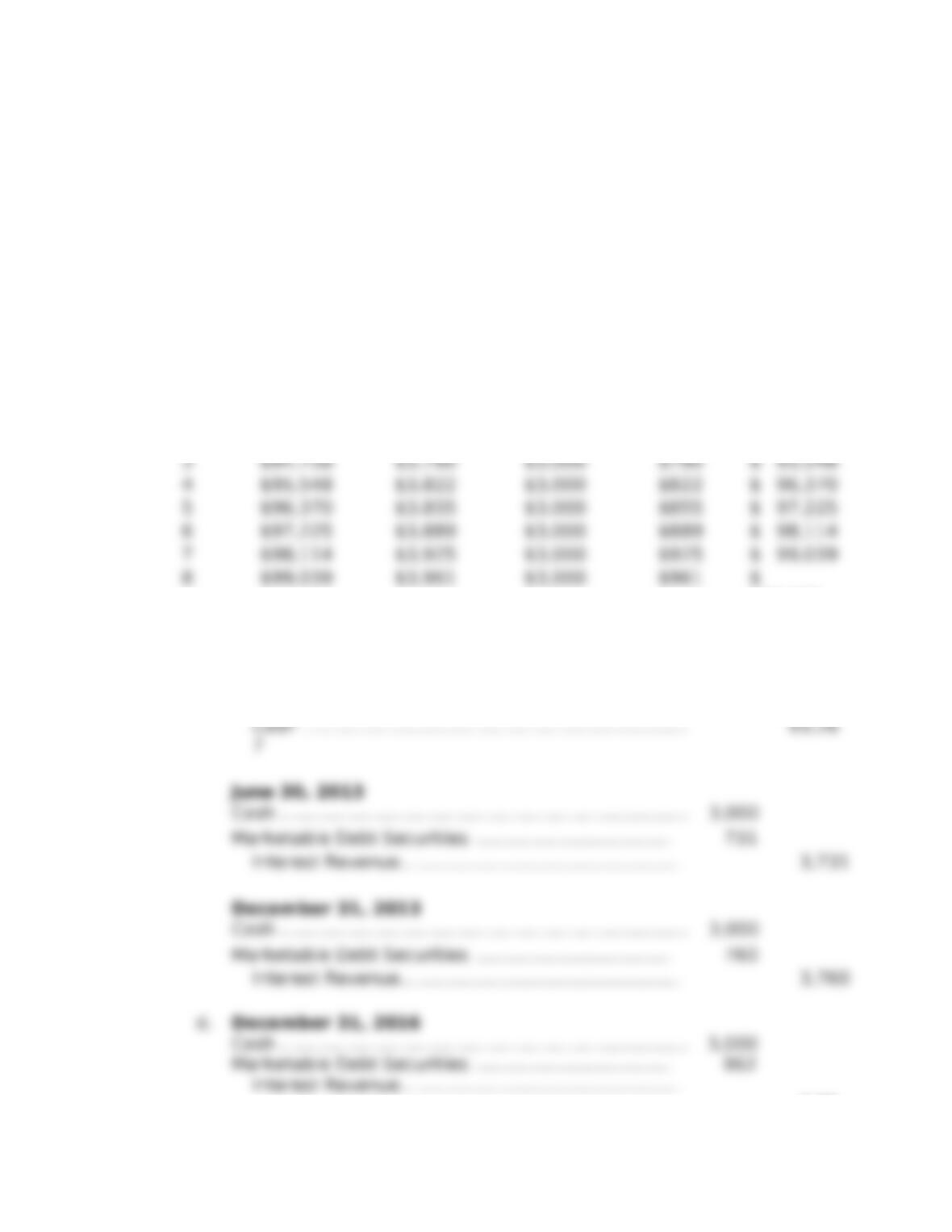
b. See Schedule 13.1 below.
Schedule
13
.
1
Amortization Table for $100,000 Bonds with
I
n
t
ere
st
Paid Semiannually at 6% and Priced to
Yield 8% Compounded
S
e
m
i
a
nnu
a
ll
y
(Exercise
13)
Portion of
Payment
Balance at Interest Increasing Balance
Beginning Revenue Cash Carrying at End
Period of Period for Period Received Value of Period
1 $93,267 $3,731 $3,000 $731 $ 93,998
2 $93,998 $3,760 $3,000 $760 $ 94,758
100,000
13-5Solutions
c. January 1,
2013
Marketable Debt Securities ……………………………… 93,267
3,96
2
December 31, 2016
100,00
0
13.14 (Kelly Company, accounting for bonds held to maturity.) (amounts in US$)
a. Present Value of Periodic Payments: $17,500 X 5.41719a = $
Solutions13-6
b. See Schedule 13.2 below.
Schedule 13
.
2
Amortization Table for $500,000 Bonds with
I
n
t
ere
st
Paid Semiannually at 7% and Priced to
Yield 6% Compounded
S
e
m
i
a
nnu
a
ll
y
(Exercise
14)
Portion of
Payment
Balance at Interest Reducing Balance
Beginning Revenue Cash Carrying at End
Period of Period for Period Received Value of Period
(1) (2) (3) (4) (5) (6)
1 $513,541 $15,406 $17,500 $(2,094) $
511,447
509,291
507,069
504,781
aAmount does not equal 3% of balance at the beginning of the period
due to rounding.
c. January 1,
2013
June 30, 2013
Ca
sh
……………………………………………………………….
.
17,500
Interest Revenue…………………………………………… 15,406
December 31, 2013
Ca
sh
……………………………………………………………….
.
17,500
13-7Solutions
d. December 31, 2015
Ca
sh
……………………………………………………………….
.
17,500
December 31, 2016
13.15 (Elston Corporation; accounting for available-for-sale securitie
s.) (amounts in US$)
10/15/2013
11/02/2013
12/31/2013
12/31/2013
3,00
0
To record unrealized loss on Security A.
12/31/2013
Solutions13-8
2/10/2014
0
12/31/2014
12/31/2014
7/15/2015
13-9Solutions
13.16 (Simmons Corporation; accounting for available-for-sale securitie
s.) (amounts in US$)
6/13/2013
10/11/2013
Cash……………………………………………………………………. 39,000
12/31/2013
12/31/2013
12/31/2014
Solutions13-10
13.16 continued.
12/31/2014
Marketable Securities (Security T) (= $31,700 –
$26,200) …………………………………………………………… 5,500
2/15/2015
Cash……………………………………………………………………. 14,900
8/22/2015
Cash……………………………………………………………………. 28,500
Unrealized Gain on Security T (Accumulated Other
13.17 (Fischer/Black Company; working backward from data on
marketable securities transaction.) (amounts in US$
a. $21,000 = $18,000 + $3,000.
b. $18,000, the amount credited to Marketable Securities in the journal entry
c. $5,000 loss from the debit for Realized Loss.
13-11Solutions
13.18 (Canning/Werther; working backward from data on marketable
13.19 (Reconstructing events from journal entries.) (amounts in
US
$)
a. The fair value of a marketable security classified as available for sale is
$4,000 less than its carrying value and the firm increases the Unrealized Loss
account on the balance sheet.
b. A firm sells marketable securities classified as either
trading securities or as available-for-sale securities in the same
t
h
em
.
c. The fair value of marketable securities classified as available for
d. A firm sells marketable securities classified as either
trading securities or available-for-sale securities in the same period
acquisition cost of the security.
13.3 Firms acquire trading securities primarily for their short-term profit
potential. Including the unrealized gain or loss in income provides the
13.4 The required accounting does appear inconsistent. One explanation for
this inconsistency is that the balance sheet and income statement
serve diferent purposes. The balance sheet displays the resources of a
Solutions13-2
13.5 A derivative is an accounting hedge when the firm bears a risk
(a variability in outcomes) such that the change in the value of the
derivative ofsets the change in the value of the hedged item as time
13.6 A fair value hedge is a hedge of an exposure to changes in the fair value
of a recognized asset or liability or of an unrecognized firm commitment.
13.7 Firms do not recognize the fair value of the commitment except to
the extent that they recognize the fair value of the derivative that is
13.8 The reason relates to matching. Under a fair value hedge, firms
report recognized assets and liabilities at fair value and include
unrealized gains and losses in net income. Firms also report associated
derivatives at fair value and include unrealized gains and losses in net
13-3Solutions
13.9 To qualify for hedge accounting, there must be an expectation that
the derivative will be efective in hedging a particular risk. Obtaining a
13.10 This statement is correct. Firms would report all financial assets and
financial liabilities at fair value and include unrealized gains and losses
in net income.
13.11 (Classifying securities.)
a. Available-for-sale securities; current asset.
13.12 (Accounting principles for marketable securities and derivatives).
a. (4) The firm has option to use hedge accounting, deferring
Solutions13-4
c. (1) Because not both ability and intent to hold to maturity are
d. (3)
Standard treatment for available-for-sale securities.
13.13 (Murray Company; accounting for bonds held to maturity.) (amounts in
US$)
a. Present Value of Periodic Payments: $3,000 X 6.73274a = $ 20,198
b. See Schedule 13.1 below.
Schedule
13
.
1
Amortization Table for $100,000 Bonds with
I
n
t
ere
st
Paid Semiannually at 6% and Priced to
Yield 8% Compounded
S
e
m
i
a
nnu
a
ll
y
(Exercise
13)
Portion of
Payment
Balance at Interest Increasing Balance
Beginning Revenue Cash Carrying at End
Period of Period for Period Received Value of Period
1 $93,267 $3,731 $3,000 $731 $ 93,998
2 $93,998 $3,760 $3,000 $760 $ 94,758
100,000
13-5Solutions
c. January 1,
2013
Marketable Debt Securities ……………………………… 93,267
3,96
2
December 31, 2016
100,00
0
13.14 (Kelly Company, accounting for bonds held to maturity.) (amounts in US$)
a. Present Value of Periodic Payments: $17,500 X 5.41719a = $
Solutions13-6
b. See Schedule 13.2 below.
Schedule 13
.
2
Amortization Table for $500,000 Bonds with
I
n
t
ere
st
Paid Semiannually at 7% and Priced to
Yield 6% Compounded
S
e
m
i
a
nnu
a
ll
y
(Exercise
14)
Portion of
Payment
Balance at Interest Reducing Balance
Beginning Revenue Cash Carrying at End
Period of Period for Period Received Value of Period
(1) (2) (3) (4) (5) (6)
1 $513,541 $15,406 $17,500 $(2,094) $
511,447
509,291
507,069
504,781
aAmount does not equal 3% of balance at the beginning of the period
due to rounding.
c. January 1,
2013
June 30, 2013
Ca
sh
……………………………………………………………….
.
17,500
Interest Revenue…………………………………………… 15,406
December 31, 2013
Ca
sh
……………………………………………………………….
.
17,500
13-7Solutions
d. December 31, 2015
Ca
sh
……………………………………………………………….
.
17,500
December 31, 2016
13.15 (Elston Corporation; accounting for available-for-sale securitie
s.) (amounts in US$)
10/15/2013
11/02/2013
12/31/2013
12/31/2013
3,00
0
To record unrealized loss on Security A.
12/31/2013
Solutions13-8
2/10/2014
0
12/31/2014
12/31/2014
7/15/2015
13-9Solutions
13.16 (Simmons Corporation; accounting for available-for-sale securitie
s.) (amounts in US$)
6/13/2013
10/11/2013
Cash……………………………………………………………………. 39,000
12/31/2013
12/31/2013
12/31/2014
Solutions13-10
13.16 continued.
12/31/2014
Marketable Securities (Security T) (= $31,700 –
$26,200) …………………………………………………………… 5,500
2/15/2015
Cash……………………………………………………………………. 14,900
8/22/2015
Cash……………………………………………………………………. 28,500
Unrealized Gain on Security T (Accumulated Other
13.17 (Fischer/Black Company; working backward from data on
marketable securities transaction.) (amounts in US$
a. $21,000 = $18,000 + $3,000.
b. $18,000, the amount credited to Marketable Securities in the journal entry
c. $5,000 loss from the debit for Realized Loss.
13-11Solutions
13.18 (Canning/Werther; working backward from data on marketable
13.19 (Reconstructing events from journal entries.) (amounts in
US
$)
a. The fair value of a marketable security classified as available for sale is
$4,000 less than its carrying value and the firm increases the Unrealized Loss
account on the balance sheet.
b. A firm sells marketable securities classified as either
trading securities or as available-for-sale securities in the same
t
h
em
.
c. The fair value of marketable securities classified as available for
d. A firm sells marketable securities classified as either
trading securities or available-for-sale securities in the same period