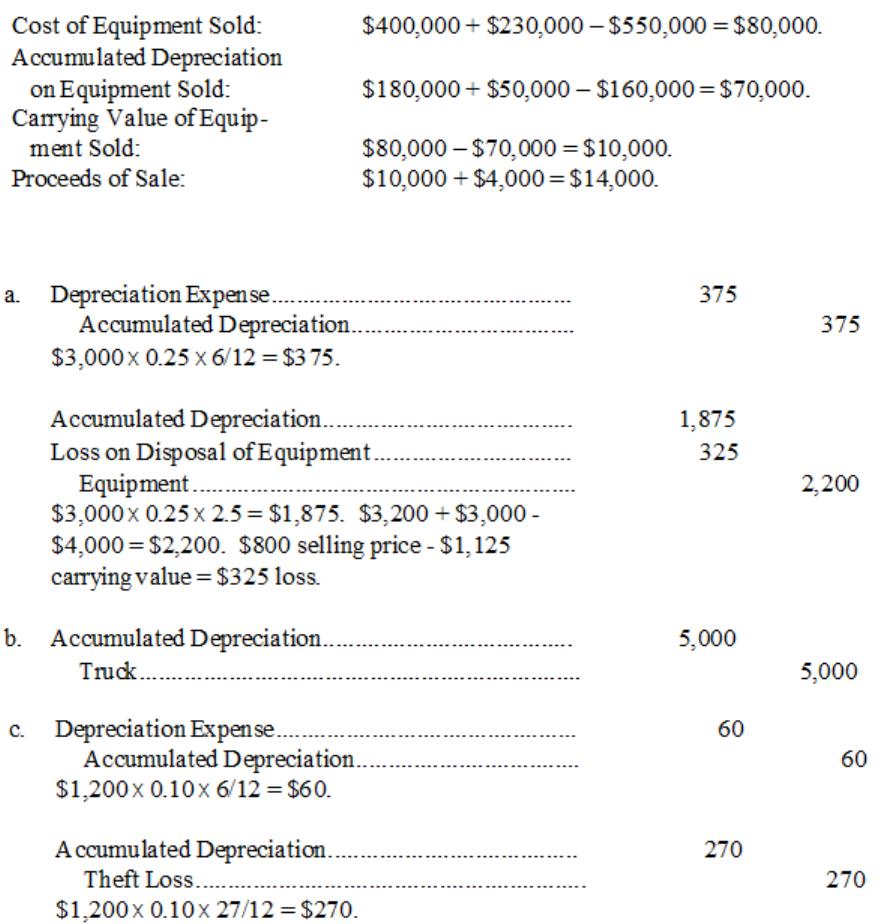
10.27 (Wilcox Corporation; working backward to derive proceeds fr
om disposition of plant assets.) (amounts in US$)
10.28 (Journal entries to correct accounting errors.) (amounts in US$)
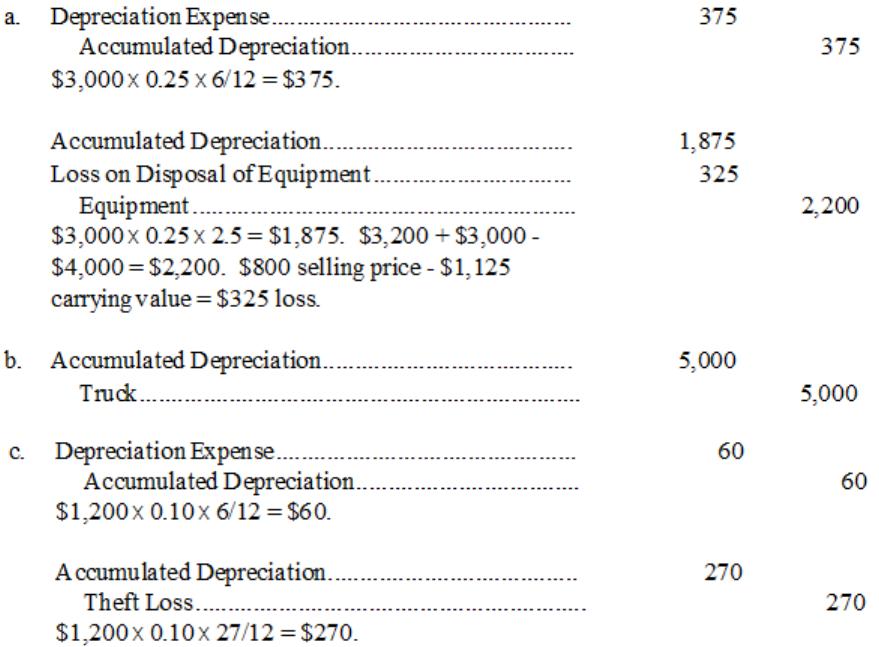
10.29 (Moon Macrosystems; recording transactions involving tangible and intangible assets.)
(amounts in US$)
a. Office Equipment……………………………………………… 400,000
Computer
S
oft
w
a
r
e …………………………………………..
Ca
sh
…………………………………………………………….
40,000
Computer
S
oft
w
a
r
e …………………………………………..
Ca
sh
…………………………………………………………….
10,000
c. 2011 and 2012
Depreciation Expense [($400,000 + $20,000 –
Amortization Expense [($40,000 + $10,000)/4] …… 12,500
Computer
S
oft
w
a
r
e ………………………………………. 12,500
d. Impairment Loss of Computer Software
($40,000 + $10,000 – $12,500 – $12
,
500) ………..
25,000
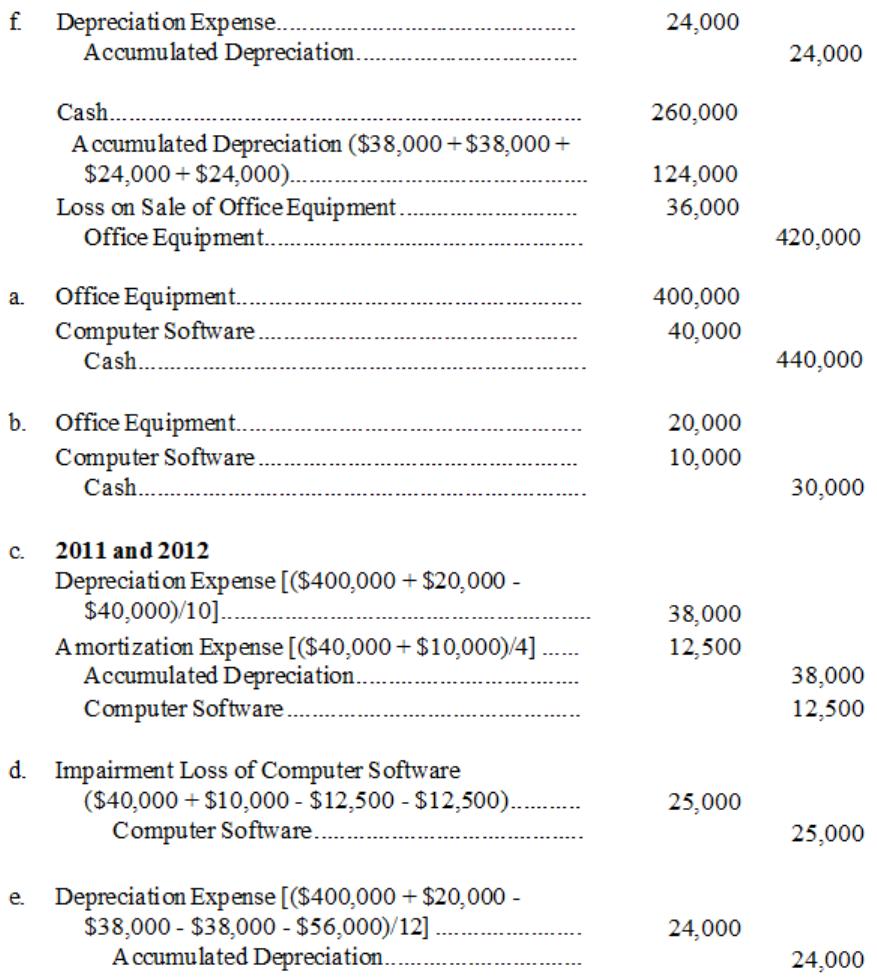
e. Depreciation Expense [($400,000 + $20,000 –
$38,000 – $38,000 – $56,000)/12] …………………..
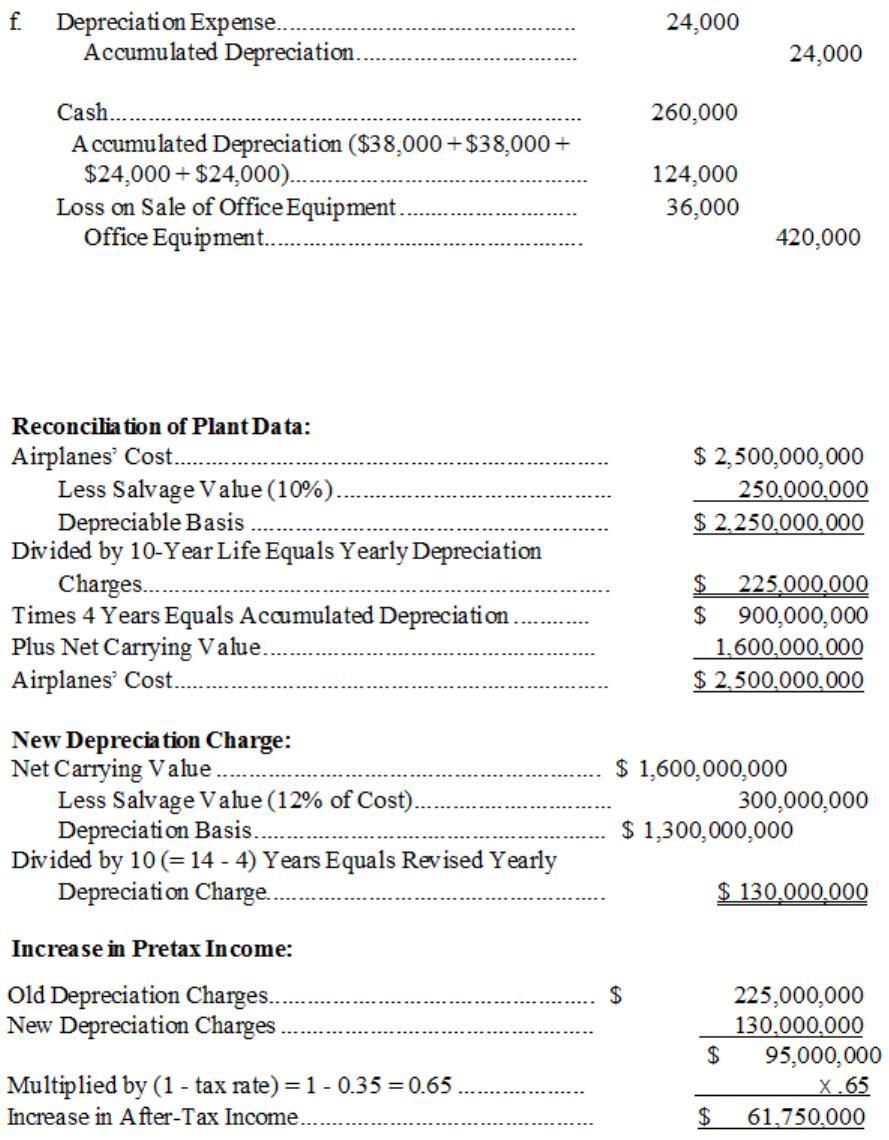
10.30 (Cloud Airlines; effect on net income of changes in estimates for depreciable assets.)
(amounts in US$)
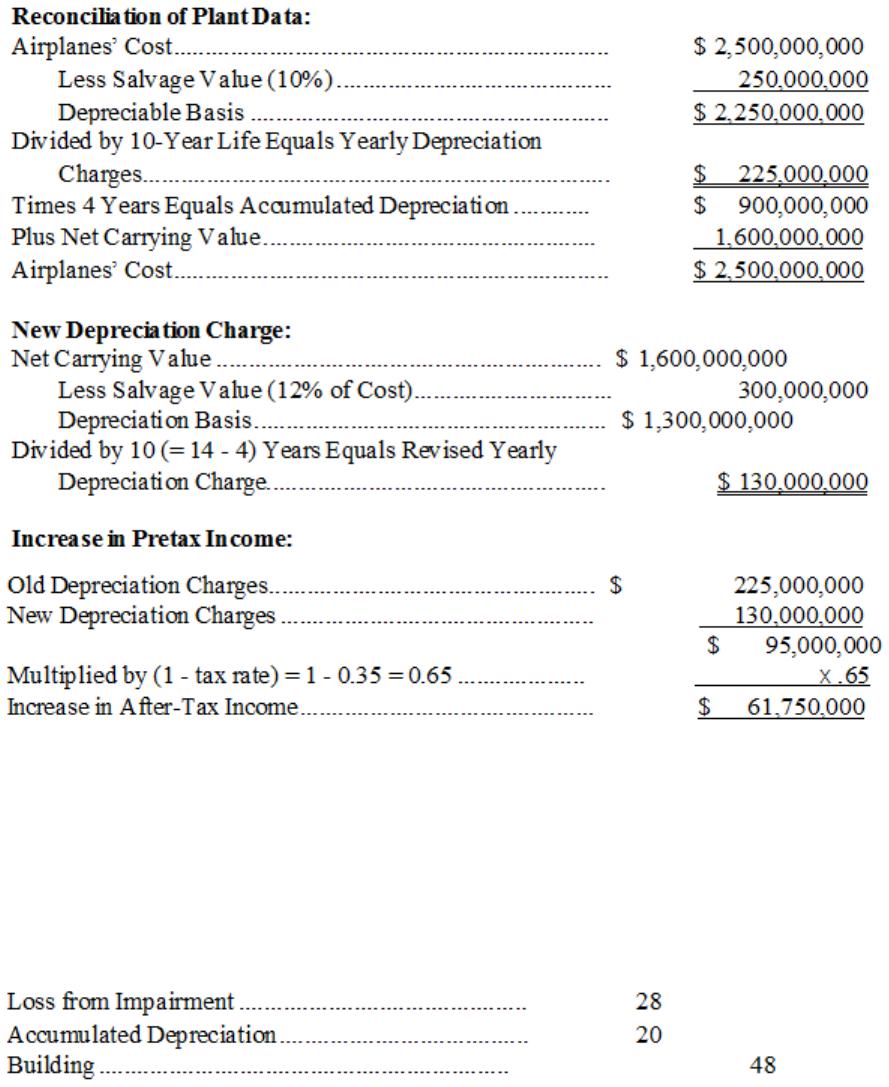
Income has been about $180 million (= 0.06 X $3 billion) per year.
Income will rise by about 34.3% (= $61.75/$180.0).
Note that a modest change in depreciation parameters can significantly affect net income.
(Cloud Airlines; effect on net income of changes in estimates for depreciable assets.) (amounts
in US$)
10.31 (Recognizing and measuring impairment losses.) (amounts in US$)
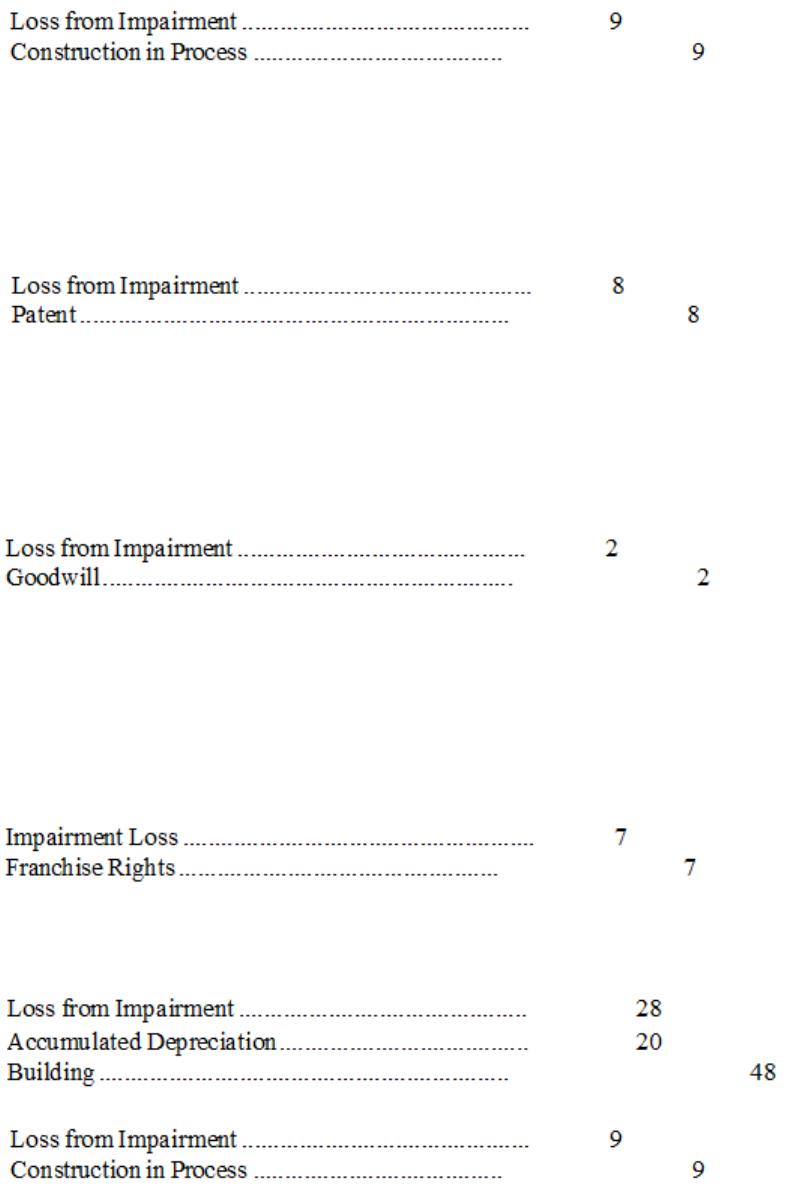
a. The loss occurs because of an adverse action by a governmental entity.
The undiscounted cash flows of $50 million are less than the carrying value of the building of $60 million.
An impairment loss has therefore occurred. The fair value of the building of $32 million is less than the
carrying value of $60 million. Thus, the amount of the impairment loss is $28 million (= $60 million –
$32 million). The journal entry to record the impairment loss is (in millions):
This entry records the impairment loss, eliminates the accumulated depreciation, and writes down the
building to its fair value of $32 million (= $80 – $48).
b. The undiscounted cash flows of $70 million exceed the carrying value of the building of $60 million.
Thus, no impairment loss occurs according to the definition in U.S. GAAP. An economic loss occurred
but U.S. GAAP does not recognize it.
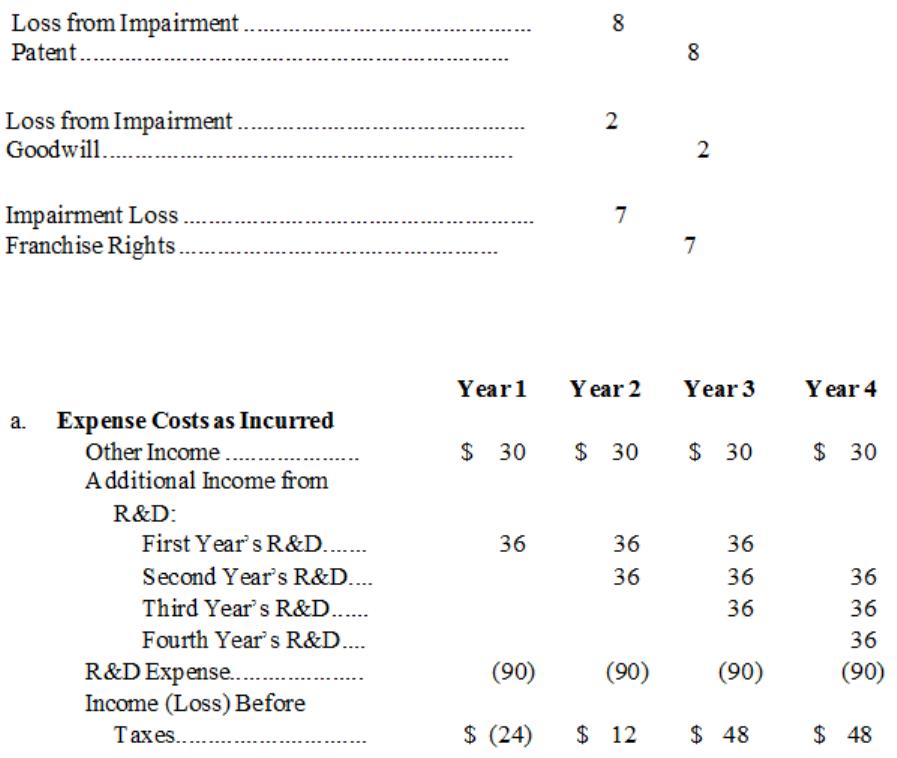
c. The loss arises because the accumulated costs significantly exceed the amount originally anticipated.
The carrying value of the building of
$25 million exceeds the undiscounted future cash flows of $22 million. Thus, an impairment loss has
occurred. The impairment loss recognized equals $9 million (= $25 million – $16 million). The journal
entry is (in millions)
d. The loss occurs because of a significant decline in the fair value of the patent. U.S. GAAP requires
calculation of the impairment loss on the patent before computing the impairment loss on goodwill. The
undiscounted future cash flows of $18 million are less than the carrying value of the patent of $20 million.
Thus, an impairment loss occurred. The amount of the loss is $8 million (= $20 million – $12 million).
The journal entry to record the loss is (in millions):
The second step is to determine if an impairment loss on the goodwill occurred. The fair value of the
entity is $25 million. The carrying value after writing down the patent is $27 million (= $12 million for
patent and $15 million for goodwill). Thus, a goodwill impairment loss occurred. If the fair value of the
patent is $12 million, the market value of the goodwill is $13 million. The impairment loss on goodwill
is therefore $2 million (= $15 million – $13 million). The journal entry is (in millions):
e. The loss occurs because of a significant change in the business climate for Chicken Franchisees. One
might question whether this loss is temporary or permanent. U.S. GAAP discusses but rejects the use of a
permanency criterion in identifying impairment losses. Thus, an impairment loss occurs in this case
because the future undiscounted cash flows of $6 million from the franchise rights are less than the
carrying value of the franchise rights of $10 million. The amount of the impairment loss is $7 million (=
$10 million – $3 million). The journal entry is (in millions):
This entry assumes that Chicken Franchisees does not use an Accumulated Amortization
account.
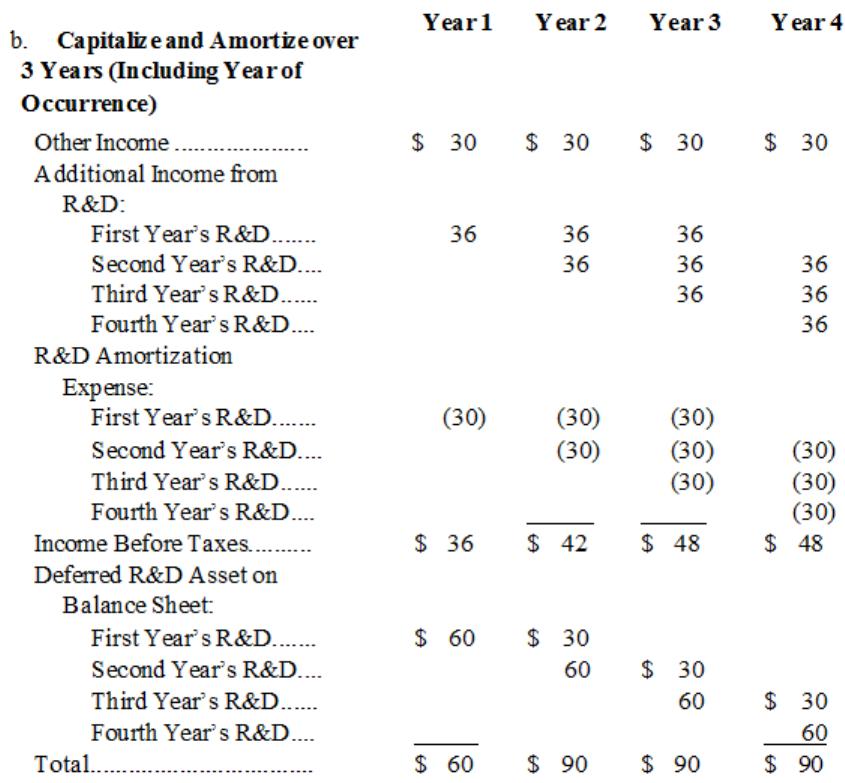
10.32 (Pfizer; expensing versus capitalizing research and development costs.) (amounts in millions of
US$)
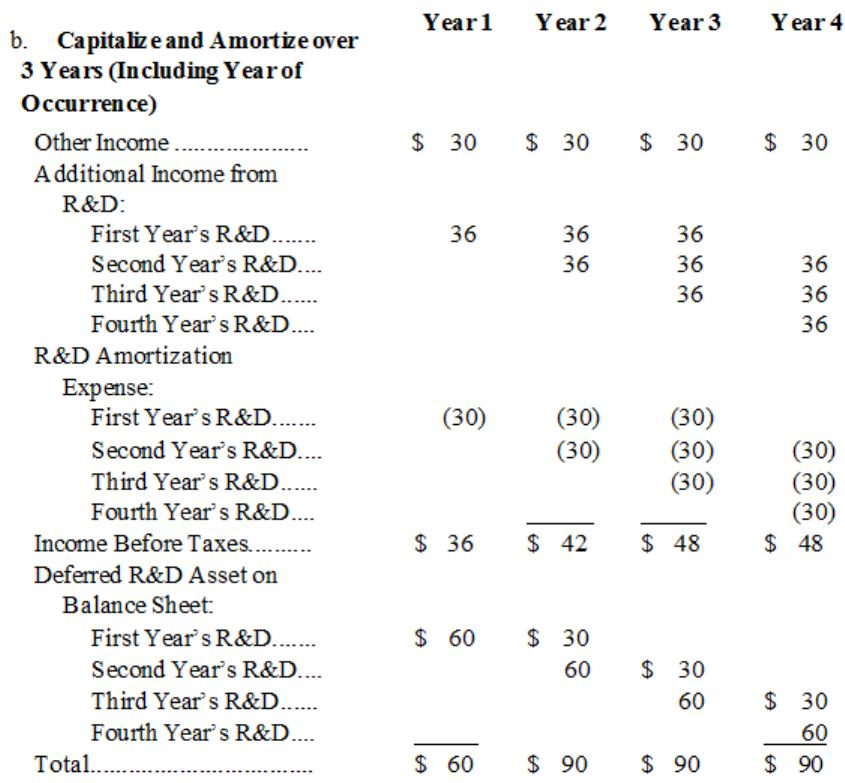
c. The expensing policy leads to higher expenses and lower income before income taxes, in the first two
years. After that, the two policies are the same. When the firm ceases to spend on R&D, the policy of
expensing will show higher income in the two years when the benefits of prior R&D continue, but
there are no matching expenses. There are no expenses under policy (1), but policy (2) continues
to show amortization expense. Thus, policy (1) is more conservative in the sense that it results in
smaller cumulative income before taxes until the firm ceases to spend on R&D. Policy (1) also results
in smaller assets on the balance sheet because, unlike policy (2), it shows no asset for Deferred
R&D Costs.
d. The pre-tax income under the two policies will continue to be the same if there is no growth or
change in policy. Policy (2) will show a lower rate of return on total assets and a lower rate of return on
stockholders’ equity than will policy (1) because the asset and equity totals are larger under policy (2)
under policy (1).
10.33 (Comerica Mills; interpreting disclosures regarding long-lived assets.) (amounts in millions of
US$)
a. Comerica Mills purchased software for its internal use from a software developer. Comerica Mills
expects to receive future benefits from using the software and the acquisition cost provides evidence of
the amount of expected future benefits.
b. Yes. The computer software has a finite life because of technological obsolescence and would be
depreciated.
c. Average Total Life: 0.5($5,806 – $54 – $252 + $6,096 – $61 –
$276)/$421 = 13.4 years.
Average Age: 0.5($2,809 + $3,082)/$421 = 7.0 years.
d. Yes. The accumulated depreciation account increased by $273 (= $3,082 – $2,809).
Depreciation expense increased accumulated depreciation by $421. Thus, the accumulated depreciation
on assets sold or abandoned was $148 (= $273 – $421).
e. Comerica Mills has grown heavily by corporate acquisitions.
Intangibles comprise 57.9% (= $10,529/$18,184) of total assets. Because GAAP does not require firms to
recognize internally developed intangibles, these intangibles arise from corporate acquisitions.
f. Yes. The amount for brands and goodwill increased. Because firms cannot write up assets for
increases in fair value, the increased amounts suggest a small acquisition during the year.
g. Patents have a specified legal life. Trademarks are subject to renewal at the end of their legal life as
long as a firm continues to use them. Comerica Mills must intend not to renew these trademarks.
h. Comerica Mills must expect the brand names to have an indefinite life.
The firm would need to provide evidence based on past experience for its brand names and from industry
experience to convince its independent accountants that the timing of any cessation of benefits is highly
uncertain.
i. Comerica Mills shows amounts in its Construction in Progress account.
Thus, Comerica Mills must capitalize a portion of interest expense. The reported amount is the net of
total interest cost minus the amount capitalized in Construction in Progress.
10.34 (Hargon, Inc.; interpreting disclosures regarding long-lived assets.)
(amounts in millions of US$)
a. No. Firms do not commence recognizing depreciation until they put an asset into service. The assets
under construction have not yet reached that stage.
b. Average Total Life: 0.5($7,321 – $294 – $958 + $8,688 – $398 –
$1,271)/$593 = 11.0 years.
Average Age: 0.5($2,283 + $2,767)/$593 = 4.3 years.
c. Yes. Accumulated depreciation experienced a net increase of $484 (= $2,767 – $2,283) during
the year. Depreciation increased the Accumulated Depreciation account by $593. Thus, accumulated
depreciation on assets sold or abandoned was $109 (= $484 – $593).
d. Hargon is in an industry subject to technological change. Thus, any technology-based intangible
likely has a finite life and is, therefore, subject to amortization. The Developed Product Technology
likely relates to specific biotechnology products it currently sells. Either Hargon or another company will
likely develop new products that will lead to obsolescence in the near future. The Core Technology
intangible relates to basic findings and principles that affect the development and sale of biotechnology
products in general. One might expect this item to have a longer useful life than Developed Product
Technology. Given the relatively young age of the biotechnology industry, however, the extent to which
core technologies will last is uncertain. Hargon could probably make a stronger case for treating Core
Technologies as an intangible with an indefinite life than is the case for Developed Product Technology.
It apparently chose to treat it as having a finite life. The Trade Name likely attaches to a particular
product and, like Developed Product Technology, is subject to replacement by a more technologically
advanced product. The Acquired Technology Rights arise from contractual arrangements that have
prescribed time limits during which Hargon can enjoy the benefits.
e. Average Total Life: 0.5($4,950 + $5,219)/$370 = 13.7 years.
Average Age: 0.5($1,208 + $1,472)/$370 = 3.6 years.
f. It appears that Hargon made no corporate acquisition during 2013 because the acquisition cost of
Core Technology and Trade Name remained the same. The decrease in the acquisition cost of Developed
Product Technology might have occurred because of the discontinuance of a particular product or because
of the recognition of an asset impairment loss on that intangible.
g. Goodwill likely includes technologies that are not separately identifiable, the value of research
scientists, and perhaps some overpayment for acquired companies.
h. Hargon shows amounts in its Construction in Progress account. Thus, Hargon must capitalize a
portion of interest expense. The reported amount is the net of total interest cost minus the amount
capitalized in Construction in Progress.
10.35 (HP3; interpreting disclosures regarding long-lived assets.) (amounts in millions of US$)
a. Average Total Life: 0.5($15,024 – $534 + $16,411 – $464)/$1,922 = 7.9 years.
Average Age: 0.5($8,161 + $8,613)/$1,922 = 4.4 years.
b. Yes. The Accumulated Depreciation account increased $452 (= $8,613
– $8,161). Depreciation increased the Accumulated Depreciation account by $1,922. Thus, the
accumulated depreciation on assets sold or abandoned was $1,470 (= $452 – $1,922).
c. Customer Contracts have a specific term and, therefore, have a finite life. Core Technology likely
involves technologies related to the design of computer hardware and software in general and is not
product specific. Given the pace of change in the computer industry, even core technologies change over
time. HP3 would likely encounter difficulties in convincing its independent accountants that core
technologies do not have a finite, albeit uncertain, life. Patents have a 20-year life, although the
technological life in the computer industry is much shorter. Trademarks are renewable as long as a
firm continues to use them. HP3 must expect to discontinue using the trademarks.
d. Average Remaining Total Life: 0.5($4,612 + $6,122)/$783 = 6.9 years.
Average Age: 0.5($2,682 + $3,465)/$783 = 3.9 years.
e. At the time of the acquisition, the Casio name was highly recognizable.
HP3 likely had no difficulty convincing its independent accountants that the brand name had an
indefinite life. Given the elapsed time since the acquisition and the merging of Casio products into
HP3’s line of offerings, one wonders whether HP3 will write off the brand name at some point.
f. Yes. The amount of each intangible, except the Casio brand name, increased during 2013. HP3
allocated a portion of the purchase price to these intangibles, with most of the increase involving goodwill.