CHAPTER
10
LONG-LIVED TANGIBLE AND INTANGIBLE
ASSE
T
S
Questions, Exercises, and Problems: Answers and
S
ol
u
tio
ns
10.1 See the text or the glossary at the end of the book.
10.2 The central concept underlying GAAP for these three items is the ability to identify and reliably
measure expected future benefits. The self-constructed building has physical substance and the
accountant can observe the effect of an expenditure on the physical structure of the building. The
building provides evidence of future benefits. Research and development (R&D) expenditures may give
rise to an intangible, such as a patent on a new technology. The accountant cannot, however, observe the
physical creation of an asset with future benefits when a firm makes R&D expenditures. Thus, reliably
identifying and measuring future benefits is problematic. U.S. GAAP does not permit recognition of an
asset for research and development expenditures. Expenditures on software development present an
in-between case. The programming underlying the software is embedded in a computer but the
accountant can observe how well the software works. When the software has not yet reached the stage of
technological feasibility, future benefits are uncertain. Thus, U.S. GAAP treats expenditures up to this
point as expenses of the period when incurred. When software reaches the point of technological
feasibility, future benefits become more certain. U.S. GAAP, therefore, permits firms to capitalize
software development expenditures after this point.
10.3 The central concept underlying U.S. GAAP for these three items is the ability to identify
and reliably measure expected future benefits. Expenditures to research new drugs may give rise to future
benefits, but identifying the existence of those future benefits while research progresses is problematic.
Thus, U.S. GAAP requires immediate expensing of research and development expenditures. The
external market transaction for a patent on a new drug validates both the existence and fair value of the
patent. U.S. GAAP, therefore, recognizes the patent as an asset. In- process R&D has characteristics of
the previous two cases. Whether the in- process project will yield future benefits is uncertain, suggesting
that firms should expense such expenditures at the time of acquisition. An external market transaction
between independent parties suggests the existence of future benefits, supporting recognition of an asset
until such time as the status of the research project becomes more certain. FASB Statement No.141
(Revised) requires firms to recognize as an asset the fair value of in- process R&D acquired in a corporate
acquisition, placing greater weight on the evidence provided by the external market transaction than on the
uncertainty of future benefits.
10.4 Over the life of the project, income is the same regardless of whether the firm capitalizes
interest or expenses it. Capitalizing and then amortizing interest versus expensing it affects the timing but
not the total amount of income. Capitalizing interest defers expense from the construction period to the
periods of use. This increases income in the years of construction and decreases it in the periods of use.
In periods of use, depreciation charges are larger.
10.5 A long-lived asset with a finite life is expected to provide benefits for a limited amount of
time. Benefits will eventually decline to zero, either because of physical use, obsolescence, or
disposal. Firms depreciate or amortize assets with finite lives. Note that firms must estimate the
finite life in most cases. U.S. GAAP and IFRS treat assets that have an extended life, but for which the
length of that life is highly uncertain, as having an indefinite life. U.S. GAAP and IFRS do not require
firms to depreciate or amortize assets with an indefinite life. U.S. GAAP and IFRS require that
these assets – in fact, all long-lived assets – be tested annually for possible asset impairment.
10.6 Thames must demonstrate that the brand names amortized have a finite life and those not
amortized have an indefinite life. Thames would examine the age of particular brand names, the pace at
which brand names come in and out of favor in a particular industry, and similar factors in deciding
the classification of a particular brand name acquired. This process likely involves considerable
subjectivity, but it is subject to audit by the Thames independent accountant.
10.7 The treatment of this change in depreciable life would depend on the reason for and the
materiality of the change. The change in this case appears prompted by new governmental regulations
imposed on the airline industry. If the change in expected life is material, the firm can make a case
for recognizing an asset impairment loss and revising its depreciation going forward. If the impact is
not material, the airline might treat the change in depreciable life as a change in an estimate and spread the
effect of the change over the current and future years. The purpose of this question is to demonstrate that
judgments are often required in applying authoritative guidance.
10.8 The relevant question to apply authoritative guidance is whether the expenditure maintained the
originally expected useful life or extended that useful life. Firms should expense, as maintenance or
repairs, expenditures that maintain the originally expected five-year life. In this case, the expenditure
both maintains and extends the useful life. A portion of the expenditure should appear as an expense
immediately (perhaps two-thirds) and a portion (perhaps one-third) should increase the depreciable base
for the asset. The portion of the expenditure treated as an asset would be based on the extent to which the
expenditure increased the useful life.
10.9 U.S. GAAP compares the undiscounted cash flows from an asset to its carrying value to
determine if an impairment loss has occurred. The rationale is that an impairment loss has not occurred
if a firm will receive cash flows in the future at least equal to the carrying value of the asset. Receiving
such cash flows will permit the firm to recover the carrying value. This criterion ignores the time value of
money. Cash received earlier has more economic value than cash received later, but this criterion ignores
such differences.
10.10 The cash recoverability criterion requires firms to estimate the expected undiscounted cash
flows. This estimate requires projection of cash flows for a specified number of periods. Non-amortized
intangibles have an indefinite life. For indefinite lived assets, it is not possible to project the total
undiscounted cash flows because it is not possible to discern when the forecasted cash flows stop.
10.11 An asset impairment loss that arises during a period results from a decline in fair value
due to some external event. Fair values are based on discounted cash flows, not undiscounted cash flows.
Therefore, using undiscounted cash flows to signal an impairment loss ignores the actual decline in fair
value that occurred. Firms will not recognize the asset impairment loss as long as the undiscounted
cash flows exceed the carrying value of the asset.
10.12 The excess purchase price will affect net income if and when the firm recognizes a goodwill
impairment loss. A goodwill impairment loss results when the acquirer will not recover the carrying

amount of the purchased goodwill. Firms must test goodwill annually for possible impairment.
Management might, however, operate the acquired entity in such a way that its value increases over time,
10.13 (Outback Steakhouse; calculating acquisition costs of long-lived assets.) (amounts in US$)
The relative market values of the land and building are 20% (= $52,000/$260,000) for the
land and 80% (= $208,000/$260,000) for the building. We use these percentages to allocate the combined
$260,000 cost of the land and building.
Land Building
Purchase Price of Land and Building $52,000 $208,000
Legal Costs Split 20% and 80% 2,520 10,080
Renovation Costs – 35,900
Property and Liability Insurance Costs
During Renovation Split 20% and 80% 800 3,200
Property Taxes During Renovation Split
20% and 80% 1,000 4,000
Total $56,320 $261,180
Note: One might argue that the split of the insurance and property taxes should recognize the increase
in market value of the building as a result of the renovation and use some other percentages besides 20%
and 80%. Note also that the insurance and property taxes for the period after opening are expenses of
the first year of operation.
10.14 (Classifying expenditure as asset or expense. These solutions apply U.S.
GAAP.)
a. (3) Expense.
b. (3) Expense.
c. (3) Expense.
d. (1) Noncurrent asset (machine).
e. (3) Expense.
f. (3) Expense.
g. (2) Current asset (inventory).
h. (1) Noncurrent asset (equipment).
i. (3) Expense.
j. (1) Noncurrent asset (ore deposit).
k. (1) Current asset (prepayment).
l. (1) Current asset (marketable securities).
m. (2) Current asset product cost (inventories).
n. (1) Noncurrent asset (trademark).
o. (1) Noncurrent asset (copyright).
p. (1) Noncurrent asset (computer software).
q. (3) Expense. Acquired in-process research and development (IPR&D) is recognized as an asset
when the item is acquired as part of a business combination.
10.15 (Bolton Company; cost of self-constructed assets.) (amounts in US$) Land: $70,000 + $2,000
(14) = $72,000.
Factory Building: $200,000 (1) + $12,000 (2) + $140,000 (3) + $6,000 (5) – $7,000 (7) + $10,000 (8) +
$8,000 (9) + $3,000a (10) + $8,000 (11) + $4,000 (13) + $1,000* (15) = $385,000.
Office Building: $20,000 + $13,000 (4) = $33,000. Site Improvements: $5,000 (12).
*The firm might expense these items. It depends on the rationality of the firm’s “self-insurance” policy.
Item (6) is omitted because firms may not recognize opportunity costs in financial reports.
Item (16) is omitted because no arm’s length transaction occurred in which the firm earned a profit.
10.16 (Duck Vehicle Manufacturing Company; cost of self-developed product.)
The first four items qualify as research and development costs which, under U.S. GAAP, the firm
must expense in the year incurred. It might appear that the firm should capitalize the cost of the
prototype because it acquires the prototype from an external contractor. Completion of a prototype does
not, however, signify a viable product. Purchasing the prototype externally versus constructing it
internally does not change the accounting.
The firm should capitalize the legal fees to register and establish the
patent as part of the cost of the patent. The firm might consider this cost as sufficiently immaterial to
warrant treatment as an asset and expense it immediately.
The firm should capitalize the cost of the castings and amortize them over the expected useful life of the
vehicle. The cost of the manufacturing permits and the cost of manufacturing the first vehicle are
product costs that increase work-in-process inventory.
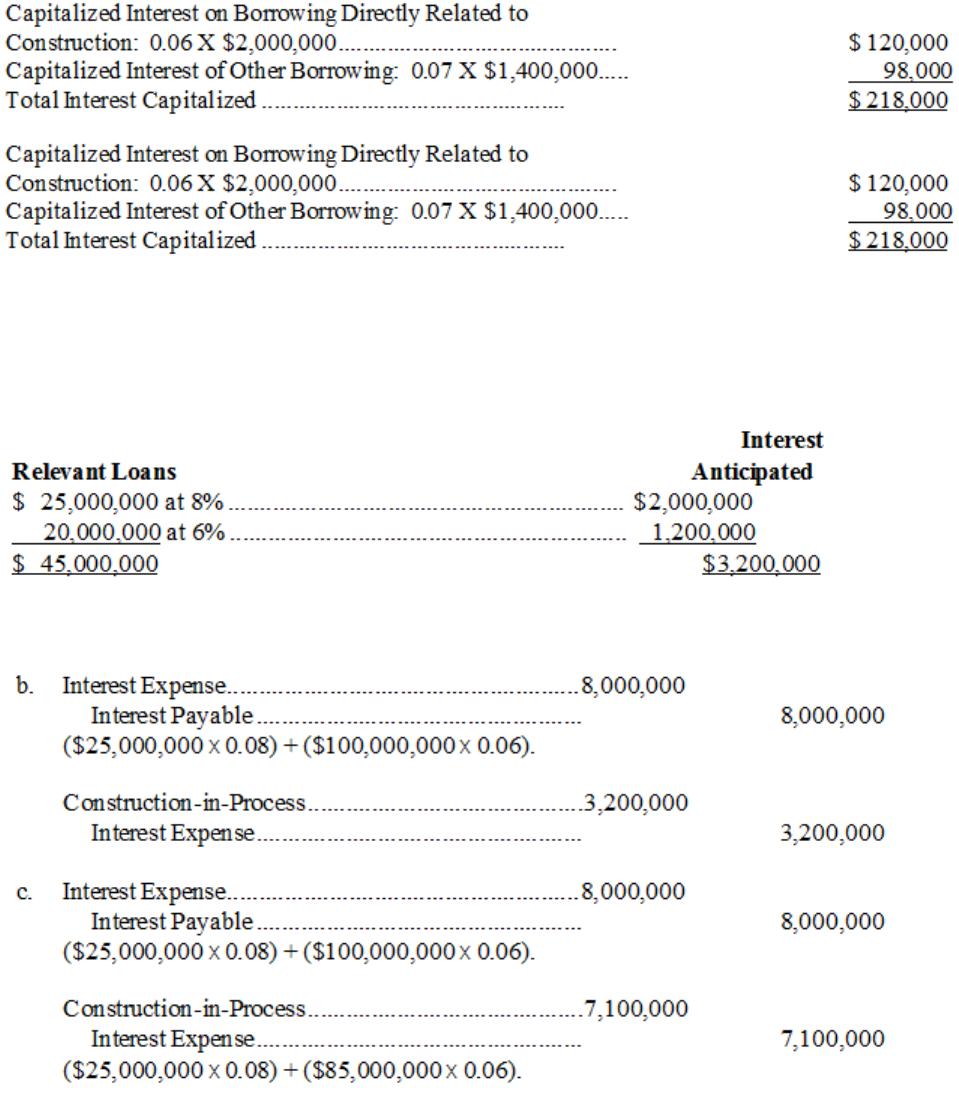
10.17 (Bulls Eye Stores; calculating interest capitalized during construction.) (amounts in US$)
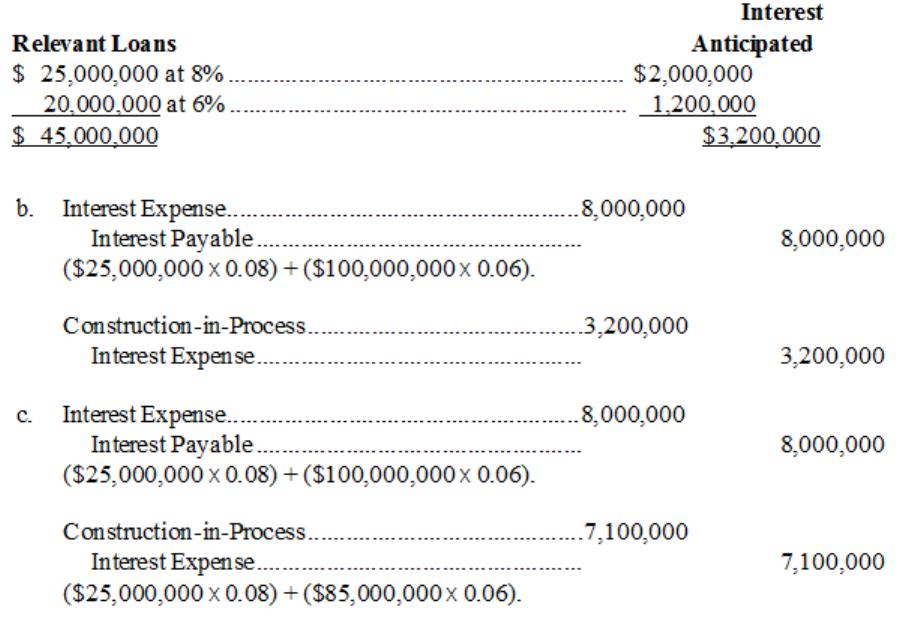
10.18 (Nexor; amount of interest capitalized during construction.) (amounts in
US$)
a
.
Average Construction = ($30,000,000 + $60,000,000)/2 = $45
,
000
,
000
.
10.19 (Carlton, Inc.; calculations for various depreciation methods.) (amounts
in
US$)
2013 2014 2015
a. Straight-Line (Time) Method ……
($88,800 – $4,800)/6 = $14,000.
$14,000 $14,000 $14,000
b. Straight-Line (Use) Method …….. $12,600 $14,000 $15,400
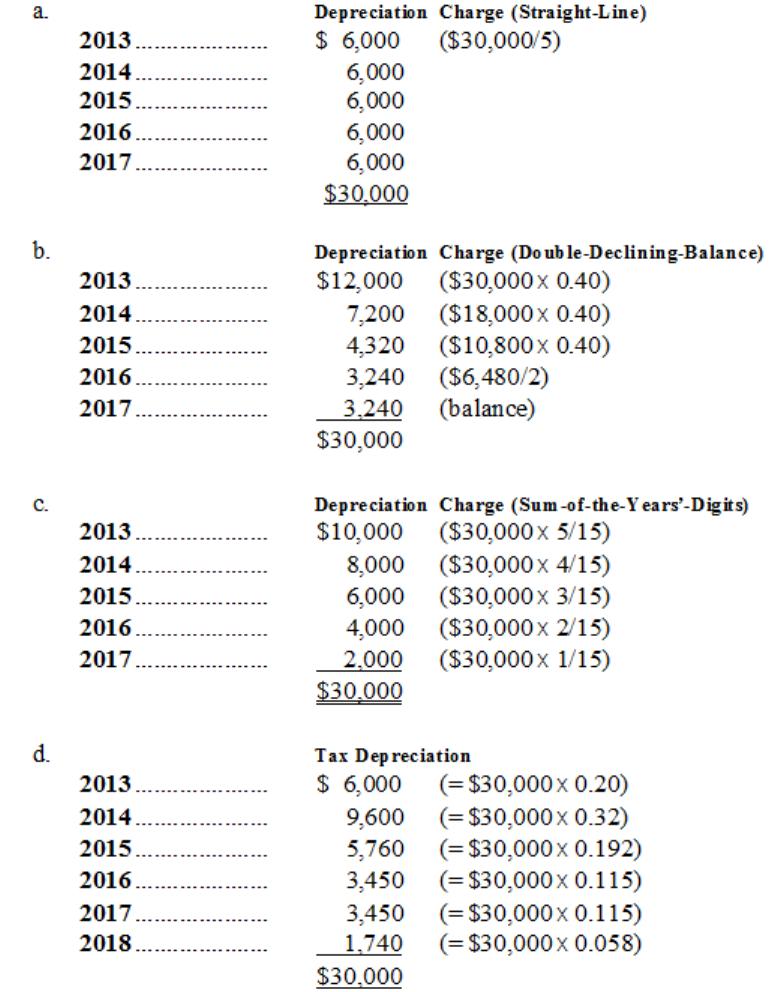
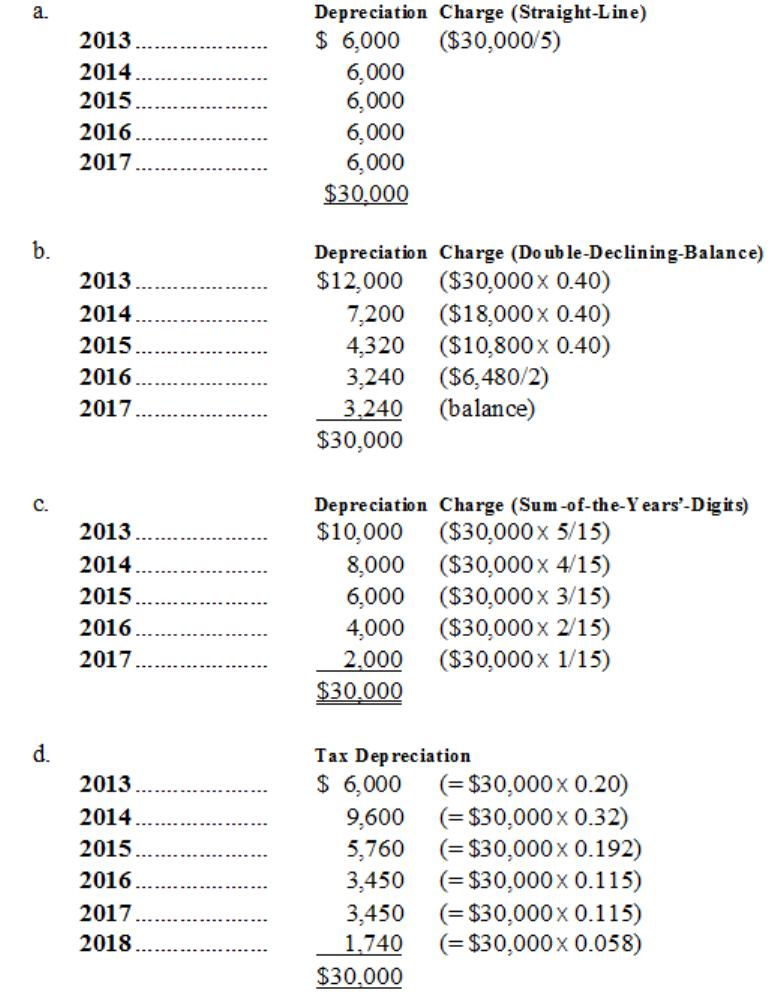
10.20 (Luck Delivery Company; calculations for various depreciation methods.) (amounts in US$)
10.21 (Thom Corporation; change in depreciable life and salvage value.) (amounts in US$)
Carrying Value on January 1, 2013: $10,000,000 – {2 X [($10,000,000 – $1,000,000)/6]} =
$7,000,000. Depreciation expense for 2013 based on the new depreciable life and salvage value is
$3,200,000 [= ($7,000,000 – $600,000)/2].
10.22 (Florida Manufacturing Corporation; journal entries for revising estimate of service life.)
(amounts in US$)
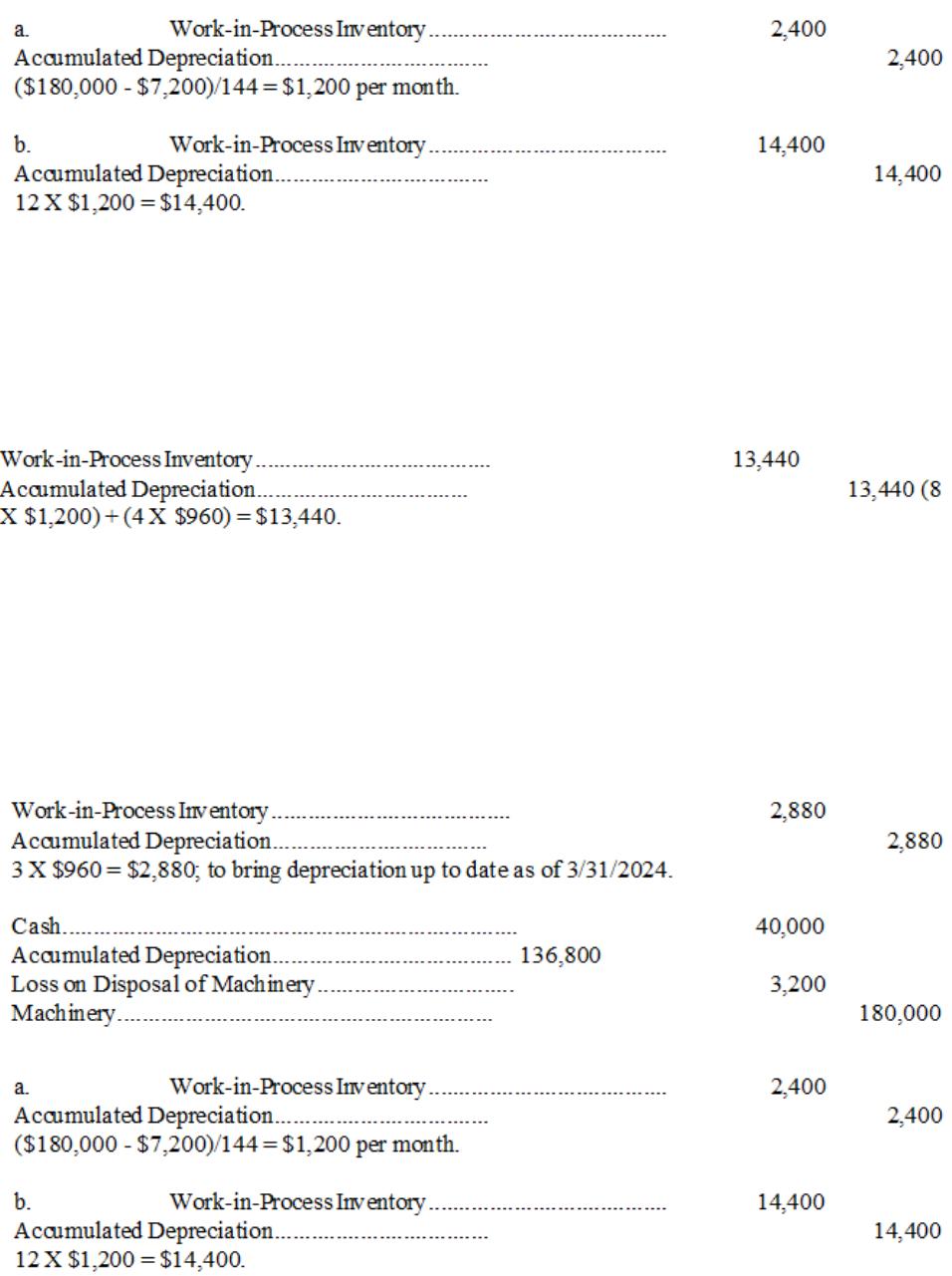
c. Depreciation to 1/1/2019 = 62
months
X $1,200 = $74,400.
Remaining depreciation = $180,000 – $74,400 – $3,840 = $101,760. Remaining life = 168 months – 62
months = 106 months as of 8/30/2019.
Depreciation charge per month = $101,760/106 = $960.
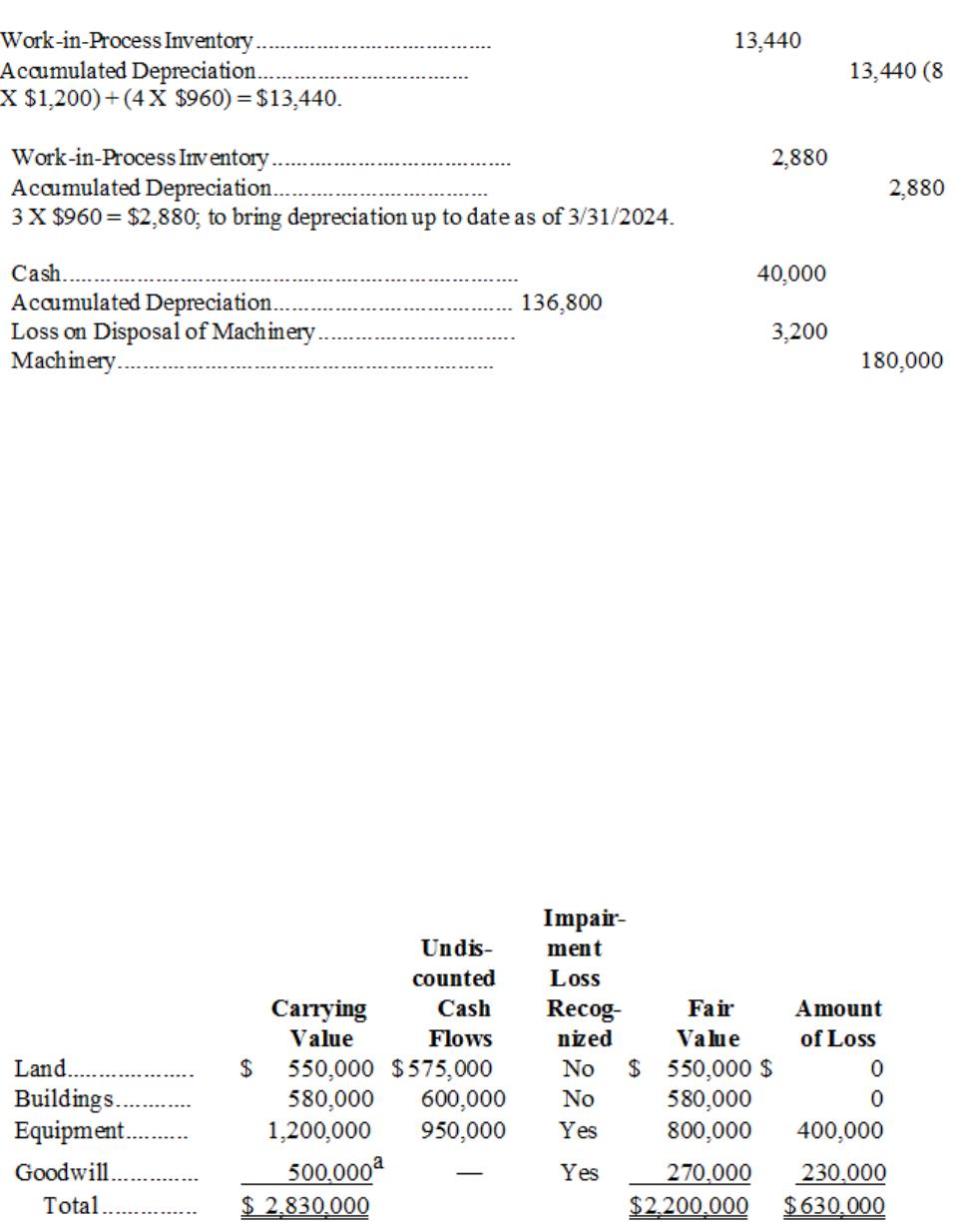
d. By March 31, 2024, the machine has been on the new depreciation schedule for September 2019
through March 2024 (55 months total). Accumulated depreciation is $84,000 + (55 X $960) =
$84,000 + $52,800 = $136,800.
Carrying value is $180,000 – $136,800 = $43,200; sale at $40,000 results in a loss of $3,200 (=
$40,000 – $43,200).
Joural entries are as follows:
10.23 (Disney World; distinguishing repairs versus improvements.) (amounts in US$)
Repair: (1.00/1.20 X $30,200) + $86,100 + (1.00/1.25 X $26,900) + $12,600 = $145,387.
Improvement: (0.20/1.20 X $30,200) + (0.25/1.25 X $26,900) = $10,413
10.24 (Wildwood Properties; computing the amount of an impairment loss on tangible long-lived
assets.) (amounts in US$)
The undiscounted cash flows total $12,400,000 [= ($1,400,000 X 6) + $4,000,000]. The carrying
value of the building of $15,000,000 exceeds the undiscounted estimated cash flows, so an impairment
loss has occurred. The present value of the expected cash flows when discounted at 10% is
$8,355,244 [= ($1,400,000 X 4.35526) + ($4,000,000 X 0.56447) = $6,097,364 +
$2,257,880]. The impairment loss is, therefore, $6,644,756 (= $15,000,000 – $8,355,244) under both
U.S. GAAP and IFRS.
10.25 (Kieran Corporation; computing the amount of impairment loss.) (amounts in
US$)
a$500,000 = $2,400,000 – $400,000 – $600,000 – $900,000.
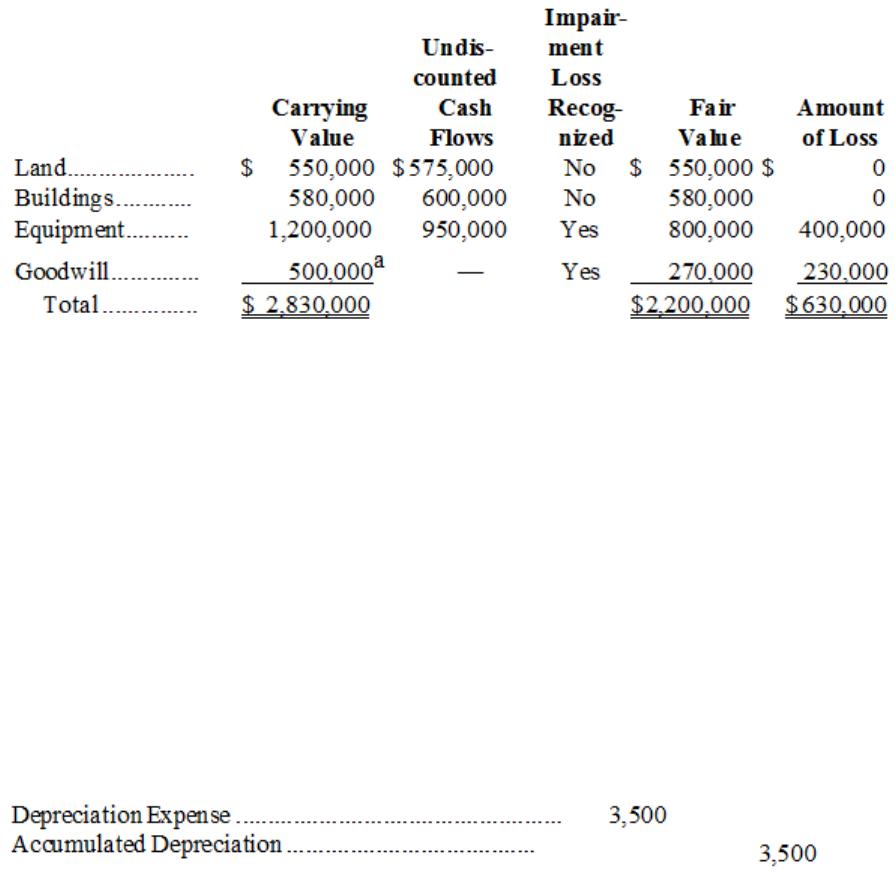
After recognizing the impairment losses on the property, plant, and equipment, the carrying value of
Kieran Corporation is $2,430,000 (= $550,000 for land + $580,000 for buildings + $800,000 for
equipment + $500,000 for goodwill). The carrying value of $2,430,000 exceeds the fair value of the
entity of $2,200,000, so a goodwill impairment loss may have occurred. The fair value column
above shows the allocation of the $2,200,000 fair value to identifiable assets, with the residual of
$270,000 attributed to goodwill. The carrying value of the goodwill of $500,000 exceeds its implied
fair value of $270,000, so Kieran Corporation recognizes an impairment loss on the goodwill of
$230,000.
10.26 (Fedup Express; computing the gain or loss on sale of equipment.) (amounts in US$)
Annual depreciation is $7,000 [= ($48,000 – $6,000)/6]. Depreciation expense for the first six months of
2013 is $3,500.
The carrying value of the delivery truck after the entry above is $16,500 [= $48,000 – (4.5 X $7,000)].
The accumulated depreciation totals $31,500 (= 4.5 X $7,000). The entry to record the sale is:
Cash……………………………………………………………………. 14,000
Accumulated Depreciation ……………………………………. 31,500
Loss on Sale of Delivery Truck ………………………………. 2,500
Delivery
Truck
………………………………………………….. 48,000