Chapter 6
Lesson 6-1 Look for Employment
Check Your Understanding (Example 1)
$67.3K = $67.3 × $1,000 = $67,300
Check Your Understanding (Example 2)
Check Your Understanding (Example 3)
Extend Your Understanding (Example 3)
Check Your Understanding (Example 4)
Jane’s price = 0.39(77) = $30.03. From the
information in Example 5, Pete would need to order
1 set of copies. From the piecewise function in
Example 5, the cost would be $29.95. Pete can get
100 copies (or even 200 copies) for $29.95, which
is less expensive than paying per copy.
Extend Your Understanding (Example 5)
Applications
find them. With all of today’s technology, your
resume often exists in a sea of hundreds of
Rounded to the nearest dollar, the weekly salary
6a. K stands for $1,000.
$51.2K = $51.2 × $1,000 = $51,200
7a. From the table next to Example 4, 5–20 postings
cost $320 each, so 5 postings cost $320 each.
$575 × 52 = $29,900
K stands for $1,000.
$29,900 ÷ $1,000 = $29.9K
10. There are 12 months in a year.
$y × 12 = $12y
11a. 2 < 3, so the cost of a 2-line ad is $45.
3 = 3, so the cost of a 3-line ad is $45.
11d. Yes; the additional two lines will cost $18, since
13a. $34.6K = $34.6 × $1,000 = $34,600
$620 × 52 = $32,240
Lesson 6-2 Pay Periods
and Hourly Rates
Check Your Understanding (Example 1)
Check Your Understanding (Example 2)
Check Your Understanding (Example 3)
Check Your Understanding (Example 4)
Check Your Understanding (Example 5)
Check Your Understanding (Example 6)
Check Your Understanding (Example 6)
Extend Your Understanding (Example 6)
The piecewise function is
Applications
1. There are many talented people doing excellent
2. Semimonthly means 2 checks every month.
52 – 24 = 28
paychecks.
52 ÷ 2 = 26 paychecks.
paychecks.
2 = 26 checks in a year.
9c. $1,787 – $1,475 = $312
10. $76,000 + $12,500 = $88,500
11a. Semimonthly means 2 checks every month.
11b. New salary = Old salary + increase
New salary = x + y
x
11c. +
x
y
24 –
x
24 = y
24
14d. $360 + $40.50 = $400.50
17. 41 – 35 = 6 overtime hours
35 × $9.20 = $322.00
6 × 1.5 × $9.20 = $82.80
$322.00 + $82.80 = $404.80
$404.80 – $305.80 = $99
21a. 40x + 1.5(8x) = $1,248
21b. 1.5 × $24 = $36
22a. x × $5.90 = $5.90x
22c. $5.90x + 0.18y
23a. 6 × $11 = $66
23b. 0.15 × $1,188 = $178.20
Max works 49x hours.
exceeds the $562.42 total cost of his monthly
car and insurance payments.
26a. regular pay = regular hours × hourly rate
=B2*C2
26b. overtime hours = hours worked – regular hours
x
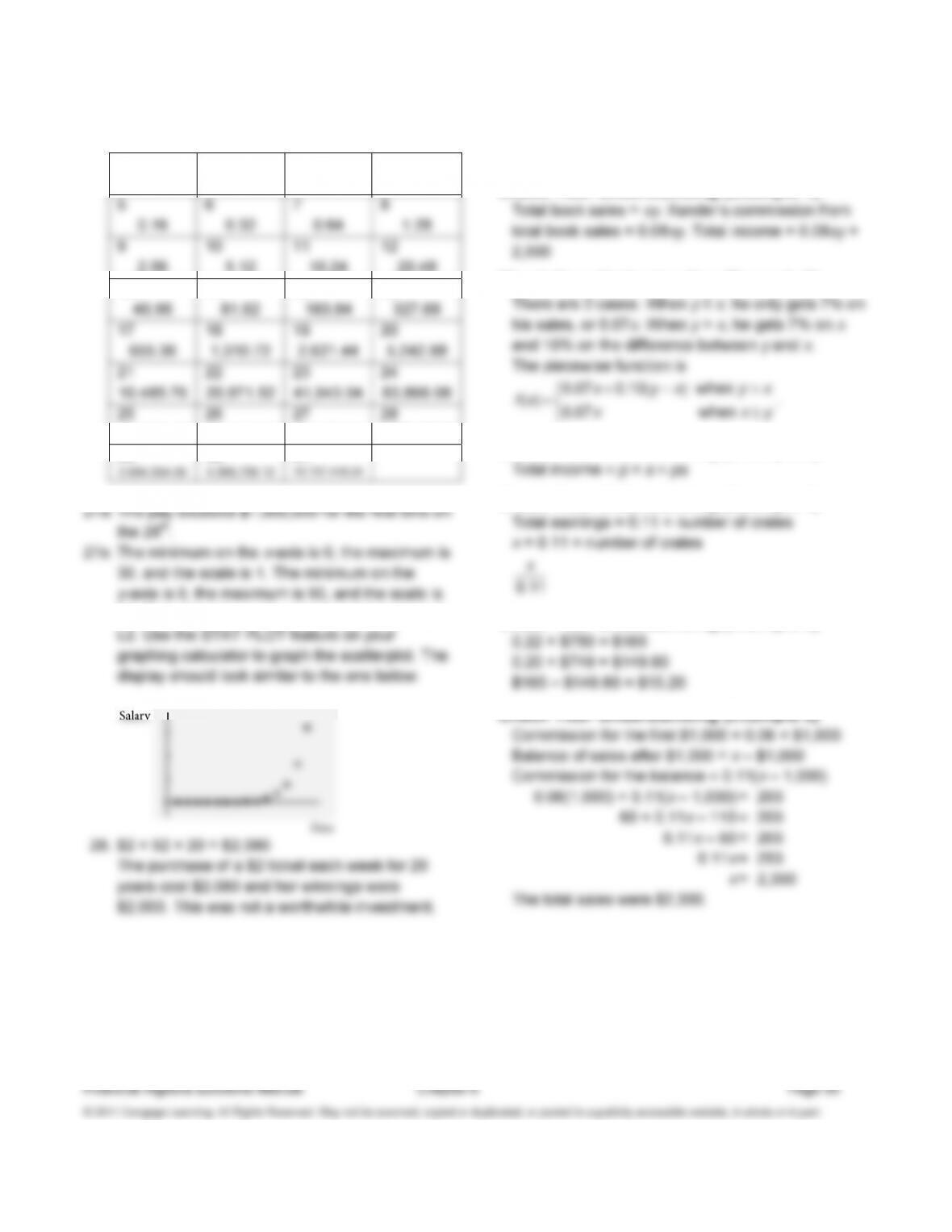
27a-c. The grid is shown below.
1
0.01
2
0.02
3
0.04
4
0.08
2.56
5.12
10.24
20.48
13
14
15
16
167,772.16
335,544.32
671,088.64
1,342,177.28
29
30
31
10. Enter the day number in L1 and the salary in
Lesson 6-3 Commissions,
Royalties, and Piecework Pay
Check Your Understanding (Example 1)
Check Your Understanding (Example 2)
Check Your Understanding (Example 3)
Check Your Understanding (Example 4)
Check Your Understanding (Example 3)
Applications
1. To many people, money is a top priority. Many
people feel that money buys happiness, and, as
a result, they go to great lengths to acquire it.
6. $1,715,000 + (0.10 × 300,000 × $24)
7. $250,000 + $310,000 = $560,000
8. Hourly: 35 × $9.60 = $336
9. Hourly: 20 × $10 = $200
10. 731 × $0.28 = $204.68
11a. $1,000 × x = $50
11b. $y × x = $x
x
y is the decimal.
x
y(100) is the percent.
14c. $90.60 + $304 = $394.60
14d. Producing 0 units would result in hourly pay
only, which is 38 × $8 = $304.
15. 80 × $0.50 = $40
5 = 317.4
is 390.
is 390.
22. 0.14x = $1,233.60
23. 0.095 × $1,000 = $95
Balance of sales after $1,000 = $1,000 – x
0.155x = 1,294.25
x = 8,350
The total sales were $8,350.
24a. $1,500 is in the third part of the piecewise
function, so the commission rate is 0.25, or
25b. $22,800 – $21,696 = $1,104
26. profit: c – d
Commission: 0.24(c – d)
200 + 0.12x – 240 = 231.20
Lesson 6-4 Employee Benefits
Check Your Understanding (Example 1)
Check Your Understanding (Example 2)
Check Your Understanding (Example 3)
Check Your Understanding (Example 4)
Extend Your Understanding (Example 4)
Applications
1. Perhaps one of the biggest employee benefits a
2a. The number of paid vacation days goes up by 2
Substitute 8 for x in y = 2x + 3.
2(8) + 3 = 16 + 3 = 19
He will have earned 19 days.
3b. Substitute 5 for x in y = 3x + 2.
3(5) + 2 = 15 + 2 = 17
6 years.
It will take 9 years to earn 18 paid vacation days.
5c. 5 weeks = 5 × 5 = 25 days
25 = 2x
7a. $47,700 < $55,000, so Arielle pays $40 per
7b. $68,300 > $55,000, so family coverage is $165
per month. $165 + $935 = $1,100
4 = $98,000.
1.2% × 20 × $98,000 = 0.012 × 20 × $98,000
3 =
$,292 998
$43,510.20.
10a. The salaries are in cells B3, B4, B5, B6. The
formula is =average(B3:B6). Other formulas are:
=sum(B3:B6)/4 or =(B3+B4+B5+B6)/4.
Check Your Understanding (Example 1)
Check Your Understanding (Example 2)
Check Your Understanding (Example 3)
Check Your Understanding (Example 4)
Applications
1. A nation is stronger when its people are cared
for. The Social Security program does just that.
2a. $17,700 × 0.0605 = $1,070.85
4a. $48,000 ÷ 12 = $4,000
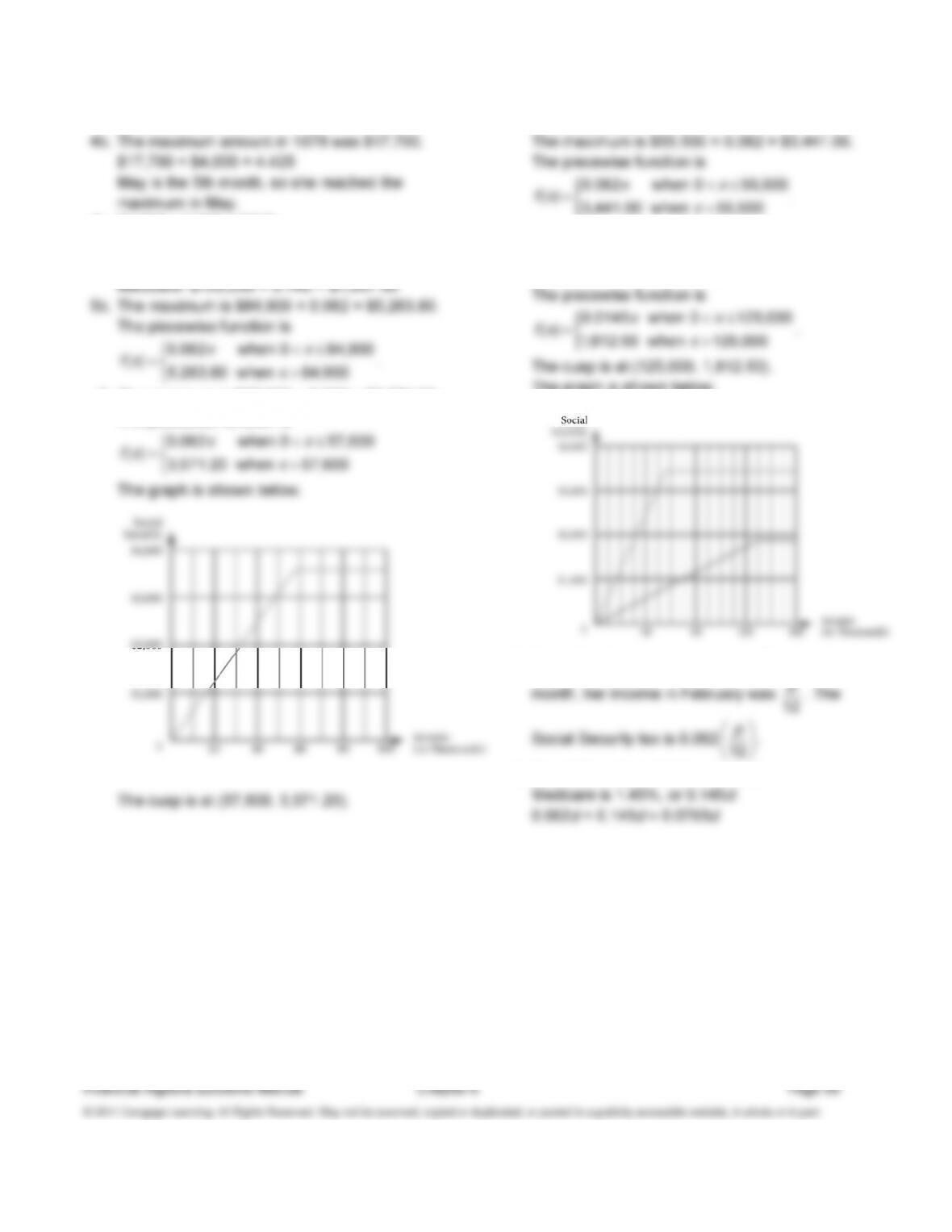
6. The maximum is $57,600 × 0.062 = $3,571.20.
The piecewise function is
The graph is shown below.
.,
<≤
⎧
xx
0 062 when 0 57 600
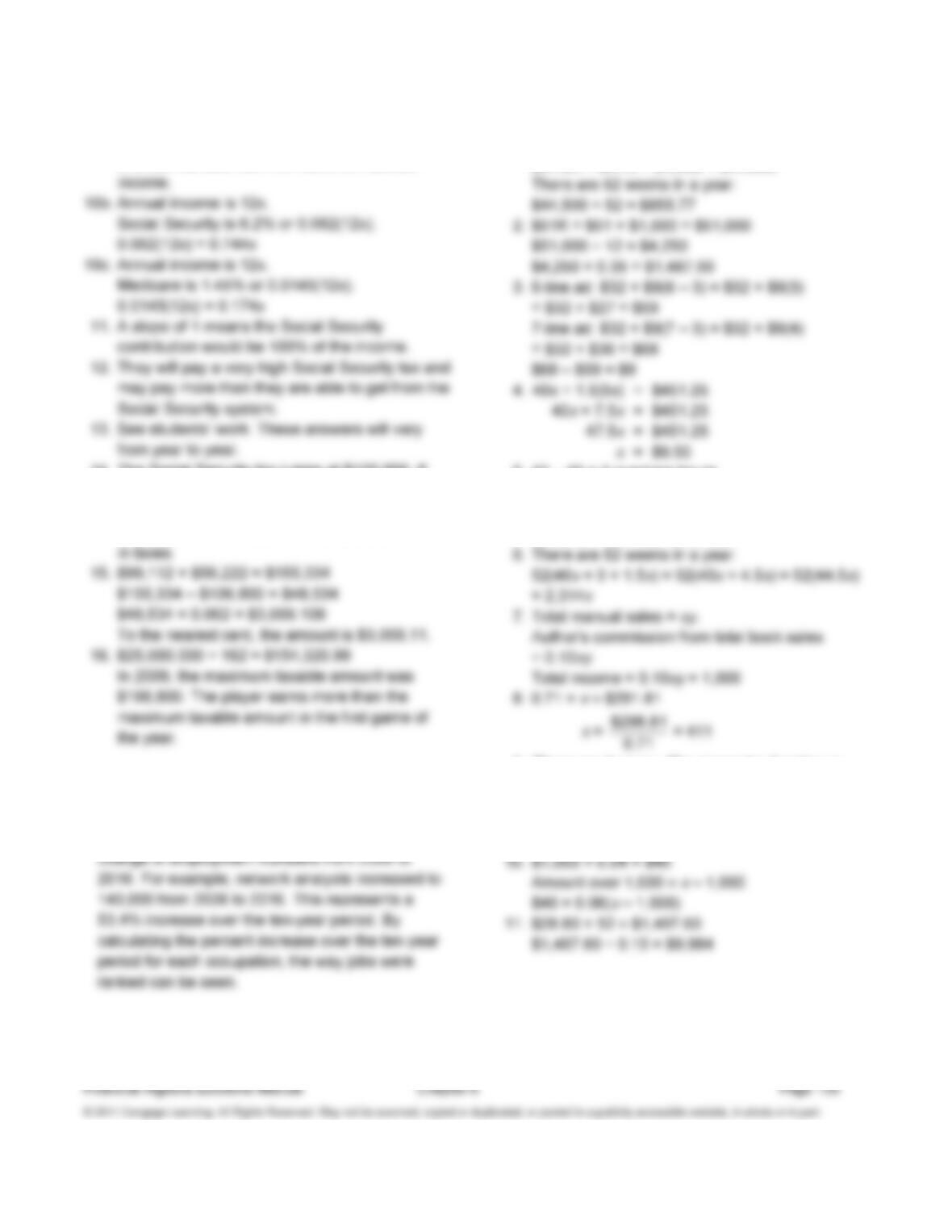
7. Social Security:
The graph is shown below.
8. Assuming her income was proportional per
p
p
9. Social Security is 6.2% or 0.062d.
10a. $5,600 × 12 = $67,200
$67,200 < $94,200
She earned less than the maximum taxable
14. The Social Security tax jumps at $100,000. If
you make $99,999.99, you would pay very close
to $6,000. But, if your income is just 2 cents
more, $100,000.01, you would pay $2,000 more
Assessment
Really? Really! Revisited
The sorting was done by determining the percent
Applications
1. K stands for $1,000.
$44.5K = $44.5 × $1,000 = $44,500
5. 43 – 40 = 3 overtime hours
40 × $13.50 = $540.00
3 × 1.5 × $13.50 = $60.75
$540.00 + $60.75 = $600.75
9. There are 3 cases. The piecewise function is
.
.
() . ,
.,
≤
⎧
⎪
=<
⎨
⎪>
⎩
xx
cx x x
xx
0 18 when 900
0 20 when 900 1500
0 25 when 1500
≤
15a. $80,400 > $76,200
2000 Social Security: $76,200 × 0.062
= $4,724.40
= $6,150.60
2002 Social Security: $80,400 × 0.062
= $6,150.60
12. The average of the last five salaries is
$, $, $, $ , $ ,+++ +92 000 92 800 99 000 100 500 105 000
5
14a. The maximum Social Security is $102,000 ×
0.062 = $6,324.
14b. $143,000 > $102,000
15b. $5,890.20 ÷ $80,400 ≈ 0.07326 ≈ 7.3%
Social Security and Medicare rate of 7.65%
when the salary was less than the maximum.
The more you make, the smaller percentage of
your salary is used.
16. Divide the amount in cell B1 by 100.