Chapter 7 Multicomponent diffusion page 7-1
Chapter 7 Multicomponent diffusion
1. Sulfate diffusion across membranes
Because the volumes are large, the concentration in both chambers change slowly, and can be considered constant.
From Table 7.4-2,
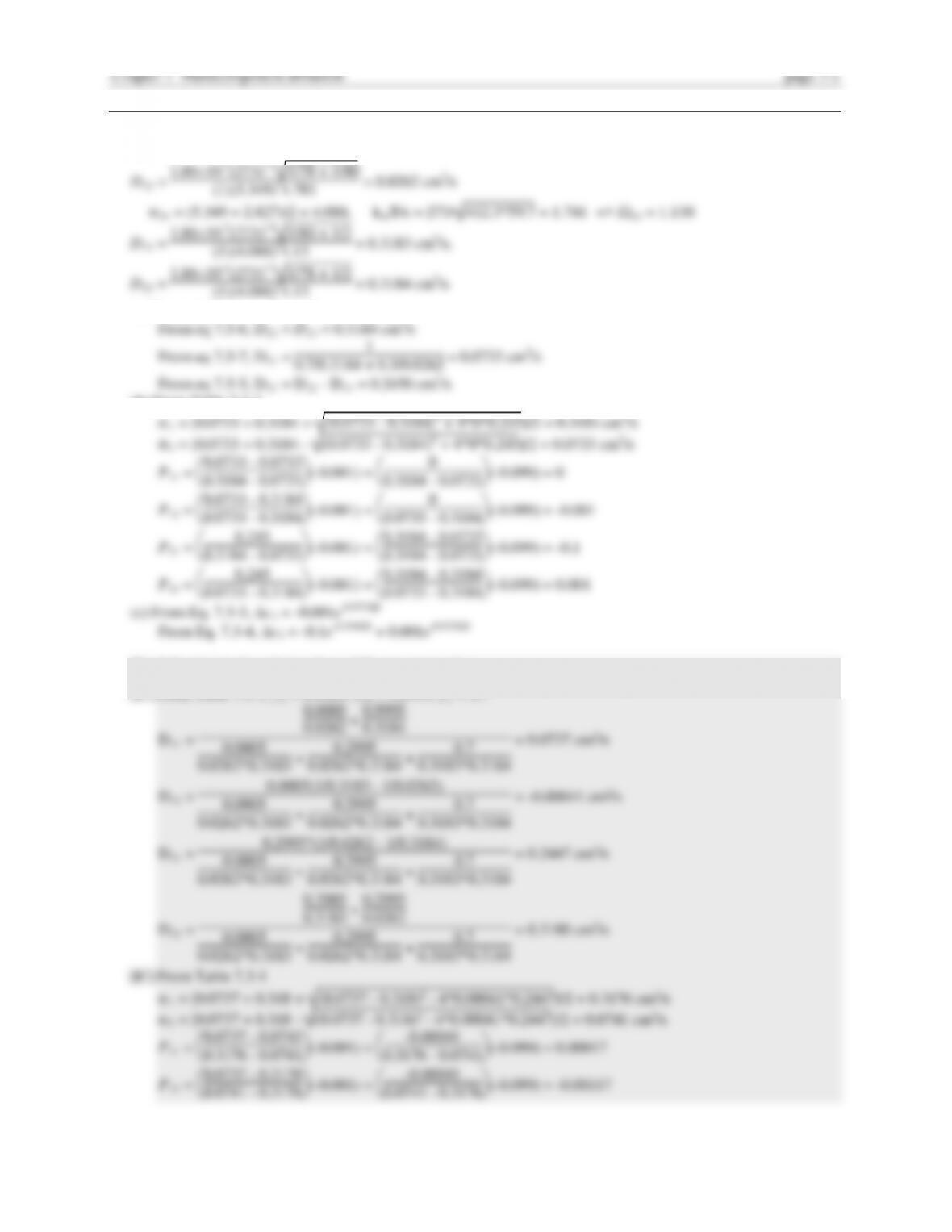
2. Organic ternary mixture
In this diaphragm cell, y10 = 0.52 – 0.12 = 0.4, y20 = 0.15 – 0.55 = -0.4
From Table 7.3-1,
-5 2
0.4
0.5
t (hr) y1 y2
3. Ternary diffusion in a two-bulb capillary apparatus
First, the binary diffusion coefficients:
(a) For very dilute c1, D12 = 0
(b) From Table 7.3-1,
2
The following is the solution from different approach:
Chapter 7 Multicomponent diffusion page 7-3
0.2447
0.318 – 0.0741
4. Iron bars
5. Air as a single species
Let 1 = H2, 2 = O2, 3 = N2
Binary diffusion coefficients:
0.2127 – 0.7446 = -8.5110-5
Chapter 7 Multicomponent diffusion page 7-4
2.98t – 8.5110-5 erf z
0.851t
But for binary diffusion, 1 = H2, 2 = Air
6. Diaphragm cell analysis
The detailed solution to this problem, which is straightforward but algebraically complex, is given in the reference
quoted.
7. Ternary diffusion in molten silicates