
Chapter 9: Style & Language
Chapter Objectives
Define style.
Explain how style connects language and the body.
Discuss questions that you can ask about the audience to help with your word choice.
List the kinds of language choices that will assist you with perceptions of expertise and credibility.
Explain how vivid language engages an audience.
Describe how repetition and rhythm can interest an audience.
Define what a trope is and list two examples.
Explain how a speaker can communicate something he or she doesn’t intend.
List three ty pes of language use that speakers can avoid to preven t misunderstanding or possible
offense.
Lecture Outline
I. What Is Style?
A. Learning objectives
1. Define style.
2. Explain how style connects language and the body.
B. Style in public speaking is discussed in two ways
1. In terms of the selection and use of language (discussed in this chapter)
2. In terms of the delivery of a speech (discussed in chapter 10)
C. Style in ancient times
1. Aristotle said that style concerned word choice and diction.
2. In ancient Rome, Cicero believed that style was intertwined with what a speaker
said and how the speaker said it.
D. Defining Style for Our Time
1. Style is complicated and encompasses many
definitions.
a)
In the broadest sense, style refers to the way in which a person presents
him- or herself to others.
b)
In the context of public speaking, style refers to the relationship between
what one says and how he or she says it. Traditionally, the focus on style in
public speaking concerns word choice and delivery.
E. Style as a Meeting of the Body and Language
1. Think about style as not only saying something meaningful but also saying
something about who you are and with whom you wish to associate.
2. Disposition refers to a person’s mental and physical orientation toward the world
and others. In the context of public speaking, audiences perceive your disposition through
your style.
3. In public speaking, you are trying to communicate meaning to your audience.
Meaning incorporates the denotation and connotation of words and ideas.
a) Denotation refers to the literal and primary meaning of a sign, what you
would expect to find in a dictionary.
II. Connotation refers to the feelings one associates with a sign.
A. Impression Management
1. In addition to your word choice, your body language is part of your style.
2. Impression management refers to the way in which a person navigates his or
her self-presentation in body and language.
1

III. Choosing Your Words
A. Learning Objectives
1. Discuss questions that you can ask about the audience to help with your word
choice.
2. List the kinds of language choices that will assist you with perceptions of
expertise and credibility.
B. Adapting Your Language: What Do You Play?
1. When preparing a speech, remember that not every audience has the same
beliefs, values, attitudes, or familiarity with the topic. What makes sense for one group
may confuse another.
IV. When adapting your speech to each audience, keep these three questions in mind:
a) Is my audience familiar or unfamiliar to me? If you know the
audience, you can be less formal. The more familiar you are with the audience,
the less likely the audience will misunderstand you. On the other hand, if you are
unfamiliar with the audience, a good rule is to be more formal.
b)
Am I an outsider or an insider? If you are an outsider, you should
speak more formally to your audience. However, if you are part of the same
group as the audience you can be more informal. Words like “we” and “us”
identify you as part of the same group as the audience. Keep in mind that you
should only connect yourself with the audience if it is contextually appropriate
and you are genuinely part of the group you are including yourself in.
c)
Should I be formal or informal? Use contextual reasoning to help you
figure out the degree of formality of a speaking event. If you are unsure if the
setting of a speech is formal or informal, do not be afraid to ask the
person/people who asked you to speak about the event. Remember that formal
events use formal language.
B.
Expertise and Credibility through Word Choice
1. Expertise refers to having knowledge or skills particular to a given field. In the
context of public speaking, expertise is closely associated with credibility.
2. One of the challenges of public speaking is “speaking to the inexpert.” This
happens when you must convey your expertise of a topic to an audience that is unfamiliar
with it. You should communicate clearly so that the audience can understand.
a)
Use Simple and Concise Language. It is easier for an audience to
follow shorter and concise words. Your audience’s primary concern is
comprehension. Unfamiliar words can confuse your audience.
b)
Be Accurate. Try to speak as precisely as possible. Vague or inaccurate
phrases can be off-putting to your audience.
c)
Avoid Jargon. (Jargon is the specialized or peculiar language of a
particular community or group.) Jargon can confuse audience members who are
unfamiliar with the terms. Only use specialized terms if you define them or if
your audience comprises specialists who will know what you are talking about.
d)
Use Concrete Imagery. Words create a mental image in the mind of an
audience. Use concrete words, images, terms, and examples to create a vivid
mental picture.
V.
On Rhythm and Word Choice.
A.
Learning Objectives
1. Explain how vivid language engages an audience.
2. Describe how repetition and rhythm can interest an audience.
3. Define what a trope is and list two examples.
2

Copyright Macmillan Learning.
B. Vivid Language
1. Vivid language concerns words that are sensuous, cuing the mind to the
experiences of touch, taste, sound, smell, and sight.
2. Vivid words can create a mood or stir feelings in the audience and can help the
audience remember your speech.
C.
Repetition and Rhythm
1. Repetition establishes the rhythm of your speech and helps an audience
remember your key points.
2. Rhyming words also makes your speech memorable. However, it is seen as very
artistic. With that in mind, rhyming should be used sparingly.
3. Alliteration is the recurrence of the same sound in a series of words. Alliteration
can be artful and make your speech stick in the minds of the audience members.
4. See “The Effect of Repetition and Rhythm” for a detailed example of the use of
repetition and rhythm.
D.
Tropes
1.
Tropes are figures of speech. Popular tropes include metaphor, simile, and irony.
See the table called “Common Tropes at a Glance” for examples of tropes.
VI.
Metaphors are tropes or figures of speech that compare two seemingly dissimilar things.
VII.
Similes are metaphors that use or imply the word “like.”
VIII.
Irony is the trope for saying one thing but meaning another and is mostly used for humor. Irony
uses indirect communication, and some members of the audience may not understand what you are
saying, so be careful when using irony.
IX.
Using Language That Uses Us: Cultivating Awareness
A.
Learning Objectives
1. Explain how a speaker can communicate something he or she doesn’t intend.
2. List three types of language use that speakers can avoid to prevent
misunderstanding or possible offense.
B.
The unconscious of language
1. When speaking, keep in mind that language can have a different meaning than
what you intend.
2. Try to be conscious of the different meanings of words.
3. Malapropism is the accidental confusion of ideas or similar-sounding words,
sometimes referred to as a “Freudian slip.” See the box called “Malapropism” for an in-
depth look.
C.
Biased Language
1. Biased language refers to the use of words and phrases that indicate unfounded
assumptions about others based on personal experience.
2. Everyone has a tendency to be biased.
3. Keep your assumptions in mind when preparing a speech and try to avoid biased
language.
D.
Sexist Language
1. Try to avoid assumptions based on gender.
2. Be careful when using gendered pronouns not to make assumptions about people
2. Generally, you should not use slang in a speech because it can alienate some

1. Dress appropriately for the speaking situation.
3. Choose words that not only reflect your expertise but also relate to the audience.
5. Use vivid language, repetition, and other artful language choices when
appropriate and possible.
6. Avoid technical jargon, biased language, and slang.
Key Terms
Style: the way in which a person presents himself or herself to others.
Disposition: a person’s mental and ph ysical orientation to ward the world and others. In th e context of
public speaking, audiences perceive your disposition through your style.
Denotation: the literal and primary
meaning of a sign, what you would expect to find in a dictionary.
Connotation: the feelings one associates with a sign.
Impression management: the w ay in which a per son navigates his or her s elf-presentation in body and
language.
Expertise: h aving k nowledge or skill s particular to a give n fie ld. In t he context of p ublic speaking,
expertise is closely associated with credibility.
Jargon: the specialized or peculiar language of a particular community or group.
Vivid language: words that are sensuous and evocative.
Alliteration: the recurrence of the same
sound in a series of words.
Tropes: figures of speech. Popular tropes include metaphor, simile, and irony.
Metaphors: tropes or figures of speech that compare two seemingly dissimilar things.
Similes:
metaphors that use or imply the word “like.”
Irony: the trope for saying one thing but meaning another.
Malapropism: the ac cidental confusion of ideas or si milar-sounding words, someti mes referred to as a
“Freudian slip.”
Chapter Summary
While previous chapters focused on how to develop a speech, Chapter 9: Style and Language covers the
impression speakers want to make in their speeches and focuses on how to present speech content with
consideration of the type of language used. This chapter gives a clear definition of style in public
speaking, which refers not only to what one says but also to how one says it. The chapter further explains
the importance of thinking about the impression you want to make when it comes to your language and
tone, and even your dress. Disposition, denotation, connotation, and impression management are
introduced.
The chapter then focuses in depth on language and emphasizes the importance of using language that
demonstrates one’s expertise and credibility. Expertise, vivid language, alliteration, tropes, metaphors,
similes, malapropism, and irony are explained. The chapter concludes by discussing the importance of
using language that is easily understandable to one’s audience. Also discussed are the value of using
simpler words and shorter sentences and avoiding jargon, slang, and biased and sexist language.
Discussion Questions
4
1. How can language choice help speakers craft their style?
A. Language can reflect identity through vivid depictions, insider knowledge, references to
2. How do style and expertise or credibility impact each other? How does this mutual impact relate to a
speaker’s language choice?
A. Credibility results from style as impression management and from audience perception as
3. If you are an outsider, how much can you adapt your style to your listeners before you cross a line and
become fake? When Is being fake acceptable? Consider, for example, politicians, marketers, or bosses (as
in the television show Undercover Boss).
A: The answer depends on the speaker, topic, audience, and occasion. The discussion should
4. What happens when a speaker’s style conflicts with his or her message? What strategies would you use
if your style and message were contradictory?
A. Style reflects how we understand ourselves and how others perceive our character based on
5. What does it mean to say that biased language, sexist language, and slang “use us”? Illustrate this idea
using your experiences or from speeches we’ve listened to in class.
A. Burke’s quote in the chapter means that language can move and trap us into thinking certain
ways. The tea-cup dog and the son with autism are good examples, but students should provide
additional illustrations. The illustrations should give a springboard for exploring how students
could unintentionally alienate listeners.
5
Copyright Macmillan Learning.
liked the name and started using it. To his supporters, the term has a positive connotation. To
One example of gender biased language illustrates the mental trap of “generic he”: “Each
student should wash his hands before leaving the women’s bathroom.”
Activities for in-class work or homework
1. Compare and contrast the conclusions to President Barack Obama’s eulogy for Beau Biden and for
Rev. Clementa Pickney. Delivered just three weeks apart, these two speeches illustrate two different
styles. Consider what Obama says, how he says it, and the way he presents himself. Do you think his
choices are effective for his different audiences? Why or why not? Support your answer with examples
from the speeches.
2. Listen to Ellen DeGeneres’s commencement address to the “Katrina Class” at Tulane University in
New Orleans (2009). Evaluate how well she balances her style as a comedian with the formal demands of
a ceremonial address. Illustrate your evaluation with examples from the speech.
3. Prepare and deliver a brief speech in at least two different styles (e.g., formal and informal; talking to
sixth graders and job interviewers). Be sure to review the definition of style and incorporate mindful
language choices; focus on more than delivery.
Note: This activity resembles the “genre roller coaster” or “genre replay” in theatre sports or
improv comedy except with less exaggerated style. For an example of genre roller coaster in
improv, search “cornerstonesf improv: genres.” Encourage students to experience the difference
6
4. Choose a website or magazine that focuses on non-visual sensory experiences such as taste or sound
(ex: Rolling Stone, Pioneer Woman, SoulBounce, Nordic Music Review). Evaluate how well the style and
language choices relate to the target audience through building physical and emotional experiences.
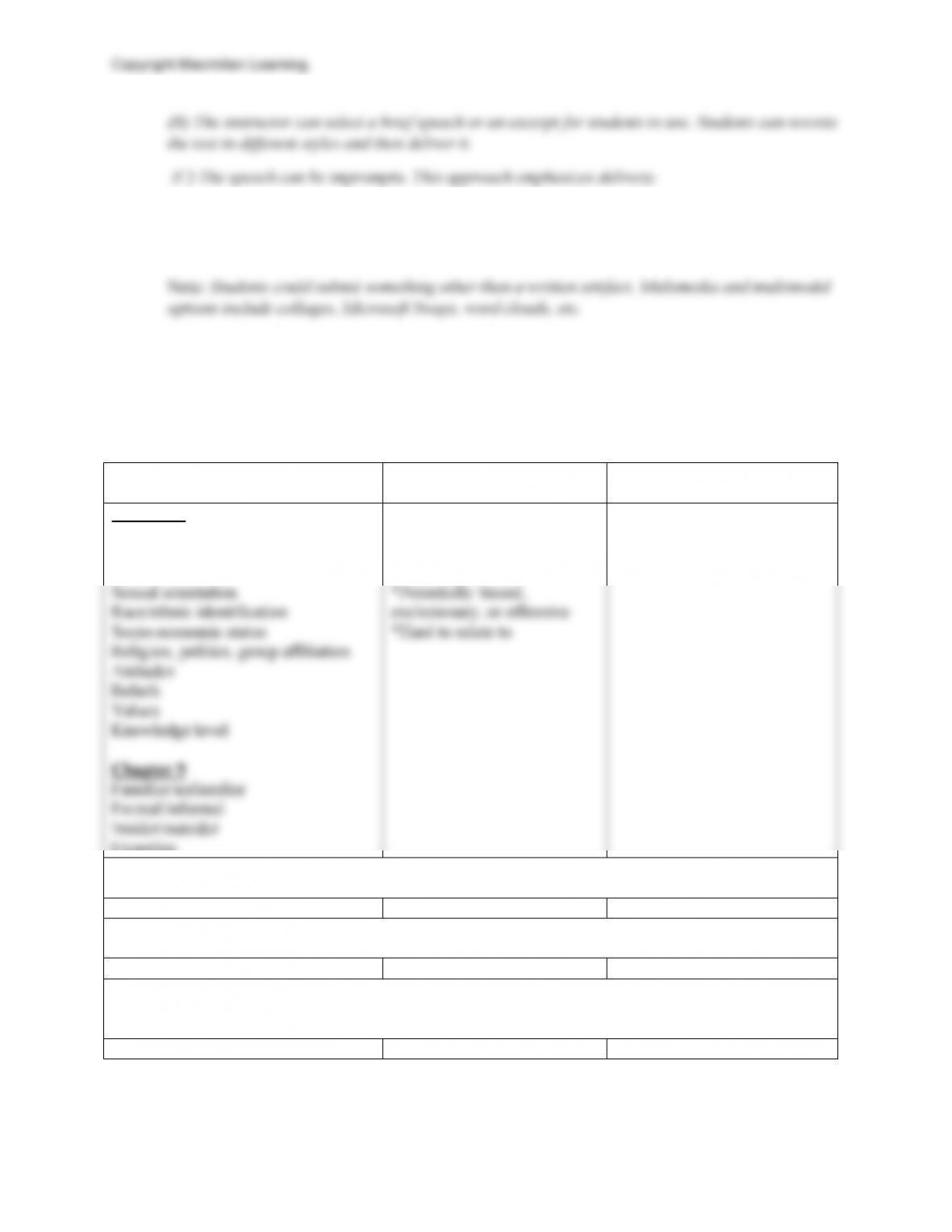
5. How will you adapt the language in your next speech to your listeners? What are some of the potential
trouble spots for language and how can you prevent problems? Complete an audience analysis that
focuses specifically on language and style. Include ideas from Chapter 3 and Chapter 9.
Before assigning the homework or in-class activity, begin by modeling the process (“I do, we do,
you do”).
Key Categories for Audience
Analysis
Possible Trouble Areas Possible Fixes
Chapter 3
Age
Sex
Gender
Expertise
*Technical language
*Jargon
*Abstract words
*Hard to pronounce
I Do (instructor demonstrates)
Topic: Renaissance Art
Expertise Hard to pronounce: Titian Google a sound file
We Do (example as whole class)
Topic: pick something from student and brainstorm solution
You Do
Topic: Student’s topic for next speech
Homework or in-class activity as individuals, think-pair-share, or small group
7
Teaching Tips
1. Speech Craft defines style differently from other textbooks. Instructors with course structures may want
to rethink scaffolding, introduce some concepts earlier, or consider pre-teaching the vocabulary in this
2. Because language and style are a draw for those interested in rhetorical criticism, and because students
3. Multiple chances to practice delivery skills throughout the semester helps students manage speech
anxiety through systematic desensitization. Have students practice aloud frequently by giving short
4. Chapter 9 illustrates eloquence and repetition with President Barack Obama’s eulogy for Rev.
Clementa Pinckney and closes with an activity analyzing Martin Luther King, Jr.’s famous “I Have a
5. This chapter presents delights and challenges regarding diversity. Having students discuss personal
style and sense of self can create an open environment. It can also raise potential conflict and increase
microaggressions. The section on political correctness can be particularly difficult, especially in today’s
Content Presentation Ideas
1. Making an Impression
This assignment focuses on various style decisions speakers make before giving a speech. Students will
be given class time to plan and will be asked to present during the next class session. Presentations should
be no more than 3-4 minutes long.
After each presentation, the audience will give feedback on the particular impression made and whether it
was appropriate for the type of speech and setting/speaking situation.
Preparing for the Assignment
Prepare index cards with details about a specific speech. Include on each card:
8

Copyright Macmillan Learning.
Topic
Setting/speaking situation
Some details about the audience (e.g., a business presentation at a convention hall or a toast at a
wedding)
Assignment Instructions
The impression you make on an audience is often determined by the type of speech you are giving and the
speaking situation. In considering your audience, you should ask yourself three questions before planning
your speech:
Is the audience familiar or unfamiliar with me?
Should I be formal or informal?
Does this audience consider me to be an insider or an outsider?
For this assignment, you will work in small groups. Use the speech details provided as a starting point. As
a group, flesh out the remaining details related to style:
What type of impression do you want to make?
How should you dress?
What type of language you will use?
What kind of body language will you display?
You will have time in class to plan. You will then present during the next class session. Presentations
should be no more than 3–4 minutes long. After each presentation, the audience will give feedback on the
particular impression made.
2. Playing with Language
This assignment focuses on the use of vivid language, such as alliteration, tropes, metaphors, similes, and
irony. Students will be given class time to plan and will present either at the end of class or during the
next class session. Presentations should be no more than 3-4 minutes long.
After each presentation, the audience will give feedback on the type of language used and the impression
Copyright Macmillan Learning.
You will have time in class to plan and will present either at the end of class or during the next class
3. Showing Credibility
For this assignment, students will work individually to devise a topic in which they feel they are an
expert. In putting their speeches together, students’ main goal is to use language that shows their
credibility, so they should use simple and concise language; be accurate; avoid jargon, slang, and biased
language; and use concrete imagery. They also need to appear confident and think about how they should
dress.
More Resources
1. For stylistic devices, see California Federation of Chaparral Poets’ list of stylist devices: search
“chaparral poets poetic devices pdf.”
2. Fun speeches to analyze speaker style, disposition, and formal/informal language choice: 9 Comedians
4. Amy Mullins, a US Paralympic athlete and model, gives a TED Talk about the word “disabled.” In
both content and form, this talk illustrates style as holistic and provides an opportunity to discuss
5. MLA Commons, a rich site to mine for insights and activities about style, disposition, and affect: