
Chapter 3 Audience Analysis
Chapter Objectives
Explain the importance of the space and place of a speech.
Explain how the size of an audience can influence a speech.
Explain stereotyping and why people do it.
Describe the characteristics of an audience that a speaker should consider before developing
speech.
List and explain the three basic concepts for analyzing audience psychology and feelings.
Explain the difference between formal and informal analysis.
List and explain the three types of formal audience analysis.
Define identification, and explain how to create it with an audience.
Define beliefs, attitudes, and values, and explain how they differ.
Define identification, and explain its importance to public speaking.
Explain audience disposition and how a speaker would analyze it.
Lecture Outline
I. In general, what many fear the most about public speaking are the negative judgments of an
audience.
A. A nudity dream is a common dream in which the dreamer realizes he or she is naked in
front of a group of people.
B. Public speaking anxiety can be avoided by anticipating the possible reactions of the
audience and by gathering information about them.
1. Audience analysis is the process of studying an audience before, during, and
after a speech.
II. Checking Out Your Speech Location
A. Learning Objectives
1. Explain the importance of the space and place of a speech.
2. Explain how the size of an audience can influence a speech.
B. Analyzing the speech space and knowing when you will be speaking can give you a lot of
useful information for preparing for your speech.
C. Physical Location
1. Most of the speeches you will give throughout your life will take place in less
professional settings (e.g., reception halls, places of worship, or restaurants).
2. If possible, you should scope out your speaking location before your speech. If it
is not possible to see the space yourself, ask those more knowledgeable about the setting.
3. Clarify the size and type of room as well as the available technology.
4. The bigger the space, the more animated you will need to be when speaking. The
smaller the space, the more subdued you will need to be.
D. Technological Needs
1. Technology directly affects how you can relate to an audience.
2. Sound reinforcement is the use of microphones, sound processors, and
amplifiers to enhance the quality or volume of sounds.
3. When you think about your speaking space, be sure to consider all your
technological needs—both digital and analog.
E. Audience Size
1. In general, bigger audiences require more preparation and formality.
1
2. Internet audiences, known as amorphous or unknown audiences, are a group of
individuals brought together by a given message who may or may not share common
characteristics.
a) This poses a challenge when anticipating a message’s eventual audience.
III. Who Is Your Audience?
A. Learning Objectives
1. Explain stereotyping and why people do it.
2. Describe the characteristics of an audience that a speaker should consider before
developing a speech.
3. List and explain the three basic concepts for analyzing audience psychology and
feelings.
B. How audience members think of themselves will affect how your message is received,
and central to that thinking is identity.
C. Demography and Stereotyping
2. A stereotype is an overgeneralization about a person or group based on assumed
characteristics.
a) Stereotypes are often harmful, however they can be useful when you
have limited information about an audience.
b)
Thinking about the age of your audience members is important because
different generations have different core values and goals.
c) Depending on the topic, knowing the basic sex and gender of your
audience can be important for developing speeches.
2

(2) Harvey Milk was the first openly gay elected official in the
United States. Until his assassination in 1978, he was regarded as a
masterful public speaker whose impassioned oratory helped change
minds about LGBTQ persons.
e) Most U.S. audiences today are racially diverse and will continue to
become even more so.
(1) Race indicates a group of people identified as having the same or
similar physical characteristics based on genetic heritage, visible traits,
or social relations.
(2) Ethnicity is the understanding of oneself to participate in the
language, culture, style, and history of a given group of people.
(3) Speakers cannot assume audience members share racial or ethnic
experiences, or that English is their first language.
Socioeconomic status refers to the incomes, occupations, and educational
background of a given group of people.
f)
(1) Socioeconomic status is sometimes related to the concept of
class.
(2) Karl Marx argued that the best way to understand how society
works is to focus on its class system. Furthermore, Marx argued that
many, if not most, social problems can be traced back to class struggle.
(3) In a persuasive speech, your arguments will vary
depending on
your audience’s predominant social class.
g) Determining the religious and political beliefs of your audience is
difficult since these types of beliefs are generally diverse.
(1) Although the speaking venue can often be a clue to the
audience’s religious or political beliefs, you cannot assume this in most
speaking situations.
IV. Gathering Info about Your Audience
A. Learning Objectives
1. Explain the difference between formal and informal analysis.
2. List and explain the three types of formal audience analysis.
B. Informal audience analysis refers to the way in which a speaker gathers information
about his or her audience in an unsystematic way by asking the host of the event, thinking about
the physical location, or relying on past speaking experiences.
C. Formal audience analysis refers to employing various tools and methods for gathering
information about people, such as with focus groups, interviews, or surveys.
V. Audience Psychology: Identification and Core Values
A. Sigmund Freud and his colleagues argued that most people share common motives and
desires.
B. When discussing audience psychology, we are concerned with the Freudian ideas that
have proven helpful and that have been accepted by scholarly and scientific communities.
C. Freud’s concept of love, or the basic desire to be important and recognized, is useful to
public speakers.
VI. Audience Psychology: All You Need Is Love (and Identification)
A. Learning Objectives
1. Define identification, and explain how to create it with an audience.
2. Define beliefs, attitudes, and values, and explain how they differ.
3

B. From Freud’s perspective, all people are inherently separate but also desire love and
connection at the most basic level.
1. Good speakers can harness the power of love and foster togetherness by creating
moments of identification, or moments when both audience and speaker forget the
differences between them by recognizing that they are alike in some fundamental way.
C. Burke-ification: Identification and Kenneth Burke
1. Learning Objective
a) Define identification, and explain its importance to public speaking.
2. Kenneth Burke argued that all compelling speech is established on the basis of
identification. Burke also argued that prior separation is a prerequisite for identification,
since we would not desire to be “connected” if we were not divided from each other in
the first place.
a) Burke’s idea is that speaking successfully to an audience requires the
speaker to communicate that he or she is fundamentally like the audience in some
way.
3. Beliefs, Attitudes, and Values
a) Identifying with your audience is important but requires you to know
something about their beliefs, attitudes, and values.
(1) Social psychologist Milton Rokeach’s model of belief and
attitude change is a predictor of how audiences tend to process and
respond to messages.
(2) In general, people tend to hear only in a way that is consistent
with their beliefs, attitudes, and values.
(3) It is easier to inform or entertain an audience than it is to
persuade them, because persuasion often pushes toward a change in
beliefs, attitudes, and values.
b) According to Rokeach, beliefs are the ideas we have about reality.
(1) Rokeach found that some beliefs matter more than others, and
the more they matter, the harder they are to change.
c) Rokeach defines attitude as a group of beliefs that form around a
common object and predispose behavior.
(1) Whereas simple beliefs tend to function as truth, attitudes clump
beliefs together into feelings, which serve as the glue of attitudes.
d) The most important component of Rokeach’s model is values, or the core
beliefs of an individual that are almost impervious to change.
(1) Rokeach argues that values come in two types: terminal values
(life goals) and instrumental values (goals that guide us to our life goals).
e) Attitudes and values are more difficult to change since the developments
of both are directly related to time.
f) Changing behavior is also very difficult. Speakers are more successful
when trying to influence beliefs or attitudes and less successful when attempting
to change values or cause a behavior.
VII. Feelings: More on Audience Disposition
A. Learning Objective
1. Explain audience disposition and how a speaker would analyze it.
B. To be a good public speaker in our postmodern times, you should focus on feelings at
least as much as you focus on logic. This allows you to address the whole human being, not just
the rational part.
1. Psychological audience analysis is the anticipation of audience feelings and an
attempt to marshal those feelings in order to change beliefs, attitudes, values, or behavior.
4

2. Understanding the demographic characteristics, group affiliations, and the
general BAVs of an audience can give you a good sense of how they will feel about you
and your speech topic.
3. After you’ve analyzed your audience, your actions will depend on how the
audience feels about you, your topic, and the occasion for which you’re speaking—an
orientation known as audience disposition.
Key Terms
Audience analysis: the process of studying an audience before, during, and after a speech.
Sound reinforcement: the use of microphones, sound processors, and amplifiers to enhance the quality
or volume of sounds.
Amorphous or unknown audiences: groups of individuals who are brought together by a given message
who may or may not share common characteristics.
Demography: the study of the statistical characteristics of a given population.
Stereotype: an overgeneralization about a person or group based on assumed characteristics.
Social norms: rules that govern what is normal in a given culture.
Sexual orientation: the gender identity of those with whom you choose to be intimate.
Sexual identity: how you express your gender and, perhaps, your sexual orientation to yourself and
others. Sexual orientation and identity are often, but not necessarily, the same.
Informal audience analysis: the way in which a speaker gathers information about his or her audience in
an unsystematic way.
Formal audience analysis: employing various tools and methods for gathering information about people.
Identification: the shared sense of identity between or among two or more people, usually in reference to
a common thing, experience, or event.
Belief: an idea about reality.
Attitude: a set of beliefs that cluster around a common object and predispose behavior.
Values: deeply held core beliefs.
Psychological audience analysis: the anticipation of audience feelings and an attempt to marshal those
feelings in order to change beliefs, attitudes, values, or behavior.
Audience disposition: how the audience feels about you, your topic, and the occasion for which you’re
speaking.
Chapter Summary
Because one’s specific audience can be just as important as the content of one’s speech, Chapter 3:
Audience Analysis focuses on the audience rather than the speaker. If you do not consider to whom you
are speaking, the intended message is unlikely to get across to your audience. Therefore, this chapter
focuses on the importance of audience analysis. In particular, this chapter delves into the three
components speakers should consider regarding audience analysis: the location and physical space of
where the speech is being delivered, the demographics of audience members, and the psychology of the
audience.
This chapter also discusses the importance of connecting with the audience to create a message that will
resonate more strongly with them. Assessing the psychology of audiences also consists of considering the
beliefs, attitudes, and values of that audience; this chapter distinguishes the differences among these three
concepts. Additionally, this chapter details how to gather information about one’s audience, through
informal analysis and formal analysis.
5
A: Discuss the difference between identity and geography. Define identity by referring to
4. Understanding audience disposition will help you craft an effective message. How would you handle a
situation if you misjudged your audience despite your best effort at audience analysis? Explain your
answer by using terms from the chapter and examples.
5. The chapter advises focusing on feeling as much as logic. In your opinion, how do you strike a balance
and when do you know you’ve crossed the line? Defend your answer using terms or ideas from the book
and examples.
Activities for in-class work or homework
1. Formal audience analysis of age/generational cohorts
Require students to research the beliefs, attitudes, values, and characteristics of a generational cohort
rather than a biological age group. Design and format this activity based on where it falls in the schedule
and on class needs. Assign a topic, leave the choice open, or have students use upcoming speech topics.
Students can use the analysis chart modified from the chapter. The activity builds off the discussion
question about age groups, but can stand by itself. Debriefing can compare the informal audience analysis
to the formal audience analysis.
Step 1:
Research the characteristics, beliefs, attitudes, and values of a generational cohort at least one
generation away from your age group: Post-Millennial, Millennial, Generation X, Boomer, Silent
Generation, Greatest Generation.
7
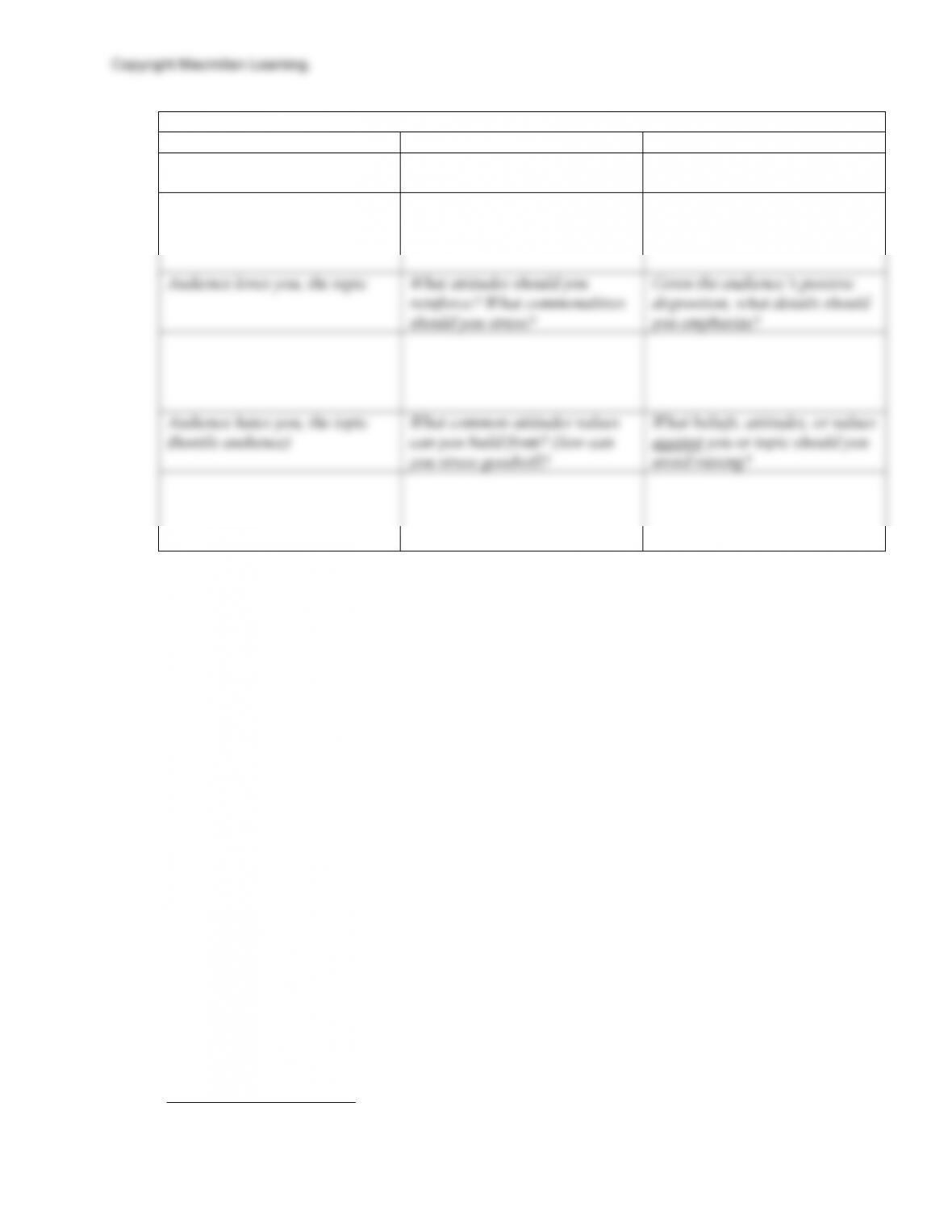
Audience Disposition
Speaking Situation Dos Don’ts
Audience doesn’t know anything Why should they listen? What
should you simplify?
What jargon or issues should
you avoid?
2. Construct > Rehearse > Deliver in a formal setting.
Create a situation that imposes formal constraints or a non-classroom setting on students to deliver a
speech. This allows them to experience physically the impact of situation and physical context on
preparation and delivery. The speech can be impromptu, a famous speech, or something the student
prepares. Keep the assignment brief. The setting can be outside, in an auditorium on campus, or simply
requiring students to dress up and present a speech on camera. Explain that people dress up when they
practice for interviews or interview on Skype, and people who telecommute put on “work clothes” to stay
task oriented and focused. Make this activity a low-stakes assignment to reduce anxiety but generate
student investment. Low-stakes assignments are explained in the teaching tips for this chapter.
3. Video analysis
The lighthearted and humorous video “What Kind of Asian Are You?” illustrates several chapter concepts
based on people’s racial and ethnic identification. Issues include the idea of white as normative or neutral,
assumptions that people make about ethnic identification, and the difference between flattery and
pandering. The video is an exchange between a white man and an Asian-American woman jogging in a
park. The man tries to guess the ethnic identity of the woman and then makes many false and offensive
assumptions about her. The woman flips the scenario by making similar assumptions about his Anglo-
American ethnic background. The scenario resembles the chapter discussion of JFK referring to
Americans as “we” and black Americans as “they.”
This activity can be completed adapted to many formats.
To access the video, search “what kind of asian are you video.”
Directions/Writing Prompt:
8

The man in the video “What Kind of Asian Are You?” obviously fails to recognize the woman he
meets in the park even though he tries to build identification. What causes this failure? What
could he have done differently? How does this scenario apply to public speaking?
Other approaches/extend the activity:
1. Have students research or generate similar misconceptions about other identity categories.
2. Have students discuss, write, and/or perform parallel scenarios for other identities (Ex: LGBTQ
and heterosexual).
In both activities, require students to connect their answers to crafting speeches. How does this
information help them to adapt to an audience?
4. Stereotype activity
Students have varying degrees of sensitivity toward dominant stereotypes in the U.S. about identity
categories. Some students may have limited experience feeling left out of an audience. Some may lack
awareness of how Americans are stereotyped outside the U.S. This activity introduces some stereotypes
that Europeans may have of Americans. The goal of this activity is to question assumptions about
audiences.
Directions/Writing Prompt:
Good speakers recognize their audiences and build identification. Mental Floss has collected tips
from international travelers that unwittingly show how they view people in the U.S. If you were
hired as a speech coach for an international business executive, which misconceptions would you
most want to clear up to ensure your client delivers an effective speech? What are the potential
dangers from the misconceptions? Choose your top three and justify why they are the most
important.
5. Video analysis
Have students complete a before and after audience/situation analysis of a speech. Graduation speeches
from the current college or university make a good choice. Students are familiar with the location,
occasion, and audience. Students can use the audience disposition chart in Question 1 or another
approach. Include a discussion of genre expectations such as addressing future concerns, thanking
administrators and donors, etc.
Directions:
9

Teaching Tips
1. “Low-stakes” assignments are worth few points but include evaluation or feedback. The traditional
introductory speech is a one example. Using frequent low-stakes assignments shifts focus away from
grades. It also improves student-teacher communication and student performance. For more information,
search “depaul teaching commons low-stakes assignments” and “faculty focus frequent low-stakes
grading.”
2. Obviously, given the country’s current political division, discussions about demographics could be
risky. Conversely, shutting down difficult conversations can potentially damage an open environment.
One strategy that can defuse a heated discussion is redirecting attention to chapter objectives and
terminology. Point out that stereotypes, division, misunderstanding, and misrecognition have contributed
to our current political situation, so speakers need informal and formal audience analysis to build
identification. This approach can help instructors find balance consistent with their teaching philosophy.
3. One strategy to promote and deepen discussion is the “Think Aloud.” Commonly practiced in K12,
Think Aloud externalizes student learning. It helps students take risks, develop comfort with trial and
error, and build metacognitive skills. The process is easy: students share their thoughts out loud as they
mentally work through a question. This practice is most successful when instructors model the process.
For example, “As I’m thinking about the mayor having to talk to this hostile audience, I’m wondering
what she could say to get people to listen to her proposal. I don’t think she could talk about the previous
mayor’s failure because everyone loved him. But maybe she could frame it as an extension of his policies.
What do you guys think would work here?” Chapter 3 demonstrates this process in explaining how to
develop a topic and purpose statement.
4. Making teaching techniques transparent helps students connect classroom activities to outcomes or
objectives. Otherwise students sometimes perceive activities as frivolous. This chapter is about audience
analysis. For students who resist working in groups, point out that group work helps them understand
their audience better, which is a benefit of the “lab setting” in a public speaking class.
5. This chapter mentions scouting the technology as part of situational analysis. Teaching with technology
can cause cognitive overload as students process class content and use new equipment at the same time. It
can also increase a speaker’s apprehension. Although most students have some technical skills, remember
to reserve class time to manage technology concerns. This will reduce stress and cognitive overload. This
way, students will be more polished when they use technology in speeches.
10

Student Activities from Josh Gunn
Understanding Demography through Advertising
VERSION ONE: You can understand how demographers use statistical information about audiences by
studying television commercials. While watching one of your favorite television programs (with
commercial interruptions; HBO series don’t count!), describe the commercials of products that are
advertised. Then, ask the following questions: (a) what seems to be the age of the consumer the advertiser
is selling to? (b) does the advertiser address men, women, or both? (c) who can afford the product? (d) do
the advertisers associate the product with a given racial or ethnic category? Your answers to these
questions will help you determine the “demographics” of the audience of the show you are watching.
VERSION TWO: Find a print magazine and choose an advertisement to examine. Based on elements of
the advertisement and the type of magazine it appears in, ask the following questions: (a) what is being
sold?; (b) what seems to be the age of the consumer the advertisement is selling to? (c) does the ad
address men, women, or both? (d) who can afford the product? (e) does the advertisement address a racial
or ethnic group? Your answer to these questions will help you determine the “demographics” of the
advertisement’s intended target audience.
Adapting Audiences to Different Topics
Typically, an analysis of audience psychology leads one to select a speech topic. There will be times in
your life, however, when your topic is set or chosen for you. In this situation, you have to use audience
analysis to adapt the audience to your topic. In groups, discuss the following two scenarios and determine
how best to adapt one’s speech to the audience. What things should you say or do? What things should
you avoid? How should you dress?
Content Presentation Ideas
1. Examining Movie Previews
This assignment serves as a fun way to teach students about audience analysis. It consists of two parts.
11

6. Who are these people you are most concerned seeing your posts? Why do you think this is?
When you are finished with this assessment, read over your responses and take it all in. What conclusions
did you come to?
3. Commercial Skits
Similar to Chapter 2’s Modeling Listening Concepts, this assignment requires students to work in groups
and put together a skit that demonstrates particular chapter concepts. This time, however, these concepts
will be specific audiences. This assignment will test students’ understanding and audiences and how the
particular audience affects the message presented.
Preparing for the Assignment
1. Think of the various audiences that advertisers target for commercials. Write the name of a
different audience on an index card (e.g., women, children, teens).
2. Divide your class into small groups, and hand each group a card with the name of a specific
audience.
The task of each group will be to think of a product or service and work together to create a skit for a
commercial aimed at this particular audience. Each group will later present their skits to the class;
More Resources
1. Helpful for audience research: The Pew Research Center is a highly-respected non-partisan “fact tank”
that tracks national trends for a variety of demographics, beliefs, attitudes, values, behaviors. Search “pew
research center.”
13

2. Helpful for audience research: County Health Data aggregates national health data at the county level.
Community health is defined broadly. Search “county health rankings.”
3. Helpful for audience research: Hans Rosling, who is one of the most popular TED Talkers, speaks
about data visualization. Rosling formed a research institute called Gapminder that aggregates global data
including information about the US. Search “gapminder.”
4. A student-made video explains Burke’s identification and consubstantiality using dorms as an example.
Consubstantiality is the feeling of togetherness and connection that comes from identification. Good for a
flipped class. Search “kenneth burke’s theory of identification dorm edition.”
14