
Chapter 15 The Basics of Persuasive Speaking
Chapter Objectives
Define persuasion.
Explain the difference between an appeal and an argument.
Describe the connection between persuasion and ethics.
Explain the difference between coercion and persuasion.
List the three types of persuasive appeals described by Aristotle.
Explain Maslow’s hierarchy of needs and how it can be used in a speech.
Define an emotional appeal and provide an example.
Lecture Outline
I. Understanding Persuasion
A. Learning Objectives
1. Define persuasion.
2. Explain the difference between an appeal and an argument.
4. Explain the difference between coercion and persuasion.
B. Persuasion is the process of influencing others to do, think, or believe something through
speaking and writing.
C. There are two basic building blocks of the persuasive process: appeals and arguments.
1. An appeal is a request made to another person with the intent of influencing him
or her.
3. The difference between an appeal and an argument is explicit reasoning and
1. Because persuasion asks a person or an audience for trust, ethical persuasion
concerns influencing others through conscious choices.
2. Ethical persuasion concerns power and, in particular, empowering an audience to
make choices concerning what you are asking them to think, feel, believe, or do.
3. Coercion involves influencing someone to do or think something by using
threats, unwarranted emotion, or force, which includes distorting, hiding, or preventing
conscious choices.
E. The Psychology of Persuasion
1. The difficulty in influencing others to change their beliefs, attitudes, or values
has to do with the fact that they are inextricably linked to people’s identity.
2. Persuasion is a psychological process that works at the level of both reasoning
and feeling.
3. Values, which represent the innermost core of an individual’s identity, are almost
impossible to change unless it is done over a very long period of time through constant
reinforcement.
4. Appeals are broader, general expressions that more directly inspire feelings,
whereas arguments are designed to inspire thinking and reasoning.
II. The Persuasive Appeal
A. Learning Objectives
1. List the three types of persuasive appeals described by Aristotle.
2. Explain Maslow’s hierarchy of needs and how it can be used in a speech.
1

3. Define an emotional appeal and provide an example.
B. Aristotle’s Rhetorical Triangle
1. Rhetoric is the study of the ways in which speaking and writing influence people
to do or think what they otherwise would not do or think.
2. Aristotle maintained that a speaker can use three means to appeal to an audience:
appeals to reasoning and structure (or logos); appeals to feelings (or pathos); and appeals
to character traits, such as qualifications and trustworthiness (or ethos).
a) Logos
(1) Logos pertains to the rules of reasoning and how to use those
rules to structure arguments that appeal to an audience’s thought
processes.
b) Pathos
(1) Pathos, or appeals to feelings and emotions, concerns that
dimension of persuasive speaking that can arouse a sense of love or
hatred, or make us fearful or assertive, proud or ashamed, or peaceful or
angry.
(2) Aristotle was biased against pathos because of the tendency for
speakers to use emotion to deceive or manipulate audiences. Today we
see a similar distrust in the common assessment of political leaders.
c) Ethos
(1) Ethos, or appeals to your wisdom or character as a speaker, is the
glue that holds both rational and emotional appeals together.
(2) Aristotle suggested that if an audience does not develop a sense
of you as a good and trustworthy person when delivering a speech, no
skillful argument or appeal to emotions will help you persuade them.
(3) When persuading others, Aristotle suggested that a
demonstration of our character is created and maintained in three ways:
(a) Phronesis, or a demonstration of practical wisdom or
prudence
(b) Arête, or being a good person
(c) Eunoia, or a demonstration or evidence of goodwill
toward the audience
C. Appealing to Needs
1. Today’s theories of motivation answer the same questions in ways similar to
Aristotle’s, but tend to emphasize two kinds of appeals rather than three:
a) People are motivated to change because of reasoned or rational choices
that are in their best interest.
b) People are motivated to change because of inherent human needs.
3. Some scholars have criticized Maslow’s hierarchy by suggesting that some
people are persuaded to act on higher-order needs even when basic physical and safety
needs have not been met.
D. Appealing to Emotion
1. The best way to distinguish an emotional appeal from a persuasive argument is to
focus on the most important goal of a persuasive attempt.
2. If a speaker evokes feeling without offering a series of reasons, he or she is
making an emotional appeal and not a persuasive argument.
3. There are three appeals to emotions that people distrust: fear appeals or scare
tactics, propaganda, and false advertising.
2

a) Fear appeals or scare tactics represent the broadest category of suspicious
emotional appeals, and encompass frightening or coercing an audience to think or
do something for fear of harm.
b) Propaganda is deliberately misleading, biased, or even false information
used to manipulate an audience to agree with or adopt a particular belief system.
c) False advertising or fraud concerns the promotion of a product or
person for the benefit of the speaker, at the expense of the audience.
Key Terms
Persuasion: the process of influencing others to do, think, or believe something through speaking and
writing.
Appeal: a request made to another person with the intent of influencing him or her.
Argument: a reasoned claim, or series of claims, supported by evidence.
Coercion: influencing someone to do or think something by threats, unwarranted emotion, or force,
which includes distorting, hiding, or preventing conscious choices.
Rhetoric: the study of the ways in which speaking and writing influence people to do or think what they
otherwise would not do or think.
Chapter Summary
Because the topic of persuasive speaking is complex, it is divided into two chapters. Chapter 15: The
Basics of Persuasive Speaking introduces the concept of persuasion, which is defined as the process of
influencing others to do, think, or believe something through speaking and writing.
This chapter delves into related ideas concerning appeals and arguments, the two basic building blocks of
the persuasive process. The chapter also touches on the ethics of persuasion, as persuasion concerns
influencing people’s thoughts, feelings, beliefs, and actions. Next, the psychology of persuasion is
discussed. The discussion focuses on understanding that persuasion is a psychological process that works
at the level of both reasoning and feeling.
The chapter then reviews persuasive appeals. Aristotle’s three types of persuasive appeals—logos, ethos,
and pathos—are defined and explained. Following Aristotle’s theory on persuasion is Abraham Maslow’s
differing Hierarchy of Needs theory, as it relates to persuasion. Related to this, emotional appeals are
defined and examined. The three appeals to emotion that people distrust—fear appeals or scare tactics,
propaganda, and false advertising or fraud—are reviewed. Other key terms introduced in the chapter
include coercion and rhetoric.
Discussion Questions
1. In the United States, teaching usually ranks as one of the most trusted and credible professions. Do you
agree that teachers deserve this ranking? What characteristics do teachers embody to earn this ranking?
Excluding scandals or immoral behavior, what might cause a teacher to lose this ranking? Defend your
answer and include examples.
Note: Instructors can keep a list of characteristics on the board.
3
A: Characteristics include wisdom, character, and goodwill based on how the speaker behaves;
delivery, appearance, competence, and knowledge as demonstrated by the speaker and perceived
2. Who in your life, past or present, do you consider having the highest credibility? Do not choose a
celebrity or someone in your immediate family. Describe what makes that person the most credible. What
characteristics does he or she embody or demonstrate? Explain your answer using examples. Revealing
the person or giving identifying information is not required.
3. What does it mean to say that “appeals to ethos are self-evident”? What does this idea require from you
as a speaker?
A: The chapter explains that the speaker must embody and display ethos regardless of prior
4. Current research in psychology and sociology says that people are generally close-minded and resist
persuasion. Listeners are more persuadable when they hear about an issue for the first time or if they
haven’t made up their minds yet. What do you think about this conclusion? Given this research, do you
think that trying to persuade people is worthwhile or pointless? Defend your answers with ideas from the
chapter and use examples to illustrate.
A: The chapter refers to the psychology of persuasion and audience receptiveness. Values are
5. In Chapter 15, an appeal is a request, call, or address made to another person. In this case, appeal refers
to using ethos, pathos, and logos to influence listeners. Skim through the book and your notes for other
places where an appeal is used. What are other meanings for the word or the idea behind the word? How
does appeal in Chapter 15 relate to appeal in other chapters?
A: This question is designed to help students shift from persuasion as “getting people to do
things” to Burkean identification. Since the question is broad and complex, students need latitude
in the answer. Here are some possibilities:
Chapter 2 Listening discuses call and responsiveness, saying that listening comes before
speaking. Speakers and listeners are in a relationship and have an ethical responsibility to one
another (ethos).
Activities for in-class work or homework
1. Example video speech analysis
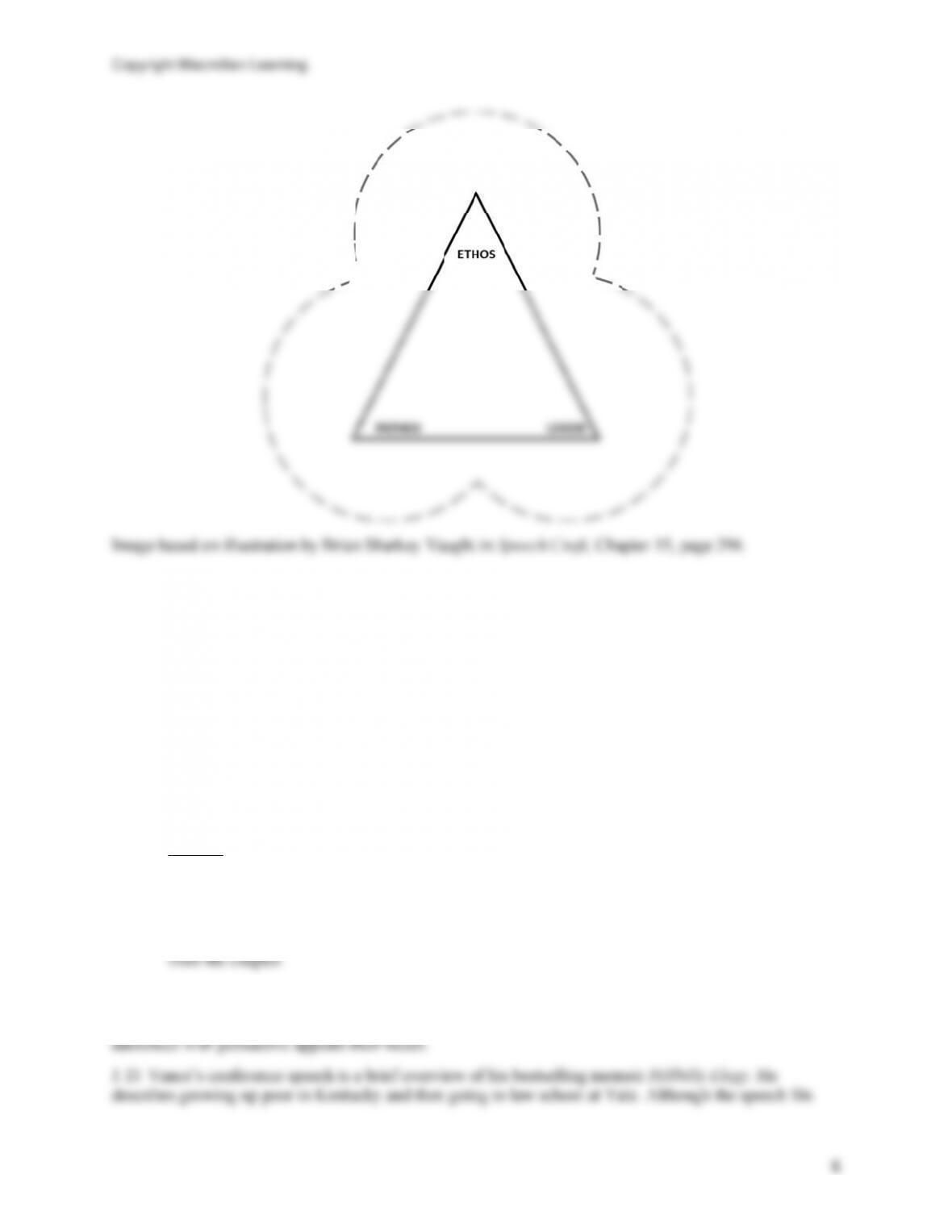
Use a graphic organizer depicting the rhetorical triangle of ethos, pathos, and logos to evaluate how James
Croft motivates his audience to join the anti-bullying “It Gets Better” movement.
James Croft, gay activist and education instructor from Harvard University, gave this anti LGBT bullying
speech at a protest at Harvard: search “James Croft harvard lgbt bullying speech.”
The activity works in most class formats and with most activity structures.
Prompt:
In the speech, James Croft directly calls on his audience to participate in the anti-bullying
movement called “It Gets Better.” Identify examples of each ethos, pathos, and logos appeals in
the speech and write them on the chart in the appropriate area. Some examples might fit in more
than one area, so you can write them in places that show an overlap. After looking at your
completed chart and thinking about the overall speech, how well do you think Croft uses appeals
to persuade his audience? Do you think his speech is effective? Defend your answer and provide
examples to illustrate.
5
more squarely in the epideictic genre than the persuasive one, it illustrates many concepts from Chapter
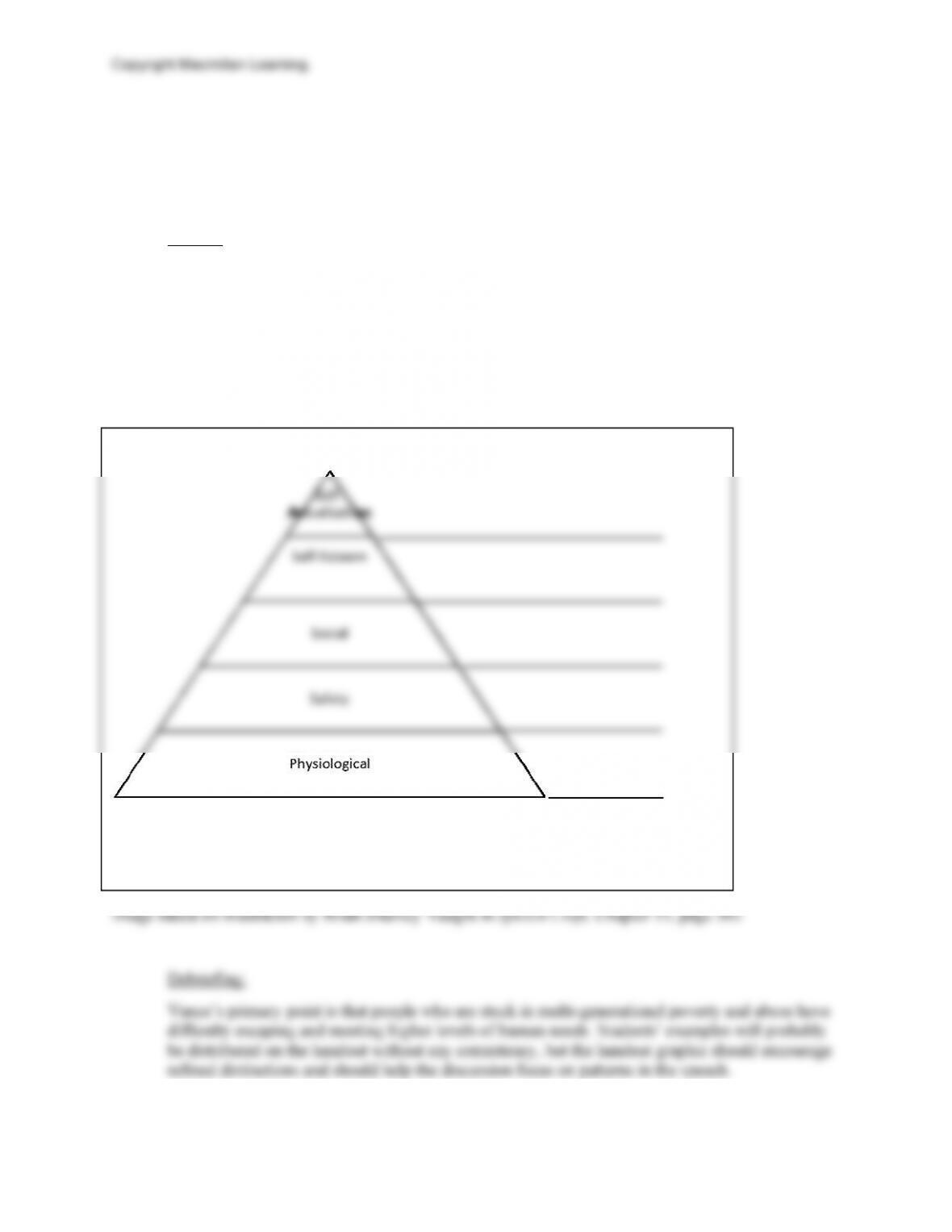
15. The chapter explains Maslow’s hierarchy and briefly describes the categories.
To access Vance’s speech, search “j.d. vance at first year experience 2-17 video.”
The activity works in most class formats and with most activity structures.
Prompt:
In his speech, J. D. Vance talks about growing up poor and attending law school at Yale. He
recounts the some of the challenges of breaking the cycle of poverty.
Listen for specific examples of the needs he appeals to and write them on the chart in the appropriate area.
Some examples might fit in more than one area, so you can write them in places that show an overlap.
After looking at your completed chart and thinking about the overall speech, how well do you think
Vance appeals to his audience’s needs in order to motivate or persuade them? Do you think his speech is
effective? Defend your answer and provide examples.
4. Dot voting on your heart issue
7
This activity provides a less-threatening forum for students to engage in clash based on their personal
viewpoints. It reveals to students the extent to which they must look below the surface for potential
audience objections when audiences are forced to weigh competing values.
The activity is loosely based on pre- and post-debate voting in Intelligence Squared debates. It takes a full
standard class period. It requires that students work in groups that form two teams. It works in most class
formats. In online settings, students could work individually or collaboratively. They would vote with
polls instead of dot voting and post reflections on discussion boards.
Directions
Materials:
1. Index cards and color code dots (blue, red, and green). There should be seven cards per
3. The instructor should determine the debate format depending on class composition, instructor’s
preference, and upcoming assignment.
Step 1:
Tell students they have $100 to donate to an organization that supports an issue they care deeply
about. This is their heart issue. They should keep this choice private, but write it on their red-dot
card, and then set the card aside. They should not discuss this.
Step 2:
Have the whole class choose a controversial topic to debate. The topic should fit the upcoming
persuasive speech assignment. It should also have a clear pro and con side that will let two groups
debate in the class time allotted. So, for example, donating to veterans’ mental health issues
would be a difficult topic for the time frame and because it’s hard to oppose. Donating to
Wounded Warrior would be easier because the debate would focus on the organization’s
reputation. Clearly state the two sides for the class. Once the topic is defined, everyone silently
8
Conclude the debate. Debrief and discuss if desired. Have students cast their AFTER votes. This
time, however, add students’ HEART ISSUE as an option. In other words:
For = give the organization $100
Against = withholds money from the organization
? = still undecided
5. Using CATS (Classroom Assessment Technique): Exit Tickets
CATS are informal assessment techniques that check students’ knowledge or progress in class. They are
1. Toward the end of class, pass out index cards to students. Explain to the students they must
answer the question before they can leave. Explain the purpose of the activity.
2. Pose a question on the board.
The question could be reflective, it could pose a problem or challenge, but it generally
4. When students finish answering the question, they turn in the index card, and then they can
leave.
The instructor reviews the cards, looks for themes, questions, things that need clarification, and so
forth. The cards might serve as a launch point for the next lesson.
Teaching Tips
1. For Question #2, students discuss a personal relationship. This low-stakes question should get the
2. Also for Question #2, personal questions about relationships can sometimes distract many students
from the chapter material as they talk about important people in their lives or get lost in examples.
Validation combined with gentle redirects that ask for an explicit connection will resolve that issue. It
also will set clear expectations about the discussion. Modeling answers can also help.
3. For Activity #1, graphic organizers work like concept maps. They help students organize and
categorize information, promote higher order thinking, and develop metacognitive skills.
4. As instructors know, many students skip the reading. The persuasion unit is challenging and often
taught at the end of the semester when students are overwhelmed. Additionally, the material is divided
into two chapters and builds off the genre and informative speaking chapters. Students need orientation
and synthesis at this point in the semester. Using lots of previews, summaries, and foreshadowing for the
next class may be beneficial.
5. Many students have difficulty gauging peers’ political views and predicting their possible objections.
As speakers, they often misjudge the degree of similarities and differences with their audience. Even
1. Using Emotional Appeals
This assignment will help students understand and identify emotional appeals. It also provides practice in
creating visual aids. Students should work in pairs.
Assignment Instructions
Working in pairs, create a presentation that includes three examples of emotional appeals from the media
(TV, print, web, social media). In your presentation, address each of the following questions:
What type of audience is being targeted?
What type of emotion is each appeal targeting?
What is the goal of each of these emotional appeals?
Do you think the appeal was successful for the advertiser? Why or why not?
Do you think the appeal could be harmful to an audience? If so, how?
2. Examples of Persuasion in News and Advertising
Whereas the first assignment focused exclusively on emotional appeals, this next assignment is more
broadly focused. Students will work individually to look for examples of persuasion in news and
advertising. A visual aid(s) is required for this presentation.
Assignment Instructions
10
Working individually, look for three real-world examples of any of the concepts discussed in the chapter.
Specifically, look for examples from the news and advertising. This can be propaganda, false advertising,
or appeals using logos, ethos, or pathos.
Create a visual aid(s) to support each example in your presentation. You should have something concrete
to show for each example. For instance, if you found an example of propaganda in a print ad, use that ad
in your presentation in some way.
Questions to consider when planning your presentation include:
What type of audience is being targeted?
What type of emotion is each appeal targeting?
What is the goal of each of these emotional appeals?
Do you think the appeal was successful for the advertiser/news source? Why or why not?
Do you think the appeal could be harmful to an audience? If so, how?
3. Emotional vs. Needs-Based Appeals
This assignment is designed to increase storytelling skills and different types of appeals (appeals to
emotions and to needs).
Preparing for the Assignment
More Resources
1. Two articles about current cognitive science research that explains why people are resistant to
2. Eric Robertson’s video on Ethos Pathos and Logos; includes direct quotes from Aristotle’s Rhetoric;
great for a flipped or online class: search “eric robertson ethos pathos logos video”; a video on the
rhetorical triangle explaining ethos, pathos, and logos: search “krista price ethos, pathos, logos video.”
3. Video about ethos, covers the basics: search “janene davison developing your ethos video.”
11

4. The speech format that James Croft follows in Activity #1 is the “Public Narrative” designed by
Marshall Ganz. The format has three parts: the story of self, the story of us, and the story of now. The
format was popularized during President Obama’s first campaign and is used frequently by progressive
organizations. Search “comm-org what is public narrative” for more information.
5. The old Monty Python “Argument Clinic” skit illustrates the difference between an argument and a
fight that is explained in the beginning of the chapter: search “monty python’s argument clinic.”
12