
234
© Pearson Education Limited 2008
Mergers and Other Forms of Corporate
Restructuring
In the takeover business, if you want a friend, you buy a
dog.
CARL ICAHN
Van Horne and Wachowicz, Fundamentals of Financial Management, 13th edition, Instructor’s Manual
235
© Pearson Education Limited 2008
ANSWERS TO QUESTIONS
1. Generally, synergy in a merger means that the earnings of the surviving company will be
2. When the P/E multiple of the acquiring firm is greater than the P/E multiple paid for the
acquired company, the shareholders of the acquired company will suffer a dilution in
3. Both methods of analysis should be used. A free-cash-flow analysis emphasizes the long
run with respect to valuation. The future incremental cash flows are discounted to present
4. Mergers are often consummated with stock and there is a marked tendency for more
5. As earnings would no doubt be less than perfectly correlated, a merger would result in less
variability relative to earnings. Therefore, risk could be reduced. If the stocks are both
6. Usually it means growth in earnings per share. Sometimes acquiring companies seek growth
in total earnings or increased growth in sales. More important is the growth in earnings per
7. So many acquisition opportunities look good because the acquirer frequently looks at the
situation with “rose-tinted” glasses. Potential problems in personnel, products, production,
Chapter 23: Mergers and Other Forms of Corporate Restructuring
236
© Pearson Education Limited 2008
8. Too often the acquiring company thinks that the merger targets are bargains, but in reality
the situations are priced fairly or overpriced. After all, no one wants to sell out at a bargain
9. Capital expenditures are deducted in a cash-flow analysis because one should be concerned
10. The current purchase treatment method treats the acquired company as an investment. This
The old purchase treatment method (i.e., pre-2001 in the United States) handled the initial
recording of the acquisition in the same way as described above. The two methods differ
11. With a cash acquisition, the selling company’s shareholders must immediately recognize
any capital gain. With a stock acquisition, the acquired company shareholders recognize any
12. There are two schools of thought. The managerial entrenchment hypothesis suggests it will
work to the detriment of stockholders, and that good offers will be thwarted. The
13. This question asks an opinion, so there is no right answer. Many economists believe that the
Van Horne and Wachowicz, Fundamentals of Financial Management, 13th edition, Instructor’s Manual
237
© Pearson Education Limited 2008
14. The two-tier tender offer is designed to get shareholders to tender their shares early in order
15. The sources of possible value creation are many. The most important are sales enhancement
and operating economies, management improvement, frequently through better incentives,
16. With a partial sell-off a business unit is sold to someone else. A spin-off involves the
separation of the business unit from the company as an entirely separate company, owned
17. Liquidation of an entire company makes sense when the individual assets have a higher
18. The motivations for going private are several. The costs of being a publicly held company
19. The leveraged buyout (LBO) is controversial. It is a means for transferring ownership and,
perhaps, getting better incentives for the management. As a result of an LBO, the
20. For the senior lender(s), the incentive to provide financing for the leveraged buyout is a
higher interest rate than on most business loans. Usually this rate is 1.5 to 2.5 percent (or
more) over prime. The incentive for the junior subordinated lender(s) is the warrant(s) to
Chapter 23: Mergers and Other Forms of Corporate Restructuring
238
© Pearson Education Limited 2008
SOLUTIONS TO PROBLEMS
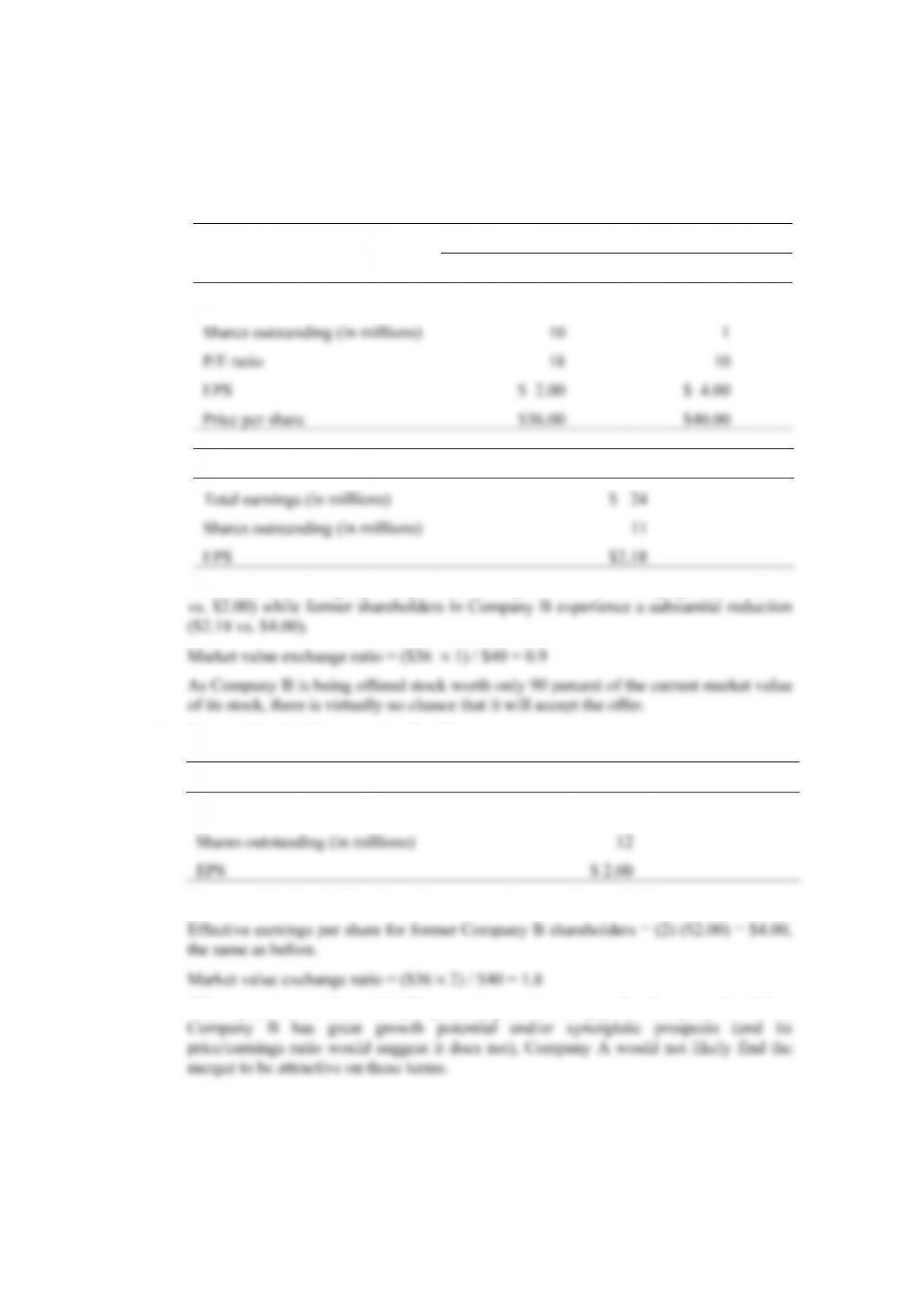
1. a. Shares offered of Company A = 1 million
PRE-MERGER
Company A Company B
Present earnings (in millions) $ 20 $ 4
SURVIVING COMPANY A
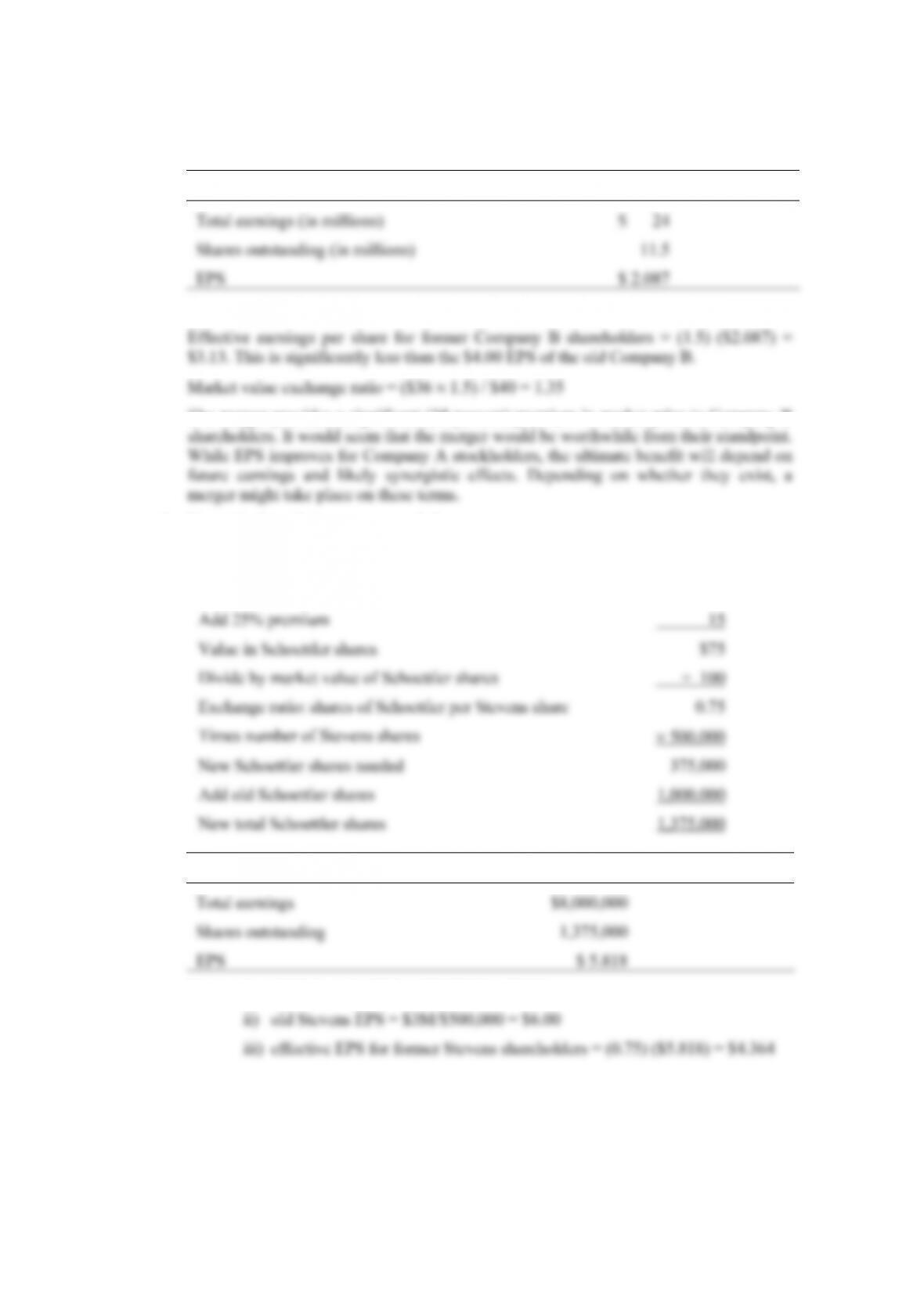
Shareholders in Company A experience an improvement in earnings per share ($2.18
b. Shares offered of Company A = 2 million
SURVIVING COMPANY A
Total earnings (in millions) $ 24
Company A’s shareholders have the same earnings per share as before.
This represents a substantial (80 percent) premium to pay for Company B. Unless
Van Horne and Wachowicz, Fundamentals of Financial Management, 13th edition, Instructor’s Manual
239
© Pearson Education Limited 2008
c. Shares offered of Company A = 1.5 million
SURVIVING COMPANY A
Company A’s shareholders experience a modest increase in earnings per share.
The merger provides a significant (35 percent) premium in market price to Company B
d. No particular solution recommended.
2. a.
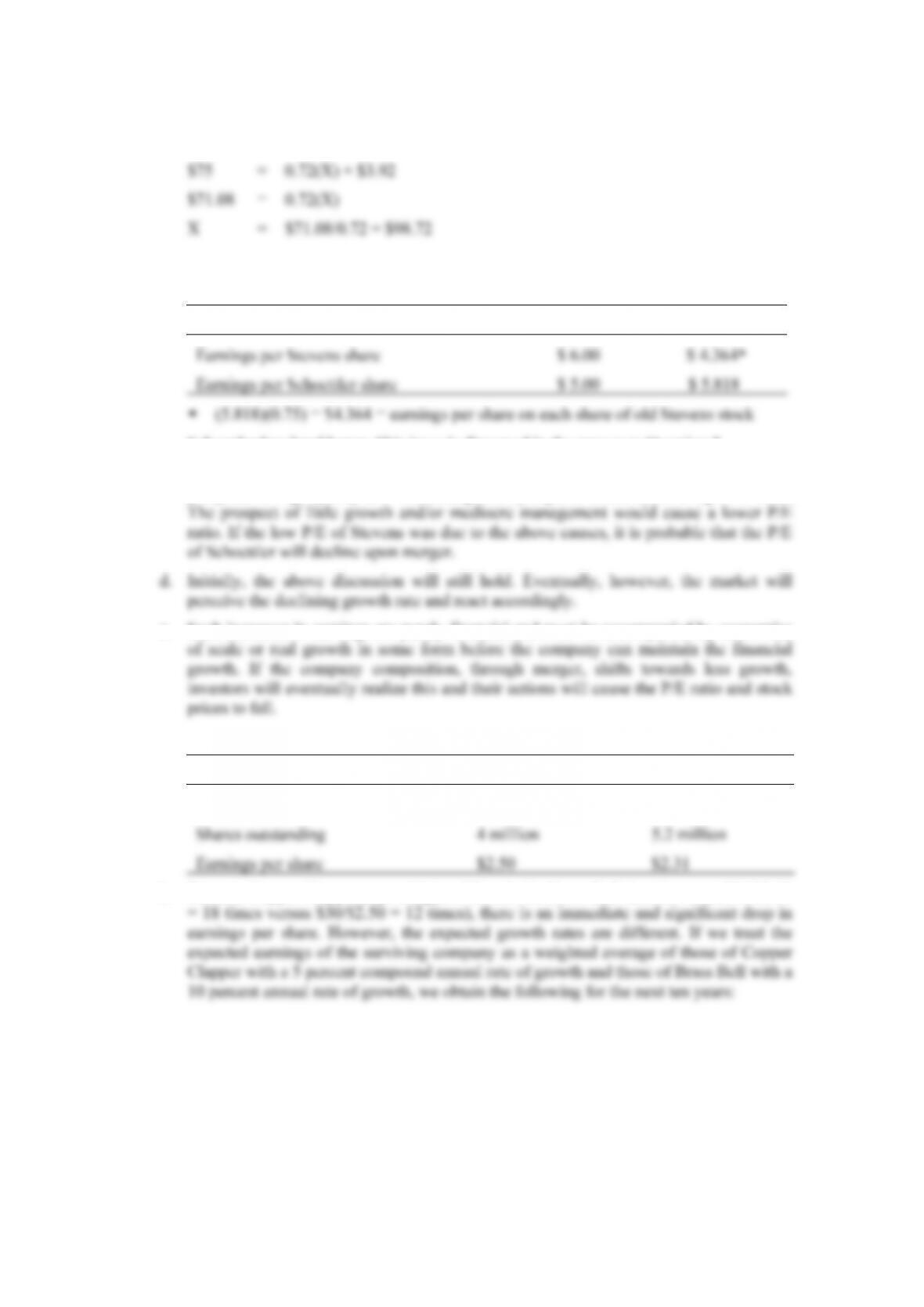
Price per Stevens share $60
SURVIVING (SCHOETTLER) COMPANY
Note: i) old Schoettler EPS = $5M/$1M = $5.00
Chapter 23: Mergers and Other Forms of Corporate Restructuring
240
© Pearson Education Limited 2008
b. $75 = X -0.28 (X – $14)
3. a. Exchange ratio = $75/$100 = 0.75 of a share of Schoettler for each share of Stevens
b.
Before After
Schoettler has fared better. This issue is discussed in the answer to Question 2.
c. The original P/E differential could be due to many factors. Typically, good growth
prospects or high quality and moderate growth prospects would cause a high P/E ratio.
e. Such increases in earnings are purely financial and must be accompanied by economies
4. a.
Copper Clapper Surviving Company
Annual earnings $10 million $12 million
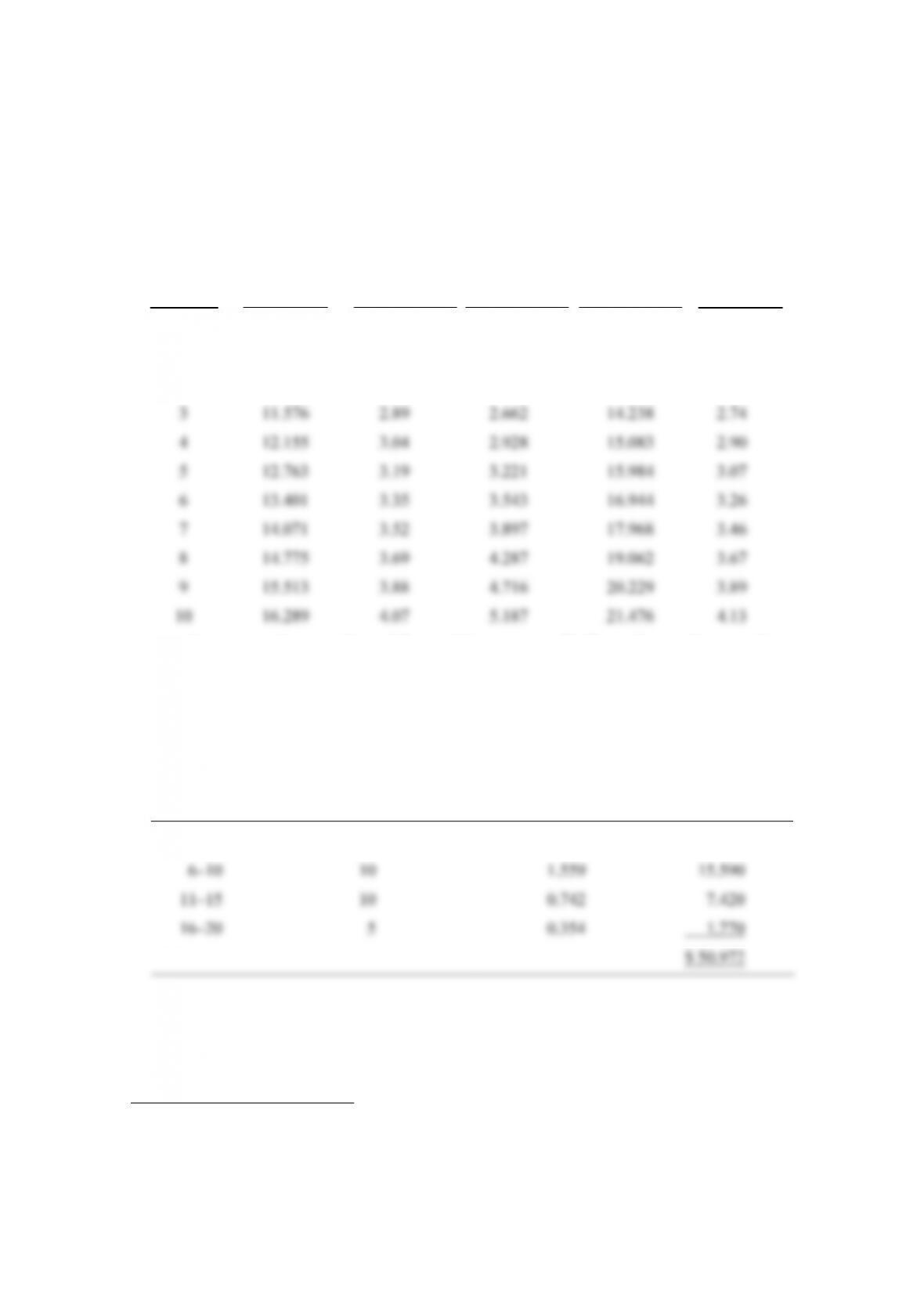
b. Because Copper Clapper pays a higher P/E ratio for Brass Bell than its own, ($36/$2.00
Van Horne and Wachowicz, Fundamentals of Financial Management, 13th edition, Instructor’s Manual
241
© Pearson Education Limited 2008
(a) (b) (c) (d) (e) (f)
Years in
Future
Total
Earnings
Copper
Clapper w/o
Merger
(in millions)
Copper
Clapper EPS
Total
Earnings
Brass Bell
w/o Merger
(in millions)
Total
Earnings
Survivor
(b) + (d)
(in millions)
Survivor
EPS
(e)/5.2M
Shares
Now $ 10 $ 2.50 $ 2 $ 12 $ 2.31
1 10.5 2.63 2.2 12.7 2.44
2 11.025 2.76 2.42 13.445 2.59
As seen, earnings per share of the surviving company finally catch up and surpass those
of Copper Clapper without the merger in the 9th year. However, that is a long way out.
Based on this information, the fact that there is no synergy, and the likelihood of the
merger increasing the relative risk of Copper Clapper,∗ the merger opportunity should
probably be declined.
5.
Period
Avg. Annual Cash
Flow (millions)
P.V. Factor
@ 16% P.V.
1– 5 $ 8 3.274 $ 26.192
∗ This would follow if the systematic risk of a stock and growth in earnings are highly
correlated. In turn, we would expect such a relationship in efficient markets.