Chapter 8: Measuring Life-Cycle Costs
– 317 –
Stage 4 for different members of the class and then have them compare the
plans that they devise. For instance, in Stage 3 you might ask some students
to devise a plan for benchmarking organizations within the banking industry
will use and a time frame over which the study will occur. This can be a
very interesting and informative exercise for students.
Stage 1:
Internal study and preliminary competitive analyses
Stage 2:
Developing long-term commitment to the benchmarking
project
Gaining senior management support
Stage 3:
Identifying benchmarking partners
Size of partners
Stage 4:
– 318 –
Information gathering and sharing methods
Type of benchmarking information:
Method of information collection:
Unilateral
Cooperative:
Determining performance measures
performance measures
Stage 5:
Chapter 8: Measuring Life-Cycle Costs
– 319 –
CASES
8-45
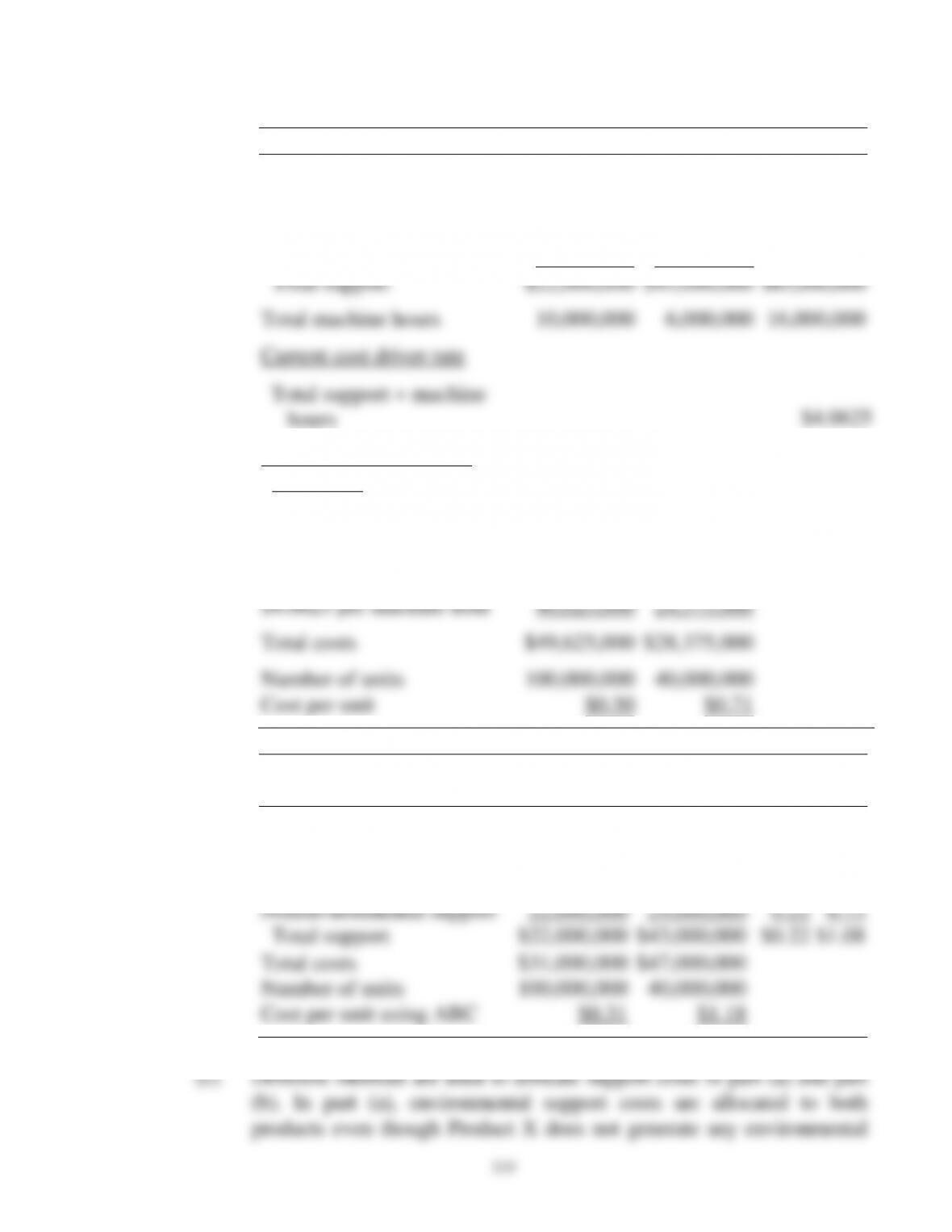
(a)
Product X
Product Y
Total
Direct costs
(material plus labor)
$9,000,000
$4,000,000
Environmental support
14,000,000
Nonenvironmental support
22,000,000
29,000,000
Total support
$22,000,000
$43,000,000
$65,000,000
Total machine hours
10,000,000
6,000,000
16,000,000
Current cost driver rate
Total support machine
hours
$4.0625
Costs using current cost
driver rate
Direct costs
(material plus labor)
$ 9,000,000
$ 4,000,000
Applied support:
$4.0625 per machine hour
40,625,000
24,375,000
Total costs
$49,625,000
$28,375,000
Number of units
100,000,000
40,000,000
Cost per unit
$0.50
$0.71
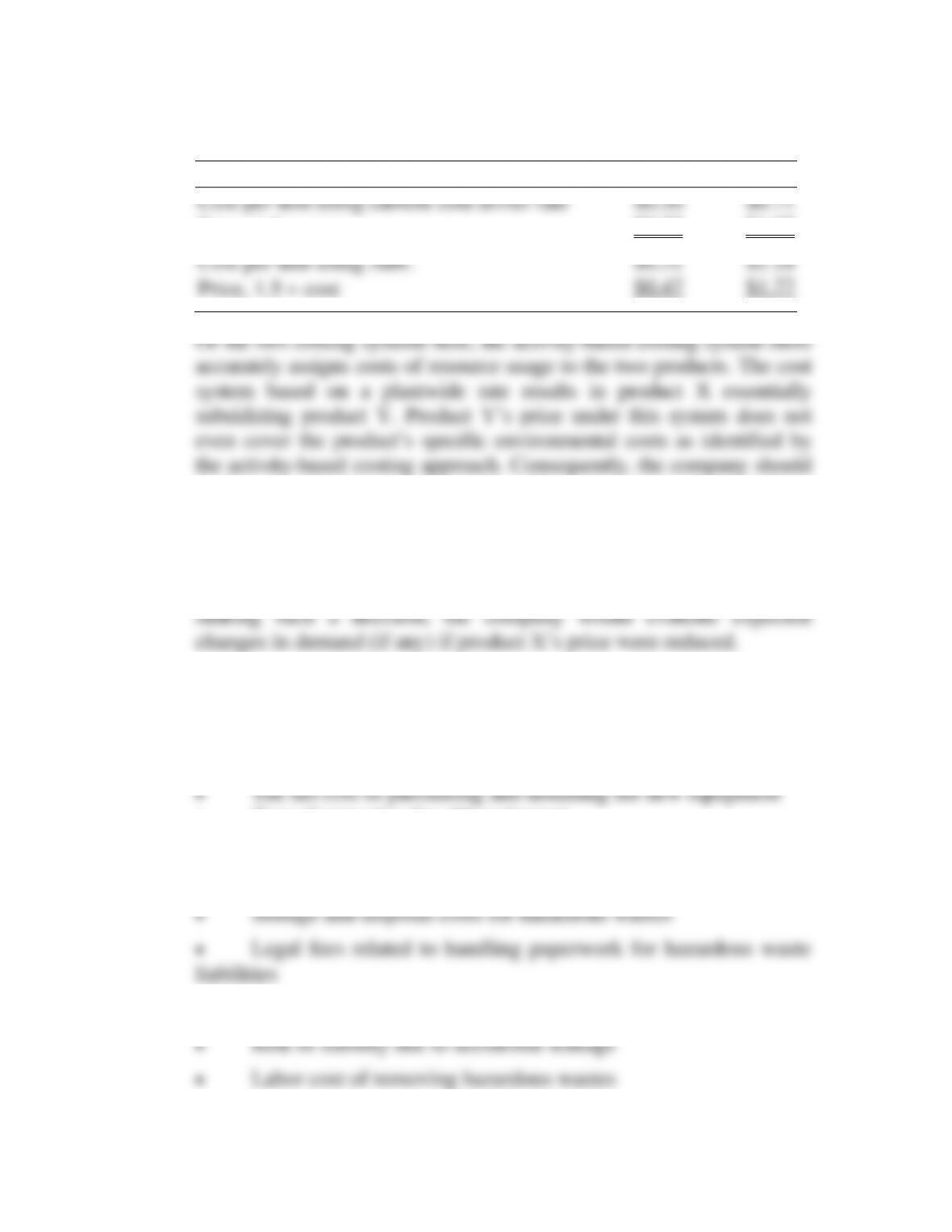
(b)
Per unit
Product X
Product Y
X
Y
Direct costs
(material plus labor)
$ 9,000,000
$ 4,000,000
$0.09
$0.10
Environmental support
14,000,000
0.35
Nonenvironmental support
22,000,000
29,000,000
0.22
0.73
Total support
$22,000,000
$43,000,000
$0.22
$1.08
Total costs
$31,000,000
$47,000,000
Number of units
100,000,000
40,000,000
Cost per unit using ABC
$0.31
$1.18
– 320 –
costs. In part (b), environmental support costs are assigned only to
Product Y.
(d)
Product X
Product Y
Cost per unit using current cost driver rate
$0.50
$0.71
Price, 1.5 cost
$0.75
$1.07
Cost per unit using ABC
$0.31
$1.18
Price, 1.5 cost
$0.47
$1.77
evaluate a price increase for product Y or ways to decrease product-
related costs for product Y. The company may be able to reduce product
Y’s costs by using a process that reduces or eliminates hazardous wastes.
Product X’s price could be reduced and still generate a profit. In
8-46 (a) Pat Polley has listed or expressed concern about a number of explicit
and implicit environmental costs.
Explicit environmental costs include:
Cost of removing the old equipment
Insurance for the equipment and the workers due to hazardous
materials
Risk of OSHA fines
Implicit environmental costs include:
Chapter 8: Measuring Life-Cycle Costs
– 321 –
Negative media coverage that will reduce demand
(b) Other environmental costs include:
Training workers on handling hazardous wastes
Monitoring hazardous wastes
Filing reports on hazardous wastes
due to hazardous work environment
Legal counsel
Employee education and awareness
Loss of goodwill if environmental disasters occur
reduce environmental costs because it identifies process activities,
including activities that cause environmental costs. Next, the costs
associated with the activities are determined. These costs are then
Atkinson, Solution Manual t/a Management Accounting, 6E
– 322 –
8-47 (a) Mercedes-Benz All Activity Vehicle (AAV)1 [Note: Additional
information can be found in the following references:
Cost Management (Autumn 1998): 13–23.
Albright, T. and S. Davis. “The Elements of Supply Chain
teaching plan generally follows the suggested student assignment
questions. Additional material that can be introduced during the case
discussion is indicated by a check mark.
Student Assignment Questions
Students may identify a number of changes, including significant market
share lost to Japanese companies such as Lexus. Stress the importance of a
cultural change taking place within top management at Mercedes. Reinforce
that Mercedes is a company that had never lost money until 1993. They
consideration. Changes include:
• cost competition;
1 Source: Institute of Management Accountants, Cases from Management Accounting Practice,