Chapter 7: Measuring and Managing Process Performance
– 217 –
7-39 (a) The article reports that customer service representatives are commonly
evaluated on time to complete a call or whether they sell a new product
to the customer. The article further states that companies should evaluate
(b) The cost of quality framework can be applied to customer service
processes by considering the customer’s experience with the customer
service representative as the “product” for which the company desires to
satisfy customer expectations. The article mentions a number of
activities that can be viewed as helping to prevent customer
resolving the customer’s problem. Measuring improvement in the number of
problems resolved on the customer’s first call is much more likely to
provide the desired insight and better aligns the representative’s incentives
with resolving the customer’s problem. The article further suggests
As in other contexts, attention should be given to prevention of poor
quality, with the intent of reducing external failures, which in this
context is a customer who is dissatisfied with the customer service
experience. The low-quality experience may cause negative financial
– 218 –
the negative experience and thereby influence the customers to purchase
the good or service from a competitor company.
7-40 There really is no one “correct way” to allocate the $2 million of quality costs
and appraisal costs, such as maintenance of test equipment, process control
monitoring and inspection of incoming materials, an organization can reduce
other quality costs, especially those related to internal and external failure.
Chapter 7: Measuring and Managing Process Performance
– 219 –
7-41
(a)
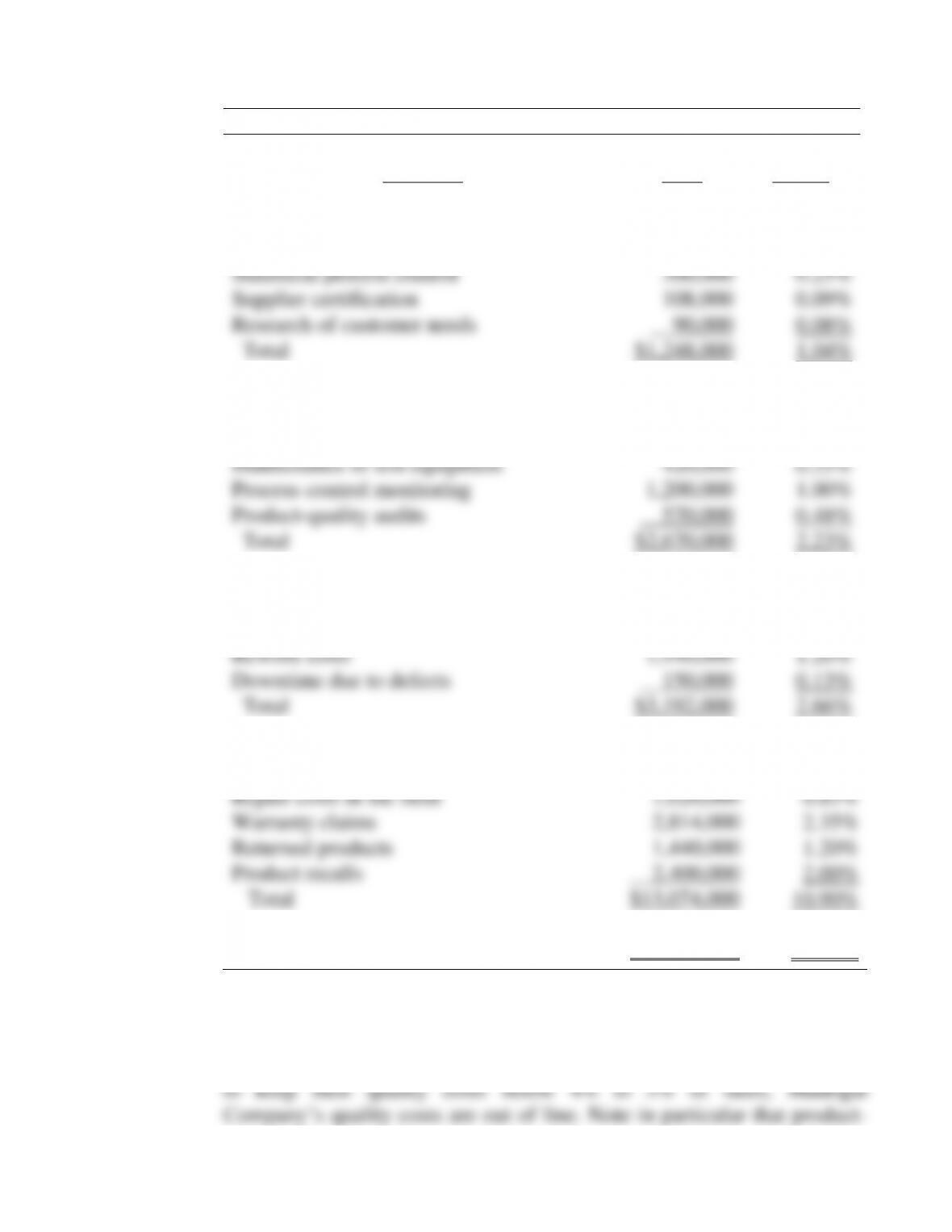
Quality Cost Report for Madrigal Company
Quality Cost
Category
Annual
Cost
Percent of
Sales*
Prevention Costs:
Quality training
$ 150,000
0.13%
Quality engineering
600,000
0.50%
Statistical process control
300,000
0.25%
Supplier certification
108,000
0.09%
Research of customer needs
90,000
0.08%
Total
$1,248,000
1.04%
Appraisal Costs:
Inspection of and testing of in-coming
materials
$ 480,000
0.40%
Maintenance of test equipment
420,000
0.35%
Process-control monitoring
1,200,000
1.00%
Product-quality audits
570,000
0.48%
Total
$2,670,000
2.23%
Internal Failure Costs:
Waste
$ 840,000
0.70%
Net cost of scrap
762,000
0.64%
Rework costs
1,440,000
1.20%
Downtime due to defects
150,000
0.13%
Total
$3,192,000
2.66%
External Failure Costs:
Product-liability lawsuits
$5,400,000
4.50%
Repair costs in the field
1,020,000
0.85%
Warranty claims
2,814,000
2.35%
Returned products
1,440,000
1.20%
Product recalls
2,400,000
2.00%
Total
$13,074,000
10.90%
Total Quality Costs:
$20,184,000
16.82%
*Total sales were $120,000,000
(b) The most obvious problem at Madrigal is the extremely high external–
failure costs of almost 11%. Since as a norm many companies would like
Atkinson, Solutions Manual t/a Management Accounting, 6E
– 220 –
Madrigal should first turn to an analysis of its other quality costs. Quality
costs are incurred throughout the total life cycle of a product. If Madrigal
At Madrigal both prevention and appraisal costs are a relatively small
percent of total quality costs (1.04% and 2.23%, respectively). Madrigal
With regard to internal-failure costs, Madrigal also apparently incurs a
great deal of rework costs. The product seems to require many additional
Note that Madrigal’s quality-related costs are very low at the prevention
stage and increase for the appraisal and internal-failure cost categories.
The more desirable quality-cost trend is the reverse of Madrigal’s
pattern. That is, organizations desire to have the greatest proportion of
quality costs incurred in the prevention stage. By increasing quality
Chapter 7: Measuring and Managing Process Performance
– 221 –
7-42
(a)
Quality Cost Report for Ideal Company
Quality Cost
Category
Annual
Cost
Percent of
Sales*
Prevention Costs:
Quality training
$ 150,000
0.20%
Quality engineering
200,000
0.27%
Statistical process control
300,000
0.40%
Supplier certification
350,000
0.47%
Total
$1,000,000
1.33%
Appraisal Costs:
Inspection of and testing of in-coming
Materials
$ 300,000
0.40%
Process-control monitoring
350,000
0.47%
Product-quality audits
350,000
0.47%
Total
$1,000,000
1.33%
Internal Failure Costs:
Waste
$ 900,000
1.20%
Net cost of scrap
1,500,000
2.00%
Rework costs
2,000,000
2.67%
Downtime due to defects
600,000
0.80%
Total
$5,000,000
6.67%
External Failure Costs:
Product-liability lawsuits
$ 500,000
0.67%
Repair costs in the field
375,000
0.50%
Warranty claims
420,000
0.56%
Returned products
380,000
0.51%
Product recalls
325,000
0.43%
Total
$2,000,000
2.67%
Total Quality Costs:
$9,000,000
12.00%
*Total sales were $75,000,000
Atkinson, Solutions Manual t/a Management Accounting, 6E
– 222 –
rework costs. Regarding external failure costs, the two highest are for
product liability lawsuits and warranty claims. Nevertheless, these costs
7-43 Exhibit 7-10 illustrates the comparison between Kaizen costing and standard
costing. In contrast to traditional standard costing, Kaizen costing focuses on
cost reduction and continuous improvement as overriding concepts in
manufacturing, revises cost reduction targets monthly, uses cost variance
Standard costing uses a cost control system concept and assumes stability in
current manufacturing processes. Standards are set annually or semiannually
and cost variance analysis is used to compare actual to standard costs. The
managers.
7-45 Kaizen is the Japanese term for making improvements to a process through small,
incremental amounts, rather than through large innovations. Kaizen costing is a
method to reduce costs through small, continuous improvements.
7-47 (a) The biggest problem with Kaizen costing is similar to the one that faces
target costing, and that is the system places enormous pressure on
employees to reduce every conceivable cost. The results of this pressure
are internal conflicts among various parties and a great deal of employee
overall system.
(b) To address the first problem, some Japanese automobile companies use a
grace period in manufacturing just before a new model is introduced.
Chapter 7: Measuring and Managing Process Performance
– 223 –
as loss of face, letting down the company, etc., associated with not
achieving targets. In the United States the threat of job loss is much more
salient. The last thing that U.S. managers would want to do is to threaten
job loss to those who did not achieve targets. This would simply
7-48 The key factors in identifying benchmarking partners are the size of partners,
the number of partners, the relative position of partners within and across
industries, and the degree of trust among partners. Choices on each of these
variables will change from one benchmarking study to the next. Organizations
partners.
7-49 A manager asked to benchmark another organization’s target costing system
would want information pertaining to the method by which target prices and
target margins (and consequently, target costs) are set, supplier relations, how
7-50 The Kaizen costing system differs from a traditional standard costing system.
Under the traditional standard costing system, the typical goal is to meet the cost
standard while avoiding unfavorable variances. With Kaizen costing, the goal is to
achieve cost reduction targets. Further, variance analysis under a standard cost
– 224 –
because standard costing systems in Japan are oriented towards complying with
financial accounting standards.
Another key difference between standard and Kaizen costing has to do with the
manufacturing processes to produce products. Thus, one of the central goals of
Kaizen costing is to give workers the responsibility to improve processes and
reduce costs.
modified to accommodate Kaizen costing.
7-51 (a) The Kaizen costing system differs quite significantly from a traditional
standard costing system and there are few similarities. Under the traditional
standard costing system, the typical goal is to meet the cost standard while
compliance with financial accounting standards and financial reporting
purposes.
Another difference between standard and Kaizen costing is that, under
responsibility to improve processes and reduce costs.
Chapter 7: Measuring and Managing Process Performance
– 225 –
what will allow U.S. organizations to embrace and be successful with
Kaizen costing. In addition, the cost of disruptions to production must be
less than the savings due to Kaizen costing.
decision maker), but also the hardest to try to emulate, as there may be a level
of innate intelligence that cannot be “learned.” In order to do the exercise, let’s
1. What procedures do you go through when you study?
a. What methods do you use to take and review notes?
b. What methods do you use to remember details?
2. Where do you study? (At home, in the library, etc.)
3. How do you decide what times of day are most effective for studying?
Atkinson, Solutions Manual t/a Management Accounting, 6E
– 226 –
5. How many hours a day do you devote to each subject?
8. What tips do you have for taking the actual exam?
Implementing some or all of these changes will take time especially if the other
students’ habits are very different from what the student currently does. One
complex organizational change is.
7-53 The instructor should:
1. Make sure that students have done their homework on what the
background information.
2. Make sure that students have read the material in the text on
Stage 1:
Internal study and preliminary competitive analyses
Stage 2:
Developing long-term commitment to the benchmarking project
Gaining senior management support