Atkinson, Solution Manual t/a Management Accounting, 6E
– 126 –
discussed in Chapter 5 and the Kaplan-Anderson HBR article, as an easy and
effective tool for handling order complexity. TN Exhibit 6-2 shows a slide that
incorporate far more process complexity and diversity than original ABC, which
would require separate activity pools to be set up to handle each major variation
in order diversity and complexity.
in a 75-minute class.
Q: What causes a cost rate ($/hour) or unit time estimate to change?
Suppose through a business process improvement (such as TQM, or 6 sigma),
Midwest improves the process so that manual customer orders can be handled
If Midwest grants its order entry clerks a 6% raise, modify the resource cost
and re-estimate the cost per hour (from $35/hour to $37.10/hour). Similarly, if
Midwest grants them an extra holiday or vacation day, reduce the practical
capacity of these resources, and recalculate the cost per available hour. Students
process.
The class can now turn to costing the third major process, distributing orders
to customers. The instructor can ask:
(a) (3)
1. Cost of resources for commercial shipments $450,000
2. Quantity of cartons shipped 75,000
3. and 4. Calculate shipping cost per carton = $ 6/carton
Chapter 6: Measuring and Managing Customer Relationships
– 127 –
Midwest has outsourced its standard shipping arrangements (rather than
The case example was simplified to assume an identical cost for each carton
shipped. In general you could direct charge the actual shipping expense to each
Having calculated the unit cost for commercial shipments, the class can now
(a) (4)
Q: How much does a desktop delivery cost?
1. Cost of desktop delivery resources: $200,000 + 250,000 = $450,000
Students may propose two alternative methods for calculating the cost of
desktop deliveries. One option, based on an original ABC calculation, assumes
an identical cost per carton for desktop delivery:
$450,000/2,000 DD’s = $225 per DD
contains two sources of error.
The other method estimates a standard cost per delivery. This allows number
of deliveries rather than number of cartons to be the cost driver. With 2,000
deliveries, the standard cost is $225 per delivery. While this calculation avoids
the second problem above, it still assumes that all deliveries are equally costly,
– 128 –
simple to implement, is to use the $75 per hour costing rate, and calculate the
time required for each delivery. You can point out that today’s technology and
information systems (such as GPS to track trucks in real time and hand-held
computers that truck drivers can use to log in upon arrival and departure at a
multiple locations.
At Kemp’s, the dairy company described in the sidebar of the assigned HBR
article, drivers have computer entry device in their trucks. They record when
For desktop deliveries, orders are costed only for the capacity they use.
Suppose the same $450,000 of resources for desktop delivery were supplied
during the year but only 1,500 desktop deliveries were made. Then the traditional
reading for the class.
At this point, the instructor can step back from the calculation details to get the
deliveries)?
1. The Willie Sutton rule:4 Look for areas with large expenses in
indirect and support resources, especially where such expenses
Chapter 6: Measuring and Managing Customer Relationships
– 129 –
have been growing over time. Operations where almost all
2. High Diversity rule: Look for a situation in which large variety
exists in products, customers, or processes. For example,
consider a facility that produces mature and newly introduced
products, standard and custom products, and high-volume and
(b) and (c)
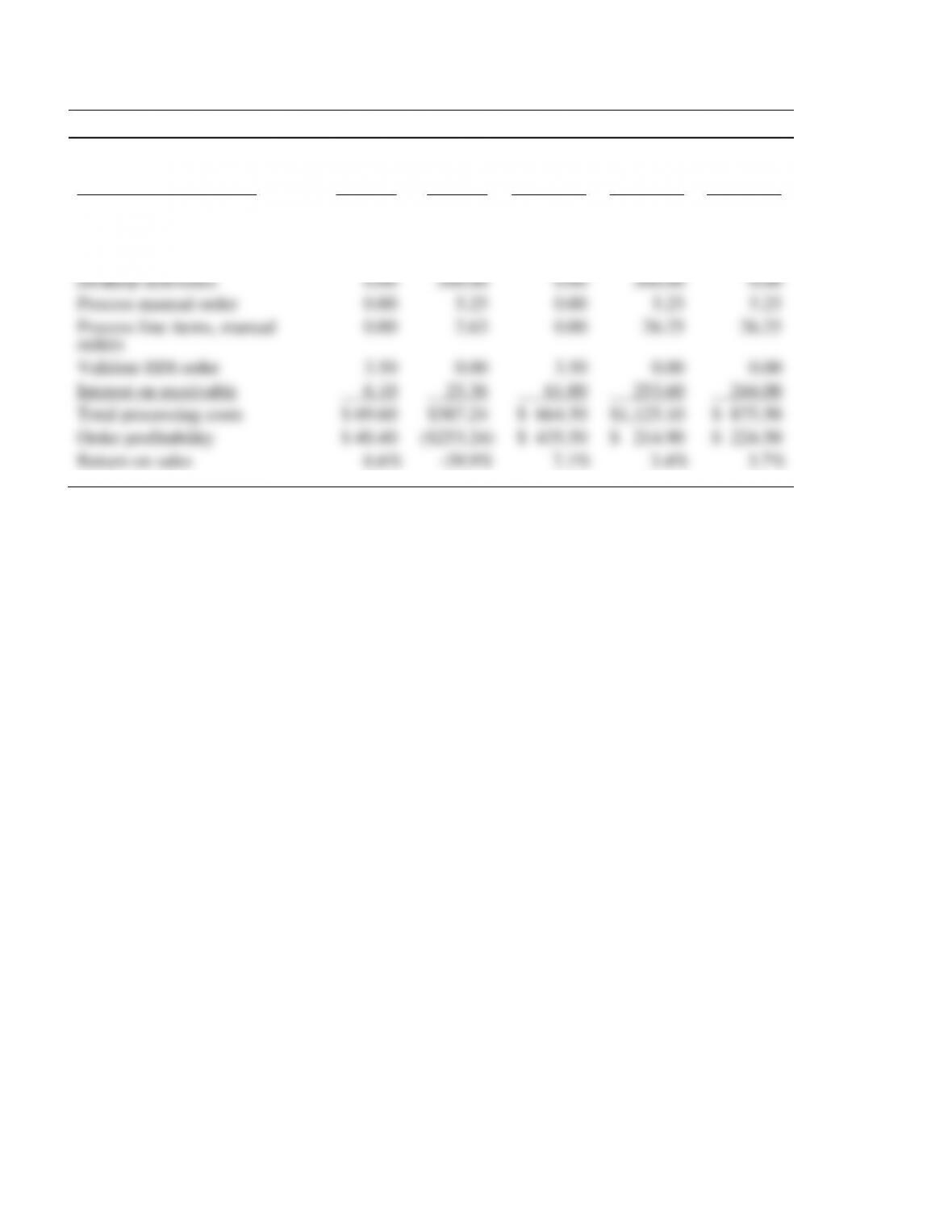
We are finally ready to cost the five orders. I recommend having a student
Order 1 and Order 2 seem identical, except that the price for Order 2 is 4%
higher because it involves direct delivery. Thus Order 2’s gross margin is
substantially higher than for Order 1. Companies operating with a traditional or
contribution margin costing system will celebrate the success of their direct
One can go into more detail by showing that the customer has willingly paid
successful for many years, “That’s where the money is!” When developing ABC systems, we
should follow Willie’s sage advice (but not his particular application of the insight) to focus on
Atkinson, Solution Manual t/a Management Accounting, 6E
differentiating strategy, to develop more sales and higher customer loyalty by
offering additional features and service that the customer values (and is willing to
pay more for). But a differentiation strategy is only successful if the value created
Orders 3 and 4 are the same as Orders 1 and 2 except that they are scaled by a
factor of 10. Order 4 now makes a positive profit contribution and it is breaking
even on its direct delivery service; the incremental revenues of $24 per carton
Order 5 illustrates the impact of the hidden costs associated with manual
order entry and long payment terms. It is the same as Order 3, except for manual
versus electronic ordering and payment in 120 rather than 30 days. These
Q: What do you suggest Midwest should do, based on its new cost estimates?
I recommend grouping the recommendations under the three columns, shown
below, without necessarily labeling the columns as you accept suggestions from
the class.
Process Improve
Pricing
Order
Acceptance/Modify
Customer
Relationships
Route optimization
Specific charges for DD
based on number of
drop points, distance
(time) traveled
Reject small orders;
establish minimum order
size
Migrate customers to
more efficient channels
(EDI)
Discounts for EDI
orders
Limit distances for DD
Chapter 6: Measuring and Managing Customer Relationships
– 131 –
Improve efficiency of
warehouse operations,
and order entry process
Menu-based pricing
Standard delivery,
packaging
Customer picks up at
warehouse; price
quoted FOB
year?
Certainly, the cost of processing orders goes down, and many more orders will
be profitable. But Midwest still loses the same $80,000 in the year. How can this
be?
capacity.
Q: A similar question to the one above is, “What if Midwest eliminates 30K of
Type 2 orders because they are unprofitable, but doesn’t get any new
orders to replace them”
Warehouse processing cost = $4,320,000/50K = $86.40/order
The risk to Midwest is it now starts to drop Type 4 and Type 5 orders
leading to a death spiral. This is why resources should be costed at
as unused capacity.
You can close the class by pointing out the next steps in extending the ABC
Atkinson, Solution Manual t/a Management Accounting, 6E
– 132 –
Analyze and assign general and selling costs
individual customers
(d)
i. Using the order entry times stated in part (a) (2), if Midwest processes
40,000 manual orders per year, with a total of 200,000 line items to
(40,000 × 0.15) + (200,000 × 0.075) + (30,000 × 0.1) = 24,000 hours
per year, which equals the current practical capacity. Therefore, the
company needs all 16 operators and there is no unused capacity.
ii. Midwest will require (20,000 × 0.15) + (100,000 × 0.075) + (50,000 ×
be $52,500 × (16 −10.33) = $297,500. If Midwest only hires full-time
employees, it will need 11 operators and the cost savings will be
$52,500 × (16 −11) = $262,500.
iii. Midwest will require (40,000 × 0.12) + (200,000 × 0.06) + (30,000 ×
savings will be $52,500 × (16 −13) = $157,500.
Chapter 6: Measuring and Managing Customer Relationships
– 133 –
TN Exhibit 6-1 Super-Variable Costs, Profitability Declines with Growth
GROWTH COMPANY SALES AND PROFIT SUMMARY, 1985–1994
1994
1993
1992
1991
1990
1989
1988
1987
1986
1985
Sales
$4,889
$4,388
$4,193
$3,915
$3,498
$3,122
$2,878
$2,483
$2,234
$2,083
Gross profit
$950
$870
$818
$727
$689
$626
$584
$508
$457
$432
Margin
19.4%
19.8%
19.5%
18.6%
19.7%
20.1%
20.3%
20.5%
20.5%
20.7%
S & A expense
$491
$454
$412
$364
$327
$293
$271
$229
$206
$196
S & A %
10.0%
10.3%
9.8%
9.3%
9.3%
9.4%
9.4%
9.2%
9.2%
9.4%
Sales (1989 = 100)
157
141
134
125
112
100
92
80
72
67
S&A expense
(1989=100)
168
155
141
124
112
100
92
78
70
67
Source: Robert S. Kaplan
of Time Equations
Customer Service Time = 6 minutes
+ 3 minutes for special orders
+ 5 minutes if credit memo required
– 2 minutes if electronic order
+ 4 minutes if Customer xyz
– 1.5 minutes if Customer pqr
…
…
Data about specific order characteristics for time equations
come automatically from company’s ERP and CRM systems.
Source: Robert S. Kaplan
Atkinson, Solution Manual t/a Management Accounting, 6E
– 134 –
TN Exhibit 6-3 Five Order Profitability
1
2
3
4
5
Sales
$610.00
$634.00
$6,100.00
$6,340.00
$6,100.00
Cost of items purchased
500.00
500.00
5,000.00
5,000.00
5,000.00
Gross margin
$110.00
$134.00
$1,100.00
$1,340.00
$1,100.00
Processing cartons
54.00
54.00
540.00
540.00
540.00
Shipping cartons, commercial
6.00
0.00
60.00
0.00
60.00
Desktop deliveries
0.00
300.00
0.00
300.00
0.00
Process manual order
0.00
5.25
0.00
5.25
5.25
Process line items, manual
orders
0.00
2.63
0.00
26.25
26.25
Validate EDI order
3.50
0.00
3.50
0.00
0.00
Interest on receivable
6.10
25.36
61.00
253.60
244.00
Total processing costs
$ 69.60
$387.24
$ 664.50
$1,125.10
$ 875.50
Order profitability
$ 40.40
($253.24)
$ 435.50
$ 214.90
$ 224.50
Return on sales
6.6%
-39.9%
7.1%
3.4%
3.7%
Source: Robert S. Kaplan