Chapter 6: Measuring and Managing Customer Relationships
– 117 –
retain Customer 4 in years 1 and 2 provides net benefits and helps
(c) Assuming that n is very large and the numbers in the table remain about
Acquisition
Customer
(M − c)/(i + [1 − r])
Cost
CLV
1
$2,750
$1,000
$1,750
2
3,000
1,000
2,000
3
1,375
1,000
375
(d) Companies can use the information gathered to calculate customers’
are
Initial acquisition cost
Profits or losses earned year
Some companies have highly sophisticated analytic systems that allow
them to estimate these parameters based on the demographic
characteristics of a potential or newly-acquired customer. The analytics
help guide the companies’ promotion strategies and campaigns to
1 V. G. Narayanan, “Customer Profitability and Customer Relationship Management at RBC
Financial Group,” HBS Case # 102-043.
Atkinson, Solution Manual t/a Management Accounting, 6E
– 118 –
6-31 The net promoter score is likely to have the greatest predictive power for repeat
purchases and growth in business-to–customer settings where customers have
X?”
CASES
6-32 The responses below are based on “Survival Strategies: After Cost Cutting,
Street Journal (September 18, 2002, p. A1).
(a) Jergens’ president based the price on what he determined to be the cost
of producing the order of 10 odd-sized fasteners from scratch. The cost
included setup for the odd size and overtime labor. The company
(b) Goodyear had been rewarding its sales force based on volume,
providing an incentive for the sales force to deeply discount prices to
large distributors. The discounts were so substantial that the large
distributors could resell the tires to smaller distributors (even with
a “revenue per tire” metric.
(c) Emerson discovered that customers were willing to pay about 20%
more than Emerson’s initially proposed cost-based price of $2,650 for a
Chapter 6: Measuring and Managing Customer Relationships
– 119 –
unit-level drivers. An activity-based costing system more accurately
assigns costs based on resource usage.
purchasing the lite version, they were informed of the benefits of the
original version, and most of these customers bought the original
version. An accurate costing system, such as a good activity-based
costing system that includes both manufacturing and nonmanufacturing
(e) Union Pacific introduced a minimum price that was higher than a third
of its customers paid. The company was not concerned if it lost these
customers because customers who were paying higher prices would fill
up the newly free space. Dropping unprofitable customers will not lead
profitable use.
6-33 Midwest Office Products2 (HBS Case 9-104–073)
Midwest is a revised version of Dakota Office Products (HBS Case No.
School Teaching Note 5-105-084. This teaching note was prepared by Professor Robert S.
Kaplan as an aid to instructors in the classroom use of the “Midwest Office Products” case,
Atkinson, Solution Manual t/a Management Accounting, 6E
– 120 –
discuss with the class how to extend the model to capture more complex and
realistic situations. The costing of five representative orders gives students
The case is simple enough that it can be used as a first activity-based
costing case. Given that the time-driven approach is both simpler and more
Teaching Objectives
customers into profitable ones.
Assignment (for the standalone case)
Read
“Time-Driven Activity-Based Costing” Harvard Business Review reprint
#R0411J
“Activity–Based Costing and Capacity” HBS No. 105-059
The Kaplan–Anderson Harvard Business Review article on Time-Driven
ABC (#R0411) should be sufficient to introduce students to ABC even if they
have not previously studied the subject. Should instructors want a more
comprehensive introduction to “original” ABC, they can consider: R.S.
(Boston: Harvard Business School Publishing, 1997).
The technical note on ABC and capacity can be optional or background
reading. It helps students understand why ABC cost driver rates should be
based on practical capacity, not actual utilization. This may shorten discussion
Chapter 6: Measuring and Managing Customer Relationships
– 121 –
Textbook Assignment Questions (adapted from the original case questions):
(a) Based on the interviews and data in the case, estimate:
(b) Using this capacity cost rate information, calculate the cost and profitability
(c) On the basis of your analysis, what actions should John Malone take to
customer profitability.
(d) Suppose that currently, Midwest processes 40,000 manual orders per year,
i. How much unused practical capacity does the company have?
iii. Returning to the original information in (d), if the company’s process
improvement efforts result in a 20% reduction in time to perform each
Discussion
Introductory Remarks
If this is the students or executives’ first exposure to activity-based costing, I
– 122 –
discussion with the senior executive team about whether to adopt activity-based
costing. In reading the company’s annual report, I saw the 10-year summary,
which I have excerpted in TN Exhibit 6-1. During the past ten years, the
company was fortunate to have had a sales increase of nearly 135%, as sales had
percentage of sales, as it would have to if any fixed costs existed—actually
increased as a percentage of sales. So not only were CGS not fixed, they were
costs rising faster than sales. An ABC model helps a company identify when it
has not recovered all the incremental costs associated with an order that has
Analysis
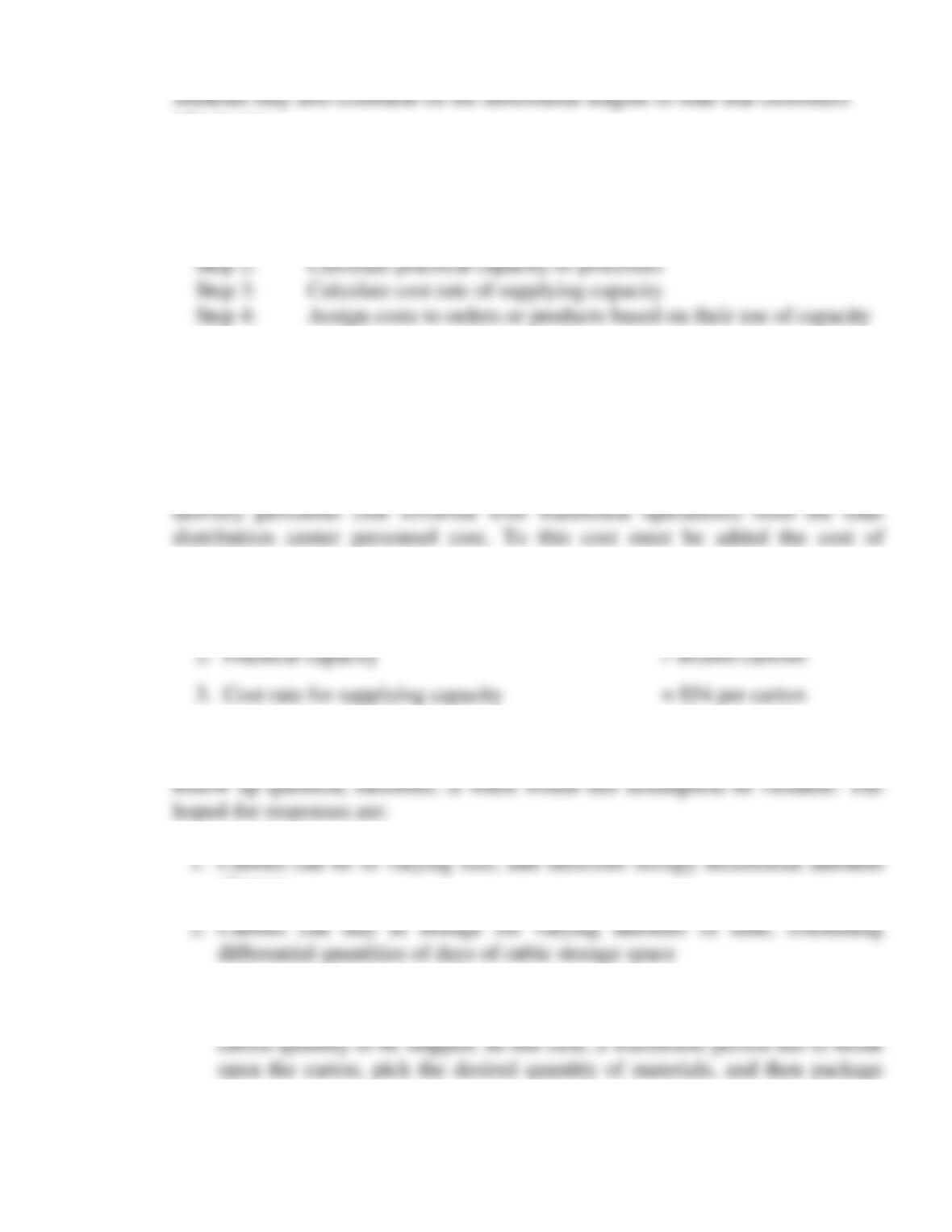
top of the board:
Process
Receive and Store Enter Customer
Orders
Distribute
or Ship
Process
Variety
none manual or electronic commercial or desktop
Receive and Store Enter Customer
Orders
Distribute
or Ship
Process
Variety
none manual or electronic commercial or desktop
Chapter 6: Measuring and Managing Customer Relationships
– 123 –
take to pay.
I then describe how to build an ABC model for the three processes performed by
Midwest:
Step 1: Assign costs to processes
I start with the warehouse process to receive and store a carton:
(a) (1)
Q: What does it cost to process a carton through the distribution center?
The cost of the warehouse personnel is calculated by subtracting the cost of the
operating the warehouse.
1. Cost of process: $2,320,000 + 2,000,000 = $4,320,000
You should ask what assumption is made by this calculation. The answer, of
course, is that all cartons place the same demands on warehouse resources. The
of space
3. Cartons can require different quantities of time by warehouse personnel to
process; as a specific example, a customer order may ask for a less than
Atkinson, Solution Manual t/a Management Accounting, 6E
– 124 –
All of these complexities can be handled by a slightly more complex ABC
model. The analyst could treat the warehousing function as consisting of two
sub-processes, one for supplying space (cost per cubic meter per day) and one for
supplying warehouse personnel time (cost per hour). In this way, products that
take up much space and stay in storage longer will have higher costs assigned to
them than products packaged in small cartons that turn over quickly in the
warehouse. Similarly, breakpack quantities will have more costs assigned to them
than standard, carton-sized quantities. To introduce such complexity into the case
Q: What else is missing from the calculation of warehousing cost?
We do not have enough information to assign some general and administrative
costs related to warehouse personnel. General and selling (G&S) costs are
reported as a single line item in the income statement, and the project team did
are not. I try to get the class to understand that using percentage markups to
allocate indirect and support costs is indefensible. The percentages bear no causal
relationship back to the cost incurrence. If instructors follow Midwest Office
The instructor has the option to give a little lecturette at this point, pointing out
that a more complete costing model would perform an ABC analysis for each
component of G&S expenses—such as human resources, finance, and
information technology costs—so that the costs of these departments can be more
Chapter 6: Measuring and Managing Customer Relationships
– 125 –
make on each of the corporate support departments. The instructor can go back to
(a) (2)
Customer Order Entry
Calculate cost per hour for the resources doing the order entry
1. Cost of resources performing order entry $840,000
2. Capacity of order entry resources: 16 1,500 hours = 24,000
4. Assign costs based on use of resources
Entering a manual customer order:0.150 35 = $5.25/manual order
Validating an EDI order 0.100 35 = 3.50/EDI order
As with the previous discussion (on warehousing costs), the instructor can ask
same amount of time to enter the basic information, independent of the
complexity of the order (other than the number of line items in a manual order).
3 H.T. Johnson and D.A. Loewe, “How Weyerhaeuser Manages Corporate Over head Cost,”
Management Accounting, August 1987, pp. 20–26.