Chapter 5: Activity-Based Cost Systems
–127–
retailer to develop a retailer profitability model for the cola beverage category
(one of the highest gross volume categories in a retail grocery store). From the
retailer’s perspective, profit would be measured by the gross margin (net
selling price less the price paid to Cott) minus retailer expenses to receive the
beverage containers in a warehouse, store and then ship them to retail outlets,
receive the shipments at the retail store, and then shelve and promote them at
the store. This requires an ABC model to be built for the retailer’s operating
Students may also suggest other, non-cost, aspects of the Coke vs. Cott
decision. But thinking about these three ABC models: factory costs reflecting
the cost of variety and customization, customer cost and profitability reflecting
5-34 This case on Gotham City is adapted from “Indianapolis: Activity-Based
(a) There are at least two reasons for estimating ABC costs of current
operations before contemplating a privatization decision. First, it may
turn out that the municipal workers are doing the work at a lower cost
than private sector alternatives. While this may seem fanciful, the
Indianapolis experience revealed quite a few tasks where the work could
be done by municipal workers at lower cost than by paying the lowest–
bidding private contractor. Of course, for this comparison to be on a
level playing field, the cost estimate for the municipal workers must
include not only their direct labor cost but also the cost of equipment,
Atkinson, Solutions Manual t/a Management Accounting, 6E
–128–
The second reason for the ABC approach is that should a company in
the private sector win the business, the city must then identify all the
resources that are no longer needed when the work is done by the
private contractor. Again, the city resources that should be reduced
include not only the front-line municipal workers, but also all their
(b) They should identify all the resource units used such as trucks,
provide services to the community.
(c) The answer to this question provides a third reason for building ABC
models before considering privatizing municipal services. Before

Chapter 5: Activity-Based Cost Systems
–129–
procedures so that a pothole could be filled with a three-person crew
message reinforces the point that sharing cost information with front–
line workers enables them to make suggestions for how to accomplish
the same outcomes with fewer resources, resulting in substantial
productivity improvements. Only good cost information can identify the
5-35
(a)
Stage 1: Allocation of S1 and S2 costs to production departments
Department P1
Department P2
Directly
traceable
costs
$480,000
$780,000
S1
1,176,000 ×
336
120
= 420,000
1,176,000 ×
336
216
= 756,000
S2
1,120,000 ×
160
40
= 280,000
1,120,000 ×
160
120
= 840,000
Total support
$1,180,000
$2,376,000
DLH
80, 000
120,000
Cost driver
rate
$14.75 per DLH
$19.80 per DLH
Stage 2: Allocation of P1 and P2 costs to products
Product R361
Product R572
P1
$14. , $885,75 60 000 000
$14. , ,75 20 000 295 000
P2
$19. , ,80 72,000 1425 600
$19. , ,80 48 000 950 400
$2, ,310 600
$1, ,245 400
–130–
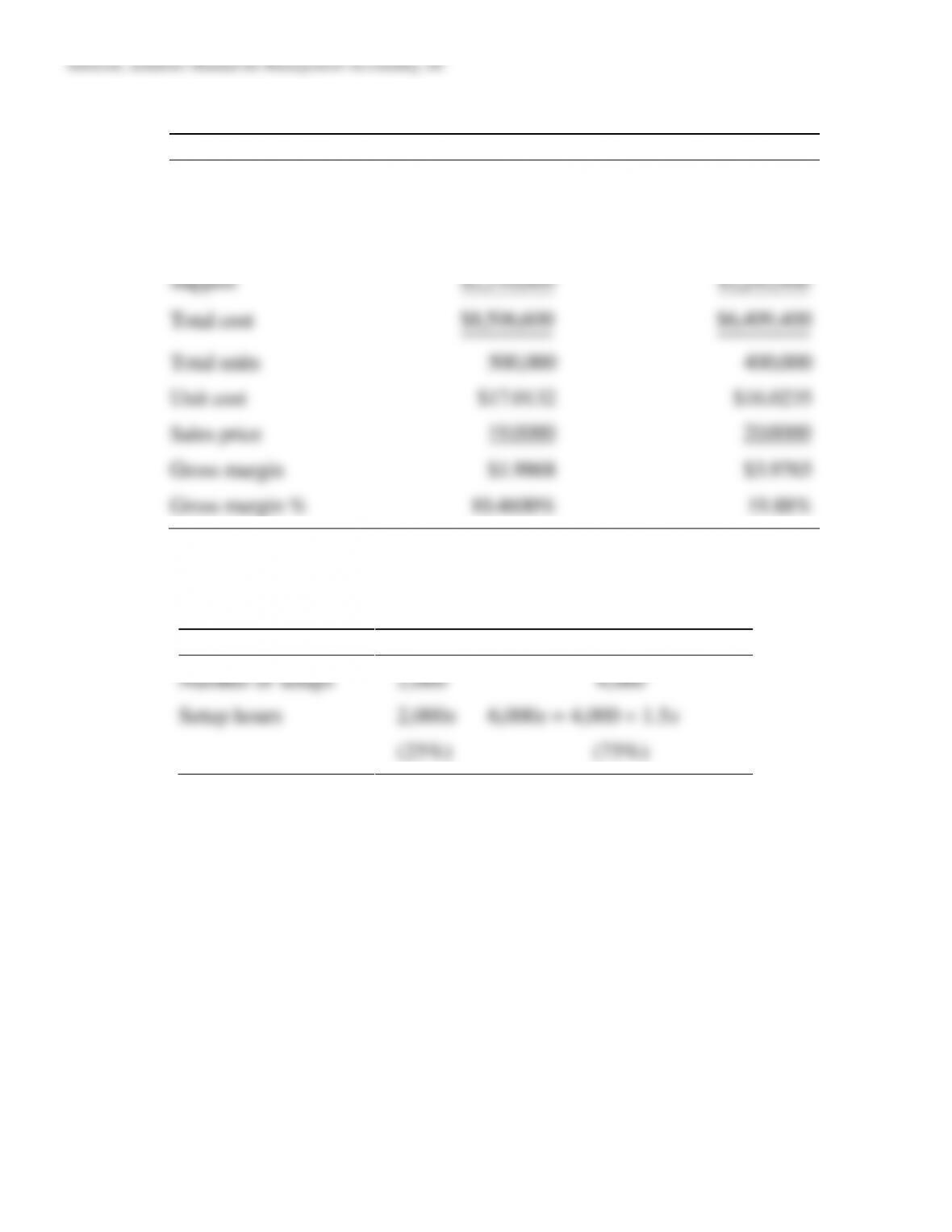
Product costing
Product R361
Product R572
Direct materials
$8 ,$4, , 500 000 000 000
$10 , , 400 000 4,000 000
Direct labor: P1
$15 , , 60 000 900 000
$15 , , 20 000 300 000
Direct labor: P2
$18 , , 72,000 1296 000
$18 , 48 000 864,000
Support
$2, ,310 600
$1, ,245 400
Total cost
$8, ,506 600
$6,409,400
Total units
500,000
400,000
Unit cost
$17.0132
$16.0235
Sales price
19 0000.
20 0000.
Gross margin
$1.9868
$3.9765
Gross margin %
10.4600%
19.88%
(b) Let x denote the number of hours required for each R361 setup. Then
the number of hours required for each R572 setup = 1.5x.
R361
R572
Number of setups
2,000
4,000
Setup hours
2,000x
6,000x = 4,000 1.5x
(25%)
(75%)
Chapter 5: Activity-Based Cost Systems
–131–
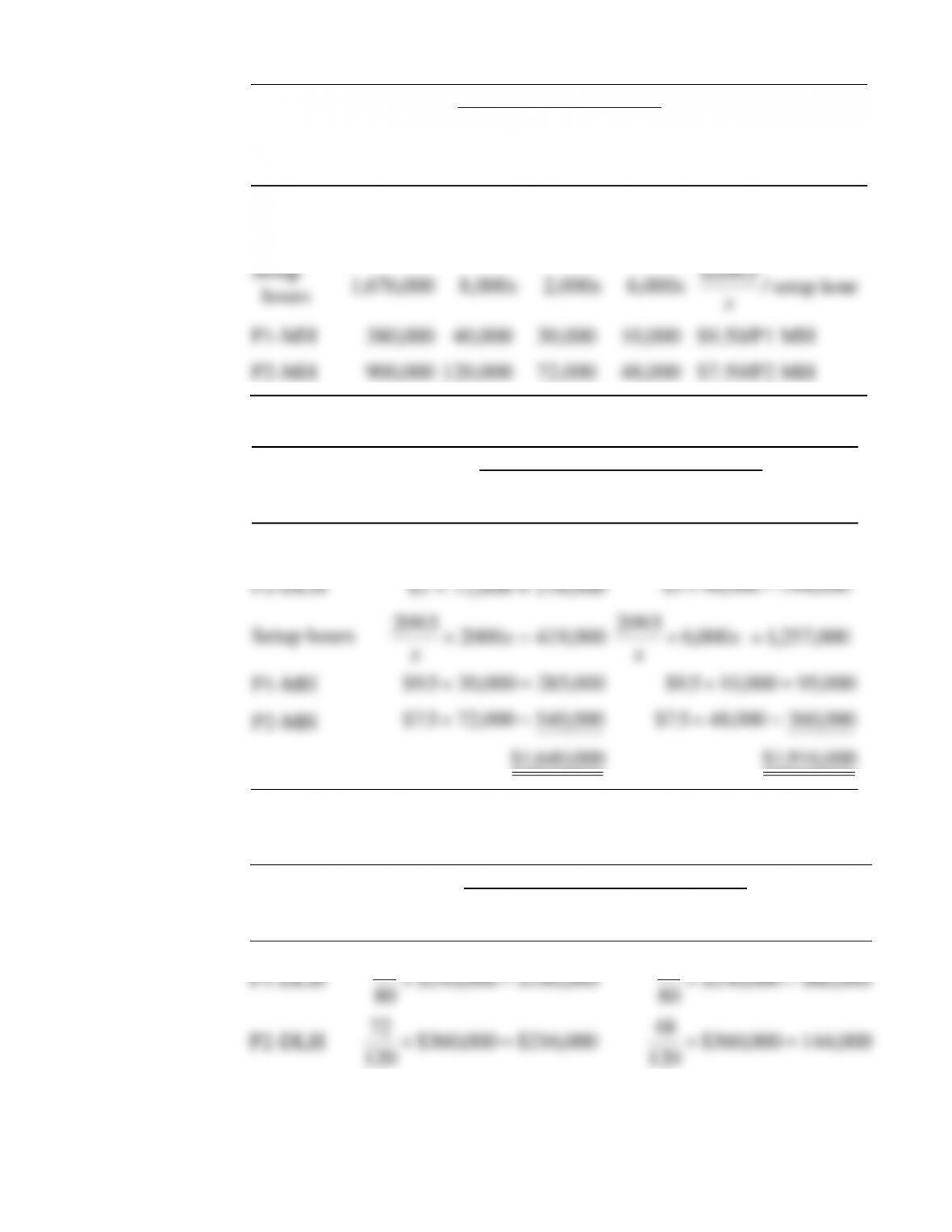
Number of transactions
Activity
Cost
Drivers
Traceable
Costs
Total
R361
R572
Capacity
Cost Driver Rate
P1-DLH
$240,000
80,000
60,000
20,000
$3/P1 DLH
P2–DLH
360,000
120,000
72,000
48,000
$3/P2 DLH
Setup
hours
1,676,000
8,000x
2,000x
6,000x
$209.5
x/setup hour
P1–MH
380,000
40,000
30,000
10,000
$9.50/P1 MH
P2–MH
900,000
120,000
72,000
48,000
$7.50/P2 MH
Total Support Costs
Capacity Cost
Drivers
Product R361
Product R572
P1–DLH
$3 60,000 = $180,000
$3 ,$60, 20 000 000
P2–DLH
$3 72,000 = 216,000
$3 , , 48 000 144 000
Setup hours
209 52000 419,000
.
xx
209 56000 1257,000
., ,
xx =
P1–MH
$9. , ,5 30 000 285 000
$9. , ,5 10 000 95 000
P2–MH
$7. ,5 72,000 540 000
$7. , ,5 48 000 360 000
$1, ,640 000
$1, ,916 000
Alternatively,
Capacity
Cost
Total Support Costs
Drivers
Product R361
Product R572
P1–DLH
60
80 000 000 $240,$180,
20
80 000 000 $240,$60,
P2–DLH
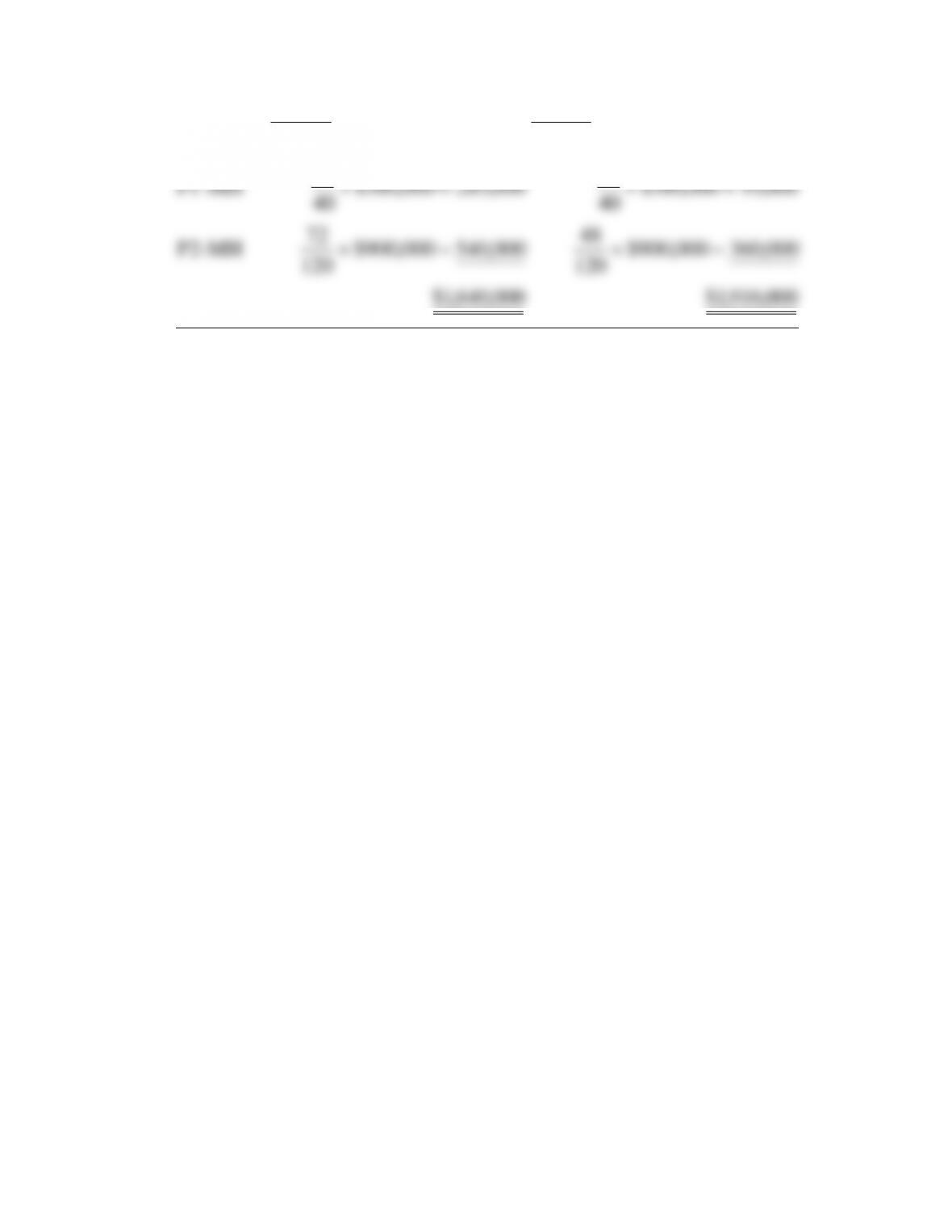
72
120 000 000 $360,$216,
48
120 000 144,000 $360,
Atkinson, Solutions Manual t/a Management Accounting, 6E
–132–
Setup
hours
2,000
8000 1676 000 419,000
x
x,, ,
6000
8000 1676 000 1257,000
,
,, , ,
x
x
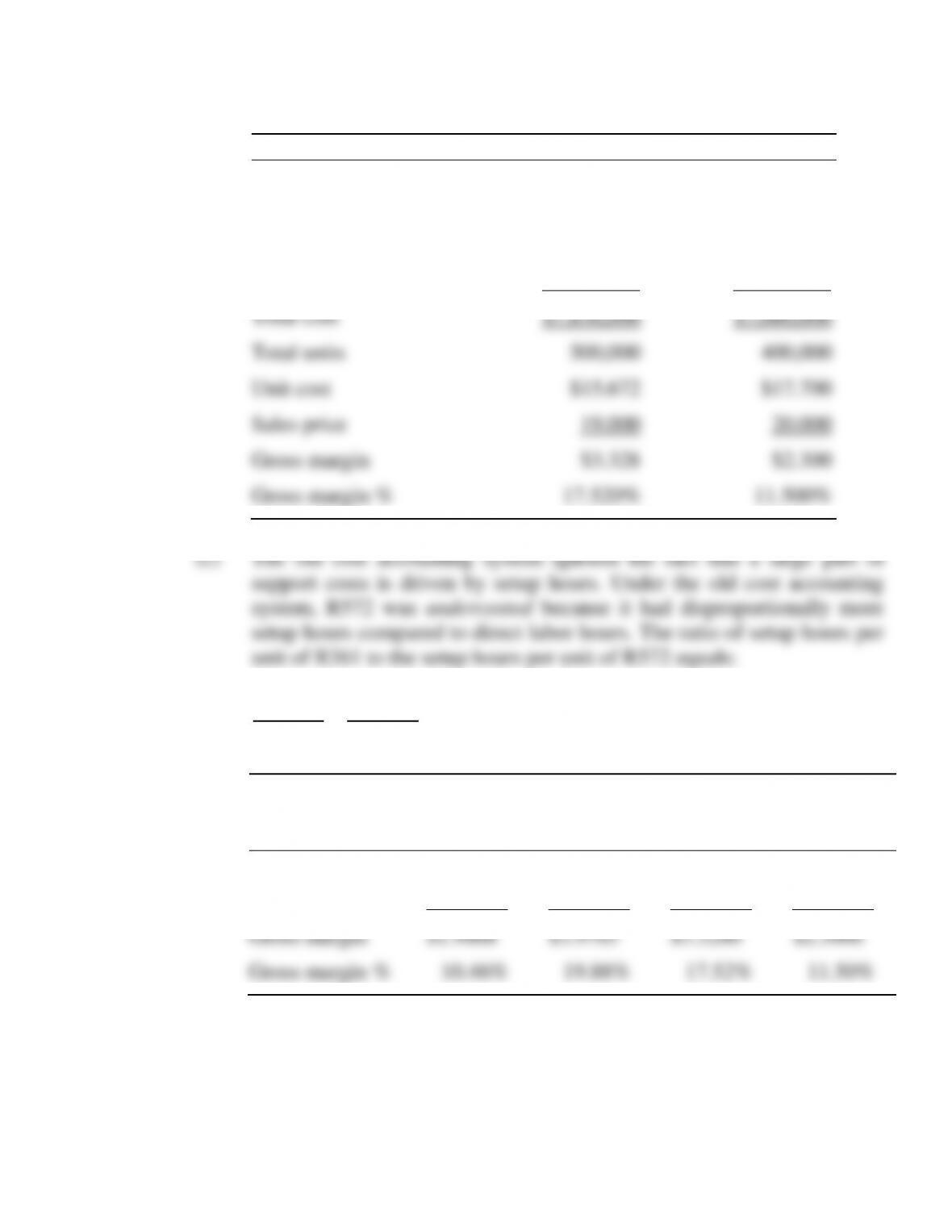
P1–MH
30
40 000 285 000 $380, ,
10
40 000 95 000 $380, ,
P2–MH
72
120 000 540 000 $900, ,
48
120 000 360 000 $900, ,
$1, ,640 000
$1, ,916 000
Chapter 5: Activity-Based Cost Systems
–133–
Product costing
Product R361
Product R572
Direct materials
$4,000,000
$4,000,000
Direct labor: P1
900,000
300,000
Direct labor: P2
1,296,000
864,000
Support costs
$1,640,000
$1,916,000
Total cost
$7,836,000
$7,080,000
Total units
500,000
400,000
Unit cost
$15.672
$17.700
Sales price
19.000
20.000
Gross margin
$3.328
$2.300
Gross margin %
17.520%
11.500%
2000
500 000
6000
400 000 415
,
,
,
,.
x x
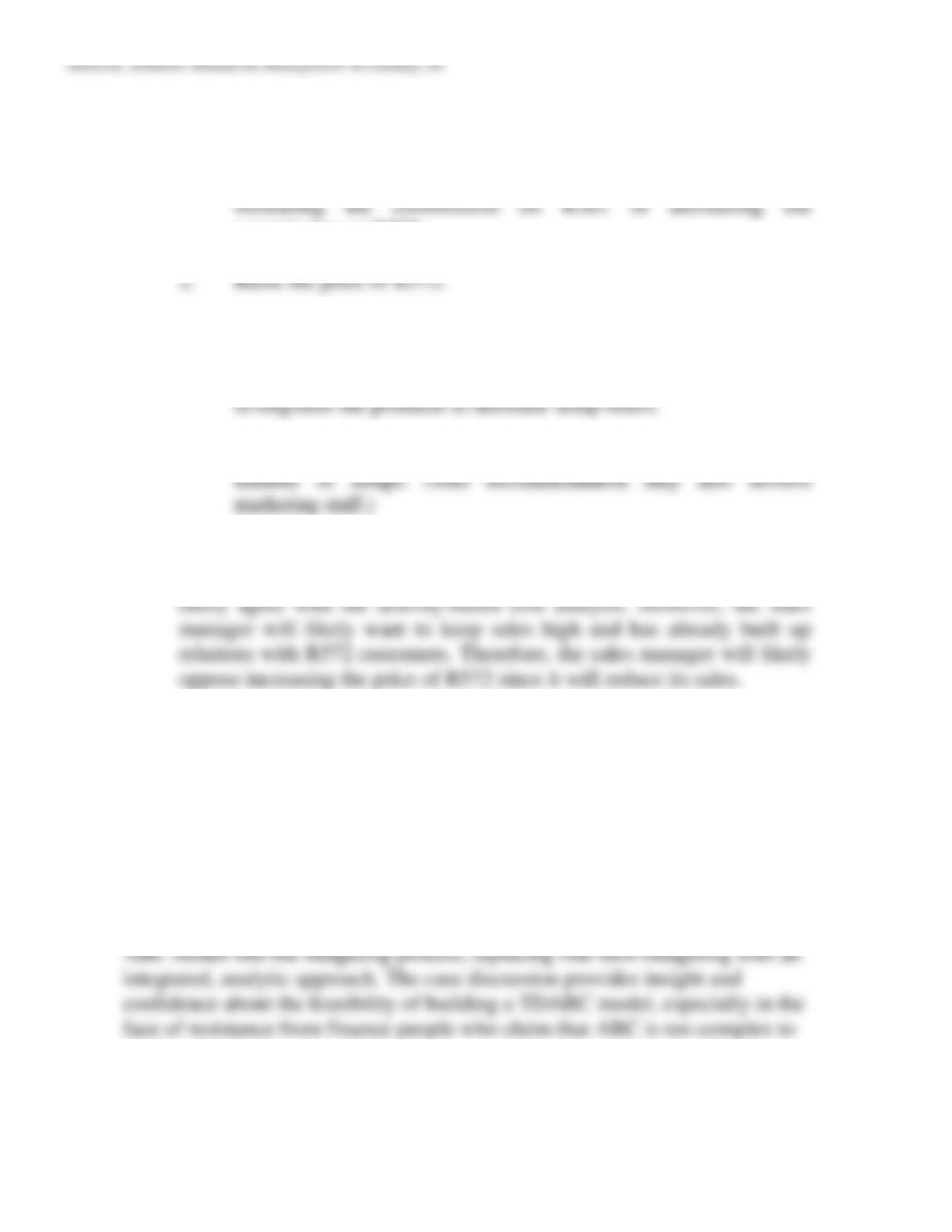
Old Cost Accounting
System
ABC
System
R361
R572
R361
R572
Sales price
$19.0000
$20.0000
$19.0000
$20.0000
Unit cost
17.0132
16.0235
15.6720
17.7000
Gross margin
$1.9868
$3.9765
$3.3280
$2.3000
Gross margin %
10.46%
19.88%
17.52%
11.50%
–134–
(d) Recommendations for marketing:
1. R361 is more profitable than R572. Therefore, push R361 by
commission on R572.
Recommendations for production:
1. A large part of support costs is driven by setup hours. Therefore,
2. Offer discounts to customers for larger batch sizes to reduce the
(e) The experienced production manager is likely to have an intuitive
understanding of the higher production complexity for R572 and will
5-36 Sippican Corporation (A) (HBS Case 9-106-058)
Teaching Plan
This is an introductory case, and yet it introduces a powerful new approach for
building an ABC model. Considerable theory is illustrated in how we build the
Sippican time-driven ABC (TDABC) model. Also, the (B) case introduces an
important link, previously recognized but not exploited, in how to embed an
implement.
Chapter 5: Activity-Based Cost Systems
–135–
Mature products
Declining profits
The following two characteristics serve as indicators that a traditional costing
approach to overhead costs is likely providing inaccurate costs:
1. The Willie Sutton rule:1 Look for areas with large expenses in
indirect and support resources, especially where such expenses
systems and traditional cost systems will likely give very
similar economic signals.
2. High Diversity rule: Look for a situation in which large variety
exists in products, customers, or processes. For example,
require large quantities of pre-sales and post-sales technical
support.
1 Willie Sutton was a successful bank robber in the United States during the 1950s. Willie, who
spending will not lead to high payoffs to the organization.
Atkinson, Solutions Manual t/a Management Accounting, 6E
–136–
∆ Revenues (from higher prices, higher sales volumes) > ∆ Costs
Q: Should Sippican abandon its overhead cost allocation system and make
managerial decision based on contribution margin; in effect use marginal costs
rather than average costs?
recurring sales.
Overhead cost is sizable ($654,600, which exceeds either direct labor or
direct material costs)
Management will benefit by understanding the impact of
variety in the use of overhead resources by individual
products.
setups, receiving, shipping, etc.).
Companies that cut prices based on contribution margin to get new
business should be cautious about (i) competitive reactions, (ii) having
to lower prices to existing customers, and (iii) filling up capacity with
business that does not pay for capacity costs.
Using TDABC, only two parameters are needed for each department or process:
1. Calculate capacity cost rates for each department or process