Chapter 5: Activity-Based Cost Systems
–117–
(d)
Cost-based Prices
Product X21
Product Y37
Traditional costing
1.25 × unit costs in part (a)
$246.88
$339.06
Activity-based costing
1.25 × unit costs in part (b)
$356.00
$284.50
If Endo plans to continue to use cost-based pricing, it should use
activity-based costs as the basis for its markups. Note X21’s current
price is not even covering its manufacturing costs as determined using
(e) The company sells half as many X21’s as Y37’s, but X21 has twice as
many design changes and 50% more parts. These facts suggest that the
company can explore ways to reduce the number of design changes and
the number of parts. Management accountants would be involved in
5-30 (a) Total manufacturing support costs = $1,000,000
(b)
Deluxe
Regular
Direct material
$45
$30
Direct labor
$20
$10
Manufacturing support
$40
$20
Unit cost
$105
$60
Atkinson, Solutions Manual t/a Management Accounting, 6E
–118–
(c)
Activity
Rate Per Unit of Cost Driver
Purchase orders
$180,$300
000
600
Quality control
$250,$125
000
2,000
Production setups
$220,$1,
000
200 100
Machine maintenance
$350,
,$10
000
35 000
Capacity costs Assigned to Products
Activity
Deluxe
Regular
Purchase orders
200 $300 =
$60,000
400 $300 =
$120,000
Quality control
1,000 $125 =
125,000
1,000 $125 =
125,000
Production
setups
100 $1,100 =
110,000
100 $1,100 =
110,000
Machine
maintenance
20,000 $10 =
200,000
15,000 $10 =
150,000
Total manufacturing support costs
$495,000
$505,000
Number of units
5,000
40,000
Unit manufacturing support costs
$99
$12.625
Deluxe
Regular
Direct material
$45.000
$30.000
Direct labor
$20.000
$10.000
Manufacturing support
$99.000
$12.625
Unit cost
$164.000
$52.625
Chapter 5: Activity-Based Cost Systems
–119–
(d)
Activity
Deluxe
Regular
Ratio of
Deluxe:Regular
Purchase orders
200
5000 004
,.
400
40 000 001
,.
4:1
Quality control
1000
5000 02
,
,.
1000
40 000 0025
,
,.
8:1
Production setups
100
5000 002
,.
100
40 000 00025
,.
8:1
Machine maintenance
20 000
5000 4
,
,
15 000
40 000 0375
,
,.
10.67:1
the deluxe model requires 4 times as many purchase orders as the
regular model, (ii) the deluxe model requires 8 times as many
prepared:
Deluxe
Regular
Selling price per unit
$140.000
$80.000
Unit cost
$164.000
$52.625
Gross margin per unit
($24.000)
$27.375
Atkinson, Solutions Manual t/a Management Accounting, 6E
Design engineers can try to re-engineer the deluxe product to decrease
its high demand for activity resources.
5-31 (Unofficial CMA Answer, adapted)
include the following:
• Provides management with a thorough understanding of complex
• Provides estimates of unused capacity costs.
process.
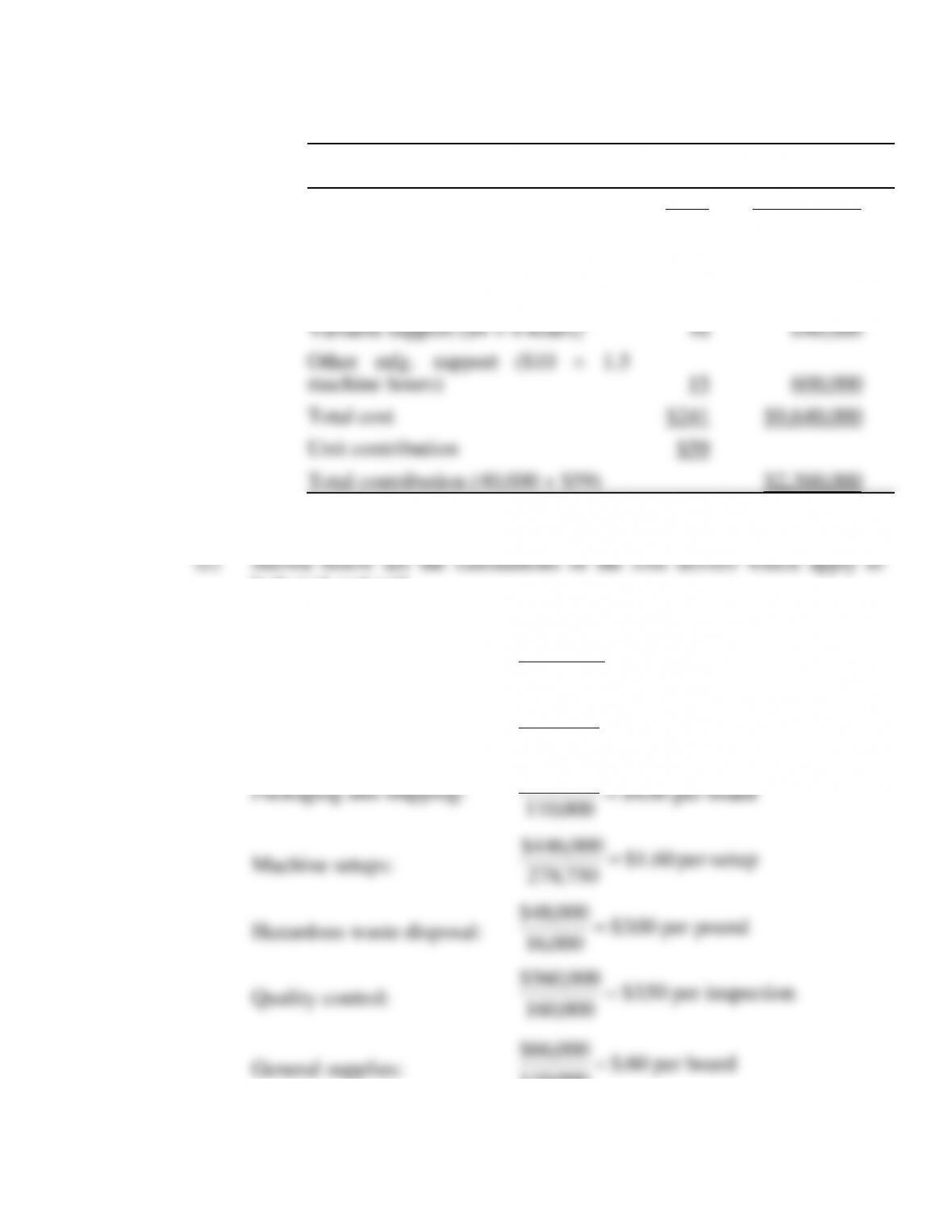
(b) 1. Using standard costs, the total contribution expected this year
Chapter 5: Activity-Based Cost Systems
–121–
2. Using standard costs, the total contribution expected this year
from the PC Board is $2,360,000, calculated as follows:
Per
Unit
Totals for 40,000
Units
Revenue
$300
$12,000,000
Direct material
140
5,600,000
Material support (10% of material)
14
560,000
Direct labor ($14 4 hours)
56
2,240,000
Variable support ($4 4 hours)*
16
640,000
Other mfg. support ($10 1.5
machine hours)
15
600,000
Total cost
$241
$9,640,000
Unit contribution
$59
Total contribution (40,000 $59)
$2,360,000
* Variable support rate: $1,120,000 280,000 hours = $4 per hour.
both (c)1 and (c)2.
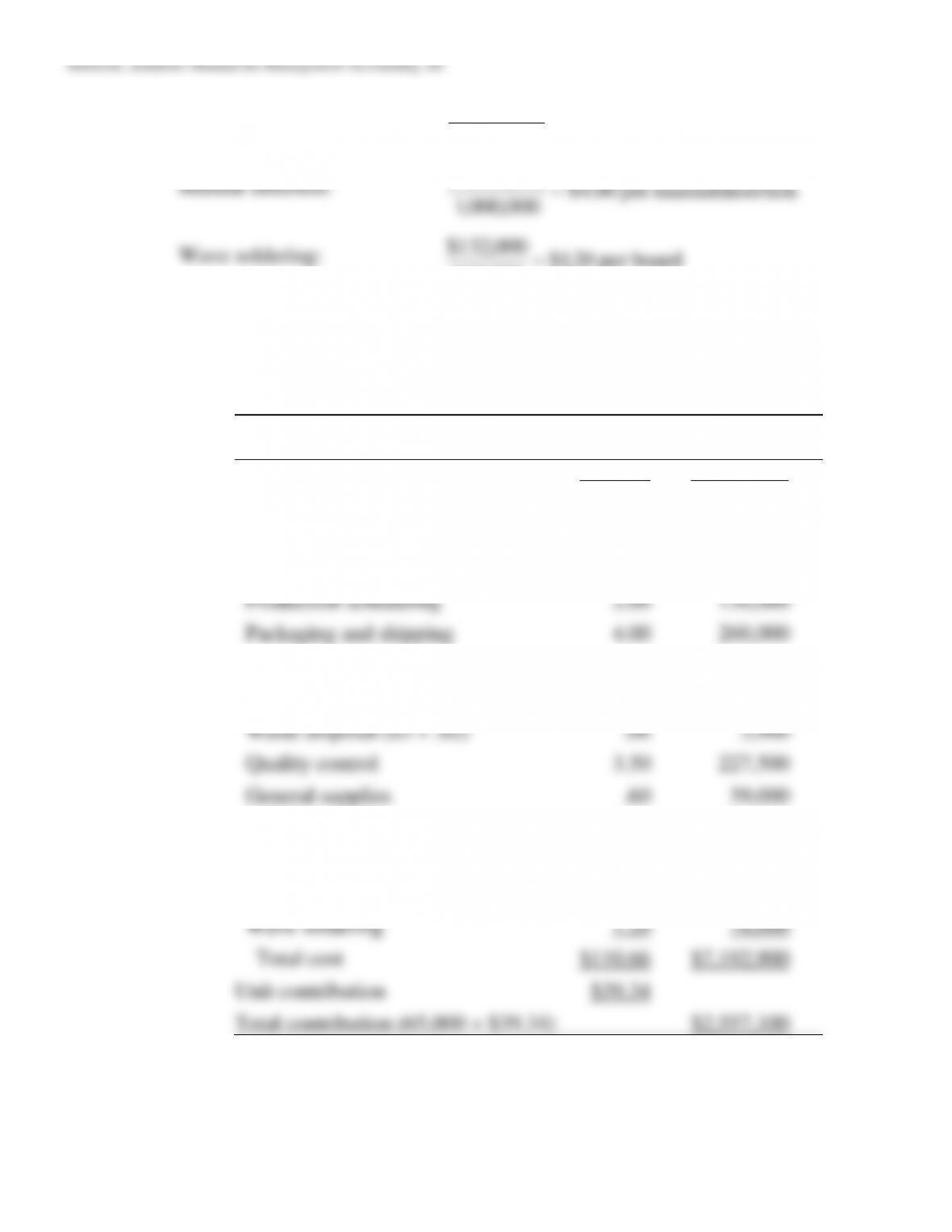
Procurement:
$400,
,$.
000
4,000 000 10 per part
Production scheduling:
$220,
,$2.
000
110 000 00 per board
Packaging and shipping:
$440,
,$4.
000
110 000 00 per board
Machine setups:
setupper 60.1$
750,278
000,446$
Hazardous waste disposal:
$48,
,$3.
000
16 000 00 per pound
Quality control:
$560,
,$3.
000
160 000 50 per inspection
General supplies:
$66,
,$.
000
110 000 60 per board
–122–
Machine insertion:
insertion machineper 40$.
000,000,3
000,200,1$
Manual insertion:
insertion manualper 00.4$
000,000,1
000,000,4$
Wave soldering:
$132,
,$1.
000
110 000 20 per board
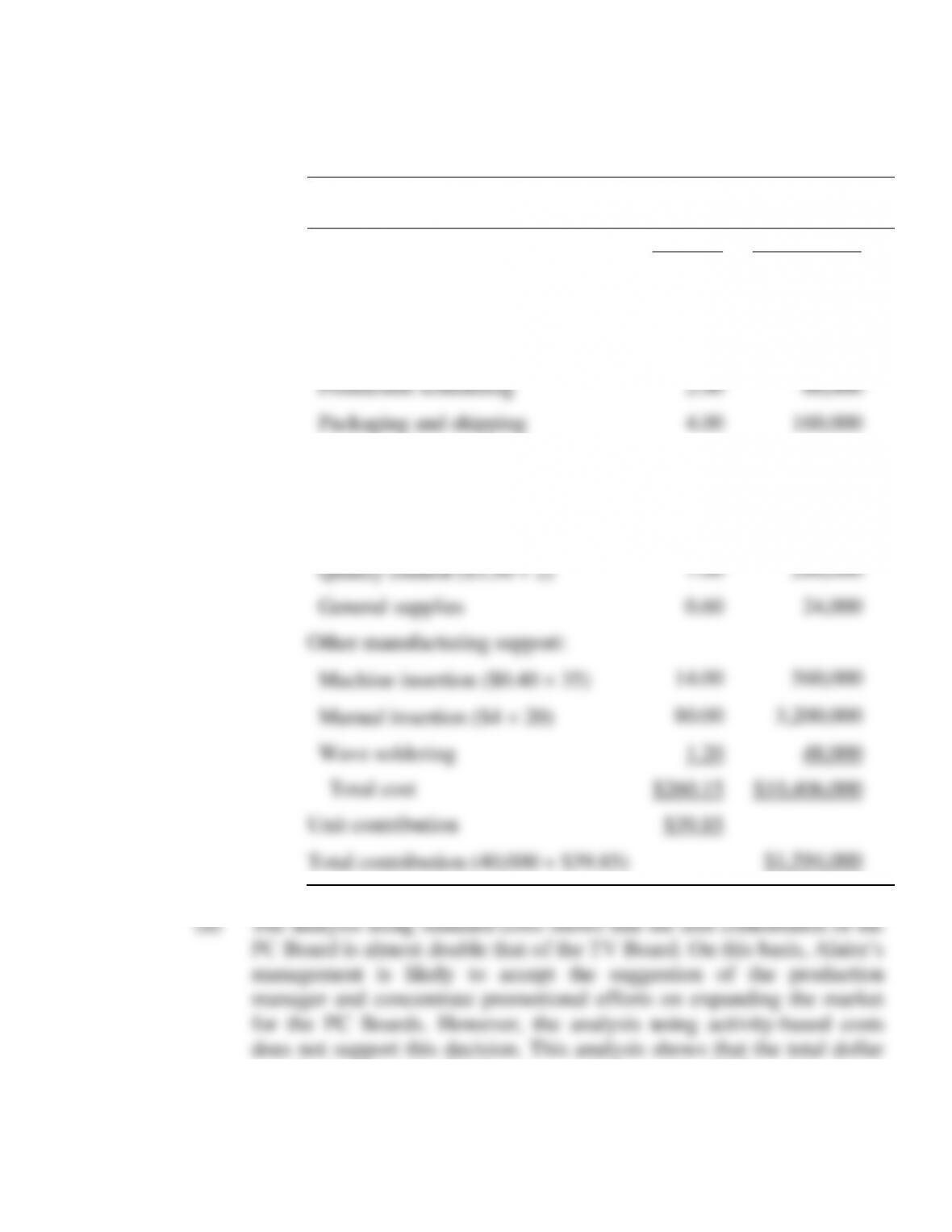
1. Using activity-based costing, the total contribution expected this
year from the TV Board is $2,557,100 calculated as follows:
Per
Unit
Totals for
65,000 Units
Revenue
$150.00
$9,750,000
Direct material
80.00
5,200,000
Material support:
Procurement ($.10 25)
2.50
162,500
Production scheduling
2.00
130,000
Packaging and shipping
4.00
260,000
Variable support:
Machine setups ($1.60 2)
3.20
208,000
Waste disposal ($3 .02)
.06
3,900
Quality control
3.50
227,500
General supplies
.60
39,000
Other manufacturing support:
Machine insertion ($0.40 24)
9.60
624,000
Manual insertion
4.00
260,000
Wave soldering
1.20
78,000
Total cost
$110.66
$7,192,900
Unit contribution
$39.34
Total contribution (65,000 $39.34)
$2,557,100
Chapter 5: Activity-Based Cost Systems
–123–
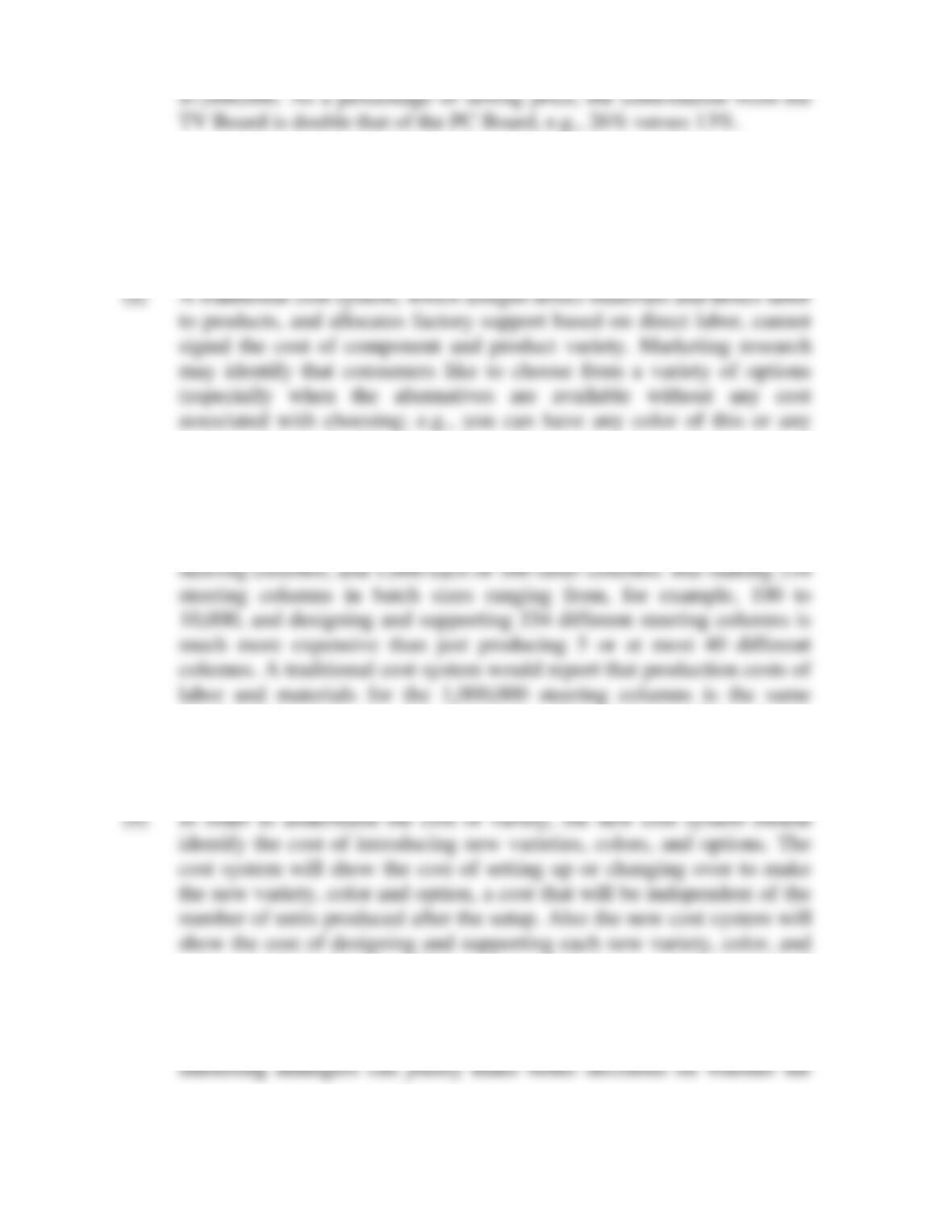
2. Using activity-based costing, the total contribution expected this
year from the PC Board is $1,594,000 calculated as follows:
Per
Unit
Totals for 40,000
Units
Revenue
$300.00
$12,000,000
Direct material
140.00
5,600,000
Material support:
Procurement ($.10 55)
5.50
220,000
Production scheduling
2.00
80,000
Packaging and shipping
4.00
160,000
Variable support:
Machine setups ($1.60 3)
4.80
192,000
Waste disposal ($3 .35)
1.05
42,000
Quality control ($3.50 2)
7.00
280,000
General supplies
0.60
24,000
Other manufacturing support:
Machine insertion ($0.40 35)
14.00
560,000
Manual insertion ($4 20)
80.00
3,200,000
Wave soldering
1.20
48,000
Total cost
$260.15
$10,406,000
Unit contribution
$39.85
Total contribution (40,000 $39.85)
$1,594,000
contribution from the TV Board exceeds that of the PC Board by almost
Atkinson, Solutions Manual t/a Management Accounting, 6E
–124–
CASES
5-32 This question is designed to get students to think about the factors creating the
demand for activity-based cost systems.
variety of that). In this situation, product engineers can design lots of
varieties and options. The cost system assigns cost only on the direct
labor and materials content of these options. Thus making one million
units of one steering column appears to cost the same as making
100,000 of 4 different steering columns, 10,000 each of 30 other
whether they are produced in 5 varieties, 40 varieties, or 334 varieties.
Thus model and component proliferation is virtually impossible to stop
when companies cost products using traditional cost systems.
option (technically, in ABC terms, called the “product–sustaining”
costs) that will be independent of the number of units produced. With
the more accurate understanding of the costs of resources that perform
batch and product-sustaining activities, the product engineers and
Chapter 5: Activity-Based Cost Systems
–125–
higher cost of introducing another customized option will be
compensated with higher sales volumes and/or higher margins.
was 5 or 6. And when the cost of stocking and servicing all the
dealerships was incorporated into the analysis, the optimal number
dropped to 2. In effect, the apparent savings in direct materials and labor
from having customized wire harnesses for individual combinations of
harnesses for a single car model.
5-33 This situation is drawn from “Cott Corporation: Private Label in the 1990s.”
Harvard Business School Case #9-594-031.
Hewlett Packard, or John Deere. This discussion shows how even small,
their only private label beverage provider, they will ask Cott to provide a fuller
line of beverages, say caffeine-free and diet-caffeine free. Also, they may want
a variety of packaging: 12 oz cans, and 1 and 2 liter plastic bottles. And they
may start to request beverages beyond the cola category, such as sparkling
–126–
water, mineral water, new-age beverages, ginger ale, flavored soft drinks, etc.
Each new retailer that Cott signs up as a customer may also want its own
slight variation in beverage formulation (ingredients) and labeling. As Cott
Cott will need an ABC system to understand the cost of these activities that
are driven by increased variety and be sure that these costs are covered by the
volume of business and prices received from retailers. Otherwise, its cost
structure will increase and it will either lose money on the incremental orders
Second, Cott is customizing its product and service offering to individual
retailers. For each retailer, Cott can offer unique product formulations,
customized to the retailer’s specifications, design of a retailer-specific label for
the beverages, and marketing, promotional, and consulting assistance to help
advance the volume and mix of business required to payback heavy front-end
investments in product design, package design, and consulting assistance. Ex
post, Cott will use the ABC customer profitability model to assess whether the
actual volume and mix of business, at actual prices and ABC-calculated
Third, one of Cott’s principal marketing devices with a retailer is to convince
the retailer’s executives, (1) that Cott beverages are profitable for the retailer