–97–
Chapter 5
Activity-Based Cost
Systems
QUESTIONS
5-1 Traditional volume-based cost allocation systems that use only drivers that
vary directly with the volume of products produced—such as direct labor
dollars, direct labor hours, or machine hours—are likely to systematically
distort product costs because they break the link between the cause for the
costs and the basis for assignment of the costs to the individual products. Costs
5-2 Volume-based traditional product costing systems that use only drivers that
vary directly with the volume of products produced—such as direct labor
dollars, direct labor hours, or machine hours—are most likely to distort
product costs under the following two conditions: (1) Indirect and support
Activity-based costing systems provide more accurate costs when these two
conditions hold by creating more accurate links between the causes of indirect
Atkinson, Solutions Manual t/a Management Accounting, 6E
–98–
also activities such as changeovers, setups, and inspection of the first item of
production run, which are not done in proportion to the number of units
5-3 Yes, traditional costing systems are more likely to overcost high-volume
products because all indirect and support costs are assigned to products in
proportion to the number of production units (through volume-based cost
5-4 Companies producing a varied and complex mix of products require many
more resources to support their highly varied mix, and therefore have higher
costs. Examples of the greater resources required include a much larger
production support staff to schedule machine and production runs; perform
5-5 A significant change in resource costs triggers an update of the capacity cost
rates. A significant and permanent change in operations, such as the efficiency
with which an activity is performed, triggers an update of the unit time
estimate. If new activities become part of operations, the time to perform the
estimate of how much of a resource’s capacity (such as time or space) is used
by the activities performed to produce the various products, services, or
customers.
Chapter 5: Activity-Based Cost Systems
–99–
by the machine or production employee, or the space provided by the
warehouse or truck. For most resources (people, equipment, and machines),
5-7 Managers use the information on activity costs to identify opportunities for
operational improvements and reductions in operations costs, decisions about
product mix and pricing, and targeted customer segments. An example of an
operational change is requiring minimum order sizes to eliminate short,
pallet shipments. Of course, customers who insist on very small order sizes or
partial-pallet shipments can be charged a price high enough to cover the extra
costs associated with such activities.
denominator should match the numerator by representing the quantity of work
the resources can perform. Unassigned costs represent the cost of unused
capacity and should be used as feedback to managers on their supply and
demand decisions.
the supply of unused resources.
Atkinson, Solutions Manual t/a Management Accounting, 6E
–100–
in advance to provide the capacity to perform work for customers during each
period. Fluctuations during the period of demand by individual products and
Unlike physical products, services cannot be inventoried for future sales.
Service companies must supply virtually all their resources in advance to
provide the capacity to perform work for customers during each period, and
demand often fluctuates. For some service industries, the increase in spending
customers.
It can be difficult to identify and measure the outputs for a service
organization. The variation in demand for organizational resources is much
more customer-driven in service organizations than in manufacturing
companies with far more relevant and useful information than at the product
level. Finally, a customer may have multiple relationships with a service
Chapter 5: Activity-Based Cost Systems
–101–
Chapter 6.
5-12 Individuals may feel vulnerable facing uncertainty about what the activity-
based cost analysis may show, or they may feel threatened by the suggestion
that their work could be improved. For example, the analysis might reveal that
system in place.
5-13 Time-driven activity-based costing has a number of advantages over
traditional activity-based costing. The advantages include (1) It is easy and
fast to build an accurate model even for large enterprises; (2) It exploits the
complexity; and (6) It is easy to update the model as resource costs and
process efficiencies change.
EXERCISES
5-15 (a) The time-driven ABC model will now incorporate a capacity cost rate for
computer resources, computed as $18,000 divided by the practical capacity
(b) Before the machinery energy costs were discovered, the machinery rate
was computed as $15,400 divided by 308 practical capacity hours, which
Atkinson, Solutions Manual t/a Management Accounting, 6E
–102–
(c) If the company introduces a new flavor, the new flavor’s consumption of
direct and indirect resources will need to be estimated and then multiplied
by the appropriate cost or cost rate. For example, start with the quantity of
5-16 (a) A 10% increase in indirect labor costs will increase the indirect labor
calculations are performed in a spreadsheet package.)
Vanilla
Chocolate
Strawberry
Mocha-
Almond
Total
Sales
$30,000
$ 24,000
$3,960
$2,800
$60,760
Direct materials
$6,000
$4,800
$720
$520
$12,040
Direct labor
(including fringes)
$8,750
$7,000
$1,050
$700
$17,500
Indirect labor usage
$4,967
$3,581
$3,889
$4,043
$16,480
Machine usage
$6,700
$5,000
$1,660
$1,640
$15,000
Gross profit (loss)
$3,583
$3,619
$(3,359)
$(4,103)
$(260)
Gross profit (loss)
as percent of sales
11.94%
15.08%
–84.82%
–146.54%
–0.43%
(b) With the reduction in unit time for scheduling a production from four
hours per run to three hours per run, we first compute the revised indirect
Chapter 5: Activity-Based Cost Systems
–103–
The revised indirect labor hours per month are calculated as follows:
Vanilla
Chocolate
Strawberry
Mocha-
Almond
Schedule production
runs, purchasing, etc.
(hours per run)
3
3
3
3
Changeovers (hours per
batch)
2.0
1.0
2.5
4.0
Number of employees
per changeover
3
3
3
3
Indirect labor hours per
changeover
6
3
7.5
12
Indirect labor time per
run (batch)
9
6
10.5
15
Number of production
runs
× 12
× 12
× 8
× 6
Indirect labor per run
108
72
84
90
Product-sustaining (hrs
per month)
9
9
9
9
Indirect labor hours per
month
117
81
93
99
Indirect rate per hour
× $38.50
× $38.50
× $38.50
× $38.50
Indirect labor cost
$4,504.50
$3,118.50
$3,580.50
$3,811.50
–104–
Vanilla
Chocolate
Strawberry
Mocha-
Almond
Total
Sales
$30,000
$ 24,000
$3,960
$2,800
$60,760
Direct materials
$6,000
$4,800
$720
$520
$12,040
Direct labor
(including fringes)
$8,750
$7,000
$1,050
$700
$17,500
Indirect labor usage
$4,505
$3,119
$3,581
$3,812
$15,017
Machine usage
$6,700
$5,000
$1,660
$1,640
$15,000
Gross profit (loss)
$4,045
$4,081
$(3,051)
$(3,872)
$1,203
Gross profit (loss)
as percent of sales
13.48%
17.00%
–77.05%
–138.29%
1.98%
Combining direct labor and indirect labor costs, the summary income
statement showing unused capacity costs is as follows:
Totals with
Assigned
Costs
Unused
Capacity
Costs
Totals
with
Capacity
Costs
Sales
$60,760
$60,760
Direct materials
$12,040
$12,040
Direct labor and indirect labora
$32,517
$68
$32,585
Machine usage
$15,000
400
$15,400
Gross profit (loss)
$1,203
$(468)
$735
Gross profit (loss) as percent of
sales
1.98%
1.21%
a Labor capacity cost = $4,655 × 7 employees = $32,585. Employees perform
direct labor and indirect labor tasks.
5-17 (a)
Hours:
Hours:
Cost:
Cost:
Pumps
Valves
Rate
Pumps
Valves
1,500
1,800
$20
$ 30,000
$ 36,000
5,000
6,000
$30
$150,000
$180,000
200
400
$80
$ 16,000
$ 32,000
$196,000
$248,000
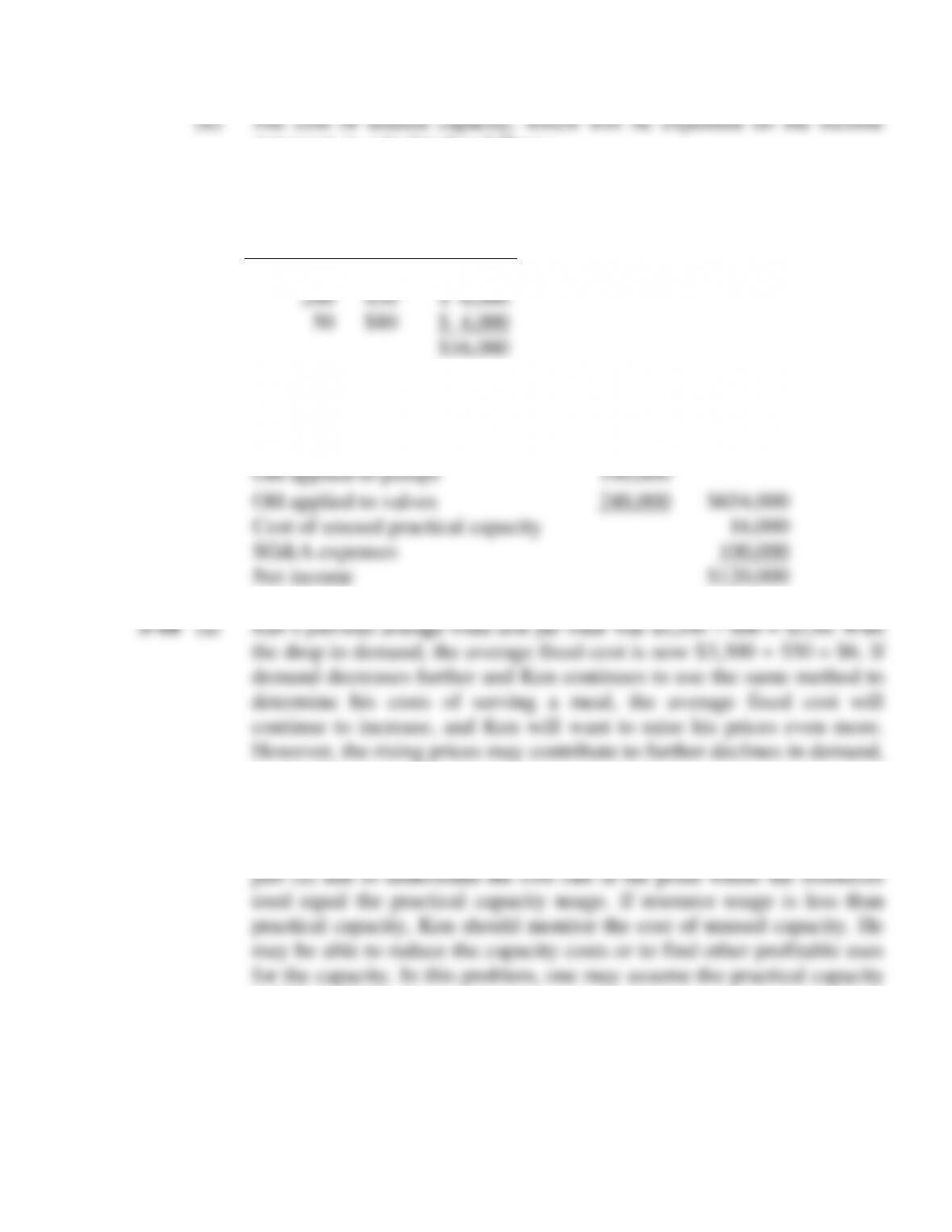
Chapter 5: Activity-Based Cost Systems
–105–
statement, is calculated as follows:
Hours:
Cost:
Unused
Capacity
Rate
Unused
Capacity
300
$20
$ 6,000
200
$30
$ 6,000
50
$80
$ 4,000
$16,000
Total revenues
$890,000
Total direct labor cost
$120,000
Total direct materials cost
90,000
OH applied to pumps
196,000
OH applied to valves
248,000
$654,000
Cost of unused practical capacity
16,000
SG&A expenses
100,000
Net income
$120,000
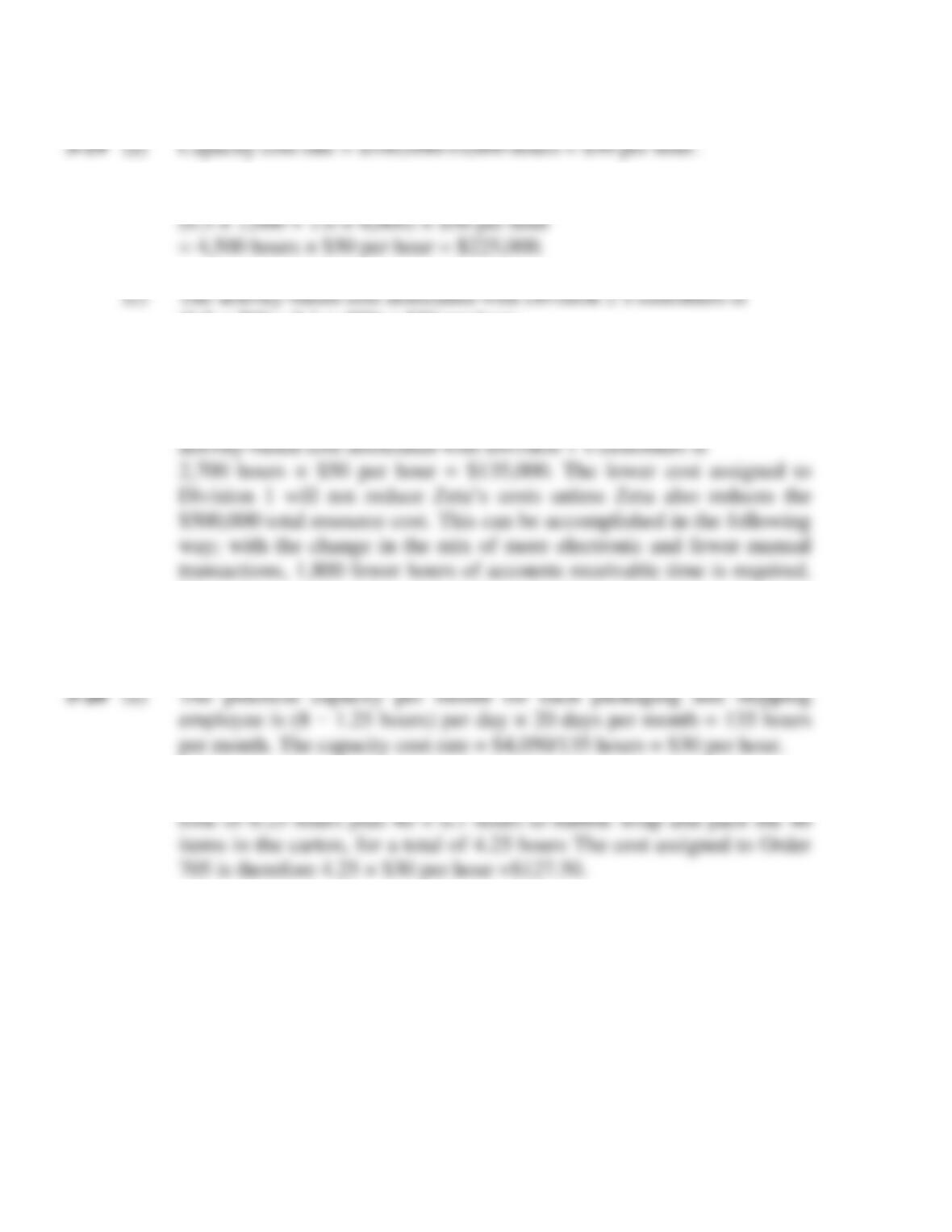
leading Ken into a downward (or death) spiral.
(b) Ken should use the practical capacity quantity of meals per day to
determine cost per meal in order to avoid the fluctuations described in
is 600 meals per day.
Atkinson, Solutions Manual t/a Management Accounting, 6E
–106–
PROBLEMS
(b) The activity-based cost associated with Division 1’s customers is
(0.5 × 200 + 0.1 × 400) × $50 per hour
= 140 hours × $50 per hour = $7,000.
(d) The change will result in (0.5 × 1,000 + 1.0 × 2,000 + 0.1 × 2,000) =
2,700 hours used, a reduction from the 4,500 hours in part (b). The new
Since the capacity of each employee is about 1,667 hours per year
(10,000 ÷ 6), Zeta can operate with one fewer employee, saving the full
cost of one employee per year.
(b) Order 705, which consists of 40 items, requires packaging preparation