Atkinson, Solutions Manual t/a Management Accounting, 6E
– 102 –
Chapter 4
Accumulating and
Assigning Costs to
Products
QUESTIONS
4-1 The cost of the raw materials entered into production is moved from the raw
materials account to the work–in-process inventory account. The cost of
inventory, and costs are moved from the work–in-process inventory account
to the finished goods inventory account. Finally, when goods are sold their
sold.
4-2 Manufacturing organizations face greater challenges in product costing,
especially the assignment of overhead costs, than retail or service
of the goods purchased is entered into an account that accumulates the cost
of merchandise inventory in the store. Stores incur various overhead costs
cost of purchasing and selling products, or department costs.
Chapter 4: Accumulating and Assigning Costs to Products
– 103 –
4-3 A cost object is anything for which a cost is computed. Examples of cost
4-4 The defining characteristic of a consumable (flexible) resource is that its
cost depends on the amount of resource that is used. Examples of
capacity-related resource is that its cost depends on the amount of resource
capacity that is acquired and not on how much of the capacity is used. As
The cost of a capacity-related resource is often called a fixed cost because
the cost of the resource is independent of how much of the resource is used.
4-5 Direct and indirect costs are specified in relation to distinct cost objects. A
direct cost is a cost that is uniquely and unequivocally attributable to a
supervisors’ salaries) are indirect costs. However, if a department within a
plant is the chosen cost object, then the department manager’s salary is a
4-6 From the time of the Industrial Revolution until the early 20th century,
manufacturing operations were mainly labor paced and direct costs
costing systems to deal adequately with indirect manufacturing costs.
– 104 –
4-7 In the context of computing a predetermined indirect cost rate, a cost driver
is the basis used to allocate indirect costs to production. Once the cost driver
indirect costs in the factory might be labor hours as factory workers use
factory space, utilities, and other overhead resources to make products. In a
4-8 In practice, predetermined indirect cost rates are commonly called
4-9 Costs need to be estimated for individual jobs in order to bid for them and to
resources. Estimated costs are also useful for comparison with actual costs
for management control purposes.
4-10 Indirect cost rates (also called predetermined indirect cost rates,
4-11 Overhead cost for a job is estimated by multiplying the cost driver rate(s) by
4-12 Indirect cost pools collect overhead costs into separate groups, for each of
4-13 Most organizations use multiple indirect cost pools in order to improve
costs for a more detailed cost system, however, must be traded off against
4-14 Determination of cost driver rates based on planned or actual short-term
usage will result in rates that are too high in periods of low demand and that
– 105 –
such a costing system. If management uses cost-plus pricing, a death spiral
can result, as follows. If expected demand goes down, the cost driver rate
4-15 Unlike direct material costs and direct labor costs, overhead costs cannot be
costs are applied to jobs using predetermined rates.
4-16 Yes. A separate cost driver rate should be determined for each cost pool
when multiple cost drivers (where “cost driver” refers to a cause of costs, as
students may note that if the different cost drivers vary together in the same
proportion (for example, if machine hours and direct labors hours are used
4-17 The three options for dealing with the difference between actual and applied
between actual and budgeted indirect costs, and the difference between
budgeted and applied indirect costs.
4-18 Computing the cost driver rate by using the planned level of the cost driver
driver rate will increase, causing the cost-plus price to increase. Increasing
4-19 Estimating practical capacity begins with an estimate of theoretical capacity.
Suppose a machine is nominally available for 100 hours each week. That is,
– 106 –
activities such as maintenance, setup, and repair. In the case of labor hired
for the year, theoretical capacity is 2,080 hours (52 weeks, 40 hours per
labor, detailed records of nonproductive time may provide a more accurate
level of practical capacity.
4-20 Conversion costs are the costs of converting raw materials into finished
overhead costs.
4-21 Continuous processing plants are characterized by the fact that production
flows continuously, semi-continuously, or in large batches from one process
reflect the input materials in each process stage.
steps are:
1. Identify the physical flow of units
2. Compute the equivalent units for materials and conversion costs
4-22 Multistage process costing systems have the same objective as job order
costing systems. Both types of systems assign material, labor, and
multistage process environment, production requirements are homogeneous
across products or jobs, so production occurs continuously, semi–
Chapter 4: Accumulating and Assigning Costs to Products
– 107 –
4-23 Production departments are those directly responsible for transforming raw
materials into finished products or for providing services for customers.
production departments.
EXERCISES
4-24 (a) Famous Flange’s previous cost driver rate was $4,000,000 100,000 = $40 per
machine hour. With the drop in demand, the cost driver rate is now
$4,000,000 80,000 = $50 per machine hour. The company will consequently
prices may contribute to further declines in demand, leading the
company into a downward spiral.
the practical capacity usage provided (the denominator). If resource
usage is less than practical capacity, the company should monitor the
4-25 The practical capacity number of machine hours per month is (6.5 hours per
4-26 The practical capacity number of labor hours per year is (34 hours per
per year) = 97,920.
Atkinson, Solutions Manual t/a Management Accounting, 6E
– 108 –
4-27
(a)
Direct material
Quantity
Price
Amount
Part A327
1,000 units
$60
$60,000
Part B149
1,000 units
120
120,000
Total direct material cost
$180,000
Direct labor
Hours
Rate
Amount
Assembly
6,000
$10
$60,000
Inspection
1,000
12
12,000
Total direct labor cost
7,000
$72,000
Overhead costs
Amount
7,000 Direct labor hours
$5 per hour
$35,000
Total cost
$287,000
Number of units produced
1,000
(b)
Selling price per monitor
$350
Cost per monitor
287
Gross margin per monitor
$ 63
4-28
Direct material
Quantity
Price
Amount
Engine oil
11 ounces
$2
$22
Lubricant
2 ounces
3
6
Total direct material cost
$28
Direct labor
Hours
Rate
Amount
Direct labor
3
$15
$45
Overhead costs
Amount
3 Direct labor hours $10 per hour
$ 30
Total cost
$103
4-29 (a) Cost driver rate:
labor cost
direct labor cost
$5, ,
$2, ,
000 000
500 000 direct
2
Chapter 4: Accumulating and Assigning Costs to Products
– 109 –
(b) Consulting engagement cost:
Labor cost
$25,000
Overhead cost
2 labor cost
50,000
Total cost
$75,000
4-30 (a) Cost driver rate for the machine department:
(b)
Machining
Department
Finishing
Department
Total
Direct materials cost
$8,000
$1,400
$9,400
Direct labor cost
250
800
1,050
Manufacturing overhead
1,250a
640b
1,890
Total costs of Job 101
$9,500
$2,840
$12,340
a $1,250 = $25 × 50
b $640 = 80% of 800
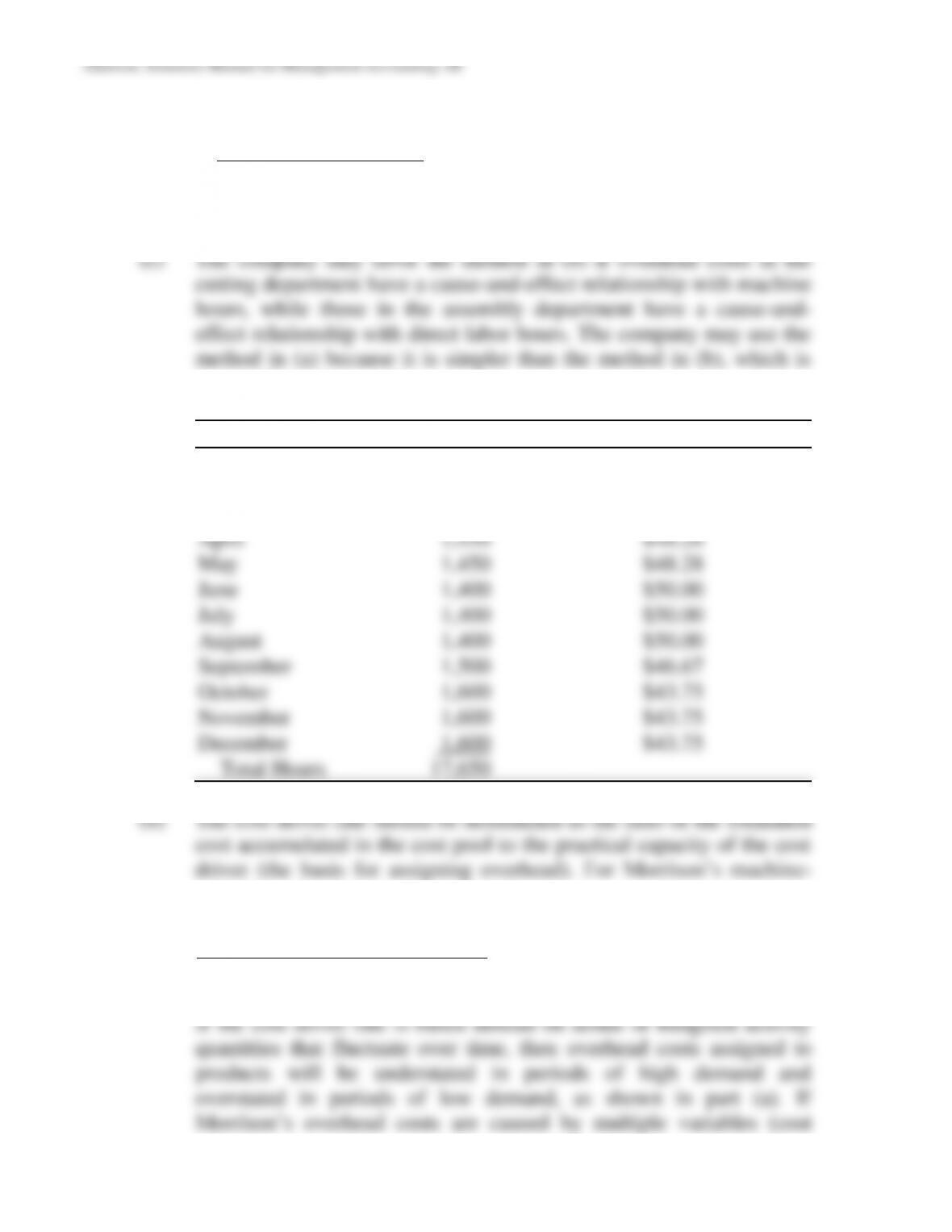
4-31 (a) Plantwide cost driver rate:
$60,000
4,000 direct labor hours
$15 per direct labor hour
(b) Departmental cost driver rates:
Cutting Department:
$25,000
4,000 machine hours
per machine hour$6.25
– 110 –
Assembly Department:
labor hours
$11.67 per direct labor hour
$35,
,
000
3 000 direct
potentially more accurate.
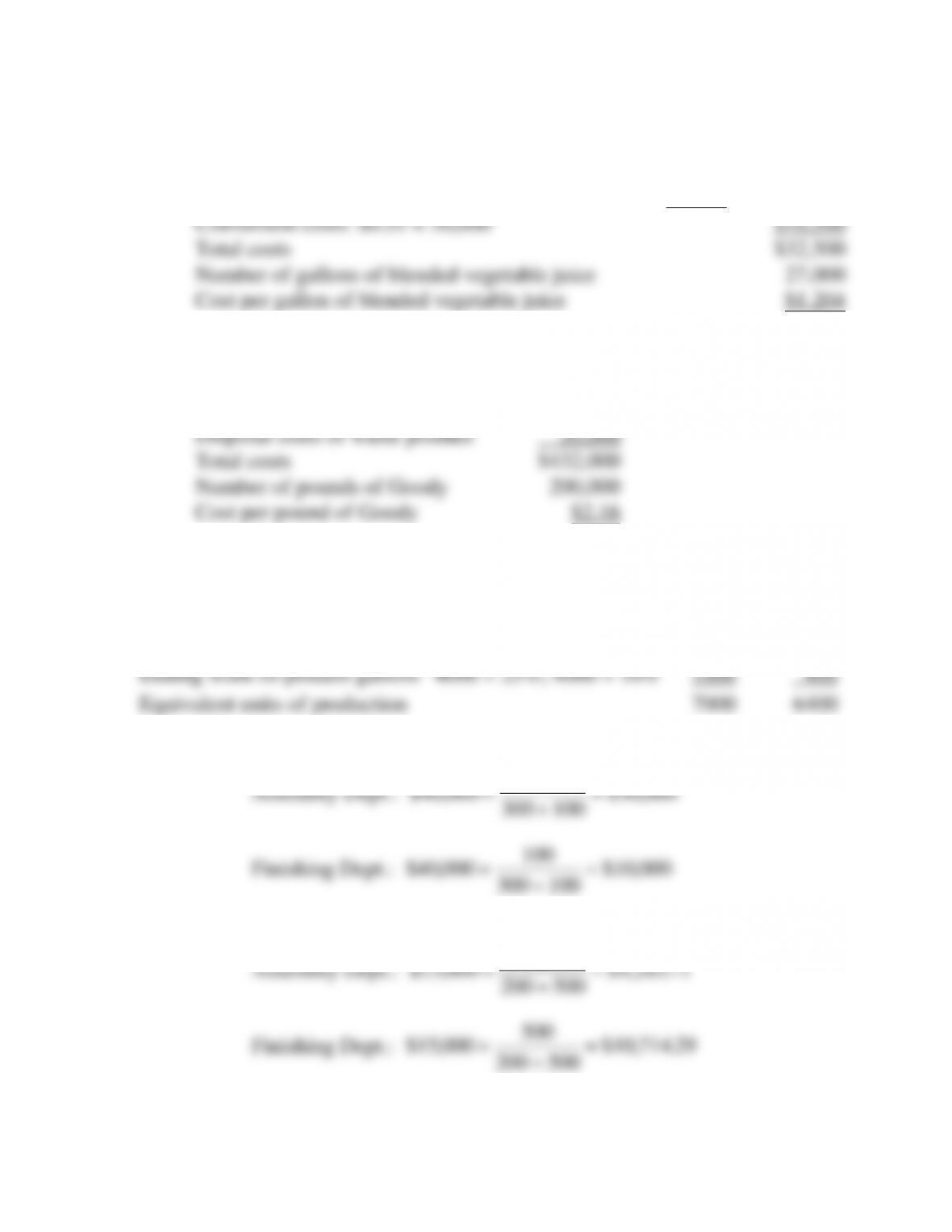
4-32 (a)
Month
Actual Machine Hours
Monthly Overhead Costs
January
1,350
$51.85
February
1,400
$50.00
March
1,500
$46.67
April
1,450
$48.28
May
1,450
$48.28
June
1,400
$50.00
July
1,400
$50.00
August
1,400
$50.00
September
1,500
$46.67
October
1,600
$43.75
November
1,600
$43.75
December
1,600
$43.75
Total Hours
17,650
related overhead costs, the computation is:
$70,$46.
000 12
12 67
months
1,500 machine hours months per machine hour
Chapter 4: Accumulating and Assigning Costs to Products
drivers, as defined in Chapter 3), the company may develop a more
accurate cost system by using multiple cost driver rates.
4-33
Ingredient A: $0.40 × 10,000
$4,000
Ingredient B: $0.60 × 20,000
12,000
$16,000
Conversion costs: $0.55 × 30,000
$16,500
Total costs
$32,500
Number of gallons of blended vegetable juice
27,000
Cost per gallon of blended vegetable juice
$1.204
4-34
Direct materials
$232,000
Direct labor
120,000
Overhead costs
60,000
Disposal costs of waste product
20,000
Total costs
$432,000
Number of pounds of Goody
200,000
Cost per pound of Goody
$2.16
4-35
Materials
Conversion
Completed and transferred out
gallons
6000 100%
6000
6000
Ending work–in-process gallons
4000 25%; 4000 10%
1000
400
Equivalent units of production
7000
6400
4-36 (a) Allocation of machine setup costs: