Chapter 3: Using Costs in Decision Making
– 69 –
The campaign was less than successful; the company announced that it
had “overreached.” Nordstrom had “alienated its faithful clientele” [7] by
(d).
Nordstrom may need to reconsider its value proposition. Reference [2]
comments:
$490 per square foot, handily eclipsing second-place
Nordstrom at $342. And Talbots Inc also took a page from
The same article points out that in response to growing customer
focus on value, Nordstrom needs excellence in inventory
or why there were audios of goats bleating [4]. Like Nordstrom,
Saks appears to have suffered some opportunity cost from this
effort to expand its customer base.
References
– 70 –
[2] Anonymous. 2001. Can Nordstroms Find The Right Style? Business Week (July
30), 59–62.
66.
[4] Byron, E. 2006. Struggling Saks Tries Alternations In Management. Wall
[5] Cuneo, A. Z. 2000. Nordstrom Breaks with Traditional Media Plan. Advertising
[6] Lee, L. 2000. Nordstrom Cleans Out Its Closets. Business Week (May 22), 105.
[7] Merrick, A. 2001. Nordstrom Accelerates Plans to Straighten Out Business:
Nordstrom previously provided the following list of references at its web site
“With a New location in Dadeland Mall, Nordstrom Seeks to Become a Florida
“Author of Books on Nordstrom Culture to Address Virginia Trade Show,”
“Nordstrom Regains Its Luster – Challenge Awaits as Rivals Encroach on Image of
“Shoppers put Heart, Soles Into Yearly Nordstrom Sale,” The Seattle Times, July 17,
2004
“Q&A with Blake Nordstrom – 4th Generation Leads Growth of Nordstrom,” The
“Nordstrom ‘Cachet’ Hits Wellington Friday,” Palm Beach Post, November 10, 2003
“Back in the Family; Fourth Generation Takes Control After a Brief Change in
“A Time of Change; Company Makes Huge Leaps with Expansion, Public Stock
Chapter 3: Using Costs in Decision Making
– 71 –
“Still in Style; From Small Shoe Store, to Upscale Retailer, Company has Kept
“Success Came a Step at a Time; Company Rose From Small Seattle Shoe Store to
Books:
The Nordstrom Way by Robert Spector and Patrick D. McCarthy
Fabled Service: Ordinary Acts, Extraordinary Outcomes by Bonnie Jameson and
Betsy Sanders
3-71 (a)
Unit cost
AA100
AA101
AA102
Direct materials: Chem. &
frag.
$560
$400
$470
Direct materials: AA 100
—
680
680
Direct labor
60
30
60
Variable mfg. overhead
60
30
60
Total variable mfg. cost
$680
$1,140
$1,270
Variable selling cost
20
30
30
Total variable cost
$700
$1,170
$1,300
Sales price
940
1,500
1,700
Contribution margin per ton
$240
$330
$400
Hours per ton
4 hrs
6 hrs
8 hrs
Contribution margin per hour
$60
$55
$50
(b) AA100 has a higher contribution margin per hour than AA101 and
A102. Aramis should produce AA100 up to 600 tons. Since the
(c) Opportunity cost is $60 per hour (the contribution margin per hour for
Atkinson, Solutions Manual t/a Management Accounting, 6E
– 72 –
Required contribution margin per ton (= $60 × 6)
$360
Variable cost per ton
1,170
Required minimum sales price per ton
$1,530
(d) It is worthwhile operating the plant overtime. The optimal production
level is AA100: 600 tons; AA101: 100 tons; and AA102: 0 tons.
Explanation: The regular capacity of 2,400 hours (before operating the
plant overtime) is used to produce 600 tons of AA100. How should 600
Under overtime:
AA100
AA101
AA102
Direct materials: Chem. & frag.
$560
$400
$470
Direct materials: AAA100
—
740
740
Direct labor
90
45
90
Variable mfg. overhead
90
45
90
Total variable mfg. cost
$740
$1,230
$1,390
Variable selling cost
20
30
30
Total variable cost
$760
$1,260
$1,420
Sales price
940
1,500
1,700
Contribution margin per ton
$180
$240
$280
Hours per ton
4
6
8
Contribution margin per hour
$45
$40
$35
Since contribution margins per hour for AA101 and AA102 are positive,
Chapter 3: Using Costs in Decision Making
– 73 –
3-72 TEACHING NOTE: A VOTRE SANTÉ 1
The A Votre Santé (AVS) case is multi-faceted in that it requires students to
incorporate operational measures into product costing results, and also to
Additionally, the case questions require both quantitative and qualitative
analyses of the business issues faced by AVS. AVS has been used in a
The detail in the case is rich enough to support a variety of analyses.
Alternative uses could be to have the student construct a cost of goods
manufactured statement or a traditional financial statement, both of which
(a) Contribution Margin Income Statement
To develop the contribution margin income statement, you first have to
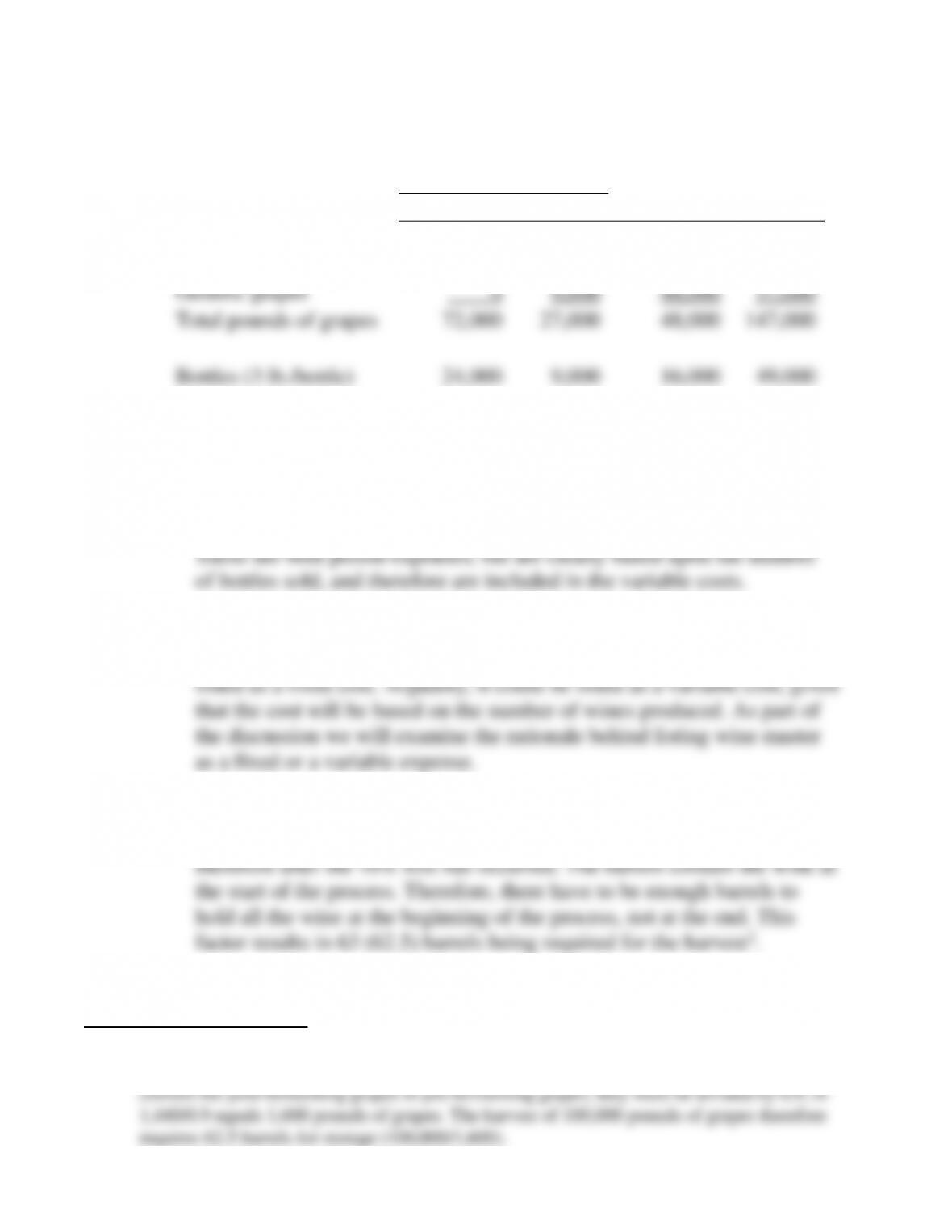
calculate the number of bottles of wine produced by AVS. This number is
dependent upon the yield from the grapes. The relevant calculations are as
follows:
Chardonnay
Generic
Yield:
Grapes
Grapes
Pounds harvested
100,000
60,000
Loss in processing
10,000
10%
3,000
5%
Yield:
90,000
57,000
Atkinson, Solutions Manual t/a Management Accounting, 6E
– 74 –
Bottles of wine produced:
Chardonnay
Blanc de
Estate
Regular
Blanc
Total
Pounds of grapes:
Chardonnay grapes
72,000
18,000
0
90,000
Generic grapes
0
9,000
48,000
57,000
Total pounds of grapes
72,000
27,000
48,000
147,000
Bottles (3 lb./bottle)
24,000
9,000
16,000
49,000
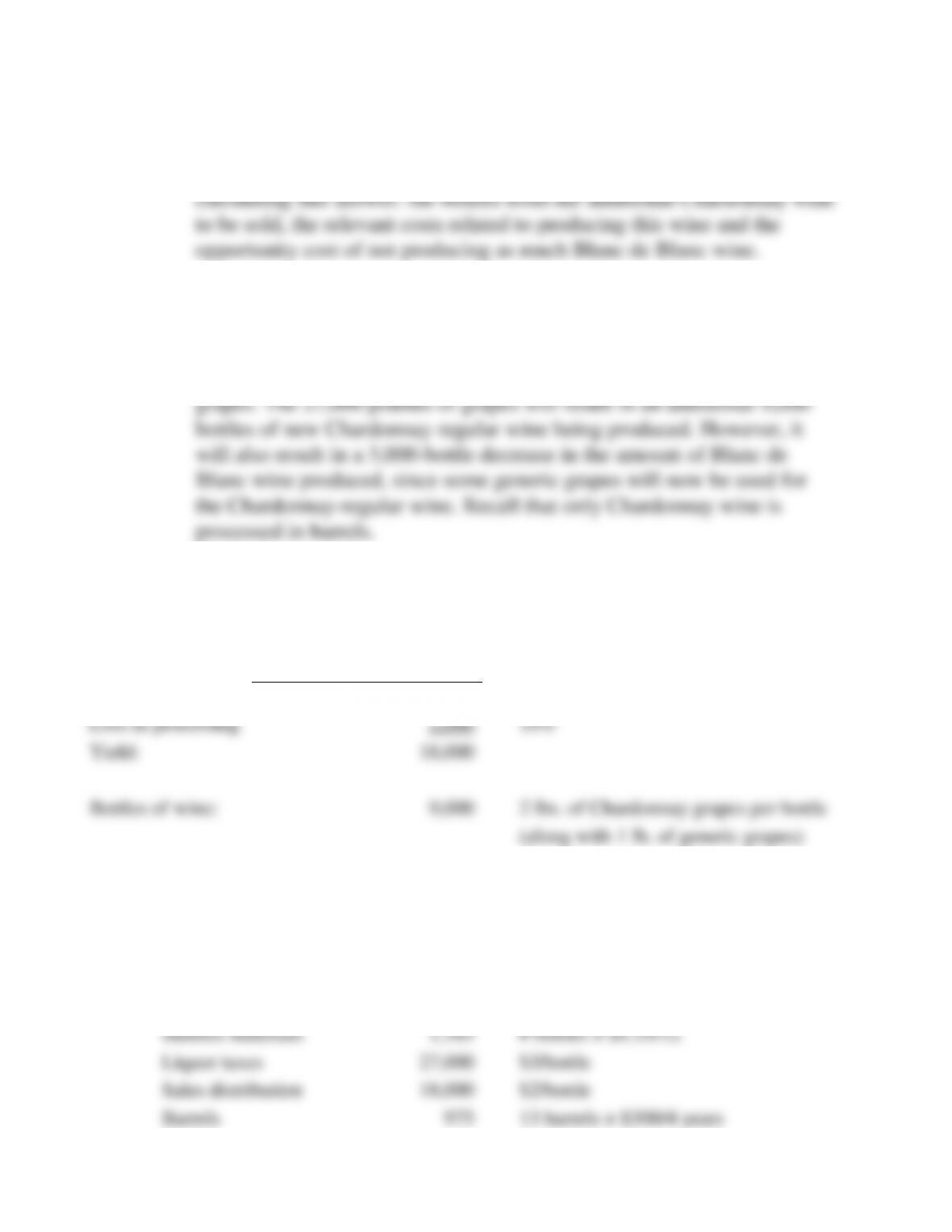
The contribution margin income statement (Teaching Note Exhibit 1) is fairly
straightforward, with the following concepts or calculations causing the most
difficulty:
The inclusion of liquor taxes and sales commissions in variable costs:
Where to include the wine master expense: Since the wine master is paid
according to number of blends, not number of bottles, this expense is
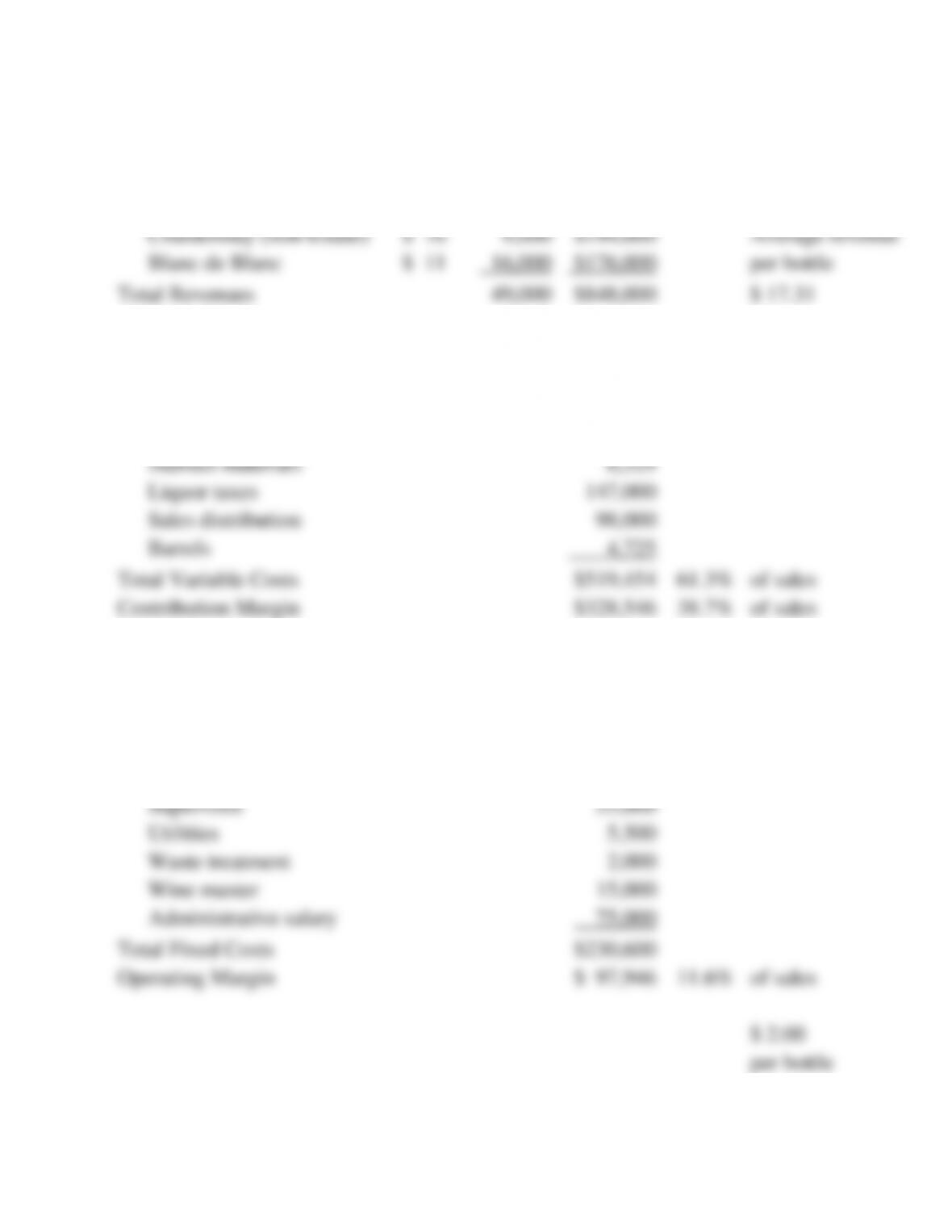
Barrel expense: The case states that the barrels produce the equivalent of
40 cases of wine. A case of wine is post-fermentation/bottling and
2 Each case of wine requires 36 pounds of grapes (post-fermenting). A barrel holds the
equivalent of 40 cases of wine (post-fermenting), or 1,440 pounds of grapes (40 × 36). To
Chapter 3: Using Costs in Decision Making
– 75 –
Teaching Note Exhibit 1: Contribution Margin Income Statement
Number
Sales
Price
of Bottles
Chardonnay – Estate
$ 22
24,000
$528,000
Chardonnay (non-Estate)
$ 16
9,000
$144,000
Average revenue
Blanc de Blanc
$ 11
16,000
$176,000
per bottle
Total Revenues
49,000
$848,000
$ 17.31
Variable Costs
Grapes
$124,000
Bottle, labels, corks
122,500
Harvest labor
14,500
Crush labor
2,400
Indirect materials
6,329
Liquor taxes
147,000
Sales distribution
98,000
Barrels
4,725
Total Variable Costs
$519,454
61.3%
of sales
Contribution Margin
$328,546
38.7%
of sales
Fixed Costs
Admin. rent and office
$ 20,000
Depreciation
8,100
Lab expenses
8,000
Production office
12,000
Sales
30,000
Supervisor
55,000
Utilities
5,500
Waste treatment
2,000
Wine master
15,000
Administrative salary
75,000
Total Fixed Costs
$230,600
Operating Margin
$ 97,946
11.6%
of sales
$ 2.00
per bottle
Atkinson, Solutions Manual t/a Management Accounting, 6E
– 76 –
(b) Additional Purchase Opportunity, Quantitative Analysis
Part b asks, “What is the maximum amount that AVS would pay to buy
an additional pound of Chardonnay grapes?” There are three parts to
Teaching Note: Exhibit 2 displays the calculations relevant to this
decision. Chardonnay regular wine requires a 2 to 1 mixture of
Chardonnay and generic white grapes. Therefore, the 18,000 pounds of
Chardonnay grapes will be combined with 9,000 pounds of generic white
Teaching Note Exhibit 2: Decision Analysis, Additional Grape Purchase
Chardonnay
Yield:
Grapes
Pounds
20,000
Loss in processing
2,000
10%
Yield:
18,000
Bottles of wine:
9,000
2 lbs. of Chardonnay grapes per bottle
(along with 1 lb. of generic grapes)
Additional Chardonnay Product Line
Sales Revenue
$ 126,000
9,000 bottles × $14/bottle
Costs
Generic grapes
$ 6,079
9,000 pounds × $0.6754/pound
Bottle, labels, corks
22,500
# bottles × $2.50
Indirect materials
1,163
# bottles × $1.55/12
Liquor taxes
27,000
$3/bottle
Sales distribution
18,000
$2/bottle
Barrels
975
13 barrels × $300/4 years
Chapter 3: Using Costs in Decision Making
– 77 –
Wine master
5,000
Total costs
$ 80,717
Gain from new Chardonnay
$ 45,283
Lost Sales of Blanc de Blanc Wine
Sales Revenue
$ 33,000
3,000 bottles × $11/bottle
Costs
Generic grapes
$ 6,079
9,000 pounds × $0.6754/pound
Bottle, labels, corks
7,500
# bottles × $2.50
Indirect materials
388
# bottles × $1.55/12
Liquor taxes
9,000
$3/bottle
Sales distribution
6,000
$2/bottle
Total costs
$ 28,967
Lost Contribution Margin
$ 4,033
Net Impact
$ 41,250
Required 15% Return on Sales
$ 18,900
15%
Total Net Benefit
$ 22,350
Pounds of Grapes
20,000
Maximum Price per Pound
$ 1.1175
(c) Additional Purchase Opportunity, Qualitative Analysis
additional grapes:
Potential increase in market share
Diversification of suppliers
Ability to leverage fixed costs over more production
Atkinson, Solutions Manual t/a Management Accounting, 6E
– 78 –
Creates an incentive for the current grower to control costs
purchase:
Poor quality of the grapes
An additional AVS Chardonnay wine creates confusion in the
marketplace
Lack of control over the harvest and crush process
additional production
Inability to use the additional barrels purchased in future years
Summary
together. Because of the different yield rates in the fermenting process, the case
had the wines ferment separately and blend at the end.
Note: The full case, which includes activity-based cost analysis, can be taught
additional assignment.