Chapter 3: Using Costs in Decision Making
– 59 –
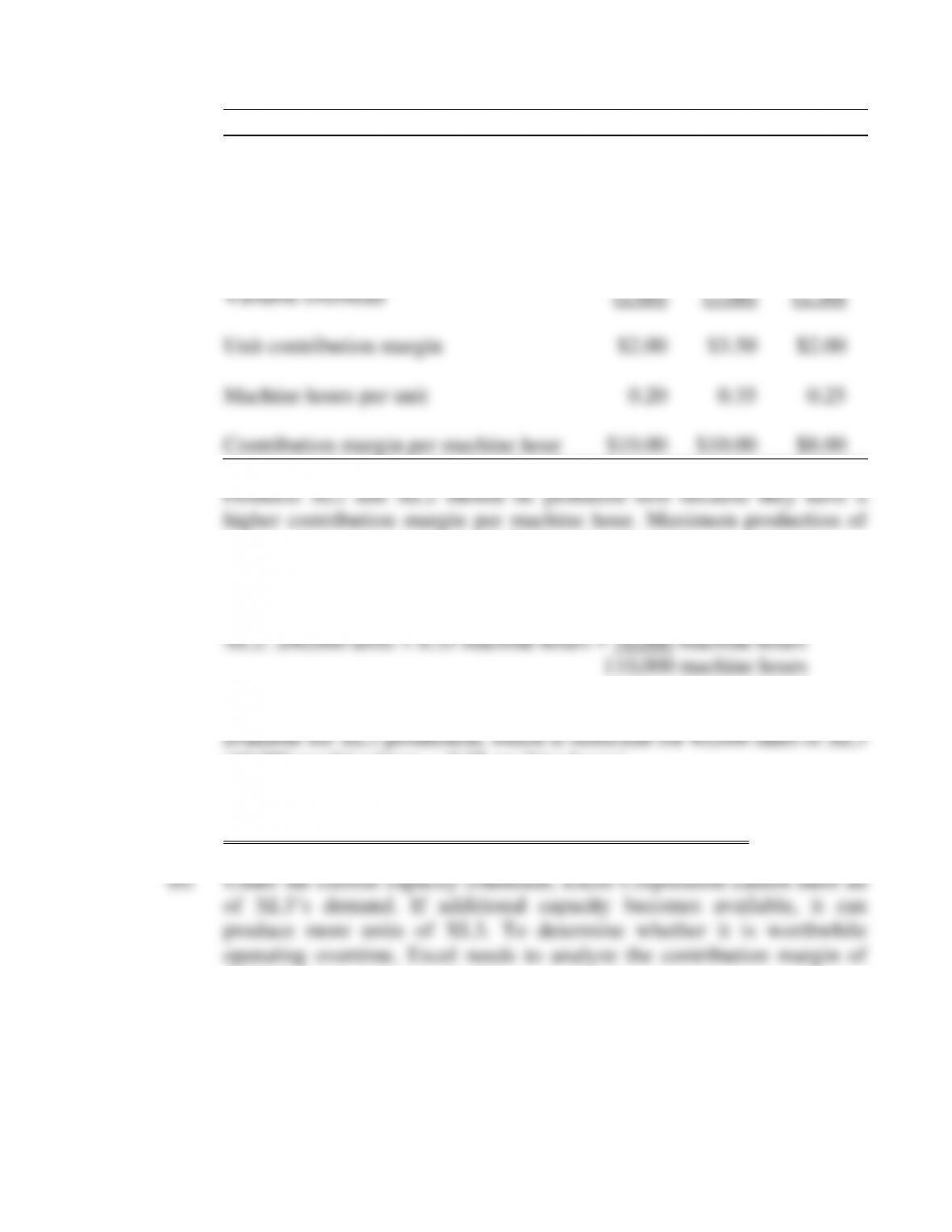
3-65 (a)
XLl
XL2
XL3
Sales price
$10.00
$14.00
$12.00
Direct materials
(4.00)
(4.50)
(5.00)
Direct labor
(2.00)
(3.00)
(2.50)
Variable overhead
(2.00)
(3.00)
(2.50)
Unit contribution margin
$2.00
$3.50
$2.00
Machine hours per unit
0.20
0.35
0.25
Contribution margin per machine hour
$10.00
$10.00
$8.00
these two products requires 110,000 machine hours:
XL1: 200,000 units 0.20 machine hours 40,000 machine hours
Therefore, a balance of 10,000 120,000 – 110,000 machine hours are
(10,000 machine hours ÷ 0.25 machine hours).
Optimal Production Levels:
XL1: 200,000 units; XL2: 200,000 units, XL3: 40,000 units
XL3 when operating overtime.
Atkinson, Solutions Manual t/a Management Accounting, 6E
– 60 –
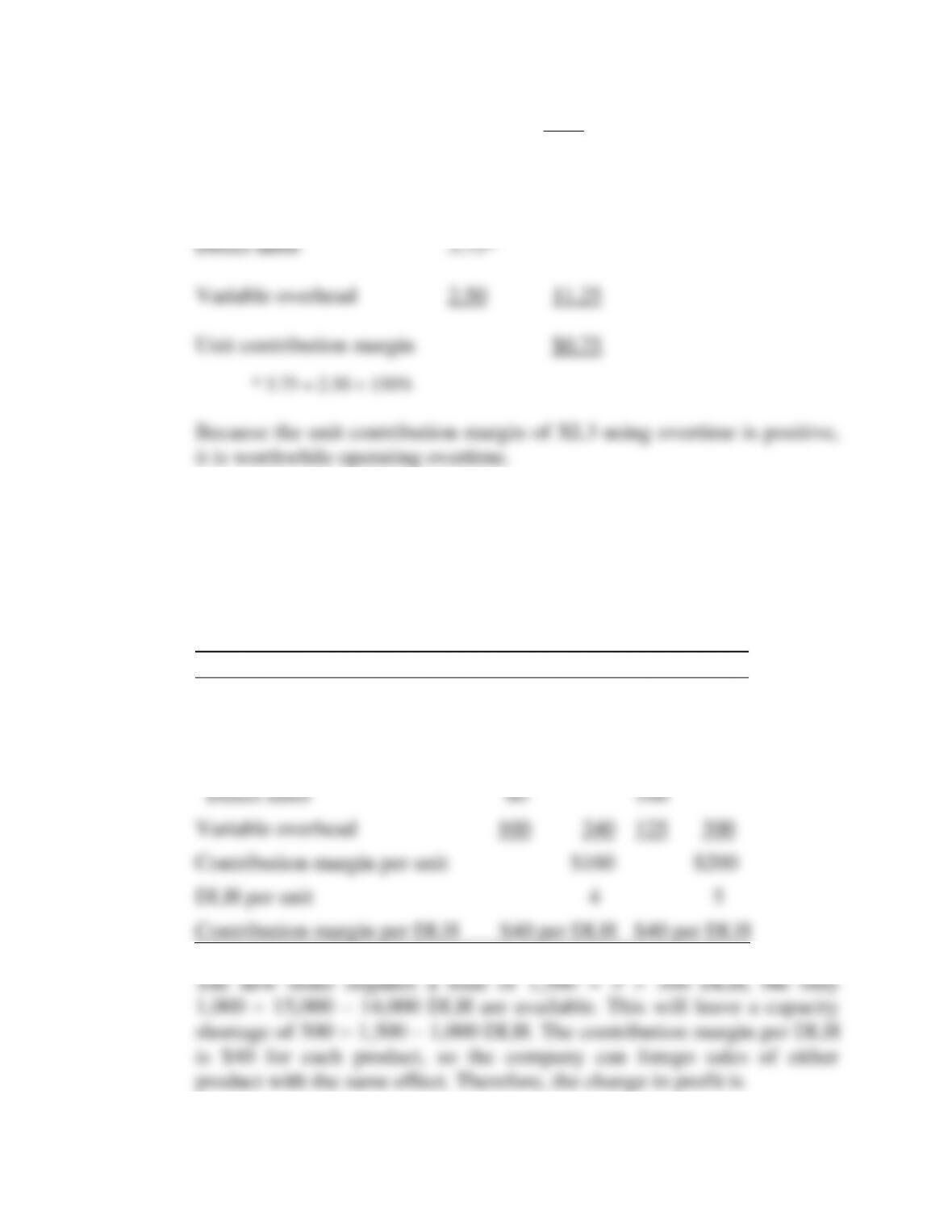
XL3
Sales price
$12.00
Direct materials
$5.00
Direct labor
3.75
*
Variable overhead
2.50
11.25
Unit contribution margin
$0.75
* 3.75 2.50 150%
Because the unit contribution margin of XL3 using overtime is positive,
it is worthwhile operating overtime.
3-66 (a) HCD2 requires $100 ÷ $20 = 5 direct labor hours per unit. The new order
requires 1,000 = 200 × 5 direct labor hours, so the existing capacity is adequate.
The contribution margin per unit of HCD2 for the new order = $400 − (75 +
100 + 125) = $100. The increase in profit is $20,000 = 200 units × $100
contribution margin.
(b)
HCD1
HCD2
Sales price
$400
$500
Variable cost:
Direct material
$60
$75
Direct labor
80
100
Variable overhead
100
240
125
300
Contribution margin per unit
$160
$200
DLH per unit
4
5
Contribution margin per DLH
$40 per DLH
$40 per DLH
Chapter 3: Using Costs in Decision Making
– 61 –
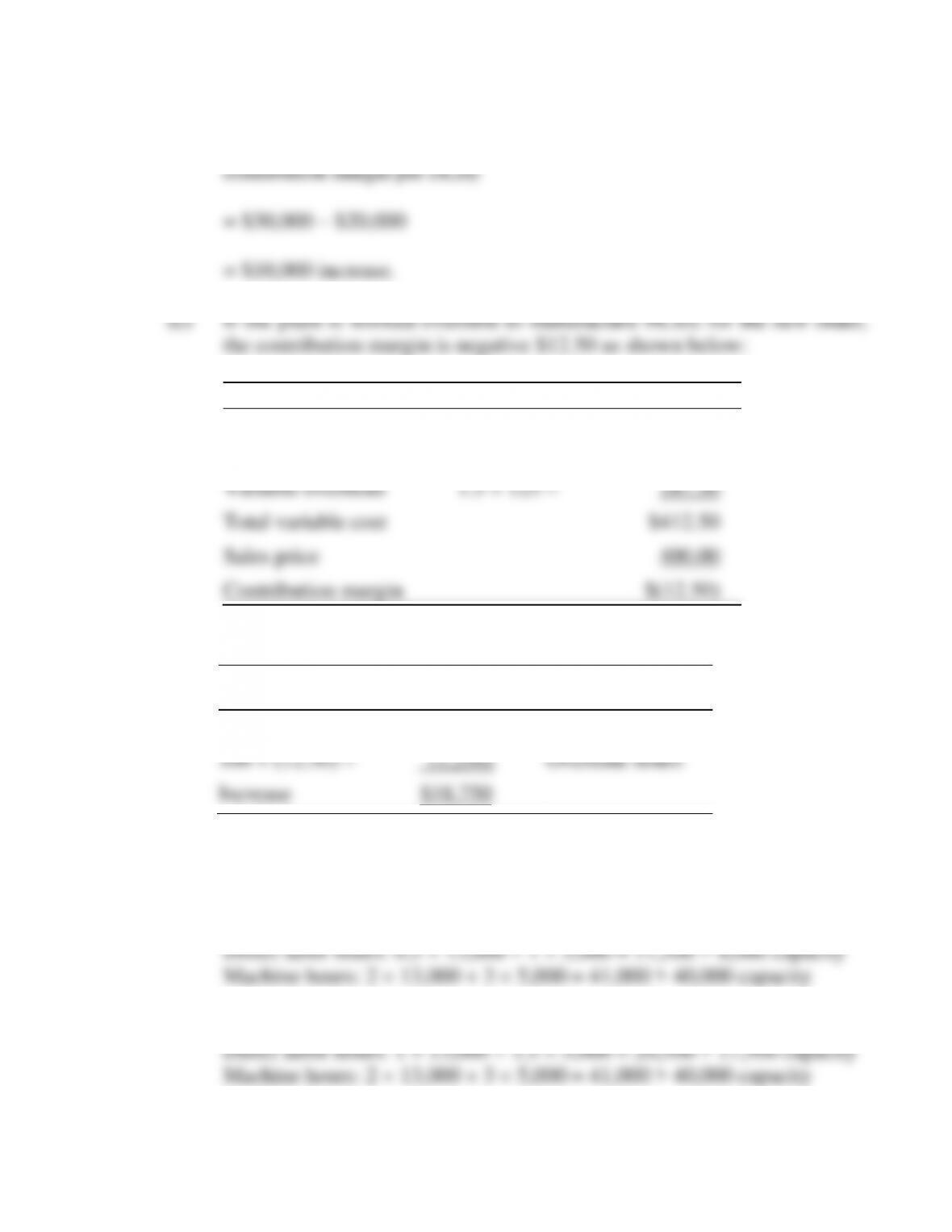
Total contribution margin – opportunity cost
= (300 units $100 contribution margin per unit) – (500 DLH $40
Unit Variable Cost for Overtime
Material
1 75
$75.00
Labora
1.5 100
150.00
Variable overhead
1.5 125
187.50
Total variable cost
$412.50
Sales price
400.00
Contribution margin
$(12.50)
a or 5 hours $30 per hour
Change in Profit
During
200 100
$20,000
Regular hours
100 (12.50)
(1,250)
Overtime hours
Increase
$18,750
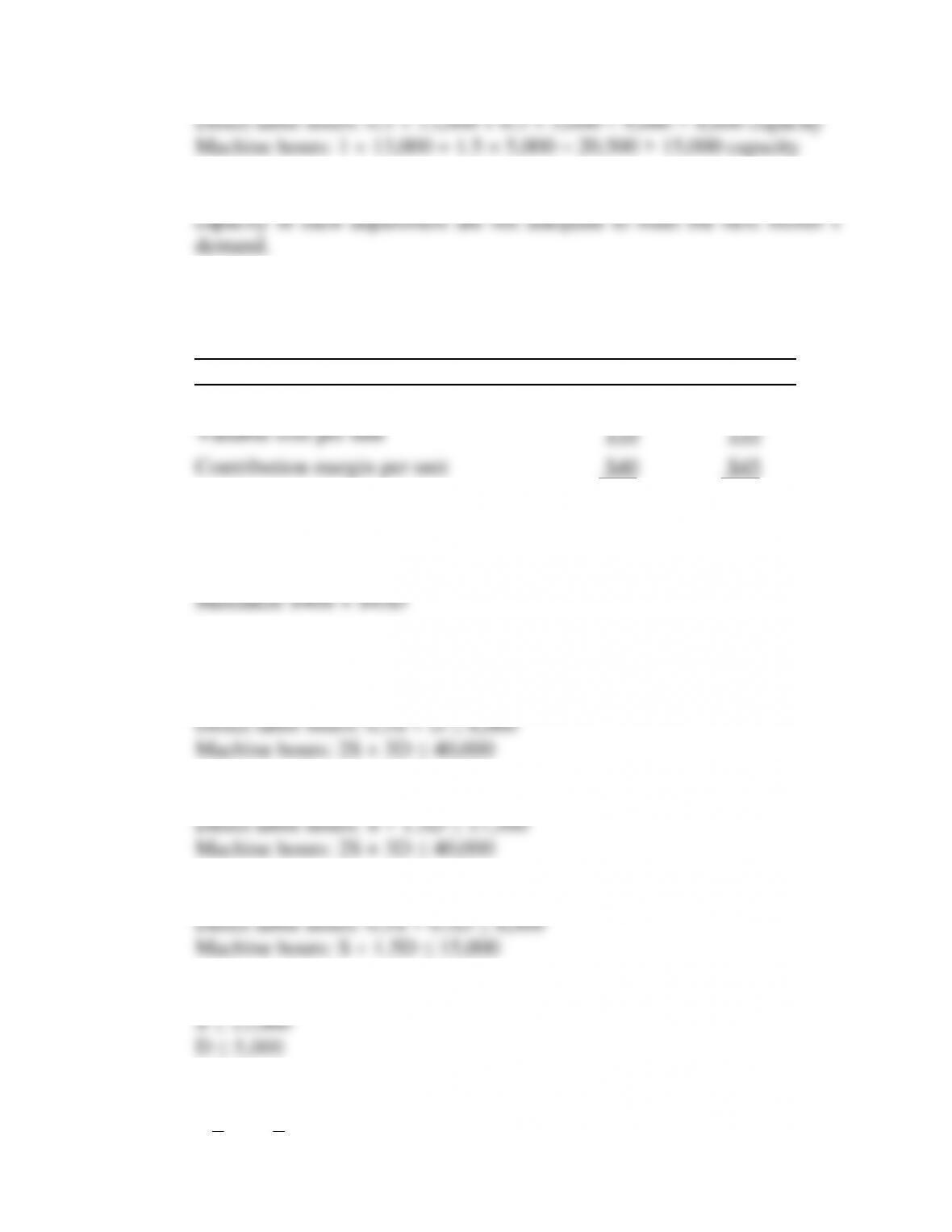
3-67 (a) In order to produce 13,000 standard doors and 5,000 deluxe doors, the
following number of direct labor hours and machine hours are required:
Cutting:
Assembly:
Atkinson, Solutions Manual t/a Management Accounting, 6E
– 62 –
Finishing:
The direct labor hour capacity in each department and the machine hour
(b) Linear programming can be used to solve this problem. The product
contribution margins needed for the objective function are:
Standard
Deluxe
Sales price per unit
$150
$200
Variable cost per unit
110
155
Contribution margin per unit
$40
$45
Let S denote the number of standard doors to produce and D denote the
number of deluxe doors to produce. The linear programming problem is:
Subject to the following constraints:
Cutting:
Assembly:
Finishing:
Maximum demand:
Nonnegativity:
S > 0, D > 0
Chapter 3: Using Costs in Decision Making
– 63 –
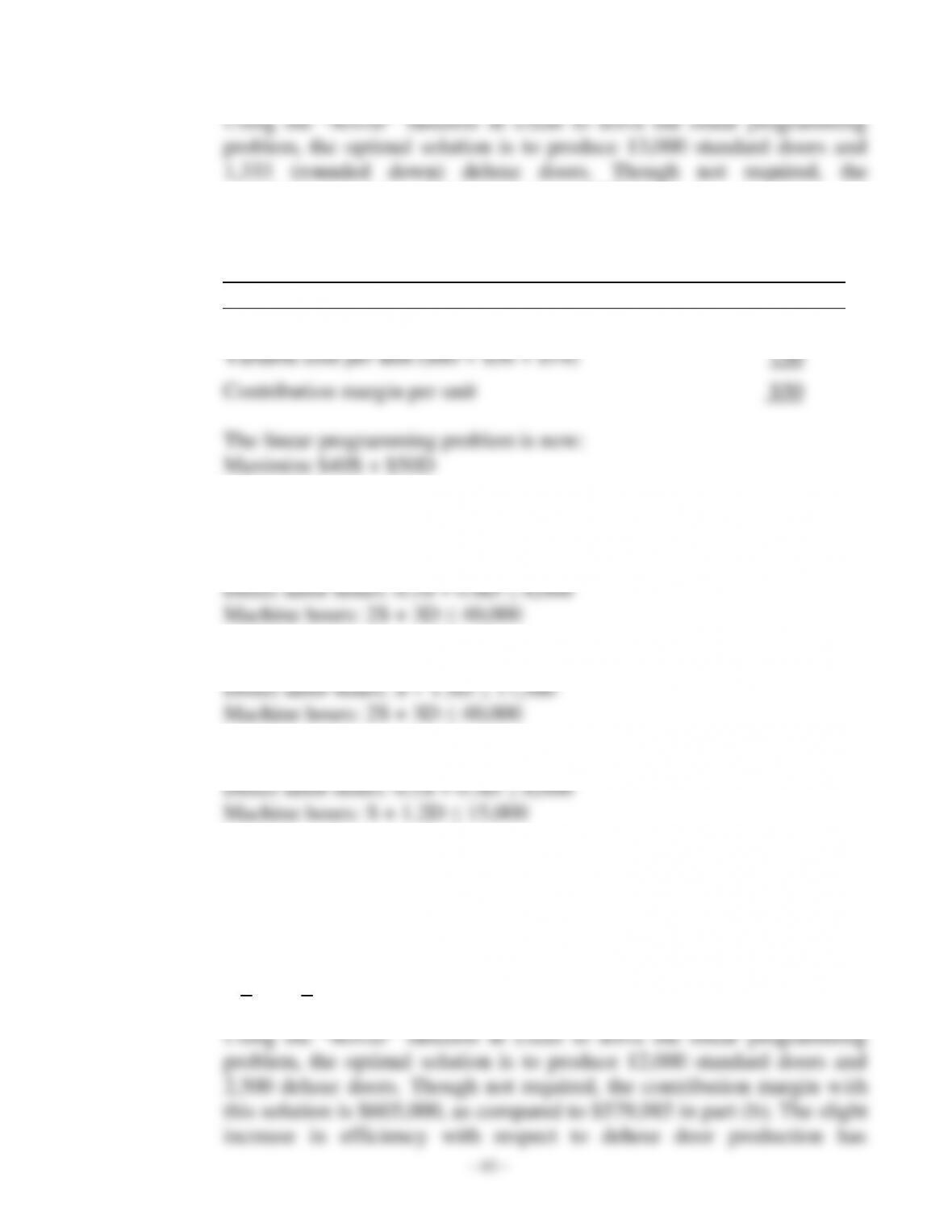
contribution margin with this solution is $579,985.
(c) The contribution margin for standard doors remains the same, but the
contribution margin for deluxe doors is now $50:
Deluxe
Sales price per unit
$200
Variable cost per unit ($80 + $56 + $14)
150
Contribution margin per unit
$50
The linear programming problem is now:
Maximize $40S + $50D
Subject to the following constraints:
Cutting:
Assembly:
Finishing:
Maximum demand:
S ≤ 13,000
D ≤ 5,000
Nonnegativity:
S > 0, D > 0
– 64 –
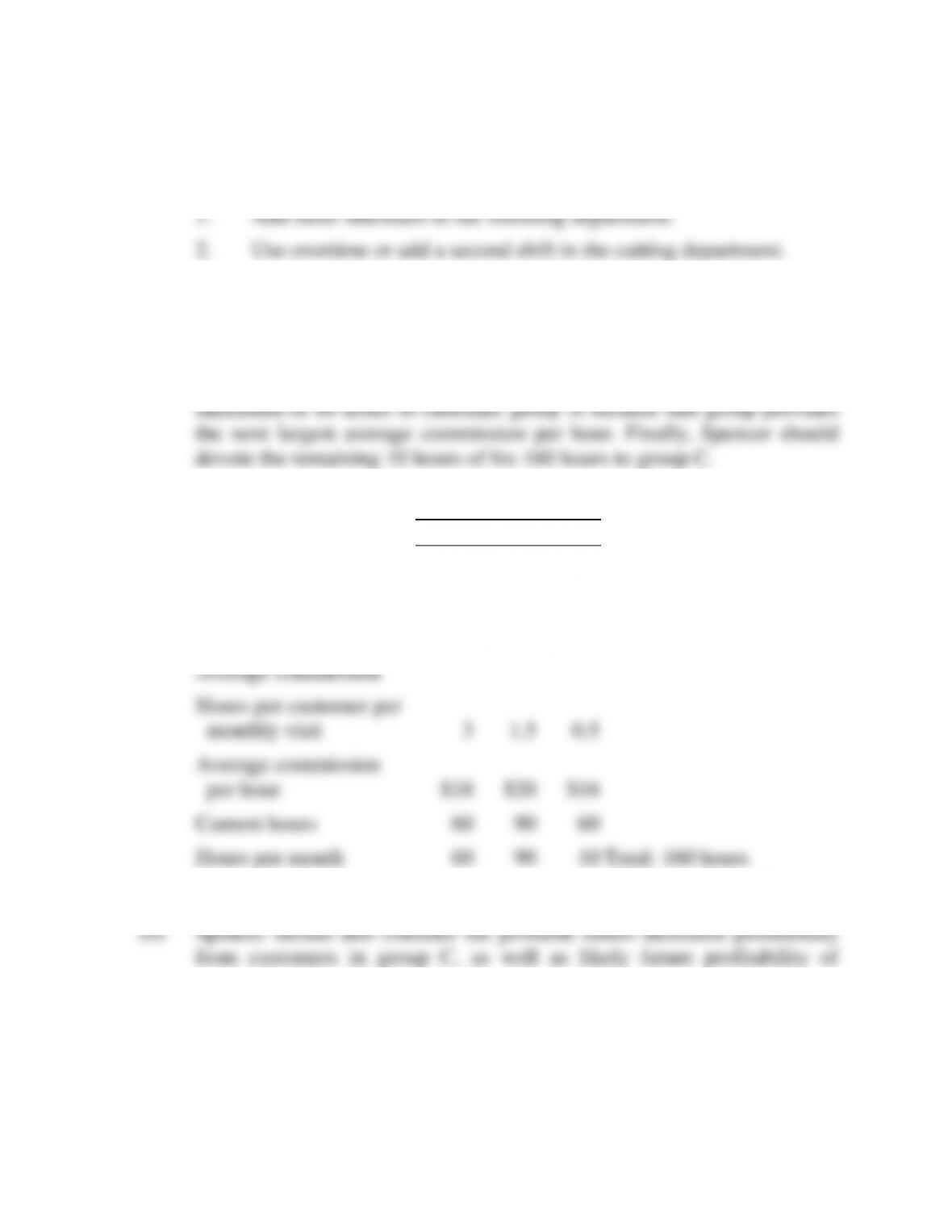
increased the number of deluxe doors in the optimal product mix and
increased the total contribution margin.
(d) The following alternatives may be considered:
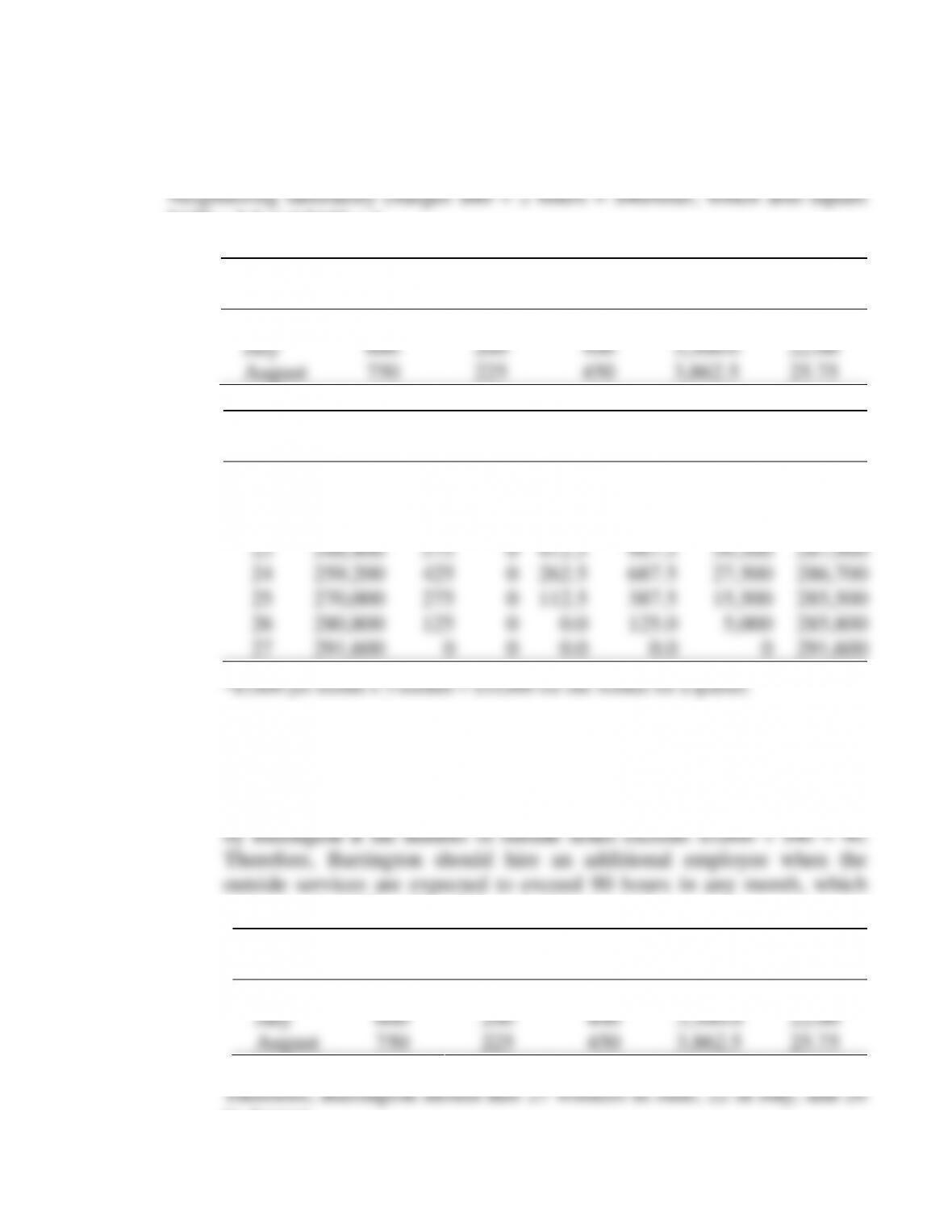
3-68 (a) To maximize monthly commissions while working 160 hours per month,
Spencer should devote the maximum allowable time (90 hours) to
customer group B because that group provides the largest average
commission per hour of Spencer’s time. Spencer should next allocate the
Customer Group
A
B
C
Average monthly sales
per customer
$900
$600
$200
Commission
6%
5%
4%
Average commission
$54
$30
$8
Hours per customer per
monthly visit
3
1.5
0.5
Average commission
per hour
$18
$20
$16
Current hours
60
90
60
Hours per month
60
90
10
Total: 160 hours
(40 hours per week)
customers in the other groups.
Chapter 3: Using Costs in Decision Making
– 65 –
CASES
3-69 Wage rate = $3,600 ÷ 150 hours = $24/hour.
$100 ÷ 2.5 and $160 ÷ 4.
(a)
Month
Simple
Routine
Simple
Nonroutine
Complex
Total
Hours
Equivalent
Workers
June
800
250
450
4,025.0
26.83
July
600
200
400
3,300.0
22.00
August
750
225
450
3,862.5
25.75
Workers
Hired
In-house
Wages*
Hours Short
Outside
Hours
Outside
Charges
Total
Cost
June
July
August
20
$216,000
1,025
300
862.5
2,187.5
$87,500
$303,500
21
226,800
875
150
712.5
1,737.5
69,500
296,300
22
237,600
725
0
562.5
1,287.5
51,500
289,100
23
248,400
575
0
412.5
987.5
39,500
287,900
24
259,200
425
0
262.5
687.5
27,500
286,700
25
270,000
275
0
112.5
387.5
15,500
285,500
26
280,800
125
0
0.0
125.0
5,000
285,800
27
291,600
0
0
0.0
0.0
0
291,600
In-house wages equal $10,800 times the number of workers hired.
Dr. Barker should employ 25 workers at a total cost of $285,500.
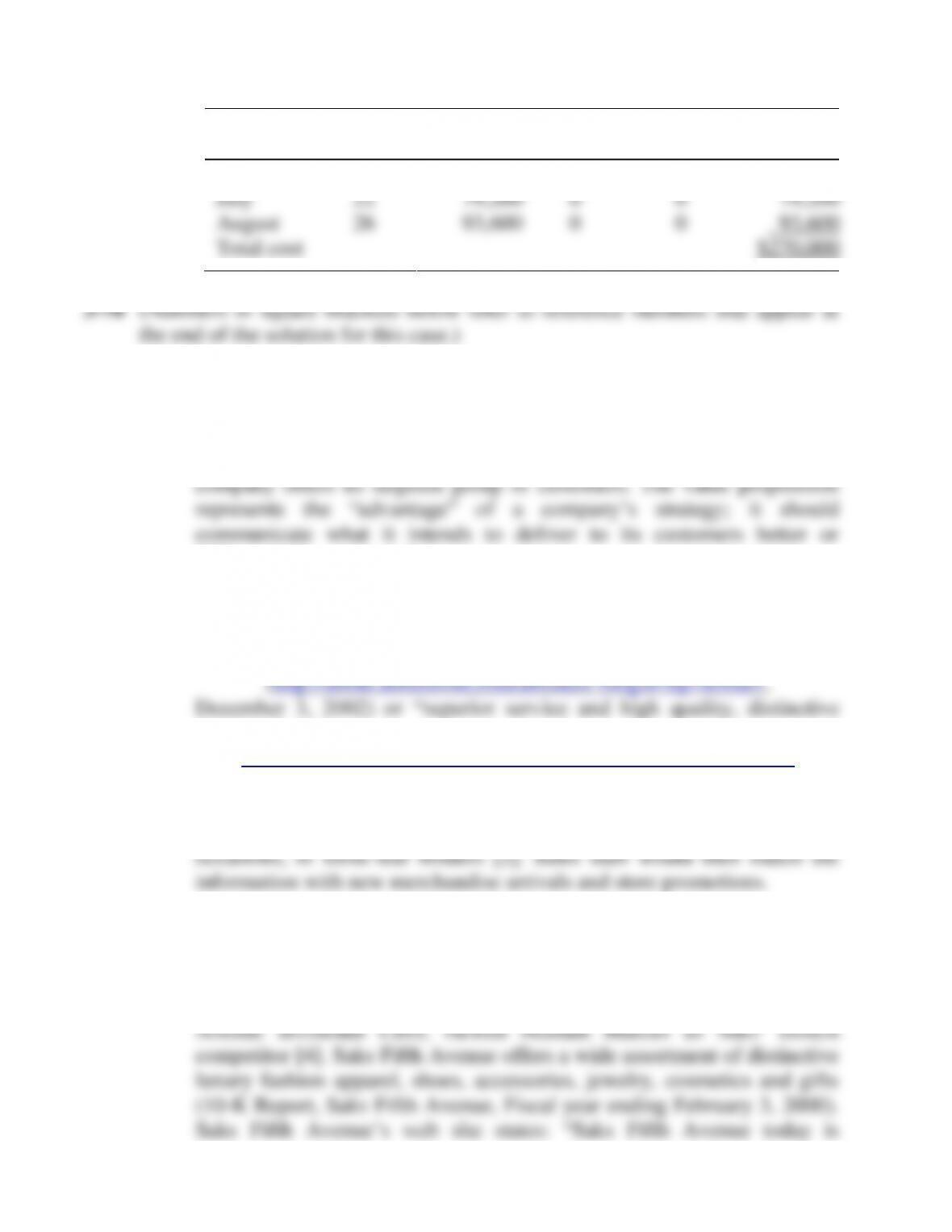
(b) Outside charges will exceed the monthly wages of an additional worker hired
corresponds to 90 ÷ 150 = 0.6 equivalent workers.
Month
Simple
Routine
Simple
Nonroutine
Complex
Total
Hours
Equivalent
Workers
June
800
250
450
4,025.0
26.83
July
600
200
400
3,300.0
22.00
August
750
225
450
3,862.5
25.75
in August.
Atkinson, Solutions Manual t/a Management Accounting, 6E
– 66 –
Month
Workers
Hired
Fixed
Cost
Outside
Hours
Outside
Charges
Total
Cost
June
27
$97,200
0
0
$97,200
July
22
79,200
0
0
79,200
August
26
93,600
0
0
93,600
Total cost
$270,000
(a) An organization’s value proposition defines what the organization tries
to deliver to its customers. As described in Chapter 2, the value
proposition is the unique mix of product performance, price, quality,
availability, ease of purchase, service, relationship, and image that a
differently from competitors.
Nordstrom is an upscale retailer, often included among lists of luxury
retailers. Nordstrom’s value proposition can be described as “quality,
value, selection, and service”
merchandise”
(http://about.nordstrom.com/aboutus/investor.asp?origin=footer,
April 7, 2003). Nordstrom’s sales force is legendary for its customer
service. As mentioned below in part (c), sales staff kept handwritten
notes about customers’ sizes and designer preferences, as well as special
Saks Fifth Avenue is a luxury retailer that can be described much like
Neiman-Marcus is described in Chapter 2. Both stores target fashion–
conscious customers with high disposable incomes who are willing to
pay more for high-end merchandise. Fred Wilson, former Saks Fifth
Chapter 3: Using Costs in Decision Making
– 67 –
renowned for its superlative selling services and merchandise offerings.
The best of European and American designers for men and women are
sold throughout its 47 stores servicing customers in 23 states.”
=iSXpdBi).
(b) Nordstrom centralized purchasing in an attempt to leverage its buying
power. Previously, Nordstrom’s buying transpired through more than 12
offices [6]. Nordstrom negotiated with suppliers to reduce markups on
proposition.
Nordstrom also laid off 2,500 employees between September 1 and
October 19, 2001. Mindful of the importance of its sales staff,
Nordstrom’s layoffs focused on “back-office employees” [7]. Retaining
foot overshadowed the $60 industry average [2].
(c) Nordstrom invested in computerized inventory-tracking systems [5, 6].
The previous system relied partly on sales staff’s handwritten notes in
loose-leaf binders [2]. In addition to inventory management, new
technology was introduced to improve customer service:
promotions.
For Nordstrom, what makes sense is getting customer
information to retail sales personnel in real time, whether those
over the telephone [3].
Atkinson, Solutions Manual t/a Management Accounting, 6E
– 68 –
Sales staff could also contact customers as soon as a desired item arrived
information on sizes and preferences [3].
Nordstrom’s 2001 Annual Report (p. 4) reports that implementation of
the perpetual inventory system is “going very well,” with the expectation
that the system will help buyers improve decision-making, manage
(d) Nordstrom’s efforts affected the classic cost-volume-profit elements of
sales prices, product costs, product mix, and selling, general, and
administrative expenses. The objective was to increase net income. In an
effort to move excess inventory, Nordstrom ran a clearance sale, unusual
Operating income decreased 50% and gross profit as a percent of sales
decreased.
In 2001 (comparing fiscal years ending January 2001 and January 2002),
April 7, 2003).
(e) “Reinvent Yourself” was an advertising campaign that began in February
2000 (see [5] for details). The advertising campaign was Nordstrom’s
into the store [5].