Chapter 3: Using Costs in Decision Making
– 49 –
Incremental profit:
Increase in contribution
margin from new sales
$34.50 120,000
$4,140,000
Decrease in contribution
margin from
cannibalization
$20 (300,000 – 240,000)
(1,200,000)
Increase in fixed costs
(2,000,000)
Increase in profits if the
new model is introduced
$940,000
3-51 (a) The number of miles driven is an important activity measure in
estimating the cost of driving. In comparing the cost of driving to work
(b) Incremental costs of driving include gas, oil, maintenance, and tire
expenditures. Costs associated with driving also include toll costs and
parking fees.
license fees, and insurance.
(d) For a two-week vacation by car, two likely activity measures are number
3-52 (a) Costs that vary with number of passengers:
Meals and refreshments = $5
($200 X 70) – ($5 X 70) – ($5,000 70) – $400,000 = $0
$13,650X = $750,000
X $750,000 ÷ $13,650 = 54.95 (i.e., 55 passengers per flight)
– 50 –
(b) Let N number of flights to earn a profit of $500,000 per week
with the number of flights.
(d) In this case, there is no opportunity cost to the airline because the seat
additional fuel cost.
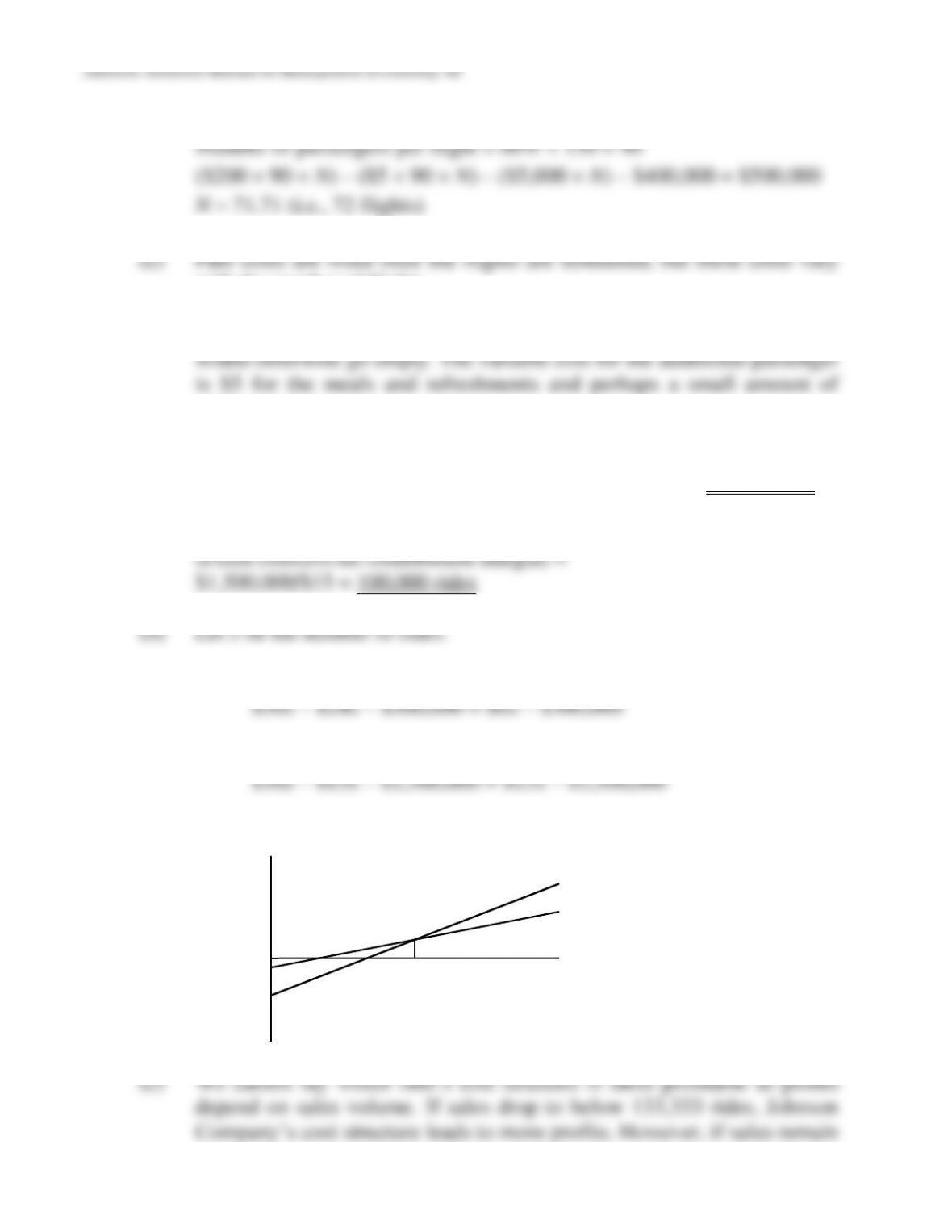
3-53 (a) Johnson Co. breakeven point in number of rides =
(Fixed costs)/(Unit contribution margin) = $300,000/$6 = 50,000 rides
Smith Co. breakeven point in number of rides =
Johnson Co.’s profit function is:
Smith Co.’s profit function is:
Number of rides
Profit
Profit-Volume Chart
J
S
133,333100,00050,000
$0
($300,000)
($1,500,000)
Loss
Chapter 3: Using Costs in Decision Making
above 133,334 rides, then Smith Company’s cost structure leads to more
profits.
has higher fixed costs to cover and a higher unit contribution margin,
which makes its profits more sensitive to decreases in the sales activity
level.
3-54 (a) Contribution margin per unit:
Selling price
$250
Less variable costs:
Variable production costs
$100
Variable selling and distribution costs
20
120
Contribution margin per unit
$130
(b) Let X the sales volume at which the profit on sales is 10%
Profit = 250X X
X
X X
X
X
120 200 000 62,500
01 250
130 262,500 25
105 262,500
2,500 units.
,
.
(c) (1) Single-shift operations
0 4,400
X
:
Selling price
$200
Variable costs
120
Contribution margin per unit
$80
(2) Two-shift operations
4,400 8800
X,
:
Selling price
$200
Variable costs
120
Contribution margin per unit
$80
Chapter 3: Using Costs in Decision Making
– 53 –
3-55
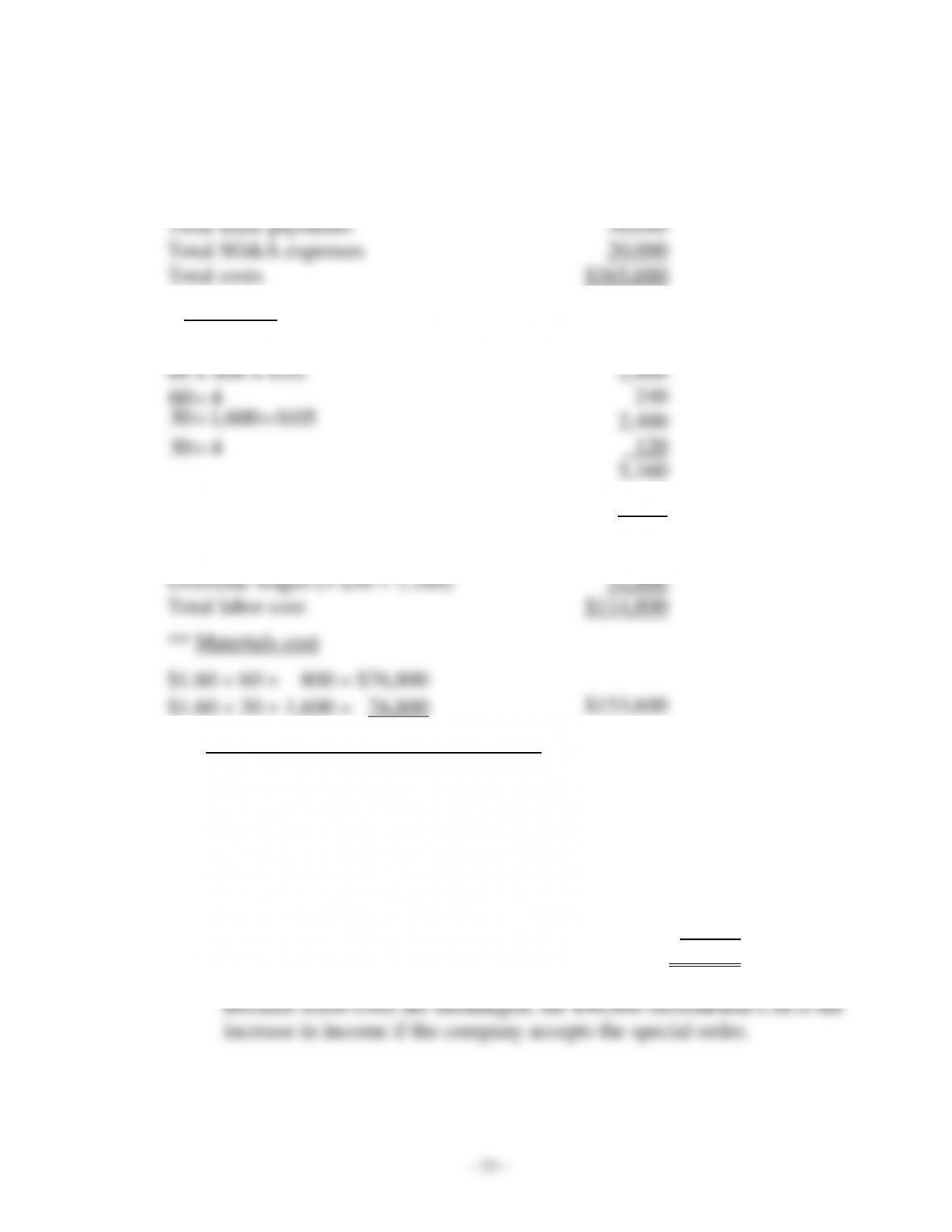
Total labor cost
$114,800
*
Total materials cost
153,600
**
Total variable manufacturing overhead
cost
41,280
***
Total lease payments
36,000
Total SG&A expenses
20,000
Total costs
$365,680
* Labor cost
Total labor hours required:
60 × 800 × 0.05
2,400
60 4
240
30 1 600 0 05 , .
2,400
30 4
120
5,160
Labor hours available
4,000
Overtime hours required
1,160
Regular wages (= $20 4,000)
$ 80,000
Overtime wages (= $30 1,160)
34,800
Total labor cost
$114,800
** Materials cost
$1.60 60 800 = $76,800
$1.60 30 1,600 = 76,800
$153,600
*** Variable manufacturing overhead cost
$8 5,160 labor hours
$41,280
3-56 (a) This is a special order where the company has sufficient excess capacity
to fill the order.
Incremental revenue
8,000 $22
$176,000
Incremental VC
8,000 ($5 + 4+1)
80,000
Incremental CM
8,000 ($22 10)
$96,000
– 54 –
(b) This is a special order where the company has insufficient excess
capacity to fill the order, and therefore faces an opportunity cost if it fills
the order.
Incremental CM from (a)
8,000 ($22 10)
$96,000
Opportunity cost from lost sales*
5,000 ($25 (5 + 4))
80,000
Net increase in CM
$16,000
3-57 (a) Variable costs per chip = $720,000/1,600 = $450 per chip
Profit = ($500 − $450) × 2,000 − $75,000 = $25,000
accepts the order is ($480 − $450) × 200 = $6,000 per week.
(c) Because there is not enough surplus capacity to produce the 600 units
company will gain ($480 – $450) 600 = $18,000 per week from the
special order, but that gain will be offset by lost contribution margin
$8,000 per week.
Chapter 3: Using Costs in Decision Making
– 55 –
3-58 (a) Acquisition cost and depreciation expense for the existing elevator
system are irrelevant.
(b)
Relevant cost
Existing System
New System
Acquisition cost
—
$875,000
Salvage value of existing system at present
—
(100,000)
Operating costs for 6 years
$900,000
48,000
Salvage value after 6 years
(25,000)
(100,000)
$875,000
$723,000
3-59
(a)
Selling price per unit
$4.00
Variable cost per unit
3.30
Contribution margin per unit
$0.70
Number of units
50,000
Increase in operating income
$35,000
Genis Battery Company should accept the special order because it is
operating under capacity and this order can generate $35,000 in
additional operating income.
(b) Average unit costs can be misleading. Fixed costs are not relevant to this
decision—the decision should be based on incremental costs.
account.
Atkinson, Solutions Manual t/a Management Accounting, 6E
– 56 –
3-60
(a)
Net cost saving over 4 years with new machine
Cash inflow:
Salvage value difference
$ 2,000
Decrease in annual operating costs (4 years $60,000)
240,000
Reduction in rework cost
10,000a
Cash outflow:
Acquisition of new machine ($360,000 – $100,000)
(260,000)
Net cash inflow (outflow):
($ 8,000)
of ($8,000).
(b) The acquisition cost of the old machine is a sunk cost.
(c) Other considerations:
is covered in other courses.)
3-61 (a) Because the distinctive desserts are a source of competitive advantage,
Beau should carefully consider the quality, freshness, and distinctiveness
replacement pastry chef. If Beau hires a new pastry chef, the chef may be
more responsive than the outside bakers to Beau’s customers’ tastes.
second bid promises only traditional desserts. In-house pastry production
is the highest-cost option. The ultimate decision should take into account
Chapter 3: Using Costs in Decision Making
– 57 –
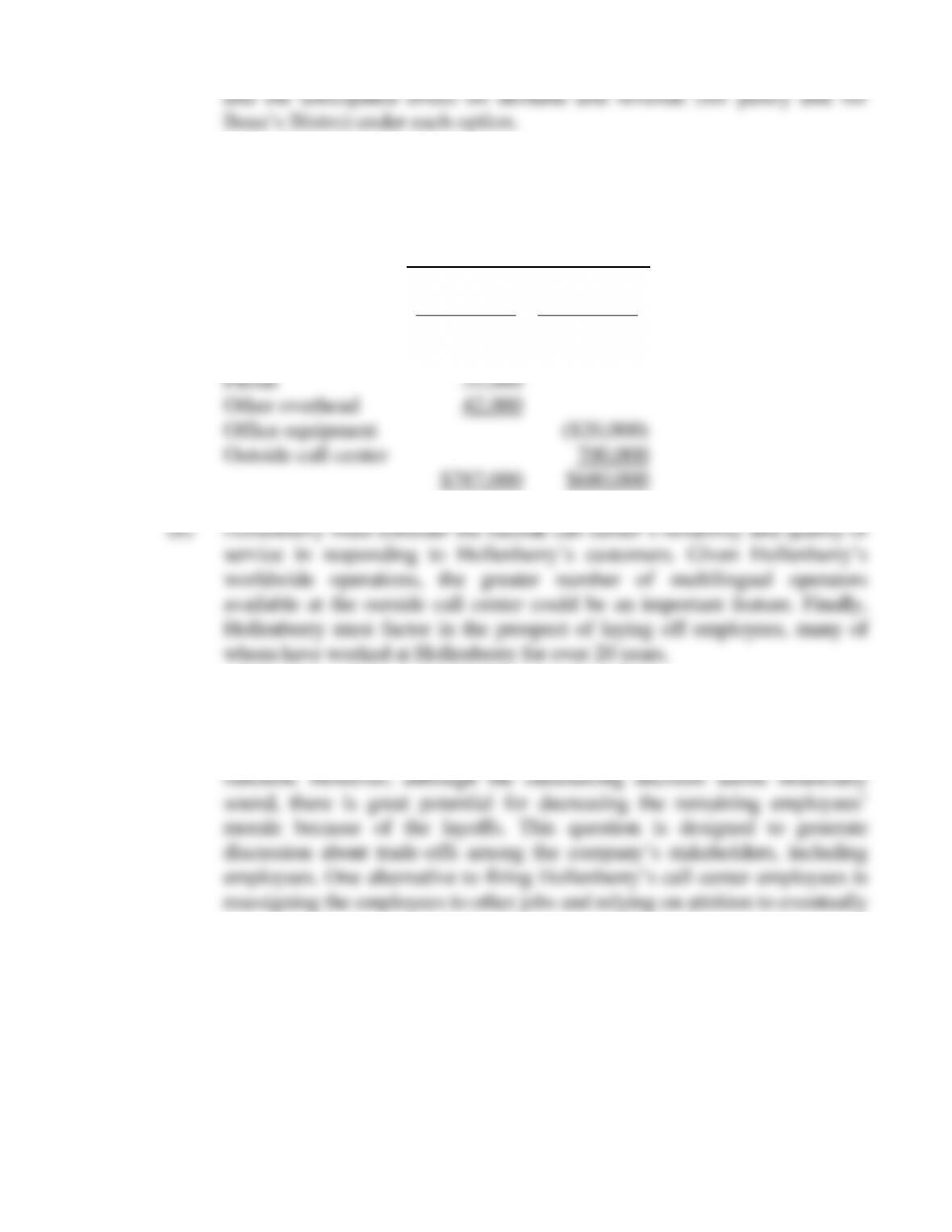
3-62 (a) The costs and benefit shown below are relevant for the outsourcing
decision. All but the –$20,000 sale of office equipment are annual costs.
Costs
In–house
Outside
Call Center
Call Center
Labor
$650,000
Rent
60,000
Phone
35,000
Other overhead
42,000
Office equipment
($20,000)
Outside call center
700,000
$787,000
$680,000
(c) If the outside call center can meet Hollenberry’s expectations for reliability
and quality, including better service for international customers, financial
considerations point toward Hollenberry outsourcing the call center
reduce employee costs to Hollenberry’s desired level. However, this would
increase the cost of the outsourcing option and reduce its financial
benefits.
– 58 –
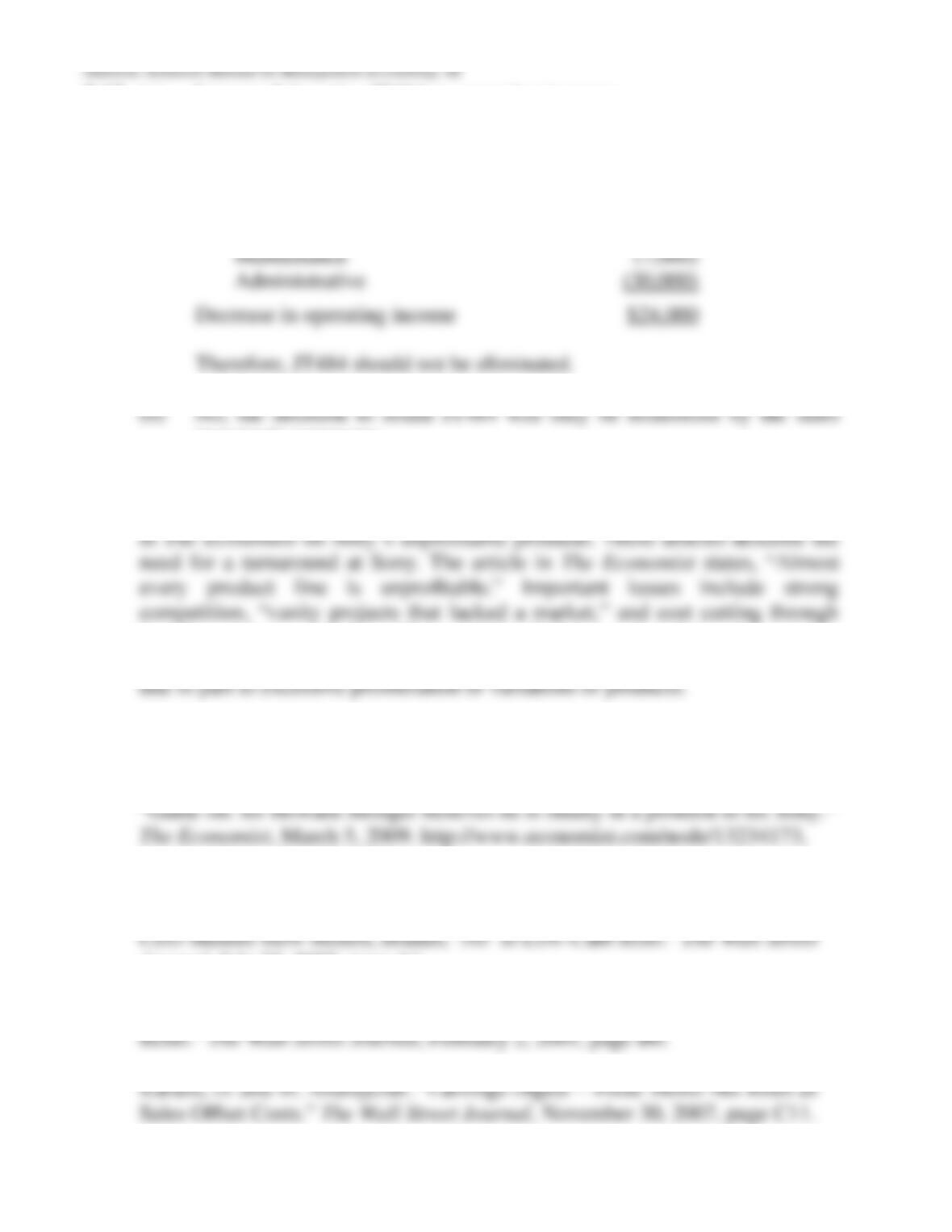
3-63 (a) Impact of dropping JT484 on operating income:
Reduction in contribution margin
$100,000
Cost savings:
Utilities
(9,000)
Supervision
(30,000)
Maintenance
(7,000)
Administrative
(30,000)
Decrease in operating income
$24,000
manager’s comments.
3-64 Some examples of articles that describe dropping unprofitable products appear
below. The article by Hymowitz provides interesting background for the article
layoffs and factory closings. The article by Ball lays a foundation for activity–
based costing through its discussion of high costs and unprofitable products
Hymowitz, C. “More American Chiefs Are Taking Top Posts At Overseas
Concerns.” The Wall Street Journal, October 17, 2005, page B1.
accessed December 12, 2010.
Ball, D. “Crunch Time: After Buying Binge, Nestlé Goes on a Diet; Departing
Journal, July 23, 2007, page A1.
Wingfield, N. “Amazon to Cut Product Offerings, Plans to Drop Unprofitable