Chapter 3: Using Costs in Decision Making
– 39 –
Incremental revenue per meal
$3.50
Incremental cost per meal
3.00
Incremental contribution margin per meal
$0.50
Number of meals
× 1,000
Increase in contribution margin and operating income
$ 500
Healthy Hearth will be better off by $500 with this one-time order. Note
that total fixed costs remain unchanged, so it is sufficient to evaluate the
change in the contribution margin. If the order had been long-term,
(b) Healthy Hearth has insufficient excess capacity to handle the one-time
Incremental contribution margin from one-time order
Incremental revenue per meal
$3.50
Incremental cost per meal
3.00
Incremental contribution margin per meal
$0.50
Number of meals
1,000
Increase in operating income from one-time order
$500
Opportunity cost
Lost contribution margin on regular sales: 500 × ($4.50 – $3.00)
$(750)
Change in contribution margin and operating income
$(250)
Now, Healthy Hearth will be worse off by $250 with this one-time order.
3-34 (a) Relevant costs:
• Acquisition cost of Ford Escort
• Repairs on the Impala
• Annual operating costs on the Ford Escort
Atkinson, Solutions Manual t/a Management Accounting, 6E
– 40 –
(b) Don will buy the Ford Escort if he bases the decision only on the
available cost information.
Year 1: (If Don buys the Ford Escort)
Cash savings:
Repairs on the Impala
$5,400
Operating cost—Impala
2,900
8,300
Cash expenditures:
Acquisition cost—Ford Escort
5,400
Operating cost—Ford Escort
1,800
7,200
First Year Savings
$1,100
(c) Additional quantitative considerations:
1. Number of years before car is replaced (decision horizon).
2. Expected resale values of both cars when they will be replaced.
3. Cost of capital (interest rate) to consider the time value of money.
(This topic is covered in other courses.)
Qualitative consideration:
1. Subjective preference for driving an Impala rather than a Ford
Escort.
3-35
Per Unit
As Is
Rework
Sales price
$4
$10.00
Rework cost
—
$5.50*
Net after rework
$4
$4.50
*55,000 ÷ 10,000
Gilmark should rework the lamps.
Chapter 3: Using Costs in Decision Making
– 41 –
3-36 (a) The original cost of $50,000 and accumulated depreciation of $40,000
are sunk, and therefore irrelevant, when the choice is between
(b) Relevant costs include the acquisition cost of the new machine, the cost
of overhauling the old machine, current salvage of $4,000 for the old
(c)
Replacement
Overhauling
Difference
Net acquisition cost
$66,000a
$25,000
$41,000
Salvage value at the
end of 5 years
(500)
(200)
(300)
Operating costs for
5 years
65,000b
70,000c
(5,000)
Total relevant costs
$130,500
$94,800
$35,700
a $70,000 – $4,000 = $66,000
b $13,000 5 = $65,000
c $14,000 5 = $70,000
– 42 –
3-37
Year 1
Year 2
Year 3
Year 4
Year 5
Cash inflow:
Sale of old machine
$40,000
(5,000)
Saving because old
machine not repaired
20,000
Salvage value of
new machine
$10,000
Decrease in annual
operating costs
20,000
$20,000
$20,000
$20,000
$20,000
Cash outflow:
Purchase of new machines
(120,000)
0
0
0
0
Net cash inflow
(outflow)
($40,000)
$20,000
$20,000
$20,000
$25,000
Cumulative cash
inflow (outflow)
($40,000)
($20,000)
$0
$20,000
$45,000
3-38
(a)
Insource (Make)
Outsource (Buy)
Smart phones:
$140 50,000
$7,000,000
$7,000,000
Component:
$35.00 50,000
1,750,000
$34.00 50,000
1,700,000
Relevant costs
$8,750,000
$8,700,000
(b)
Insource (Make)
Outsource (Buy)
Smart phones:
$140 50,000
$7,000,000
$7,000,000
Component:
$30.00 50,000
1,500,000
$34.00 50,000
1,700,000
Relevant costs
$8,500,000
$8,700,000
Chapter 3: Using Costs in Decision Making
– 43 –
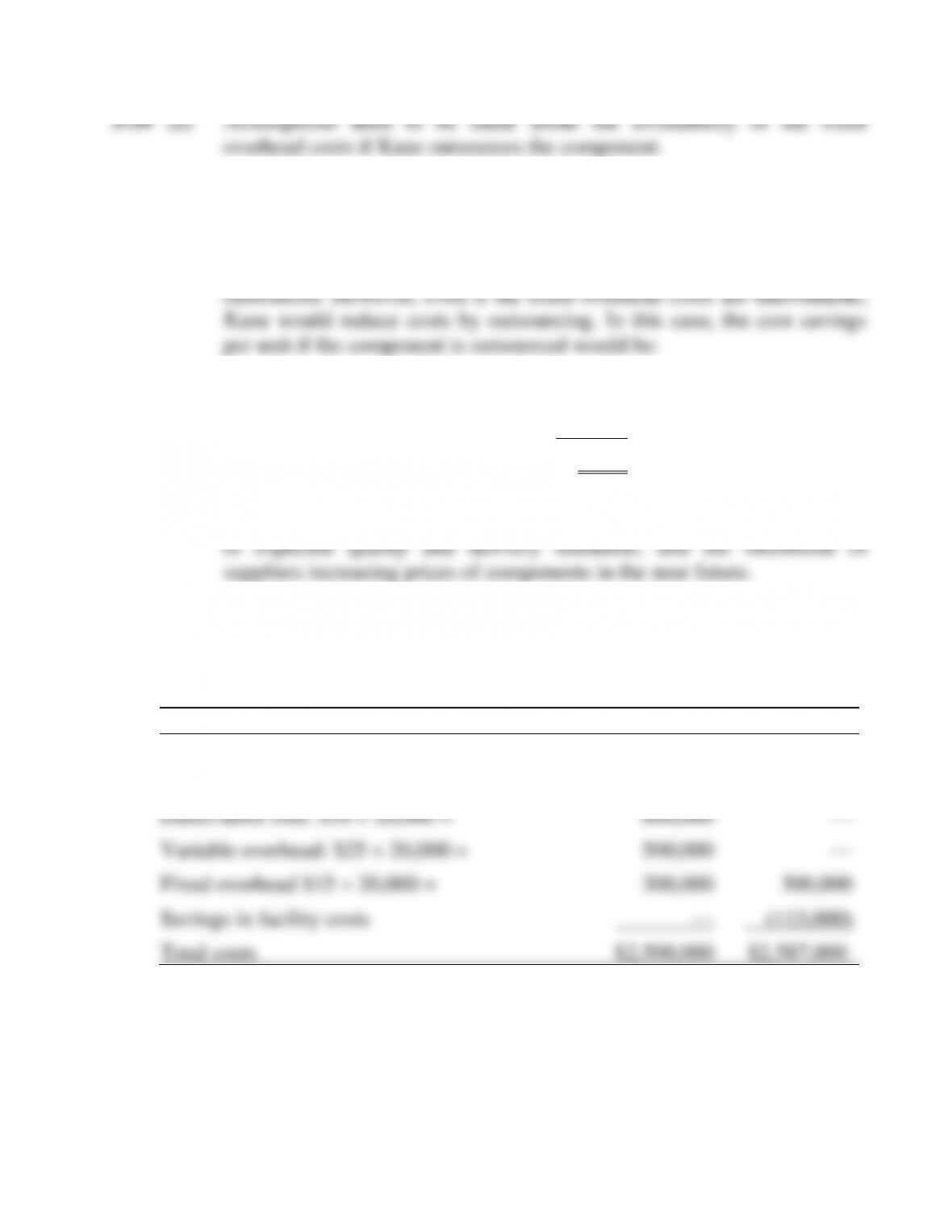
(b) If the variable costs (direct materials, direct labor, and variable overhead)
are all avoidable, then Kane will certainly reduce costs by outsourcing
the component. Fixed overhead costs may be unavoidable if the facility
cannot be converted to alternative uses when the component is
Purchase price
$64.50
Avoidable costs ($73.10 – $6.90)
66.20
Savings per unit
$1.70
(c) Other factors relevant to the decision are the supplier’s ability to live up
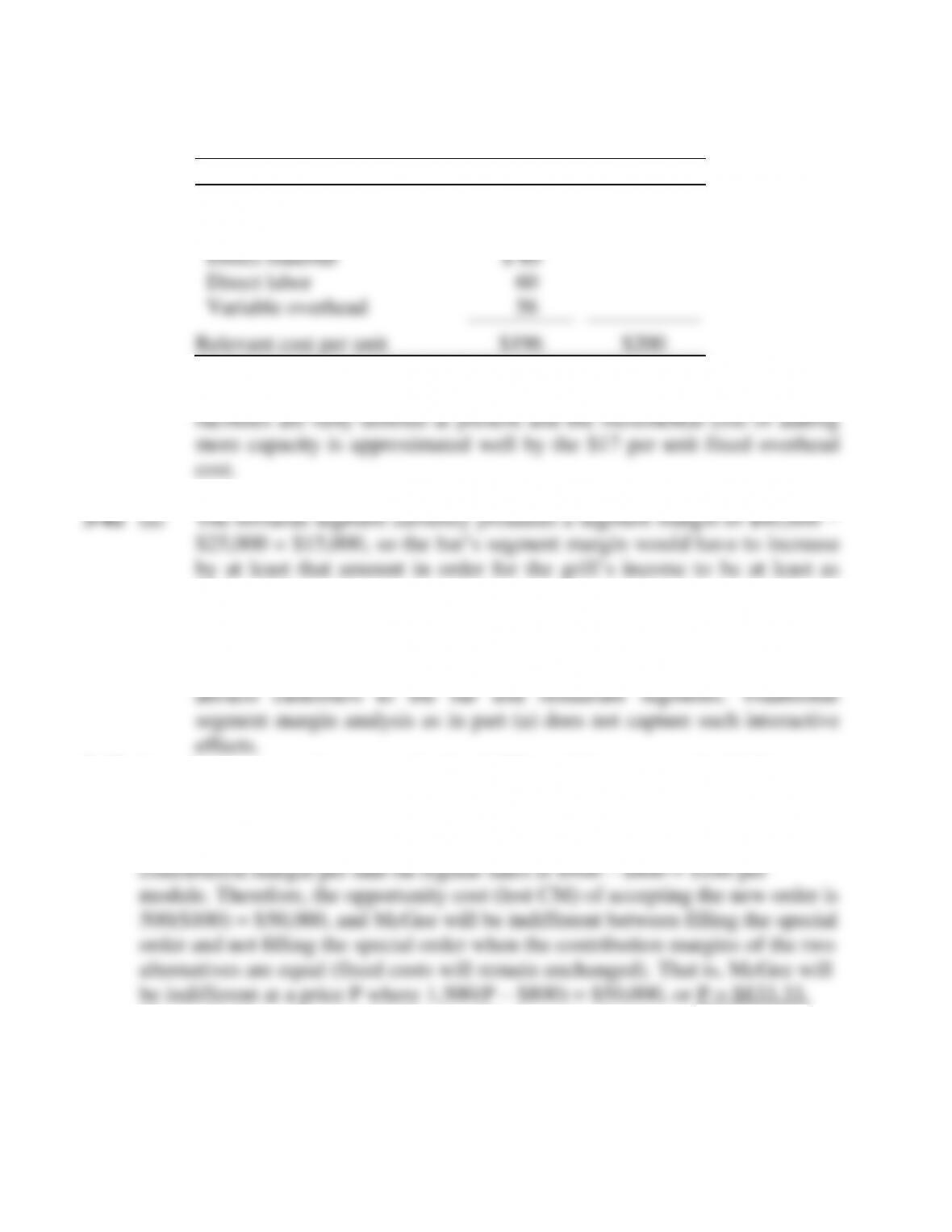
3-40 Premier should make the gear model G37 because it costs $87,000 less to
make than to buy. (Fixed overhead is irrelevant and may be dropped from
the analysis.)
Make
Buy
Cost of purchase: $120 20,000 =
$2,400,000
Direct material cost: $55 20,000 =
$1,100,000
Direct labor cost: $30 20,000 =
600,000
—
Variable overhead: $25 20,000 =
500,000
—
Fixed overhead $15 20,000 =
300,000
300,000
Savings in facility costs
—
(113,000)
Total costs
$2,500,000
$2,587,000
Atkinson, Solutions Manual t/a Management Accounting, 6E
– 44 –
3-41 (a) The offer by Superior Compressor should not be accepted if fixed
overhead costs are unavoidable.
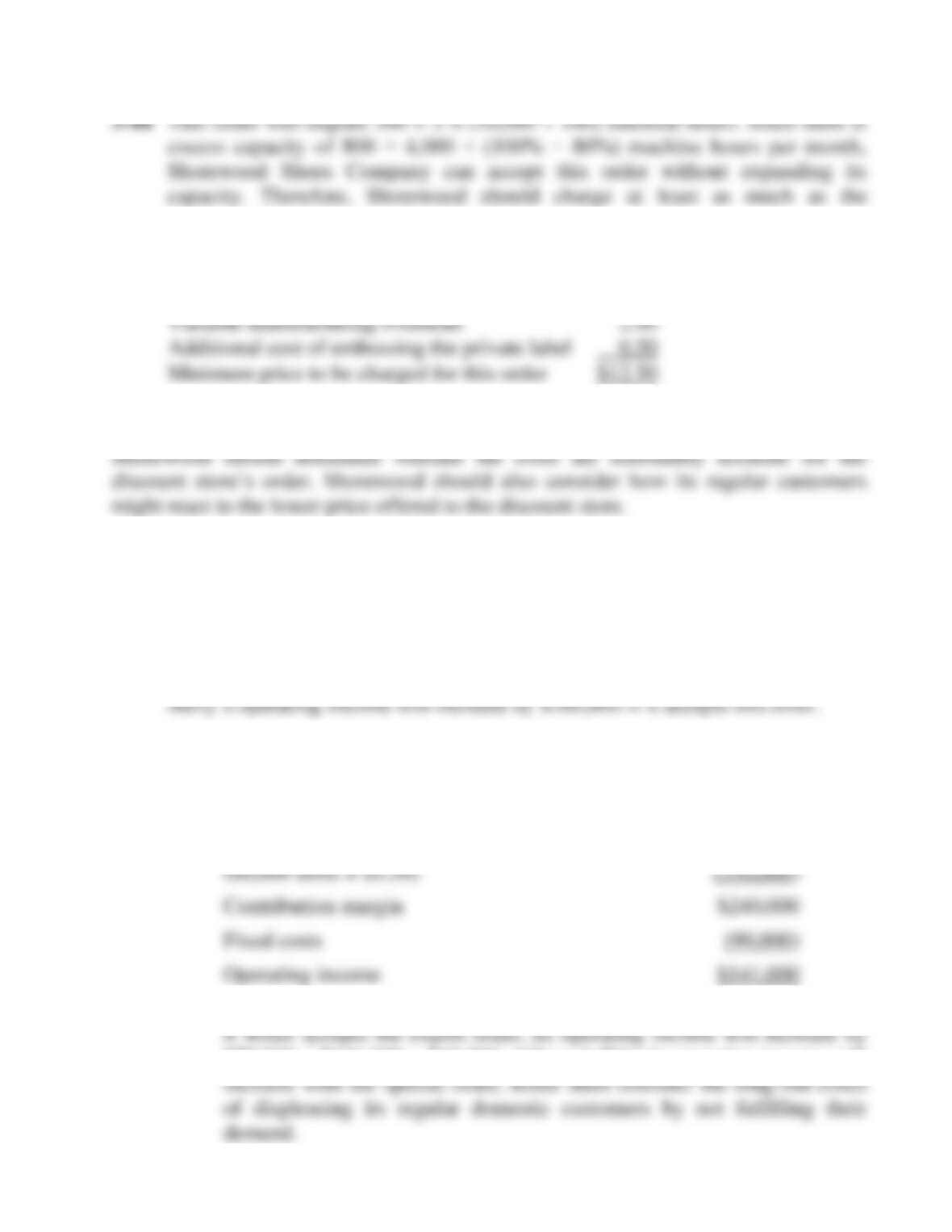
Cost per unit
Make
Buy
Cost of purchase
$200
Variable cost:
Direct material
$ 80
Direct labor
60
Variable overhead
56
Relevant cost per unit
$196
$200
(b) The maximum acceptable purchase price is $213 per unit if the plant
high as it is now.
(b) George should consider the effect on the other two segments’ revenues if
he drops the billiards segment. It may be that the availability of billiards
3-43 In order to accept the new order for 1,500 modules next week, McGee must
give up regular sales of 500 modules per week.
Variable costs are $800 per module ($2,400,000/3,000 modules). The
This is the floor price that McGee should charge for the new order.
Chapter 3: Using Costs in Decision Making
– 45 –
incremental variable costs for this order.
Direct material
$6.00
Direct labor
4.00
Variable manufacturing overhead
2.00
Additional cost of embossing the private label
0.50
Minimum price to be charged for this order
$12.50
Shorewood’s costs stated in the problem are average costs per pair of shoes.
3-45 Incremental variable costs = ($16 + $5 + $3) × 10,000
= $24 × 10,000
= $240,000.
Incremental revenue = $40 × 10,000 = $400,000.
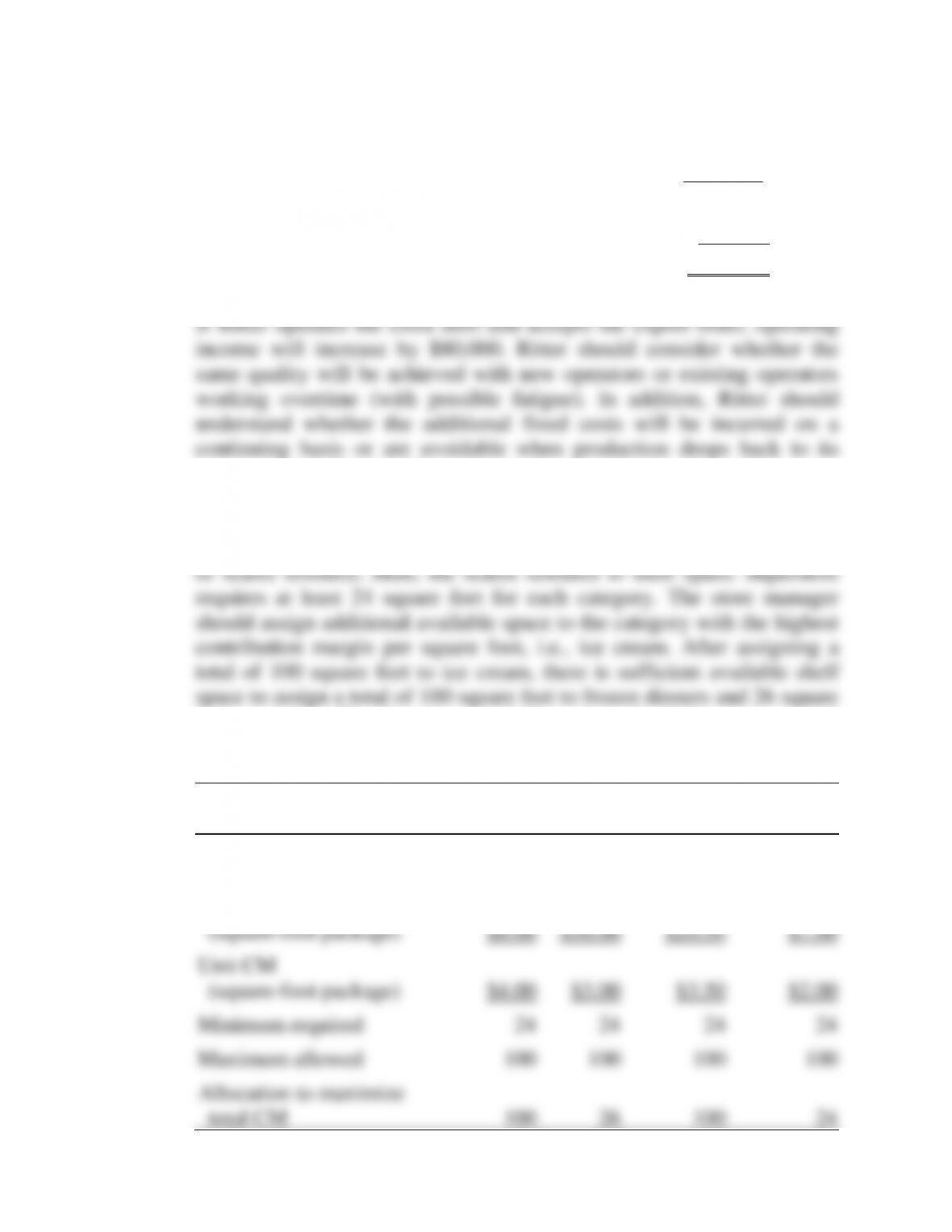
3-46 (a) Variable cost per unit = $198,000 ÷ 36,000 = $5.50.
Sales (30,000 units × $10 and 30,000 units × $9)
$570,000
Variable manufacturing and selling costs
(60,000 units × $5.50)
(330,000)
Contribution margin
$240,000
Fixed costs
(99,000)
Operating income
$141,000
$78,000 = $141,000 − $63,000. Although Ritter’s operating income will
Atkinson, Solutions Manual t/a Management Accounting, 6E
– 46 –
(b)
Sales (36,000 units × $10 and 30,000 units × $9)
$630,000
Variable manufacturing and selling costs
(66,000 units × $5.50)
(363,000)
Contribution margin
$267,000
Fixed costs: $99,000 $25,000
124,000
Operating income
$143,000
previous level. Finally, Ritter should also consider the effect of this price
reduction on regular customers.
3-47 (a) Superstore faces a problem of maximizing contribution margin per unit
feet to juices. The frozen vegetable receives the minimum required
assignment of 24 square feet.
Ice Cream
Juices
Frozen
Dinners
Frozen
Vegetables
Selling price per unit
(square-foot package)
$12.00
$13.00
$24.00
$9.00
Variable costs per unit
(square-foot package)
$8.00
$10.00
$20.50
$7.00
Unit CM
(square-foot package)
$4.00
$3.00
$3.50
$2.00
Minimum required
24
24
24
24
Maximum allowed
100
100
100
100
Allocation to maximize
total CM
100
26
100
24
Chapter 3: Using Costs in Decision Making
– 47 –
should also consider the effect of the mix on other product sales. If the
store offers only a limited selection of frozen vegetables, for example,
shoppers may switch to another store for their regular grocery shopping.
3-48
Regular
Deluxe
Sale price per sq. yard
$16
$25
Variable costs per sq. yard
10
15
Contribution margin per sq. yard
$6
$10
DLH required per sq. yard
0.15
0.20
Contribution margin per DLH
$40a
$50b
a $6 ÷ 0.15 = $40
b $10 ÷ 0.20 = $50
optimal production level for each product is:
Deluxe: 8,000 sq. yards
– 48 –
PROBLEMS
3-49 The following items are variable costs:
Carpenter labor to make shelves
$600,000
Wood to make the shelves
450,000
Sales commissions based on number of units sold
180,000
Miscellaneous variable manufacturing overhead
350,000
Total variable costs
$1,580,000
items are fixed costs:
Sales staff salaries
$80,000
Office and showroom rental expenses
150,000
Depreciation on carpentry equipment
50,000
Advertising
200,000
Miscellaneous fixed manufacturing overhead
150,000
Rent for the building where the shelves are made
300,000
Depreciation for office equipment
10,000
Total fixed costs
$940,000
Revenue – Costs = Income
(Price × Quantity) – Variable costs – Fixed costs = Income
$70X – $31.60X – $940,000 = $500,000
X = 37,500 units
3-50
(a)
Selling price per unit:
$105.00
Variable cost per unit:
Direct material
$30.00
Direct labor
20.00
Variable overhead
10.00
Commission
10.50
70.50
Contribution margin
per unit:
$34.50