– 29 –
Chapter 3
Using Costs in
Decision Making
QUESTIONS
3-1 Cost information is used in pricing, product planning, budgeting, performance
evaluation, and contracting. Examples of specific uses of cost information
3-2 Variable costs are costs that increase proportionally with changes in the activity
3-3 Contribution margin per unit, which is the difference between revenue per unit
and variable cost per unit, is the contribution that each unit makes to covering
3-4 Contribution margin per unit is the difference between revenue per unit and
variable cost per unit. The contribution margin per unit indicates how much the
total contribution margin will increase with an additional unit of sales. The
3-5 In evaluating whether a business venture will be profitable, the breakeven point
Atkinson, Solutions Manual t/a Management Accounting, 6E
– 30 –
3-6 A mixed cost is a cost that has a fixed component and a variable component.
For example, utilities bills may include a fixed component per month plus a
variable component that depends on the amount of energy used. A step
variable cost increases in steps as quantity increases. For example, one
supervisor may be hired for every 20 factory workers. Mixed costs and step
3-7 Step variable costs are fixed for a fairly narrow range of activity and increase
when the next step is reached. For example, one supervisor may be hired for
3-8 Incremental cost is the cost of the next unit of production and is similar to the
economist’s notion of marginal cost. In a manufacturing setting, incremental
cost is often defined as a constant variable cost of a unit of production.
However, in some situations, the variable cost of a unit of production may be
more complicated. For example, the variable cost of labor per unit may
decrease over time if workers become more efficient (a learning effect.
Alternatively, the variable cost of labor per unit will change during overtime
number of employees.
3-9 In evaluating the different alternatives from which managers can choose, it is
better to focus only on the relevant costs that differ across different alternatives
because it does not divert the manager’s attention with irrelevant facts. If some
irrelevant information.
3-10 Sunk costs are costs that are based on a previous commitment and cannot be
recovered. For example, depreciation on a building reflects the historical cost
Chapter 3: Using Costs in Decision Making
– 31 –
the decision.
3-11 The general principal is that sunk costs are not relevant costs. But, some
managers may consider sunk costs to be relevant because they may be
concerned about how others will perceive their original decision to incur these
3-12 No, fixed cost are not always irrelevant. For example, in comparing the status
quo and a proposal to substantially increase the quantity of goods or services
3-13 An opportunity cost is the maximum value forgone when a course of action is
chosen.
3-14 Yes, avoidable costs are relevant because they can be eliminated when, for
3-15 In the context of a make or buy decision, fixed costs such as production
engineering staff salaries are relevant if these costs can be eliminated by assigning
the staff to other tasks, or by laying off the engineers not required when a part is
outsourced. If it is possible to find an alternative use for the facilities made
3-16 There are several qualitative considerations that must be evaluated in a make–
or-buy decision. For example, one must question whether the outside supplier
Atkinson, Solutions Manual t/a Management Accounting, 6E
– 32 –
3-17 When a decision to outsource frees up space to produce an alternative product,
then the contribution margin on the alternative product is a relevant
3-18 A difficulty that arises with respect to revenue when analyzing whether to drop
a product or department is whether sales by one organizational unit can affect
sales in another organizational unit. A difficulty that arises with respect to cost
analysis is that many product costs, such as machine and factory depreciation,
environmental cleanup costs.
3-19 The answer depends on the time frame and context considered. For example, a
one-time order that covers variable production (and selling costs) is
advantageous if capacity cannot be changed in the short run and excess
the firm to survive.
3-20 No. Products should be ranked by the contribution margin per unit of the
constrained resource rather than by the contribution margin per unit of the product.
3-22 The three components of a linear program are the objective function, the
Chapter 3: Using Costs in Decision Making
– 33 –
EXERCISES
3-23 (a) Fixed
(b) Variable
(c) Variable
(d) Fixed
(e) Fixed
(f) Variable
(g) Variable
run);
(i) Fixed
3-24 (a) Variable
(b) Fixed
(d) Fixed
(e) Fixed
(f) Variable
(g) Fixed
(h) Fixed (with respect to a unit of product, as stated in the problem.
3-25
Burger ingredients
Variable
Cooks’ wages
Fixed
Server’s wages
Fixed
Janitor’s wages
Fixed
Depreciation on cooking equipment
Fixed
Paper supplies (wrapping, napkins, and supplies)
Variable
Rent
Fixed
Advertisement in local newspaper
Fixed
– 34 –
3-26 (a) Contribution margin per unit = $1,000 – $500 – $100 = $400
Sales revenue – Costs = Income
$100 = $450 and the new breakeven point is $3,500,000/$450 = 7,778
units (rounded).
3-27 (a) Let P charges per patient-day.
(5,400 P) (5,400 $500) $2,000,000) = 0
Revenue – Costs = Income
(Price × Quantity) – Variable costs – Fixed costs = Income
Chapter 3: Using Costs in Decision Making
– 35 –
3-28 (a) Contribution margin per unit = $30 – $19.50 = $10.50
Sales revenue – Costs = Income
(Price × Quantity) – Variable costs – Fixed costs = Income
pretax income of 20% of revenue
Sales revenue – Costs = Income
(Price × Quantity) – Variable costs – Fixed costs = Income
20% of revenue
Sales revenue – Variable costs – Fixed costs = Income
(Before-tax income) (1 – 0.35) = $109,200
fixed costs = $0
$30Y – $19.50Y – $38,500 = $0
Y = 3,667 units (rounded)
Atkinson, Solutions Manual t/a Management Accounting, 6E
– 36 –
The contribution margin ratio = ($1,260,000 – $570,000)/$1,260,000 =
0.547619 (rounded).
Sales revenue – Variable costs – Fixed costs = Income
Contribution margin – Fixed costs = Income
Contribution margin – Fixed costs = 0
The Domestic CM = $50 – $30 = $20; the International CM = $40 – $16 = $24
Let X = total number of units that must be sold in the International market to
earn $200,000 before taxes, assuming the stated sales mix
Total CM – Fixed costs = $200,000
Equivalently, one can compute a weighted average unit CM: (3/5) × ($20) +
Total CM – Fixed costs = $200,000
$21.60Y − $5,000,000 − $1,280,000= $200,000
Chapter 3: Using Costs in Decision Making
– 37 –
3-31
(a)
Alligators
Dolphins
Total
Units sold
140,000
60,000
200,000
Sales mix
percentage*
.7
.3
Weighted
average**
Weighted
average**
Sum of
weighted
averages
Sales price
per unit
$20.00
$14.00
$25.00
$7.50
$21.50
Variable costs
per unit
$ 8.00
$ 5.60
$10.00
$3.00
$ 8.60
Unit CM
$12.00
$ 8.40
$15.00
$4.50
$12.90
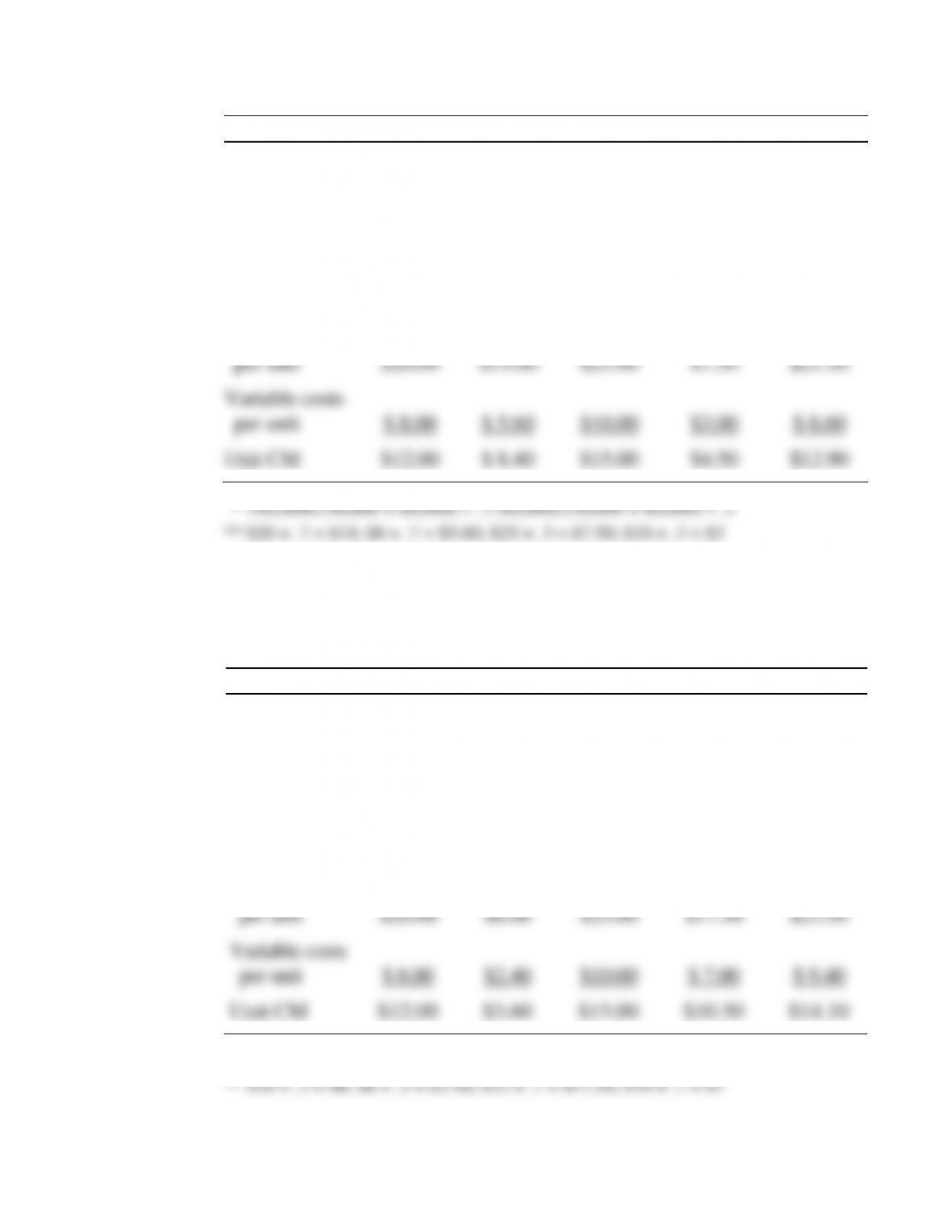
Breakeven units = $1,290,000/$12.90 = 100,000 units. Of these, 100,000
× .7 = 70,000 will be alligators and 100,000 × .3 = 30,000 will be
dolphins.
(b)
Alligators
Dolphins
Total
Units sold
60,000
140,000
200,000
Sales mix
percentage*
.3
.7
Weighted
average**
Weighted
average**
Sum of
weighted
averages
Sales price
per unit
$20.00
$6.00
$25.00
$17.50
$23.50
Variable costs
per unit
$ 8.00
$2.40
$10.00
$ 7.00
$ 9.40
Unit CM
$12.00
$3.60
$15.00
$10.50
$14.10
* 60,000/(140,000 + 60,000) = .3; 140,000/(140,000 + 60,000) = .7
Atkinson, Solutions Manual t/a Management Accounting, 6E
– 38 –
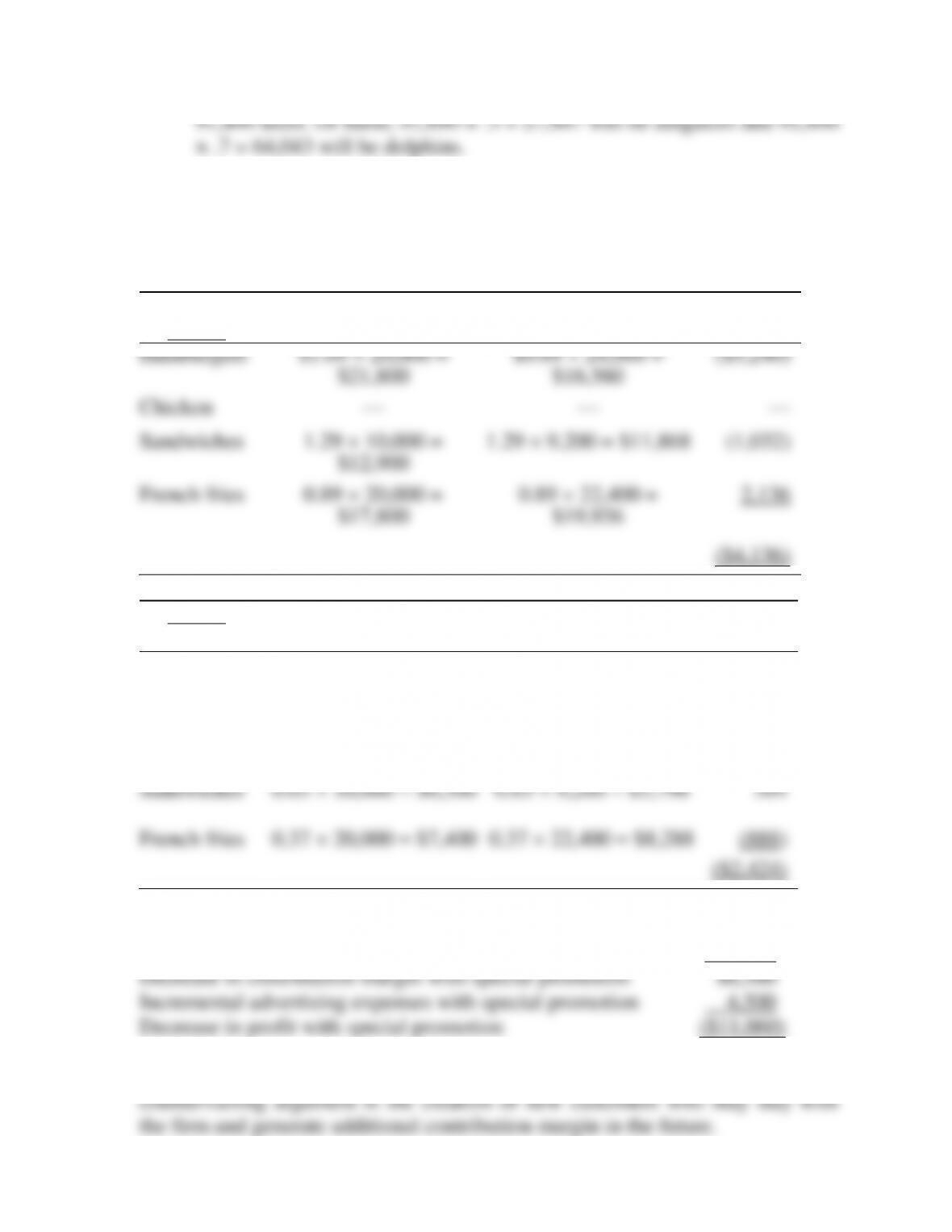
Breakeven units = $1,290,000/$14.10 = 91,489.36, which we round up to
(c) In part (b), the sales mix percentage for the higher-CM product
(dolphins) is greater than in part (a). Consequently, fewer total units are
required to break even (91,490 in part (b) versus 100,000 in part (a)).
3-32
Product
Total Sales Without
Special Promotion
Total Sales With
Special Promotion
Difference
Hamburgers
$1.09 20,000
$21,800
$0.69 24,000
$16,560
($5,240)
Chicken
—
—
—
Sandwiches
1.29 10,000
$12,900
1.29 9,200 $11,868
(1,032)
French fries
0.89 20,000
$17,800
0.89 22,400
$19,936
2,136
($4,136)
Product
Variable Costs Without
Special Promotion
Variable Costs With
Special Promotion
Difference
Hamburgers
$0.51 20,000
$10,200
$0.51 24,000
$12,240
($2,040)
Chicken
—
—
—
Sandwiches
0.63 10,000 $6,300
0.63 9,200 $5,796
504
French fries
0.37 20,000 $7,400
0.37 22,400 $8,288
(888)
($2,424)
Decrease in sales with special promotion $4,136
Increase in variable costs with special promotion 2,424
Therefore, Andrea should not go ahead with this special promotion. A