Chapter2: The Balanced Scorecard and Strategy Map
–41–
areas
development
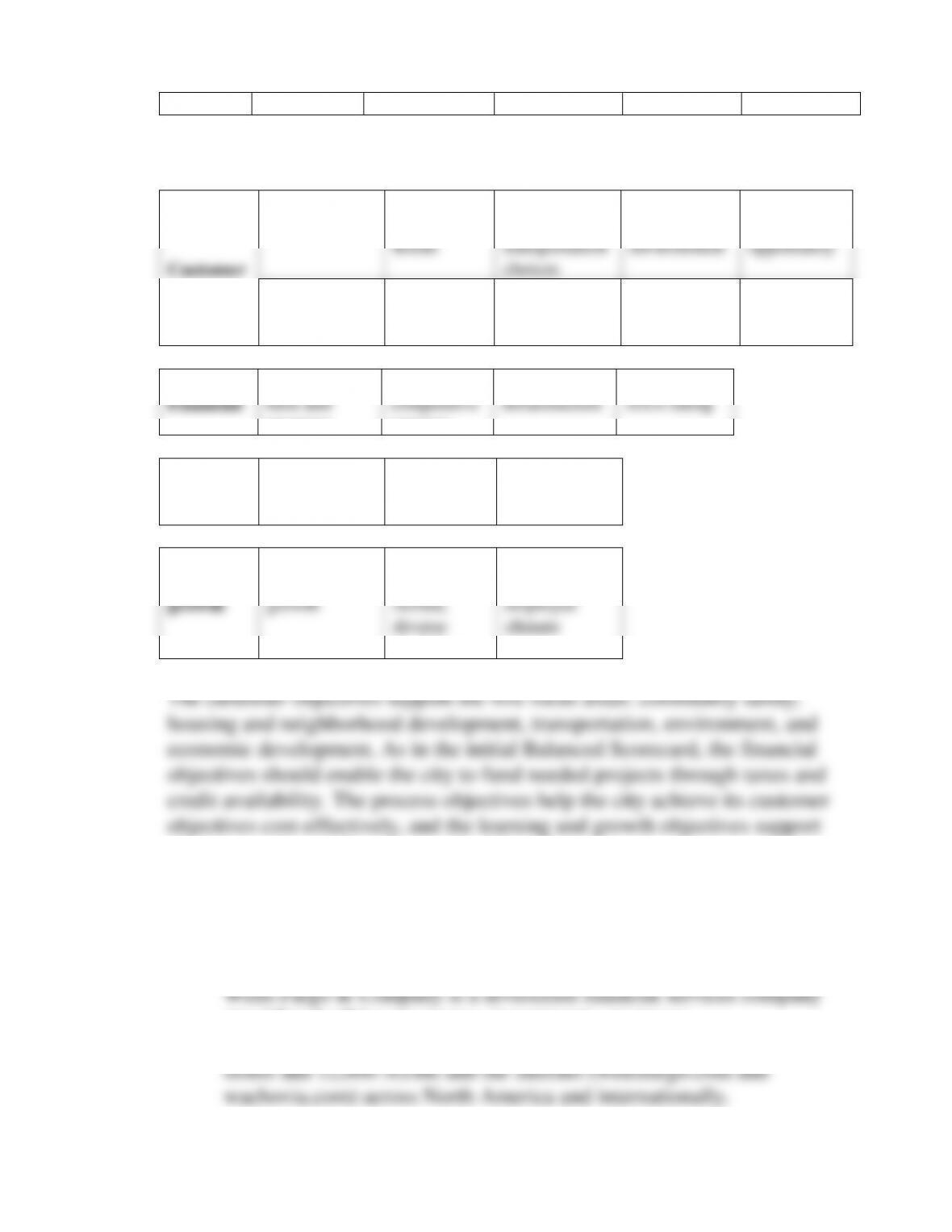
City of Charlotte Balanced Scorecard
Perspective
Customer
Reduce crime
Strengthen
neighbor-
hoods
Provide safe,
convenient
transportation
choices
Safeguard
the
environment
Promote
economic
opportunity
Increase
perception of
safety
Financial
Expand tax
base and
revenues
Deliver
competitive
services
Invest in
infrastructure
Maintain
AAA rating
Process
Develop
collaborative
solutions
Enhance
customer
service
Optimize
business
processes
Learning
and
growth
Promote
learning and
growth
Recruit and
retain
skilled,
diverse
workforce
Achieve
positive
employee
climate
the process, financial, and customer objectives.
2-52 Wells Fargo describes itself as follows in its company overview at
https://www.wellsfargo.com/downloads/pdf/about/wellsfargotoday.pdf
(June 19, 2010):
providing banking, insurance, investments, mortgage,
and consumer and commercial finance through more than 10,000
Atkinson, Solutions Manual t/a Management Accounting, 6E
companies.
The firm reported assets of $1.2 trillion as of March 31, 2010.
In the 1990’s, Wells Fargo already had a reputation for innovation and cost
management (“Wells Fargo Online Financial Services (A),” Harvard
measures and initiatives are also provided.
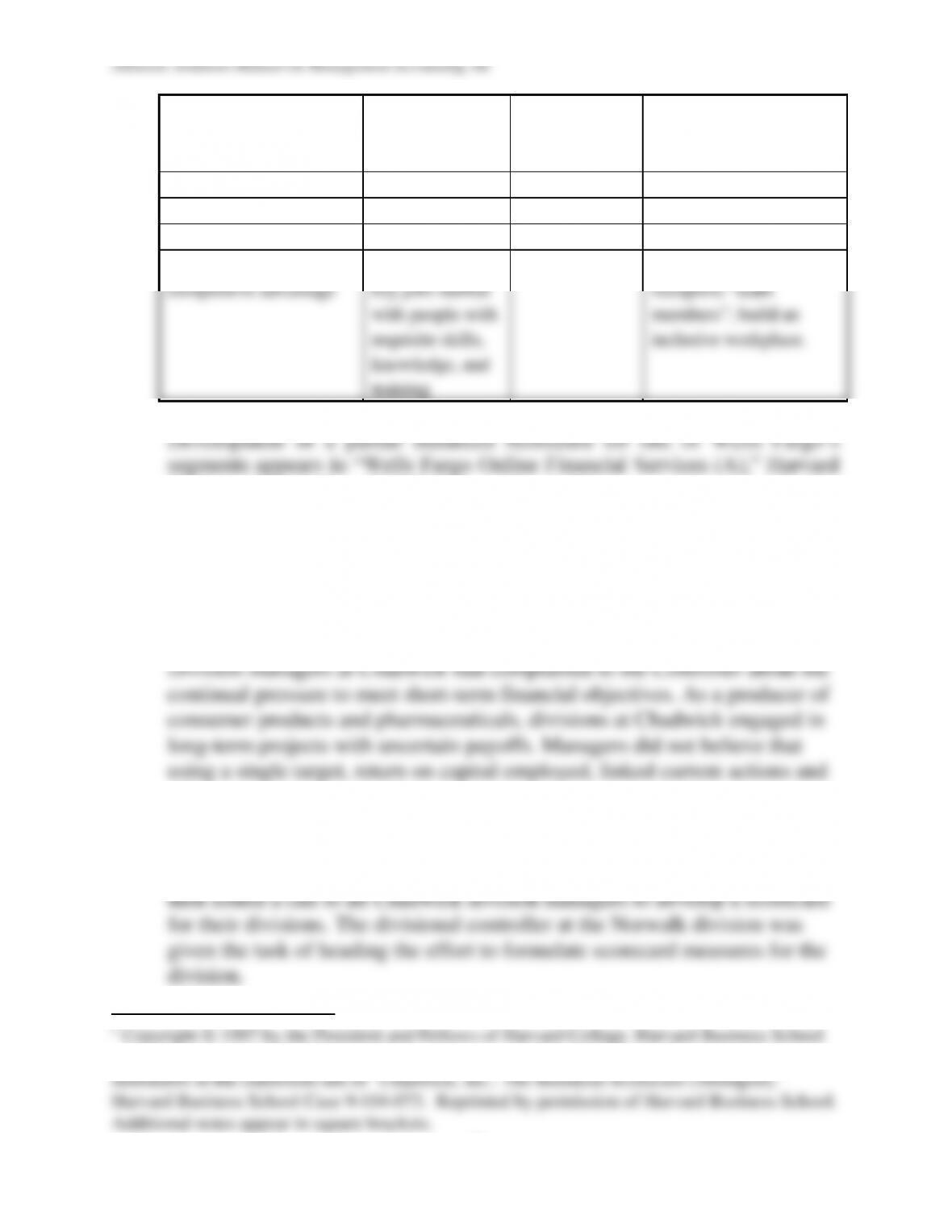
Measures
Targets
Initiatives
(1) Investments,
brokerage, trust and
insurance (satisfy
customers’ financial
needs)
Percentage of
Wells Fargo’s
profit.
Increase profit
of these
segments as a
group to 25%
of Wells
Fargo’s profit.
Add more private
bankers, license more
bankers to sell mutual
funds.
(2) Going for “gr–eight”!
(cross-sell)
Number of
products per
customer
Increase
average to 8.
Offer packages of
products that save
customers time and
money. For example, the
Homebuyers’ Package
offers new mortgage
customers a package of
banking products that
can save customers up to
$340 per year.
(3) Commercial bank of
choice
Number of active
online middle-
market/large
Have more
lead
relationships
Foster customer-focused
culture and attitudes;
provide training to

Chapter2: The Balanced Scorecard and Strategy Map
number of active
online small
business
customers;
Retention rate
for high-value
customers
every market
we serve.
100%
(e.g., service, beverage,
agribusiness,
technology, healthcare,
government, and
environmental).
(4) Doing it right for the
customer (be advocates
for customers)
Proportion of
customers lost
per year
Cut proportion
in half (to 1 in
10).
Foster customer-focused
culture and attitudes.
(5) Banking with a
mortgage
Percent of
mortgage and
home-equity
customers in
Wells Fargo’s
banking states
who bank with
Wells Fargo, and
vice versa
100% cross-
selling between
banking
customers and
mortgage/
home-equity
customers
Initiative to migrate
mortgage and home-
equity customers to
become Wells Fargo
banking customers.
(6) Wells Fargo cards in
every Wells Fargo wallet
Percent of bank
customers who
have a credit
card or debit
card with Wells
Fargo
100% for each
type of card
Cross-selling initiative
to existing banking
customers without Wells
Fargo credit card.
(7) When, where, and
how (match when,
where, and how
customers want to be
served)
Ranking of
online services;
number of active
online customers
in various
categories
#1 ranking
Integrate delivery
channels to match when,
where, and how
customers want to be
served. Some machines
and web services have
Spanish or Chinese
language options.
(8) Information-based
marketing (analyze and
meet customer’s needs)
Percentage of
customers
receiving
personalized
marketing
messages
Offer right
product at the
right time to
save customer
time and
money.
Deploy customer
relationship
management and data
mining application
packages.
(9) Be our customers’
Internet
business revenue
and transaction
volume
(10) People as a
competitive advantage
Percentage of
key jobs staffed
with people with
requisite skills,
knowledge, and
training
Develop, reward, and
recognize “team
members”; build an
inclusive workplace.
Business School Case #9-198–146.
2-53 Chadwick, Inc.: The Balanced Scorecard (Abridged)1, Harvard Business
School Case (HBS Case 9-104-073).
Substantive Issues Raised
efforts to longer term value creation.
The corporate controller has recently learned about the Balanced Scorecard.
He presented the concept to the president and chief operating officer who
teaching note 5-198-029. This teaching note was prepared by W. J. Bruns, Jr. as an aid to
Chapter2: The Balanced Scorecard and Strategy Map
–45–
Pedagogical Objectives
they can see how performance on one perspective supports or encourages
achievement on others.
[For part (a), see the “Suggestions for Classroom Use” section. Also see
[(b) and (c)]
Opportunities for Student Analysis
proposed scorecard.
Some of the things they will consider include the following.
For the customer perspective. Customer retention, market share, number of
new products released, key relationships with distributors and final
For the process perspective list, consider the [value-creating] cycle of the
business:
Identify unmet customer needs => explore compounds => test
compounds in laboratory [and] in field => gain government approval
–46–
[ => launch product] => release marketing, production, and
distribution [market, produce, and distribute product].
years — to total development costs, and the following measures that could
also be included in the learning and growth perspective: percentage of sales
inventory availability, and percentage of stockouts.]
For the learning and growth perspective. Percentage of sales from new
applications, number of new applications compared to extensions of
existing applications, gross margin on new products, number of suggestions
from distributors, and number of suggestions from customers. [Possible
For the financial perspective. Dollars and percent of spending on research
Students will put these objectives and their proposed measures together in
measures in the different perspectives.]