Chapter 12: Financial Control
– 453 –
same while the investment level will be $80,000,000 in year 2,
$70,000,000 in year 3, $60,000,000 in year 4, and $50,000,000 in year 5.
(c) The after-tax residual income currently is $1,000,000 = [$7,000,000
($50,000,000 12%)]. The after-tax residual income in the first year
11–64 The following are suggestions; individual responses may vary depending on
what performance the respondent deems critical to the organization’s success.
(a) Rate of adding or losing customers, contribution per customer, and cost
(b) Contribution per performance, other costs and revenues, and committed
innovation.
(d) Cost per unit of work, number of clients, and services per client—an
– 454 –
(f) Design cost per line, contribution per unit, and profit per line—an
11–65 Software writers are highly skilled and creative. Many organizations believe
that to attract and keep this type of person, they have to give them freedom to
organization should control and coordinate the activities of these independent
agents as they create. The example provided for an organic organization should
are free to make decisions.
Governments are mechanistic because they believe this is how they can ensure
servants to meet the spirit of the legislation without tying them down with
burdensome rules and procedures. The example provided for a mechanistic
making responsibilities are highly constrained.
11–66 The key in this question is to identify how many performance measures can
units. Examples include: A courier, any organization using just–in-time, and an
they promote.
11–67 Organizations use the functional approach to organization design to capture the
economies of scale due to specialization in task and information. The problem
Chapter 12: Financial Control
– 455 –
functional approach to product design. This is the approach that Ford Motor
Corporation exploited to design the Taurus automobile and is called concurrent
design.
11–68 (a) The regional offices meet all the criteria to be managed as investment
centers. They control sales, costs, and the level of investment.
level of costs is a difficult issue here.
promoted or controlled using a financial tool. Performance measures will
have to be established that assess the center’s ability to find the products
and at attractive prices.
11–69 (a) The issue turns on the respondent’s view of the role of accountability in
organizations. If the respondent believes that individuals can be
to make them interested in improving performance, then the issue of
controllable versus uncontrollable must be addressed.
disappear and be replaced by questions about group performance.
– 456 –
11–70 The major issue in choosing a transfer price is motivating the managers of the
two divisions to behave in a way that makes the organization’s profits as large
as possible.
For existing home kits, the manager of the sales division will want to buy home
kits as long as the sales division can realize a profit on selling the home kits to
The manager of the manufacturing division will want to sell existing home kits
as long as the manufacturing division can realize a profit on selling the homes
Therefore, any transfer price between $30,000 and $35,000 for the existing
all cottage kits. Home kits require 10 machine hours (mh) per unit and cottage
kits require 13 mh per unit, and 5,000 mh are available per year. Assuming that
requires the following:
P = $38,000 + $6,500 = $44,500.
Note that $6,500 is the opportunity cost of producing and selling a cottage kit
instead of a home kit. This opportunity cost is the $500 of contribution margin
per mh for home kits, multiplied by the 13 mh required per cottage kit. (If one
Chapter 12: Financial Control
– 457 –
= 384.62 will have to rounded down to 384, and the necessary price will be
approximately $44,511.)
requires the following:
(5,000 mh 13 mh per cottage) × (TP – $30,000 – $3,000) =
(5,000 mh 10 mh per home) × ($33,000 $30,000)
TP = $33,000 + $3,900 = $36,900.
This transfer price incorporates the original variable cost of $30,000, the
incremental manufacturing cost of $3,000, and the $3,900 opportunity cost to
($44,500 – $5000). Therefore, a transfer price between $36,900 and $39,500
11–71 This question explores some of the practical problems of using the return on
investment criterion to evaluate on-going investments in fixed assets. The return
on investment tool was originally designed to evaluate new investments rather
than on-going investments. In the case of new investments, there is no
If the original notion of return on investment is applied to evaluate on-going
investments, the philosophy would be to assume that in each period the
organization makes a reinvestment decision. Therefore, the amount implicitly
reinvested is the net realizable value (disposable value) of the investment. In a
– 458 –
(a) In this case we do not know the change in the net realizable value of the
property during the year. Therefore we could compute the return on
investment as 7.43% = [$130,000 ($2,000,000 – $250,000)], which is
(b) The first question to resolve is whether the current results are typical. The
second question to resolve is the basis that will be used to make this
decision. If the basis is purely financial and if the company requires a
land, netting $1,750,000.
CASES
11–72 (a) Shellie is likely to focus her efforts on layout design, the product line that
shows the highest reported profit. With the information provided up to
this point, one can conjecture that Shellie may be undercharging for
layout design because there is great demand for Shellie’s layout design
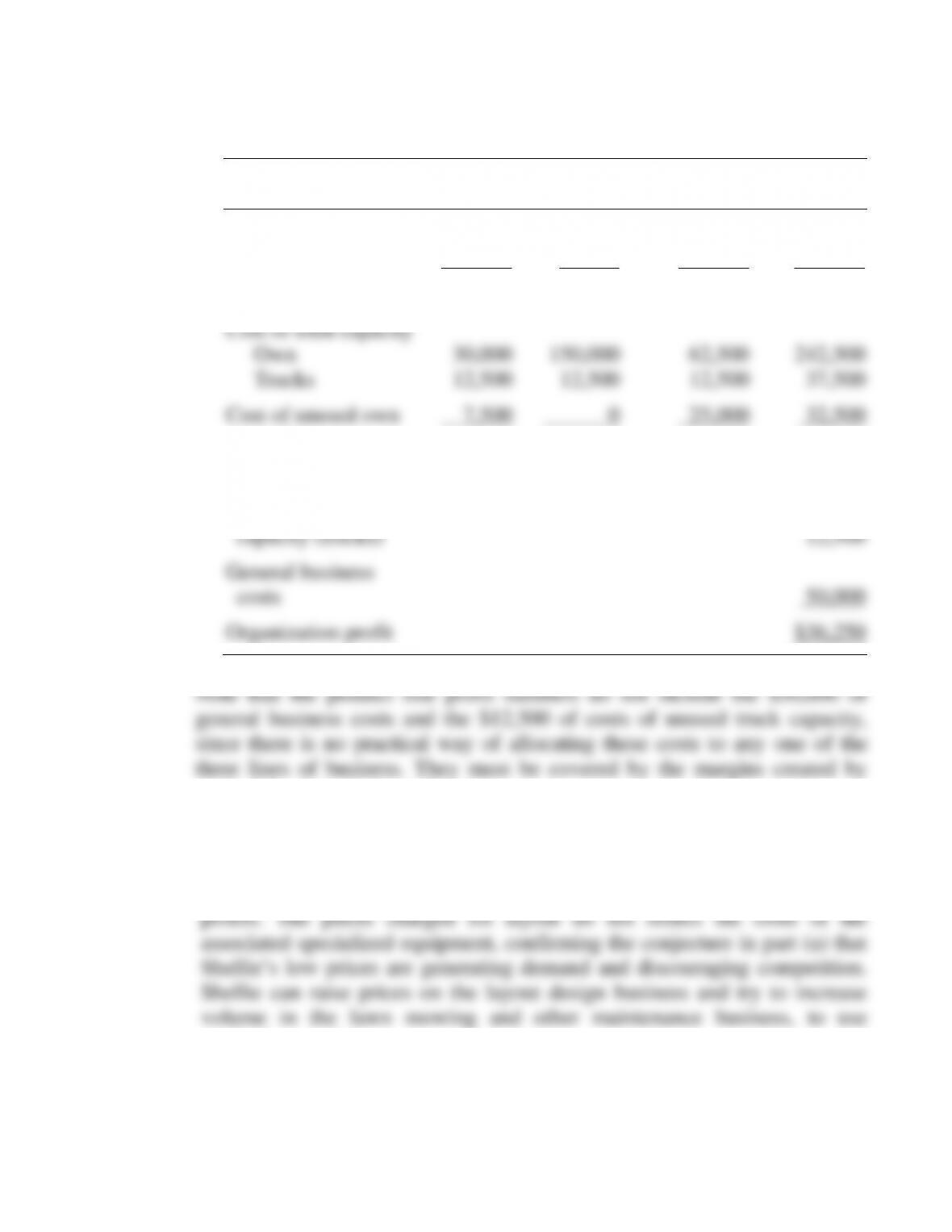
(b)
Shellie’s Lawn and Garden
Resource Use Information
Cost
Capacity
Rate
Used
Allocation
Unused
Trucks and
related costs
$50,000
800
$62.50
600
$37,500
$12,500
Lawn mowing
equipment
37,500
1,500
25.00
1,200
30,000
7,500
Layout design
equipment
150,000
400
375.00
400
150,000
0
Other
maintenance
equipment
87,500
700
125.00
500
62,500
25,000
$325,000
$280,000
$45,000
Chapter 12: Financial Control
– 459 –
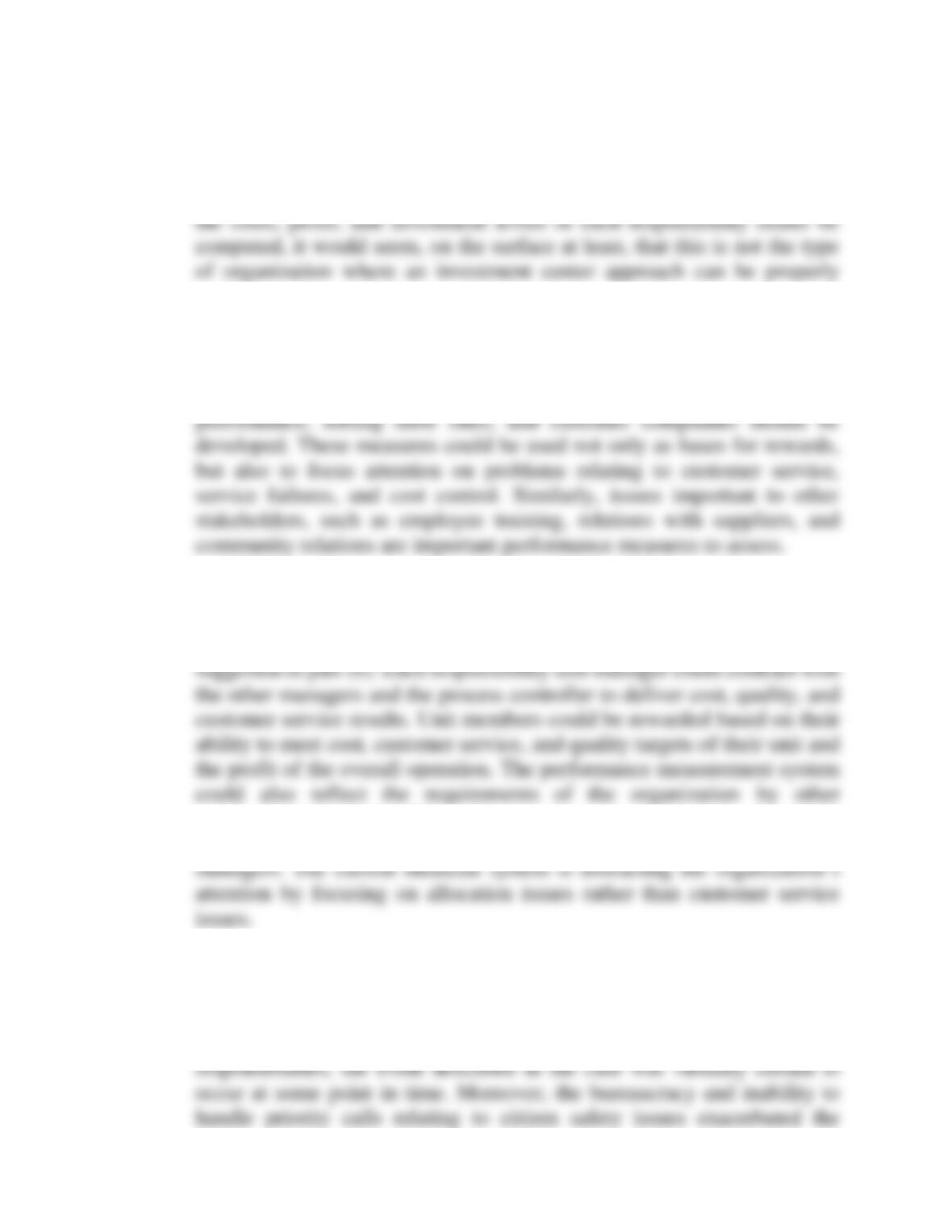
(c)
Shellie’s Lawn and Garden
Product Line Income Statements
Lawn
Mowing
Layout
Design
Other
Maintenance
Total
Revenues
$287,500
$218,750
$312,500
$818,750
Direct costs
156,250
70,000
181,250
407,500
Margin
131,250
148,750
131,250
411,250
Cost of used capacity
Own
30,000
150,000
62,500
242,500
Trucks
12,500
12,500
12,500
37,500
Cost of unused own
capacity
7,500
0
25,000
32,500
Product line profit
$81,250
–$13,750
$31,250
$98,750
Cost of unused shared
capacity (trucks)
12,500
General business
costs
50,000
Organization profit
$36,250
each of the three business lines.
(d) Based on the exhibits in parts (b) and (c), cutting back on lawn mowing and
other maintenance is undesirable if capacity stays the same. Both these
product lines have unused capacity. The layout design business is draining
available capacity.
Atkinson, Solutions Manual t/a Management Accounting, 6E
– 460 –
11–73 (a) This is an organization where the activities of all the elements of the
system must work together and be very highly integrated. This is a
setting where basing rewards on individual measures of performance can
be very dysfunctional. Since the investment center approach requires that
used.
(b) The existing performance measurement system should be expanded
beyond financial control to include measures of performance that reflect
what customers require. Performance measures relating to on-time
(c) The organization should consider eliminating the investment center
approach. The existing responsibility centers could be organized as cost
centers and the performance measurement system expanded along the lines
stakeholders (such as public safety considerations in the operation of the
courier trucks) if they are deemed controllable by the responsibility center
11–74 (a) This is a situation where historical and political issues, combined with an
inappropriate delegation of organization responsibilities to organization
units, created a problem that caused customer and safety concerns and
organization frictions. Given the structure and the division of
Chapter 12: Financial Control
– 461 –
underlying organization problem. There are at least five problems here: A
poor organization design, a poor division of responsibilities among the
organization units, a bureaucratic structure within each department that
cuts across departmental lines.
(b) Within the existing structure this incident could have been avoided by
creating a multi-department team to handle emergency and safety prob–
lems that cut across departmental lines.
proposal.
(d) The city must be reorganized so that related activities fall under the same
department. The cost focus of each department might be replaced by a
focus on accomplishing service objectives, within the constraint of not