Atkinson, Solutions Manual t/a Management Accounting, 6E
– 434 –
Chapter 11
Financial
Control
QUESTIONS
11-1 Financial control is the formal evaluation of some financial facet of an
organization or a responsibility center to assess organization and management
performance. Financial control uses financial numbers, such as costs or
11-2 Internal financial control is the application of financial control tools to evaluate
organization units. The resulting information is used inside the organization and
11-3 Decentralization is the delegation of decision-making authority from people at
11-4 Control refers to the systems and tools that an organization uses to motivate
11-5 A responsibility center is an organizational unit for which a manager is held
11-6 A cost center is a responsibility unit that is evaluated based on its ability to
Chapter 12: Financial Control
– 435 –
11-7 A revenue center is assigned the responsibility to achieve, within its own
11-8 Organizations use profit centers when profit center employees have the ability
11-9 An investment center is a responsibility unit that is evaluated based on its return
11–10 The controllability principle requires that people should only be held
11–11 Responsibility centers participate in developing the goods and services that the
11–12 A segment margin is the difference between the revenues and costs that are
11–13 A soft number is a number that is based on conventional accounting
assumptions but relies on subjective revenue and cost allocation assumptions
11–14 A transfer price is the price at which a good or service is deemed to have been
transferred between two responsibility centers within an organization. The
administered.
Atkinson, Solutions Manual t/a Management Accounting, 6E
– 436 –
11–16 Organizations earn revenues by selling goods and services to customers. When
evaluate the center’s performance.
11–17 Organizations use many types of resources to make goods and services. When
organizations use control systems that require cost numbers for responsibility
centers, the costs of the resources that are used by two or more responsibility
11–18 Return on investment is a measure of accounting income (typically, operating
11–20 All other things being equal, as productivity (the ratio of sales to investment)
11–21 Residual income is the difference between reported accounting income and the
that income.
11–22 Economic value added (EVA) is a refinement of the residual income idea. The
EVA computation adjusts reported accounting income and asset levels for what
many consider the biasing effects on current results of the financial accounting
11–23 Whole Foods states, “We use EVA extensively for capital investment decisions,
including evaluating new store real estate decisions and store remodeling
Chapter 12: Financial Control
– 437 –
(http://www.wholefoodsmarket.com/company/eva.php, accessed January 12,
2011). As mentioned in Chapter 11, Quaker Foods & Beverages, a food
manufacturer, used EVA to support its decision in June 1992 to cease trade
distribution centers.
11–24 Financial control alone may be an ineffective control scorecard for three
reasons. First, it focuses on financial measures that do not measure the
organization’s other important attributes, such as product quality and customer
service. Second, financial control measures the financial effect of the overall
EXERCISES
11–25 Decentralization creates the need to ensure that the decentralized decision
11–26 Examples of organization units that might be responsibility centers in a
university include: A school or college, a department within a school or college,
11–28 Examples of revenue centers are: The sporting goods department in a large
department store where the corporation’s purchasing group makes all stocking
decisions, the counter department in a fast food restaurant, and the sales office
in an insurance company. What these responsibility centers have in common is
investment levels.
Atkinson, Solutions Manual t/a Management Accounting, 6E
– 438 –
11–29 The manager of a large department store may have little control over stock,
center. The maintenance department is likely to meet the conditions of a cost
center—it sells nothing to outside customers and only has a vague and
11–30 Although many people assume that a foreign subsidiary will meet the
conditions to be treated as an investment center, the classification is not
service.
11–32 The manager of the cinema does not control the movie that is playing, the
advertising that is done for the movie, the cost of the products sold at the snack
bar (these would likely be purchased by a central agency, which would also
the organization of ticket and snack bar sales (which might affect total sales).
11–33 There are two generic problems in this setting. Are the revenues reported for
this division independent of the revenues reported for the other divisions? For
Chapter 12: Financial Control
– 439 –
Similarly, if there are cost interactions (for example, the divisions use the same
expensive equipment and cost allocations are used to assign the cost of that
11–34 The response to this question will reflect the degree of autonomy the respondent
feels that the center manager has. It is likely that the fitness center manager
must follow head office policy concerning the wages paid, but the center
manager will control the number of hours worked by casual employees. If the
The manager should be held accountable for controllable costs and should not
be held accountable for costs that (1) were determined or incurred by someone
else and (2) cannot be changed. The reason for distinguishing between
11–35The controllability principle asserts that the manager of a responsibility center
should be assigned responsibility only for the revenues, costs, or investments
controlled by responsibility center personnel. Revenues, costs and investments
that people outside the responsibility center control should be excluded from the
Suspending the controllability principle is desirable if there is a reasonable
expectation that this will cause the employee to find a means of controlling the
various product managers, people argued that evaluation of the managers
Atkinson, Solutions Manual t/a Management Accounting, 6E
– 440 –
stability in planning and product pricing.
Thus, managers, even when they cannot control costs entirely, can take steps to
influence final product costs. When more costs or even revenues are included in
11–36 Division C has sufficient excess capacity to supply the 200,000 units of C82 to
Division D, so neither Division C nor McCann Company will incur an
opportunity cost if the transfer takes place. The incremental cost for Division C
Company will be $2,000,000 (= $8,000,000 − $10,000,000) worse off. For
Division C, the transfer price should at least cover variable costs of $40. For
authorities are well aware of the tax incentives, and therefore examine
international transfer pricing policies of companies conducting business under
the authorities’ jurisdiction. The 1995 Organization for Economic Co-operation
and Development (OECD) guidelines (Transfer Pricing Guidelines for
Multinational Enterprises and Tax Administrations (Paris: OECD, 1995))
Chapter 12: Financial Control
– 441 –
suitable for a pulp mill, and cost-based transfer pricing would not reflect this. If
a reliable market price is available, it can be used as the transfer price.
The real issue here is the benefit to the organization of treating the logging and
finishing divisions (the saw mills and the pulp mills) as profit centers. If company
11–39 Assuming that the finished products are prepared especially for this fishing
products company, there are likely limited market prices for raw fish and semi-
processed fish, but little outside market opportunity to sell finished products.
11–40 A market price is an independent valuation of the transferred good or service.
Therefore, the market price is an excellent way of identifying where value is
is observed.
11–41 Numbers that accountants report to outsiders in financial statements are hard in
the sense that they result from the application of strict rules. In a given
situation, there is some, but limited, opportunity for discretion in determining a
– 442 –
come up with numbers that are quite close together. For internal financial
control, however, many accounting numbers, such as profits and costs, result
from applying subjective rules such as transfer prices and cost allocations.
These subjective rules create the possibility of large differences resulting from
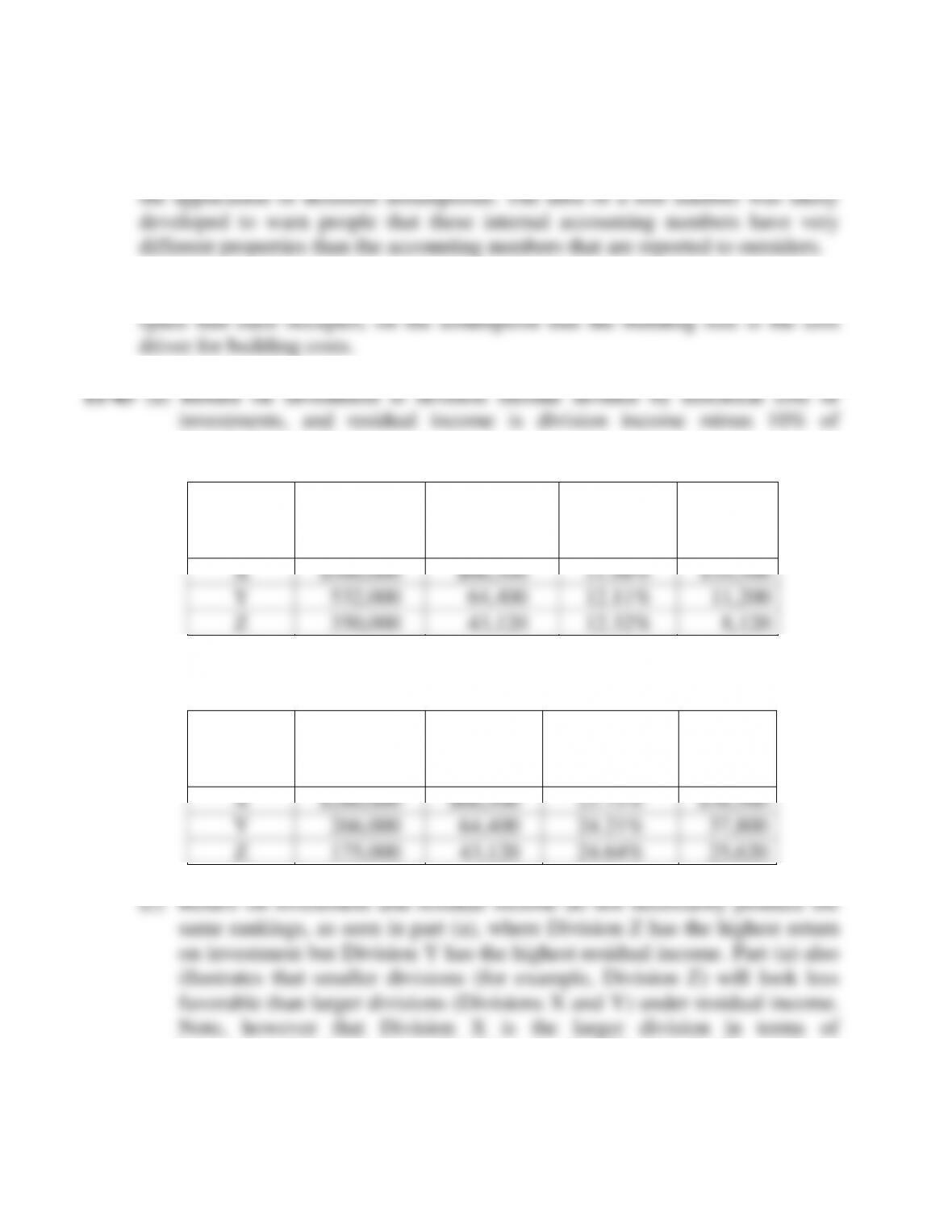
11-42One possibility is to assign building costs to the departments based on the floor
historical cost of investments.
Division
Historical
Cost of
Investments
Division
Operating
Income
Return on
Investment
Residual
Income
X
$560,000
$66,500
11.88%
$10,500
Y
532,000
64,400
12.11%
11,200
Z
350,000
43,120
12.32%
8,120
(b)
Division
Net Book
Value of
Investments
Division
Operating
Income
Return on
Investment
Residual
Income
X
$280,000
$66,500
23.75%
$38,500
Y
266,000
64,400
24.21%
37,800
Z
175,000
43,120
24.64%
25,620
investments but has lower residual income than Division Y. The results in
(b) show that, as in part (a), Division Z has the largest return on
investment, but now Division X now has the largest residual income. Only
the measurement of the value of the investment is different between parts
Chapter 12: Financial Control
– 443 –
changes the relative rankings across divisions.
(d) Managers will only find it attractive to invest in new, more costly equipment
Division
Investment
Division
Operating
Income
Sales
Return on
Investment
Sales
Margin
Turnover
E
$575,000
$75,000
$500,000
13.04%
15.00%
86.96%
F
700,000
91,000
542,000
13.00%
16.79%
77.43%
G
1,000,000
176,000
763,000
17.60%
23.07%
76.30%
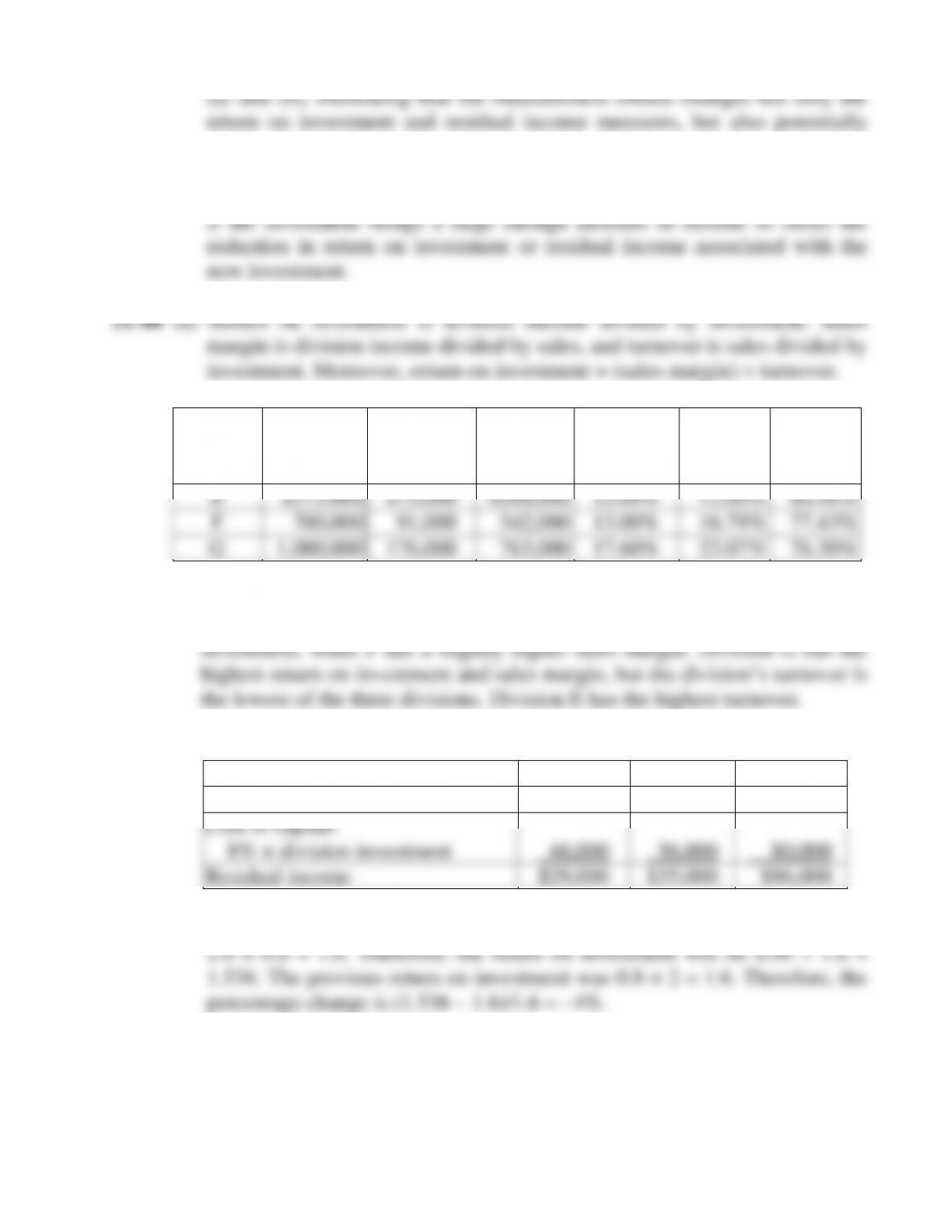
(b) Divisions E and F have nearly identical return on investment, but E has
higher turnover, indicating that E generates more sales per dollar of
(c)
Division E
Division F
Division G
Operating income
$75,000
$91,000
$176,000
Cost of capital:
8% × division investment
46,000
56,000
80,000
Residual income
$29,000
$35,000
$96,000
11–45 (a) The new return-on-sales ratio will be 0.8 × 1.2 = 0.96. The turnover will be