Chapter 10: Using Budgets for Planning and Coordination
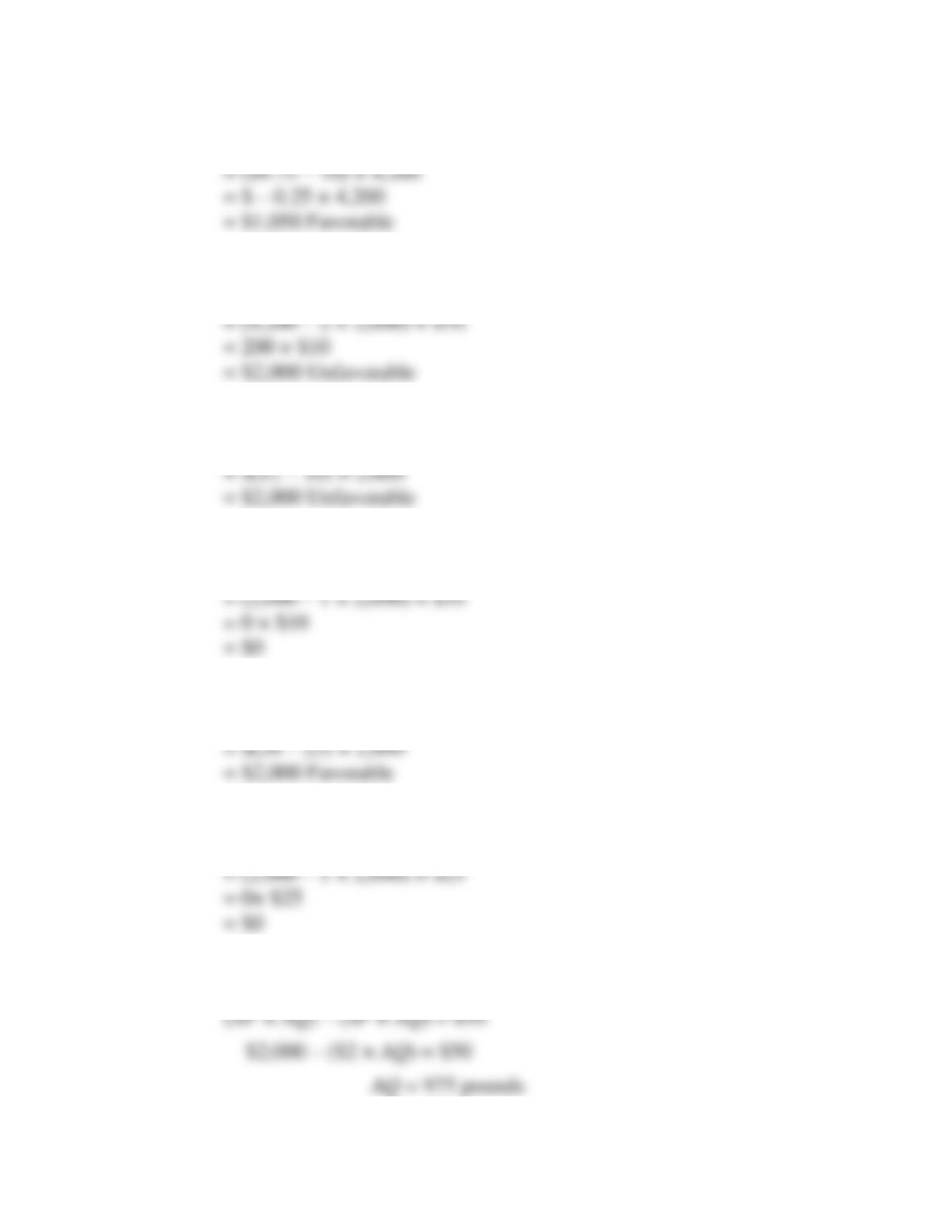
(d) Direct material price variance
= (AP – SP) × AQ
(e) Direct material quantity variance
= (AQ – SQ) × SP
(f) Direct labor rate variance
= (AR – SR) × AH
(g) Direct labor efficiency variance
= (AH – SH) × SR
(h) Variable support rate variance
= (AR – SR) × AH
(i) Variable support efficiency (use) variance
= (AH – SH) × SR
10–70
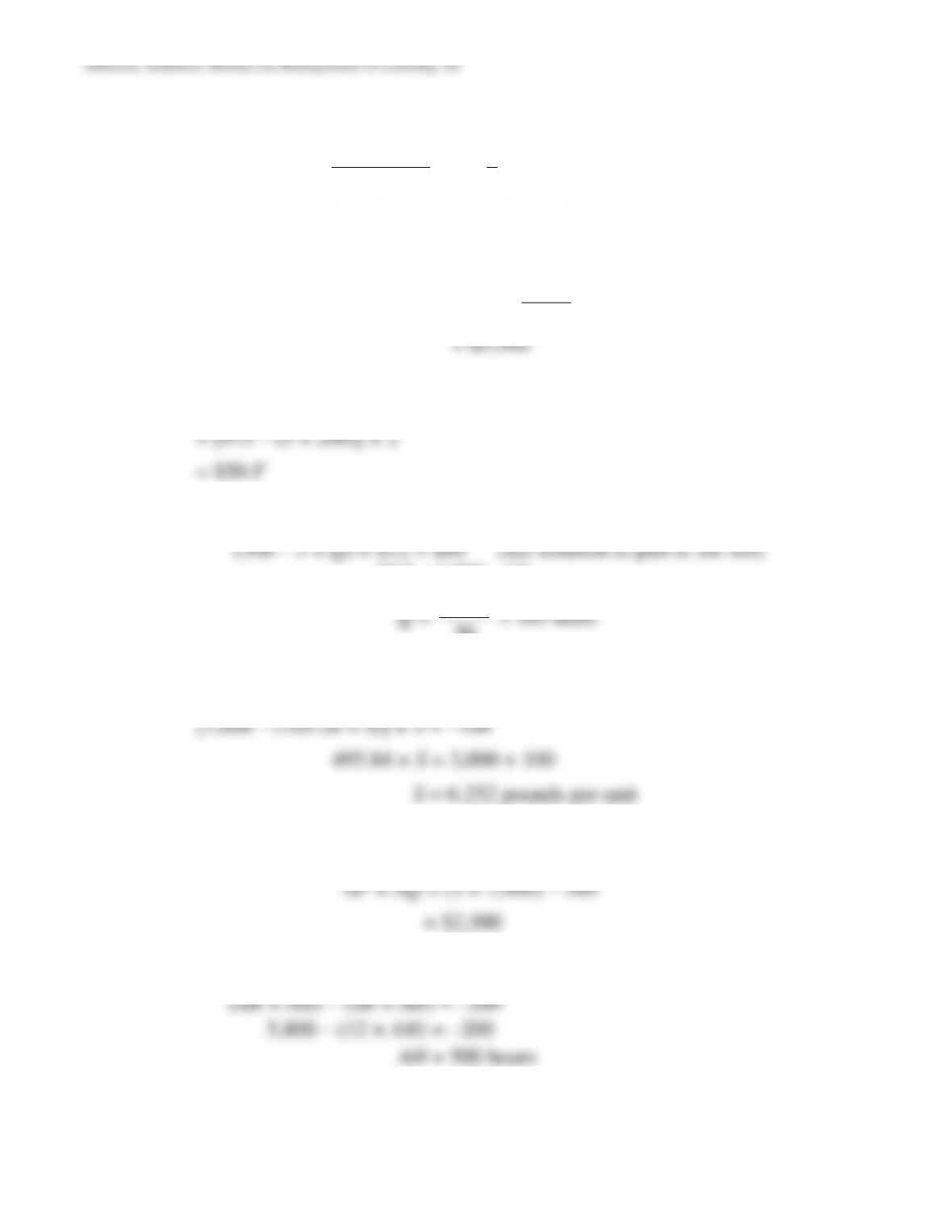
(a)
(AP – SP) × AQ = $50
(AP × AQ) – (SP × AQ) = $50
$2,000 – ($2 × AQ) = $50
AQ = 975 pounds
(b)
(AH – SH) × SR = –100
(AH × 15) – (2 × 200 × 15) = –100
hours
3
1
393
15
100000,6
AH
(c)
(AR – SR) × AH = 60
AR × AH = (SR × AH) + 60
AR × AH = (15 ×
15
900,5
) + 60
= $5,960
(d)
= (AQ – SQ) × SP
= [975 – (5 × 200)] × 2
= $50 F
(e)
(AH – SH) × SR = $60
(500 – 3 × Q) × $12 = $60 (see solution to part h, for AH)
36Q = 6,000 – 60
Q =
36
940,5
= 165 units
(f)
(AQ – SQ) × SP = –100
[1,000 – (165.28 × S)] × 3 = –100
495.84 × S = 3,000 + 100
S = 6.252 pounds per unit
(g)
(AP – SP) × AQ = –500
AP × AQ = (3 × 1,000) – 500
= $2,500
(h)
(AR – SR) × AH = –200
(AR × AH) – (SR × AH) = –200
5,800 – (12 × AH) = –200
AH = 500 hours
Chapter 10: Using Budgets for Planning and Coordination
– 425 –
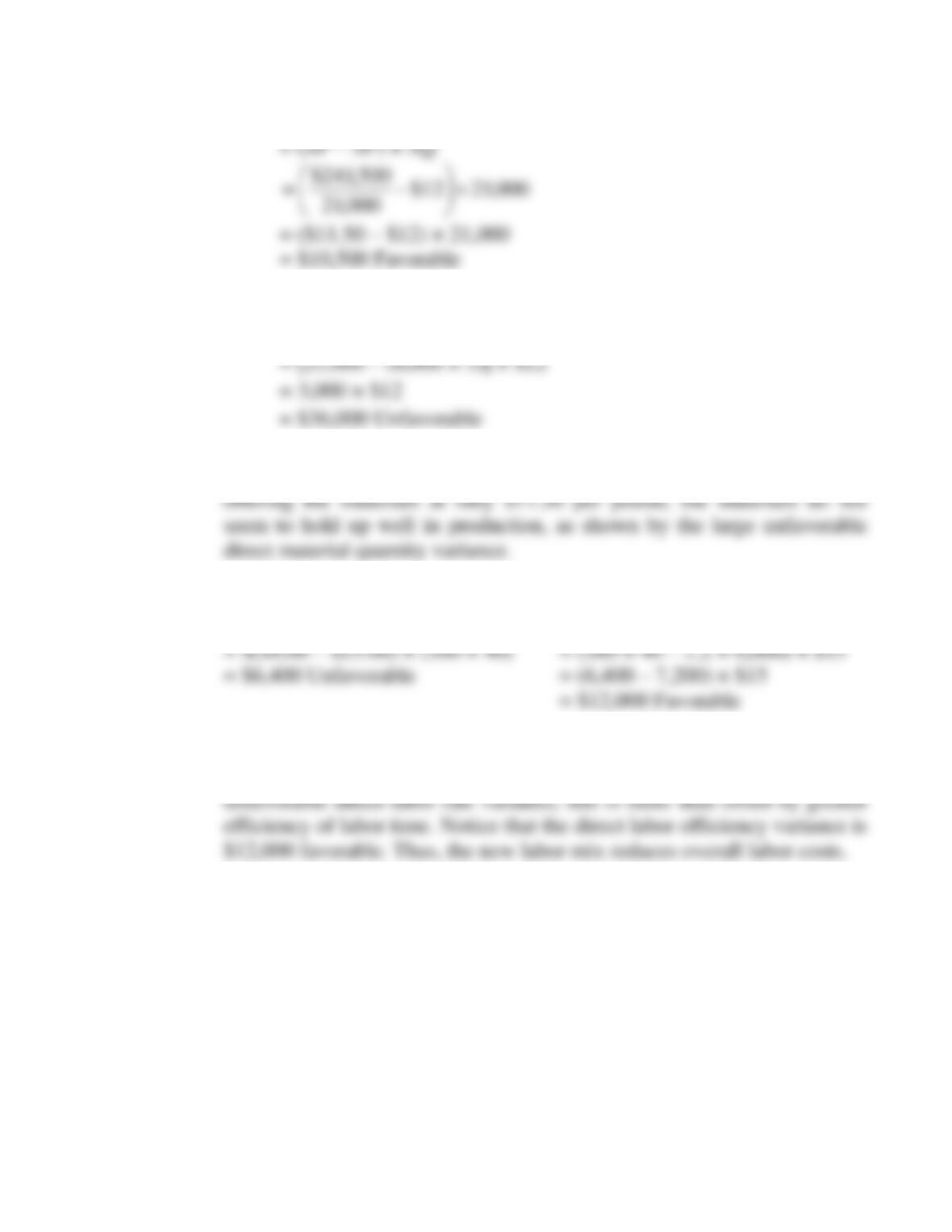
10–71 (a) Direct material price variance
Direct material quantity variance
= (AQ – SQ) × SP
(b) No, the contract should not be signed. Although the new supplier is
(c) Direct labor rate variance Direct labor efficiency variance
= (AR – SR) × AH = (AH – SH) × SR
(d) Yes, the new labor mix should be continued. Although it increases the
average hourly labor cost from $15 to $16, thereby causing a $6,400
Atkinson, Solutions Manual t/a Management Accounting, 6E
– 426 –
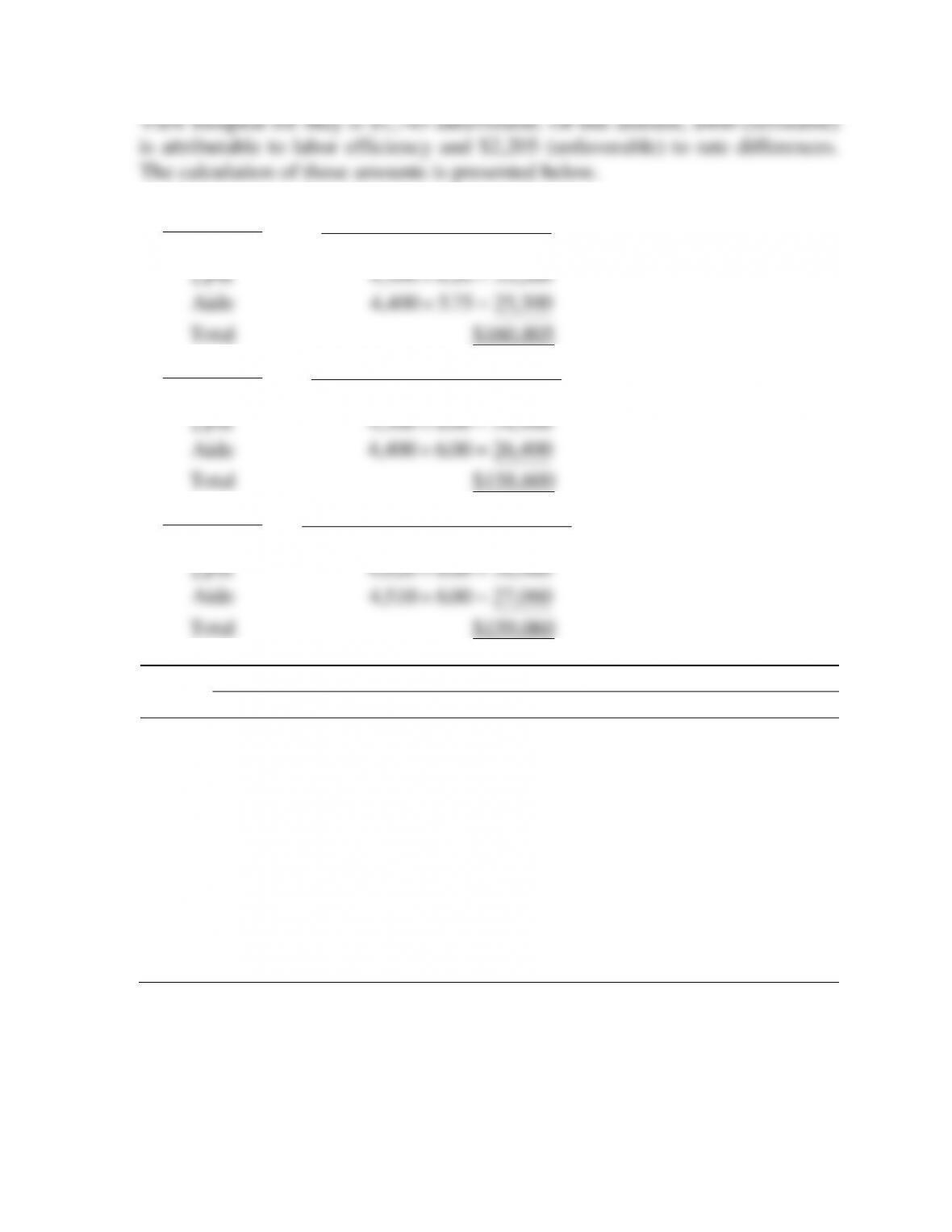
10–72 The total nursing labor variance for the fourth floor nursing unit of Mountain
Labor class
Actual hours Actual rate
RN
8150 30 245,$12.$100,
LPN
4 300 8 20 35 260, . ,
Aide
4400 575 25 300, . ,
Total
$160,805
Labor class
Actual hours Standard rate
RN
8150 00 800,$12.$97,
LPN
4 300 8 00 34 400, . ,
Aide
4400 600 26 400, . ,
Total
$158,600
Labor class
Standard hours Standard rate
RN
7920 00 040,$12.$95,
LPN
4 620 8 00 36 960, . ,
Aide
4510 600 27 060, . ,
Total
$159,060
Labor
Variances
class
Labor efficiency
Labor rate
Total
RN
$97,$95,
$2,
800 040
760
U
$100,$97,
$2,
245 800
445
U
$100,$95,
$5,
245 040
205
U
LPN
$34,$36,
$2,
400 960
560
F
$35,$34,
$860
260 400
U
$35,$36,
$1,
260 960
700
F
Aide
$26,$27,
$660
400 060
F
$25,$26,
$1,
300 400
100
F
$25,$27,
$1,
300 060
760
F
Total
$158,$159,
$460
600 060
F
$160,$158,
$2,
805 600
205
U
$160,$159,
$1,
805 060
745
U
Chapter 10: Using Budgets for Planning and Coordination
– 427 –
=
250,1418$
250,14
750,270$
= (14,250 – 8 × 1,900) × $18
(iii) Direct labor rate variance = (AR – SR) × AH
=
000,58$
000,5
800,37$
= $2,200 Favorable
= (5,000 – 2.5 × 1,900) × $8.00
(b) These variances reflect tradeoffs made by Asahi USA. More expensive
10–74 We first compute percentages of total unit sales for each product line for
planned and actual sales.
Planned Sales for February
Muffins
Scones
Carrot Bread
Units
% Total
Units
% Total
Units
% Total
Total
Unit Price
$1.35
$1.75
$2.75
Unit Sales
1,600
26.67%
3,400
56.67%
1,000
16.67%
6,000
Total
$2,160
$5,950
$2,750
$10,860
– 428 –
Actual Sales for February
Muffins
Scones
Carrot Bread
Units
% Total
Units
% Total
Units
% Total
Total
Unit Price
$1.55
$1.60
$3.25
Unit Sales
1,400
19.44%
4,500
62.50%
1,300
18.06%
7,200
Total
$2,170
$7,200
$4,225
$13,595
(a) The sales mix variance is computed as follows:
Muffins: 7,200 (19.44% – 26.67%) $1.35 = $ –702, that is, $702
Scones: 7,200 (62.50% – 56.67%) $1.75 = $735 favorable. This
Carrot bread: 7,200 (18.06% – 16.67%) $2.75 = $275 favorable. This
(b) The sales quantity variance for each product line is computed as follows:
Muffins: (7,200 – 6,000) 26.67% $1.35 = $432 favorable. This means
Scones: (7,200 – 6,000) 56.67% $1.75 = $1,190 favorable. This
means that because of the overall increase in sales, if the scones sales mix
Chapter 10: Using Budgets for Planning and Coordination
– 429 –
Carrot bread: (7,200 – 6,000) 16.67% $2.75 = $550 favorable. This
(c) The sales price variance for each product line is computed as follows:
Muffins: 1,400 ($1.55 – $1.35) = $280 favorable. This means that
Scones: 4,500 ($1.60 – $1.75) = $ –675, that is, $675 unfavorable. This
Carrot bread: 1,300 ($3.25 – $2.75) = $650 favorable. This means that
Summary:
Carrot
Muffins
Scones
Bread
Total
Price Variance
$280
-$675
$650
$255
favorable
Sales Mix Variance
-702
735
275
308
favorable
Sales Quantity Variance
432
1,190
550
2,172
favorable
Total
$10
$1,250
$1,475
$2,735
favorable
– 430 –
10–75 Variance analysis is a form of exception reporting. That is, the focus is on what
went wrong rather than what went right. An excessive preoccupation on
organization environment.
A variance is a signal that something unplanned happened. For variances to be
signals, they must be reasonable in the sense of reflecting a reasonable level of
performance. Some organizations believe in setting very tight standards, which,
As signals, variances should trigger an investigation to find out what caused the
variance. They provide no information about cause, but rather reflect only the
organization performance.
Chapter 10: Using Budgets for Planning and Coordination
– 431 –
CASES
10–76
(a)
Rust Manufacturing Co.
BUDGET FOR ACE AND BELL
For the Year Ending December 31, 2011
Ace
Bell
Sales (1)
$8,000,000
$2,000,000
Variable costs:
Direct materials (2)
$1,600,000
$300,000
Direct labor (3)
2,000,000
500,000
Variable mfg. support (4)
200,000
50,000
$3,800,000
$850,000
Contribution margin
$4,200,000
$1,150,000
Fixed costs:
Depreciation (5)
$140,000
$60,000
Rent (6)
78,000
52,000
Other mfg. support (7)
200,000
50,000
Selling costs (8)
120,000
60,000
Gen. & admin. costs (9)
32,000
8,000
$570,000
$230,000
Pretax operating profit
$3,630,000
$920,000
Supporting calculations:
(1) Ace: 200,000 units $40/unit $8M
(2) Ace: 200,000 units $8/unit $1.6M
(3) Ace: 200,000 units 2 hours $5/hour $2M
(4) Ace: $2M 10% $200K
(5) Ace: $200K 70% $140K
(6) Ace: $130K 60% $78K
(7) Ace:
M5.2$
M2$
× ($500K – $250K) = $200K
Bell:
M5.2$
K500$
× ($500K – $250K) = $50K
(8) Ace: 200,000 units
Ace:
200
300 $180 $120K K
Bell:
100
300 $180 $60K K
(9) Ace:
$8M
$10M $40K $32K
Bell:
$2M
$10M $40K $8K
(b)
Ace
Bell
Contribution margin per unit
$21.00
$11.50
Pretax operating profit per unit
$18.15
$ 9.20