– 393 –
Chapter 10
Using Budgets to for
Planning and
Coordination
QUESTIONS
10-1 A budget is a quantitative model of the expected consequences of the
10-2 Flexible resources are those that vary with the activity level of the firm or
related (or committed or fixed resources).
10-3 Yes, a spending plan is a budget since it provides a summary, in financial terms,
10-4 In many ways the goal of a family budget is quite similar to the goal of a budget
dollar amounts proposed), scope (the number of operating units and their goals),
final budget is determined.
10-5 A production plan is an exhibit that identifies proposed production during an
and trucks to routes.
10-6 Financial budgets represent projected financial results for an organization.
Such budgets include a statement of expected cash flows, projected balance
– 394 –
materials purchasing, labor hiring and training, and administrative and
discretionary spending plans.
10-7 You should not jump to the conclusion that the university’s hiring and training
plan is likely to be more important because it hires skilled rather than unskilled
reached relatively stable employment, the labor hiring and training plan would
be relatively unimportant since university faculty members are expected to
10-8 The sales plan is based on the demand forecast. The numbers in the demand
10-9 A demand forecast is an estimate of the number of units that customers would
the sales plan.
10–10 Yes. Employee training does not have a physical relationship with the
10–11 A capital spending plan summarizes an organization’s plans to acquire or sell
10–12 A capacity-related expenditure is any expenditure that an organization cannot
expenditure.
10–13 This is a tricky question. If the cafeteria is committed to preparing a given
show up to eat, the food cost is a variable cost.
Chapter 10: Using Budgets for Planning and Coordination
– 395 –
10–14 A defining characteristic of a flexible resource is one where you only pay for
what you use. Flexible resources can be acquired or disposed of in the short run
buys merchandise may consider merchandise, or materials costs, a capacity-
10–15 A line of credit is a short-term financing arrangement made between an
from a financial institution to allow the debtor to borrow money on demand up
to a specified maximum amount.
10–16 Planners use budget information for the following purposes:
resources in place.
(2) Identify potential problems. This helps to avoid problems or to deal with
them systematically.
the organization’s operating processes.
10–17 Both what-if and sensitivity analyses use the same model to evaluate future
varying key estimates of a plan or a budget to identify over what range a
10–18 A variance is a difference between an actual amount and a planned (budgeted)
Atkinson, Solutions Manual t/a Management Accounting, 6E
– 396 –
10–19 Analysis of reasons for the variance between actual and estimated job costs can
help managers in several ways. If the managerial actions that led to actual costs
changes are likely to be permanent, however, the revised cost information can
10–20 A flexible budget presents cost targets or forecasts for the organization’s
achieved level of activity.
10–21 The first level of variance analysis for a cost item focuses on the differences
between actual and estimated (master budget) costs for the item. The second
difference between flexible budget costs and master budget costs. For variable
costs, the third level of variance analysis decomposes the flexible budget
variances.
10–22 By classifying flexible budget variances into rate (price) and efficiency
expenses.
10–23 Yes. The labor efficiency variance will likely be favorable because fewer
workers.
10–24 The purchase and use of cheaper, lower-quality materials is likely to result in a
likely to be affected.
Chapter 10: Using Budgets for Planning and Coordination
– 397 –
10–25 The first step isolates the effect of sales volume differences by computing sales
10–26 An appropriation is a planned cash outflow or spending plan. In a government
money on student entrance scholarships.
10–27 A periodic budget is a budget that is prepared for a fixed interval of time,
10–28 This is called incremental budgeting because spending allocations for this
10–29 This is called zero-based budgeting because each year the charities to which
you donate must reestablish their need.
10–30 Critics argue that the traditional budgeting process (1) reflects a top-down
strategic objectives; and (3) causes resource allocations to be driven by political
10–31 The beyond budgeting approach differs in two fundamental ways from
traditional budgeting. First, traditional budgets are based on fixed annual plans
measures that link directly to the competition rather than an internal artificial
goal. Second, the Beyond Budgeting model provides a more decentralized way
motivating.
– 398 –
EXERCISES
10–32 If the organization solicits the information from the sales force, salespeople will
group, and using statistical models to identify a relationship between future
10–33 The primary purpose of budgets is for planning. Problems are created when
budgets are used after the fact for control. For example people whose
in after the fact control. (Standards for after the fact control could, instead, be
based on independent benchmark information or improvements on previous
projections.
10–34 Wages paid to graders are controllable in the short-term if the wages are based
wages paid to full-time faculty are only controllable in the long-term since most
10–35 Many organizations are run by the numbers. In these organizations managers
10–36 A consulting company is an organization that uses highly trained people to
deliver complex and customized products to its customers. This organization
Chapter 10: Using Budgets for Planning and Coordination
– 399 –
allow it to develop a hiring and training plan that will provide the people it
needs at a minimum cost.
10–37 The vegetable canner acquires and packs its products over a very short period of
needs to meet this need for a cyclical investment in inventory.
10–38 The credit granting policy is an important component of the organization’s
receivable loans to customers. The organization’s planners must balance the
10–39 A machine shop might accept and complete thousands of small jobs each year.
those of its toughest competitors. Costs that are out of line with those of
of activities that created those costs.
10–40
Units
Sales
40,000
Desired ending inventory
5,000
Needs
45,000
Beginning inventory
6,000
Purchases
39,000
– 400 –
10–41 (a)
Production Budget
January
February
March
Sales of G12
50,000
60,000
54,000
Desired ending inventorya
15,000
13,500
Needs
65,000
73,500
Beginning inventoryb
12,500
15,000
Production
52,500
58,500
(b)
Purchases Budget
January
February
Units to be produced
52,500
58,500
Raw materials needed per unit
0.5
0.5
Total production needs
26,250
29,250
Desired ending inventorya
2,925
2,025
Total material needs
29,175
31,275
Beginning inventoryb
2,625
2,925
Total material purchases
26,550
28,350
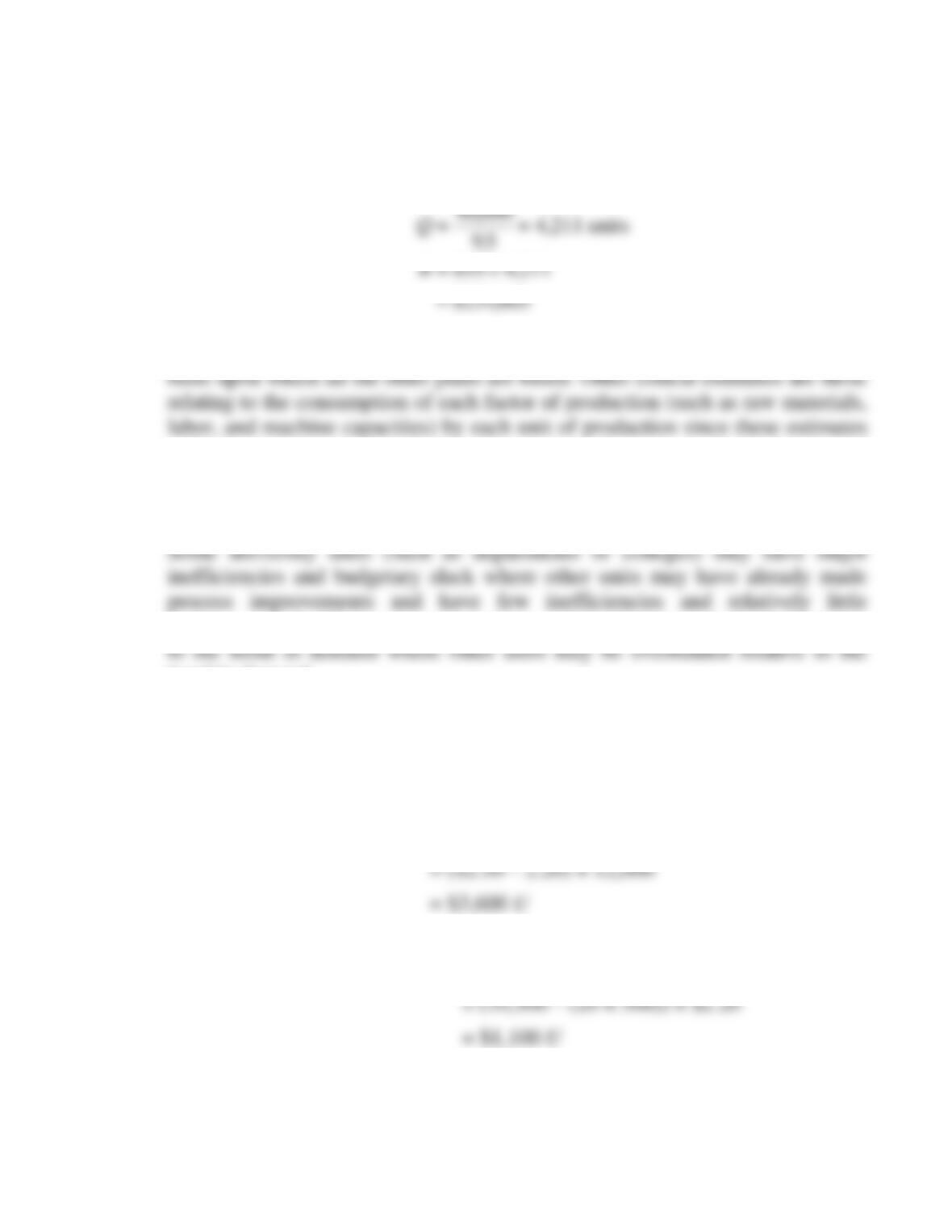
10–42 (a) Let Q sales level in units at which the costs are the same with both
machines.
in a 10% profit on sales ratio.
Chapter 10: Using Budgets for Planning and Coordination
– 401 –
Let Q be the corresponding number of units, so that R $55 Q
$$40,$55
. ,
,
.
$55
$231,
55 40 000 10%
15 55 40 000
40 000
9 5 4,211
4,211
605
Q Q
Q Q
Q
R
units
10–43 The most critical estimates are the demand estimates because they provide the
will play an important role in estimating total resource requirements and
estimating costs.
10–44 No. Incremental budgeting does not ensure that resources are best allocated.
budgetary slack. Moreover, some units may be seriously underfunded relative
trend in demand.
10–45 (a) Because the quantity purchased differs from the quantity used, the
material price variance uses the purchased quantity (PQ) instead of the
quantity used (AQ).
Material price variance = (AP – SP) × PQ
(b) Material quantity variance = (AQ – SQ) × SP

(c)
Direct labor rate variance
AR SR AH
U
$12 ,
$3,
10 1800
600
10–46 (a)
Direct material price variance
AP SP AQ
U
$ ,
$280
5880 2,800 22,800
(c) A favorable labor efficiency variance of $100 for job 822 implies that