8. Writers’ strike. On November 5, 2007, the Writers Guild of America,
representing 12,000 writers, struck the Alliance of Motion Picture and Television
Producers. A key issue in the strike was the writers’ demand for residuals from
distribution of their work in “new media”—Internet downloads, Internet Protocol
TV (IPTV), streaming video, smart phones, and on-demand cable/satellite
programming. The Writers Guild asked for 2.5% of gross income from new
media. Writers are normally paid a percentage of future revenues, but excluding
those from new media. Is it ethical for a recording studio to keep making money
on their work without compensating them? Hints. It is not enough simply to say
that fair compensation is whatever the market dictates. Any such claim should be
defended by appeal to the conditions of rational choice. The outcome may
depend on some factual issues. To deal with this, analyze the case under the four
scenarios in Table 6.2, where the propositions (a) and (b) are:
(a) There is reason to believe that paying writers the 2.5% would create more
overall utility, because they are currently underpaid and spend much of
their time making ends meet by other means.
(b) There is reason to believe that the movie/television industry as a whole
would not be profitable enough to attract investors if all executives paid
writers the 2.5%.
The conditions for rational choice are designed to analyze particular decisions by
particular people. So to fix the issue, let’s suppose that motion picture executive
It will help to clarify the arguments to suppose the writers are starving artists—
well, not literally starving, but they are just scraping by and have to drive a taxi to
The utilitarian test tells Scone to pay the 2.5% royalty if it would increase overall
utility. Perhaps MBM is doing well enough that the additional payout would
reduce profits but leave the company basically healthy. Perhaps the starving
artists are much further down the concave utility curve than the affluent
At this point students may ask, since when is MBM a welfare agency?
Corporations are supposed to create utility by selling profitable goods and
The argument goes like this. Let’s test the 2.5% payout for generalizability. Let’s
suppose that the rationale is to increase overall utility by paying writers more. If
movie executives always paid higher compensation when it would increase
overall utility, then arguably the movie business would no longer be profitable
enough to attract investors. I don’t know this to be true, but let’s suppose it is. In
If paying 2.% is ungeneralizable, it is not an action (because it has no coherent
This implicitly assumes that Scone has only two alternatives: either pay the
writers 2.5% in new compensation, or pay them only what he is paying now. A
third alternative is to decide that he doesn’t want to be in a business that exploits
writers in this way, and look for another job. This alternative must be subjected to
Note that Scone must change jobs if he has reason to believe that he could create
more utility elsewhere. The tests for rational choice require only that the
reasoning behind the action be consistent. If he has no particular reason to
Finally, the above utilitarian argument is predicated on the assumption that writers
are starving artists who must drive cabs to pay the bills. Perhaps they are better
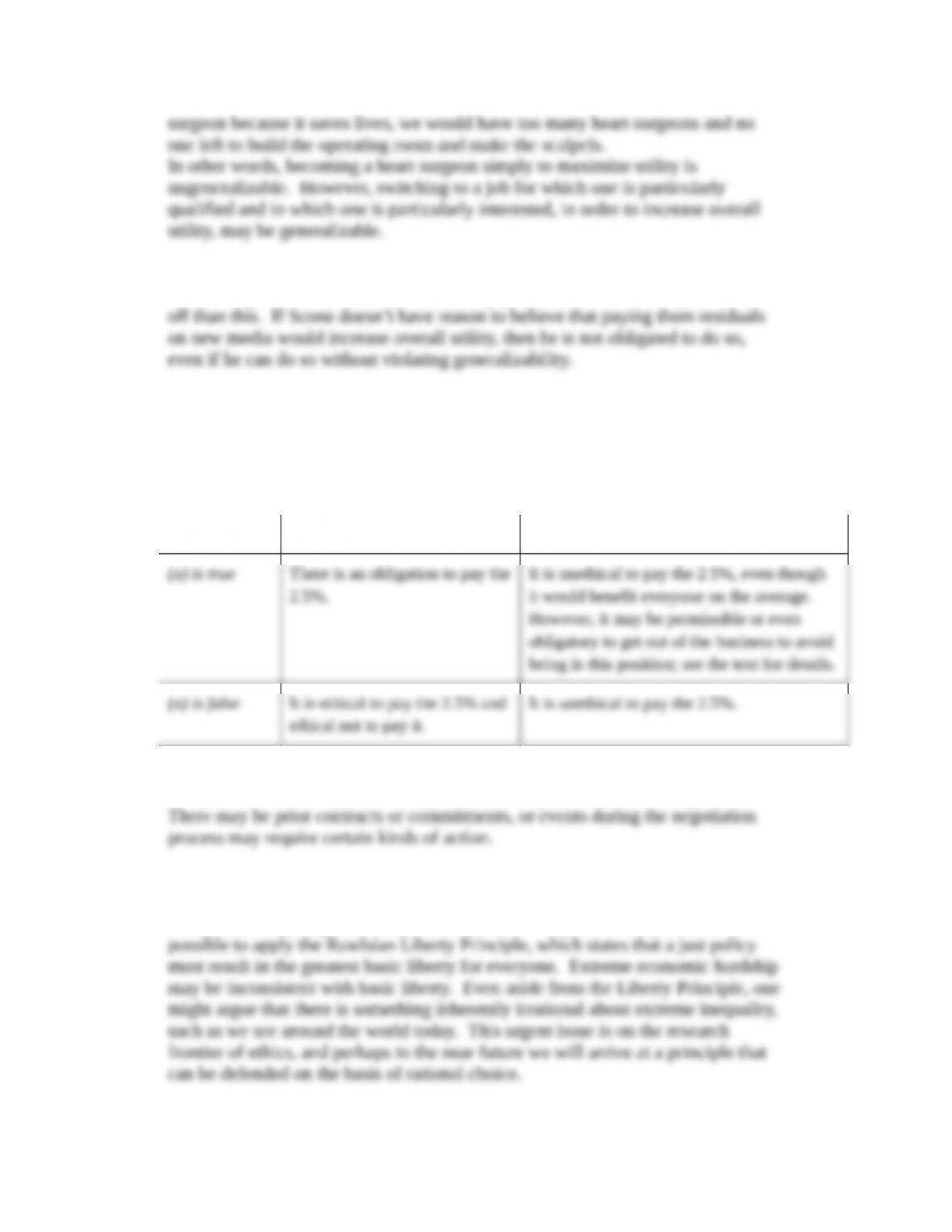
To conclude, the issue is whether it is ethical and/or obligatory to pay writers
2.5% royalties on residuals on new media. The ethical situation depends on
whether statements (a) and (b) in the exercise are true. The situation is summed
up in the table below.
(b) is false (b) is true
ethical not to pay it.
The particulars of the situation may, of course, impose additional obligations.
The arguments can change dramatically if workers are severely deprived, as in a
sweatshop. Basic needs, freedom, or human dignity may be at stake in such
cases, and it may ungeneralizable to deny these to anyone. It may also be
9. Retrocession. A large private bank employs relationship managers (RMs) who
work with high net worth individuals. The RMs help their clients to manage their
substantial wealth, avoid taxes, and so forth. When the clients invest in certain
funds, the fund owners remit retrocession payments to the bank as a reward.
Consequently, the bank provides its RMs a financial incentive to recommend
funds that provide retrocession. In theory, this need not create a conflict of
interest for the RMs, because it could incentivize them to recommend a fund with
retrocession only when there is a choice among equally attractive investments. It
is widely suspected, however, that some RMs bias their recommendations to favor
investments that yield them a higher commission. Is it ethical for the bank to
provide this kind of incentive?
On the face of it, a utilitarian perspective argues against incentivizing RMs to
promote funds that provide retrocession to the bank. This may boost utility for
the bank, but presumably capital allocation is more efficient when guided by
disinterested advice than when distorted by conflicts of interest, and this is the
As for professional obligation, the payment and acceptance of retrocession seem
to be widely accepted in the industry, as is incentivizing RMs accordingly.
There is an obvious issue of virtue ethics for the RMs. To remain true to their
calling, they must not be influenced by incentives provided by their employer.
Incentives to sell the bank’s own products can create an even more intense
conflict of interest, because the RM’s advancement in the firm may ride on it.
Let’s move on to a generalization test. Incentivizing RMs to promote investments
that are more profitable for the bank is clearly generalizable (if it is not
One might argue, however, that the bank deceives customers by incentivizing
RMs to give less than optimal advice, and this is not generalizable. It is causing
at least some customers to believe falsely that the bank is recommending
The deciding factors (for the bank’s owners/stockholders) are therefore factual
issues, which the bank is obligated to address: (a) the effect of conflicts of interest
10.* Tax avoidance. The private bank mentioned in the previous exercise has a
number of European clients for whom it provides substantial tax savings. By
exploiting loopholes in complex tax laws, the bank allows some of its wealthy
clients to avoid the high tax rates prevalent in their home countries. In some
cases, clients pay only a small fraction of the tax they would otherwise owe. Yet
these clients achieved their success due, in part, to services provided by their
home country. They benefited from an excellent state-funded education and from
a stable and productive economy that is highly subsidized and regulated by the
state. Is it ethical for the bank to provide this kind of advice? Hint. First analyze
the taxpayer’s obligation, and then address the bank’s dilemma. Keep in mind
that a private bank that fails to provide competitive tax advice is at a severe
disadvantage for attracting clients.
First we address the wealthy taxpayer’s situation. For the sake of definiteness,
let’s assume that these taxpayers are paying a much smaller fraction of their
The utilitarian calculation depends on what the taxpayers do with the money they
don’t pay in taxes. If they use it as productively as the government would use it,
In fact, the utilitarian principle may require wealthy taxpayers to avoid paying the
taxes and invest the money wisely—unless this is unethical on other grounds. It
Many people have a sense, however, that wealthy people have a duty to pay their
“fair share” of taxes. The issue is not whether the government has a duty to make
The issue may not arise if the tax avoider invests the money in pro bono causes at
least as beneficial as government programs. Let’s assume, then, for the sake of
Given this assumption, let’s see if the generalization test can establish a duty to
pay taxes above the legal minimum. It is widely assumed that, currently, wealthy
people pay the absolute minimum in taxes. If so, a practice of radical tax
avoidance is already generalized and therefore generalizable. However, do we
The more fundamental issue for this case, however is distributional. Regressive
taxes transfer wealth to the less well off to the wealthy and therefore may violate
the Rawlsian Difference Principle. A wealthy individual who pays a small tax
To conclude, we have not established an obligation for the wealthy taxpayer to
pay taxes above the legal requirement, even when the tax obligation is small
relative to income. However, there is an obligation to invest the saved tax money
We now address the bank’s dilemma. To make the issue interesting, let’s suppose
The last sentence of the exercise settles the utilitarian issue right away. If the
bank doesn’t give competitive tax advice, its customers will get the advice
Giving this kind of tax advice also seems generalizable. Although tax havens may
disappear if all wealthy taxpayers took advantage of them, it is unclear that the
The Difference Principle, however, has more bite. The test is not whether one
Rather, the test is whether the bank’s policy, if generalized, would cause the least
advantaged to be worse off than necessary. As it happens, the bank’s policy is
This puts banks in a difficult ethical position. A long-term solution for the
industry as a whole is to assist the G20 in its efforts to do away with tax havens,