15. In the previous exercise, suppose that the vaccine works only half the time. What allocation
maximizes utility? What allocation(s) satisfies the Difference Principle?
Now, ten doses of vaccine relieve the suffering of 2.5 flu cases on the average, because half of
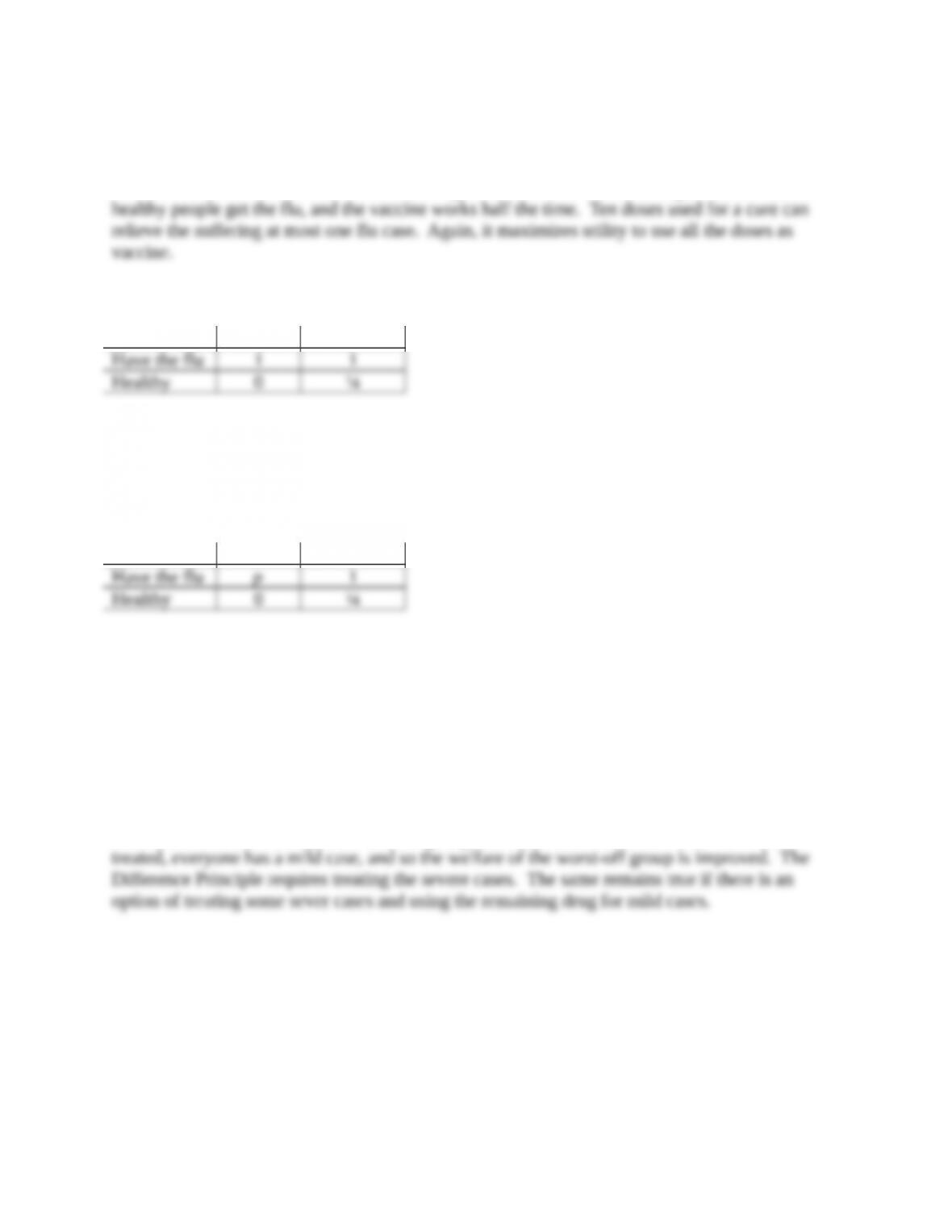
As for the Difference Principle, the table becomes
Treated Not treated
Again, people in the worst-off group have probability 1 of getting the flu in any allocation. So
all allocations of the drug satisfy the Difference Principle.
If curing the flu makes people better off, the table becomes
Treated Not treated
Again, the Difference Principle is satisfied only by using all the doses as a cure.
16. A million persons nationwide have a chronic disease. A thousand of them have a rare,
severe form of the disease that is fatal, and the rest have a mild form that gives them a headache
once a week. A new bioengineered drug can cure a mild case or convert a severe case to a mild
case. The drug is hard to manufacture and in short supply, and a severe case requires very large
doses. There is enough to treat all the severe cases or all the mild cases, but not both. How
should the drug be allocated to satisfy Rawlsian ethics?
If all mild cases are treated, the worse-off group has a fatal disease. If all severe cases are
17. In the previous exercise, suppose that severe cases are not fatal but only cause headaches
twice a week. Everything else is the same. What is the ethical allocation? Hint. Examples such
as this one suggest that a purely Rawlsian allocation may be inappropriate when the utilitarian
cost is too high. This is an active research issue in ethics, particularly in the health area.
If all mild cases are treated, the worse-off group has two headaches week. If all severe cases are
treated, the worse-off group has one headache a week. The Difference Principle again requires
18. Suppose the boss compromises and allows you to describe the list of performance results as
a “sample” of results (it is, after all, a sample consisting of all but one). Does this change the
analysis?
Presenting a sample implies two things: it is representative sample, and it is a fairly small subset
of the population. This “sample” is representative in the sense that it presents typical
However, the “sample” is not a sample in any reasonable sense. Anyone who presents all but
Some students might concede that the word “sample” is misleading, but not in any way that is
relevant to the financial decisions of your customers. The customers may get the wrong
At this point, an astute member of the class may observe that the deception argument could apply
to the boss but not to the subordinate. Perhaps the subordinate works closely with customers and
19.* Suppose the boss compromises some more and allows you to report only the average
performance of the funds. Does this change the analysis?
Presenting an average is sometimes misleading, particularly when it is very different from the
median. For example, if every house in my on my street costs $100,000 except for one that costs
20. On sale next week. Bernie walks into an electronics store and tells Sam, the salesman, that
he is looking for a particular model of flat-screen TV. The model is in stock and will in fact go
on sale for 15% off the following week. However, Sam does not mention the upcoming sale to
Bernie, because Sam’s commission would be proportionately less. Is this ethical?
Sam’s behavior is clearly generalizable. If salespeople never tipped off customers about
upcoming bargain prices, to collect a higher commission, them they would still be able to collect
We might find a utilitarian problem with Sam’s behavior. He could save the customer more
money that he would lose himself by tipping off the customer about next week’s bargain.
On the other hand, if Sam has some particular reason to believe that this customer would gain
more in utility from a price break than others would lose, perhaps because the customer needs
the screen for a struggling small business, then Sam may have a utilitarian obligation to tip off
21.* Cheap stuffing. Elite Furniture Manufacturing has a reputation for high-quality
upholstered furniture. Hard economic times have hit, however, and the company must cut costs
quickly. Top management orders that from now on, an inferior grade of padding will be used in
the upholstery, on the expectation that customers won’t notice the change at the time of
purchase. Is this an ethical decision?
Nothing in the exercise says that Elite Furniture has explicitly promised the customer
One might think that by creating this reputation and not living up to it, the company is deceptive.
It causes customers to believe something it knows is false. True, quality was high when the
Although there is no case for deception, we can apply the generalization test directly to the
company’s decision to reduce quality. Suppose that companies always reduced quality below
So if Elite’s reason for reducing quality is truly just to cut costs, its action is generalizable. But
this is its true reason only if it is willing to reduce quality when customers are aware of what is
A related but distinct issue is whether the company should warn the customer about the reduction
in quality—or whether we should say caveat emptor (let the buyer beware). The problem with
relying entirely on caveat emptor is that commerce as we know it presupposes a certain amount
22. Uncrushable Volvos. At a monster truck rally in Vermont, a huge “Bear Foot” truck drove
over the roofs of several cars and crushed all but a Volvo. Volvo’s advertising agency recreated
this scene for a highly acclaimed television commercial. Engineering analysis confirms that the
Volvo is strong enough to support the truck, and the other cars are not. However, the agency
reinforced the Volvo and partially sawed through the roof supports of the other cars. The agency
claimed that this was necessary for production purposes. The State of Texas sued Volvo for
consumer fraud based on deceptive advertising. Is it deceptive advertising, in the sense that it
misleads customers about the product? Is it deceptive in some other way? Can the ad be altered
in some small way to make sure it is not deceptive?
The case description grants that everything the ad might lead customers to believe about Volvos
23. Delayed delivery. Don is production scheduler at Fitzgerald Machine Company, where a
large order is scheduled to go out Friday. The customer calls, however, and asks Don to delay
the delivery at least a week beyond Friday, due to a labor dispute at the customer’s plant. On
authorization from his boss, Don complies with the request on the condition that the customer
will remit the amount due Friday, as specified in the original contract. The customer agrees to
these terms, and Fitzgerald sends a bill payable Friday. The next day, Don learns from the
production manager that the order won’t be ready until at least a week beyond Friday. Don does
not mention this to the customer and collects the payment Friday as agreed. Is this deceptive?
Is it ethical?
There is deception only if Don causes the customer to believe something that Don knows is false.
When Don renegotiated delivery and payment terms, he did perhaps cause the customer to
Neither is there breach of the agreement, because the agreement is not contingent on the
A possible ground for questioning Don’s action is a utilitarian one. Don may have specific
If Don has a long-term personal relationship with the customer, virtue ethics requires Don at
24. Taking credit. Janice is Chief of Research and Development. Her boss asked her some time
ago to design software that would solve certain problems at the company, but she has been too
busy to think about it. However, her assistant John invents a creative solution on his own
initiative and shares it with Janice, in hope of boosting his meager salary. Janice is impressed
by his proposal and tells John that she is going to take credit for the idea. If he objects, she will
downgrade his performance evaluation, but if he cooperates, she will give him a promotion and
a substantial raise. Is her action ethical?
Taking credit for someone else’s idea, simply to boost one’s career, is normally deceptive and
There may be an understanding in the company that managers are given credit for and rewarded
for the ideas of their subordinates, who are in turn rewarded by their managers. Perhaps
25.* Poor morale. Stacy graduated near the top of his business school class and takes a job at a
growing CPA firm. Despite his ability and training, Stacy finds himself unable to deal with
several assignments. He gradually learns that there has been heavy turnover at the senior level,
and as a result he is assigned tasks that require a more experienced accountant. He begins to
receive reprimands for his blunders, one delivered loudly in front of coworkers. The firm
eventually hires a psychologist to interview staff and determine the reason for growing turnover
at all levels. The staff complain of poor working conditions and low morale. When the partners
read the psychologist’s negative report, they take it personally, and there are rumors they will put
the firm up for sale. Nonetheless, the firm continues to interview for its vacant staff positions.
The partners ask all those who are interviewing candidates to present the firm in a positive and
favorable manner. Stacy is unsure how candid he should be with his interviewees.
Actually this issue arises whenever employees interview job candidates, because there is a
First, let’s look at the obligation to be truthful. Candidates doubtless expect interviewers to put
the firm in a positive light. They are not misled when no one mentions the irritations that go
Stacy’s superiors might argue that he has a duty to promote company interests, because this is
implicit in his employment contract. True, but because the contract doesn’t spell out exactly
what this means, we must rely on expectations that employees and employers generally share for
26. A pizza puzzle. Sharon is Restaurant and Food Services Manager for Marigold Inn. She is
concerned about a decline in room service orders, the highest margin portion of her operation.
After some marketing research, she concludes that guests are ordering pizzas from outside the
hotel because they cannot believe a hotel restaurant can make an authentic pizza. She therefore
proposes the following to George, General Manager of the inn. She will put Napoli Pizza
brochures in the rooms, with a phone number having a different prefix than the hotel number.
Calls to this number will reach a special phone in room service, which will be answered,
“Napoli Pizza, authentic Italian pizza from old, family recipes.” Hotel personnel will don a
“Napoli Pizza” hat and coat when delivering the pizza in boxes marked “Napoli Pizza.” The
hotel chef, Luigi, will in fact make the pizzas according to an old family recipe. How should
George respond to this proposal? If it is unethical, how can the plan be modified to make it
ethical?
No gimmick that causes the customer to believe that the Napoli Pizzas are authentic can be
deceptive on this account, because the pizzas are authentic. However, a gimmick can cause
We therefore ask whether Sharon will cause any customers to believe that Napoli Pizza is
unconnected with the hotel. The business about the phone number is problematic. Perhaps no
one will notice the prefix, but if so the ruse has no point. Sharon is changing the prefix precisely
Students might argue that Sharon’s approach is a “white lie” and therefore OK. “White”
At this point students may be thinking that ethics guys like me take all the joy out of life.
Flattery and surprise birthday parties require a little dishonesty, but we enjoy them anyway. I
agree that some practices may derive their spice from being on boundary of the unethical, but
27. Unmentioned plans. It is October, and Boris is in his third year at a large accounting firm.
He finds the job less than satisfactory due to his heavy workload. He therefore applies for
several MBA programs and expects to enroll in one of them next fall. Meanwhile, a firm partner
in charge of staff development, Julie, tells him about five-month internships at the firm’s
overseas offices. The requirements for the assignment include language fluency and long-term
career potential at the firm. Julie says she can probably get him the assignment at the Moscow
office due to his fluency in Russian. Boris is excited about the opportunity because he has
relatives in the Moscow area. He decides not to tell Julie about his MBA plans.
To make the case interesting, let’s suppose that Boris doesn’t actually apply for this position,
because an application might oblige him to indicate in some fashion that he satisfies the
One argument immediately comes to mind. Boris might say that it is Julie’s responsibility to
ascertain whether he has long-term potential for them firm, and if she fails to ask the right
Let’s apply the generalization test. Boris’s reason for failing to give advance notice of his
departure is to enjoy a company benefit that would otherwise be unavailable. That benefit could
be a raise, promotion, or special assignment as in this case. Suppose all employees failed to give
There could be a utilitarian issue. Departure without substantial advance notice could do
considerable harm to a company without benefiting the employee and others to an equal degree,
perhaps because the employee is deeply involved in a project. In such cases, employees should
There is something special about this particular company benefit, however. One of the express
requirements for the position is that the employee should have long-term potential for the firm.
Normally, taking a job implies an assurance that the applicant at least believes he or she meets
This appears to be the situation for Boris. He is eminently qualified for the Russian position. He
As in many such cases, however, Boris must be prepared to come clean if necessary. If Julie