
Chapter 7
Analyzing Common Stocks
◼ Outline
Learning Goals
I. Security Analysis
A. Principles of Security Analysis
1. The Top-Down Approach to Security Analysis
B. Who Needs Security Analysis in an Efficient Market?
C. Markets in Crisis
Concepts in Review
II. Economic Analysis
A. Economic Analysis and the Business Cycle
B. Key Economic Factors
C. Developing an Economic Outlook
1. Assessing the Potential Impact on Share Prices
2. The Market as a Leading Indicator
Concepts in Review
III. Industry Analysis
A. Key Issues
1. The Industry Growth Cycle
B. Developing an Industry Outlook
Concepts in Review
IV. Fundamental Analysis
A. The Concept
B. Financial Statements
1. The Balance Sheet
2. The Income Statement
3. The Statement of Cash Flows
C. Financial Ratios
1. What Ratios Have to Offer
2. Measuring Liquidity
a. Current Ratio
b. Net Working Capital



Chapter 7 Analyzing Common Stocks 123
(c) Further development of this chapter’s concepts follows in Chapter 8.
124 Gitman/Joehnk/Smart • Fundamentals of Investing, Eleventh Edition
◼ Answers to Concepts in Review
2. Intrinsic value, the end product of security analysis, is the measure of the underlying worth of a stock
3. A satisfactory investment is one that offers an expected return, from the combination of current
income and capital gains, that is commensurate with its perceived exposure to risk. The three steps in
4. If the stock market is efficient in the strongest form, then securities are never substantially mispriced
5. Economic analysis involves studying the underlying nature of the economic environment in which a
firm operates. Economic analysis also helps the investor form expectations about the future course of
6. The behavior and current state of the economy is captured in the business cycle, which measures the
126 Gitman/Joehnk/Smart • Fundamentals of Investing, Eleventh Edition
©2011 Pearson Education, Inc. Publishing as Prentice Hall
The rapid expansion phase offers the biggest payoff to investors. At this stage, the industry’s products
have gained acceptance, investors can foresee the industry’s future more clearly, and economic
variables have little to do with the industry’s overall performance. The mature growth stage is most
influenced by the economic cycle.
12. Fundamental analysis is the study of the financial affairs of a business. It is essential to the valuation
process to the extent that the value of a stock is influenced by the performance of the company that
13. Historical analysis provides some insight, along with economic and industry figures, for formulating
15. When historical standards are used, the company’s ratios are compared and studied from one period
◼ Suggested Answers to Ethics in Investing Questions
Cooking the Books: What Were They Thinking?
Will this regulation be able to eliminate conflict of interest? Discuss.
Answer:
In the wake of current accounting scandals, separation of internal and external audits and auditor
independence have been the focus of the Sarbanes-Oxley Act of 2002 and subsequent ruling of the SEC.
The role of internal audit is to perform the assessment of internal controls and review of financial
Chapter 7 Analyzing Common Stocks 127
◼ Suggested Answers to Discussion Questions
1. (a) Fiscal policy would usually remain fairly strict during a strong economy with automatic
stabilizers such as tax rates restraining inflation.
2. (a) Airline stock: production growth, fuel prices, and employment
3. (a) Profitability: d, e
◼ Solutions to Problems
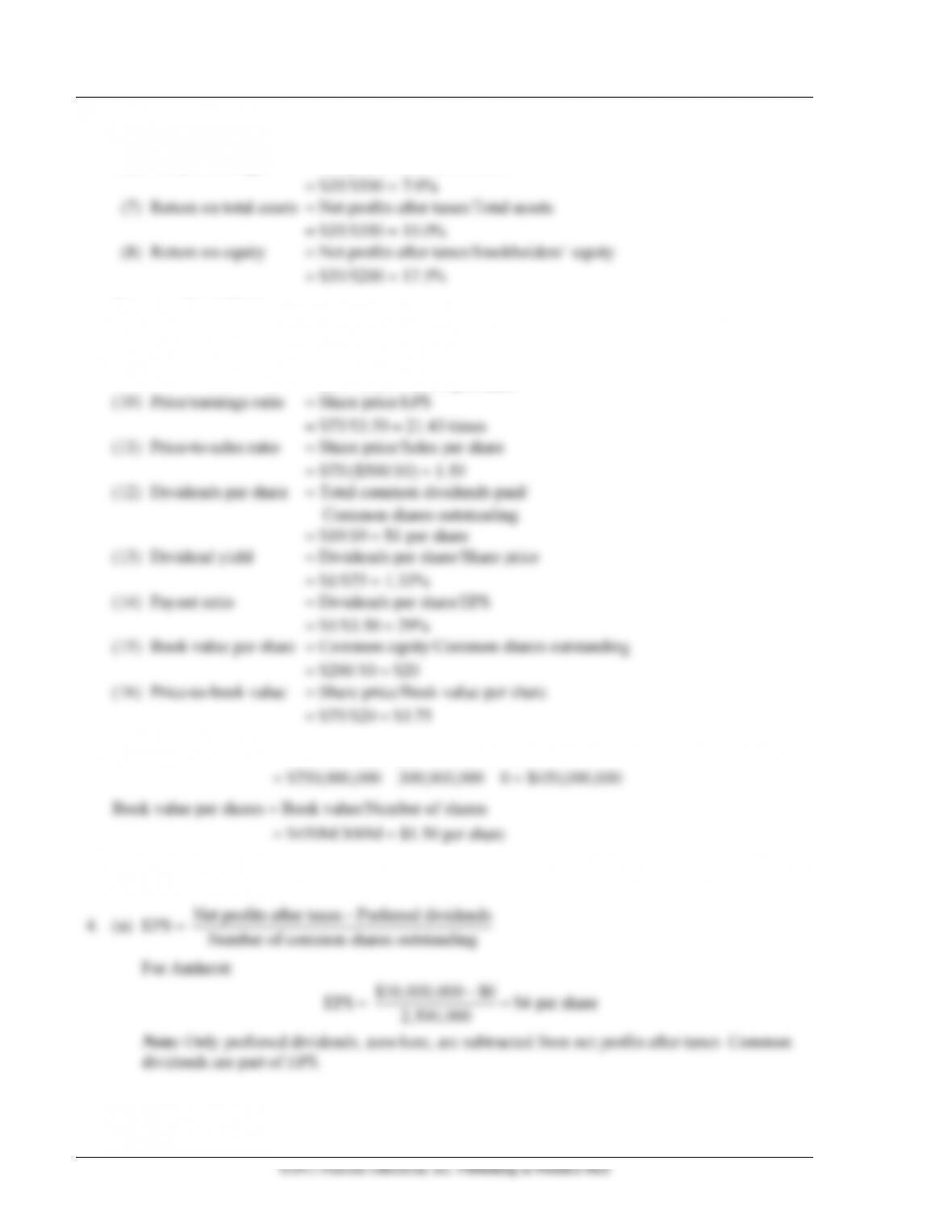
1. From abbreviated financial statements (dollars in millions):
Liquidity
(1) Net working capital = Current assets – Current liabilities:
= $150 – $100 = $50
128 Gitman/Joehnk/Smart • Fundamentals of Investing, Eleventh Edition
Profitability
(6) Net profit margin = Net profits after taxes/Sales
Common Stock Ratios
(9) Earnings per share = (Net profits after taxes – Preferred dividends)/
Number of shares of common stock outstanding
= $35 – 0/10 = $3.50 per share
2. Book value = Assets – Liabilities – Preferred stock
3. Price-to-book value = $5.50/$.50 =11
Net profits after taxes Preferred dividends
−
Chapter 7 Analyzing Common Stocks 129
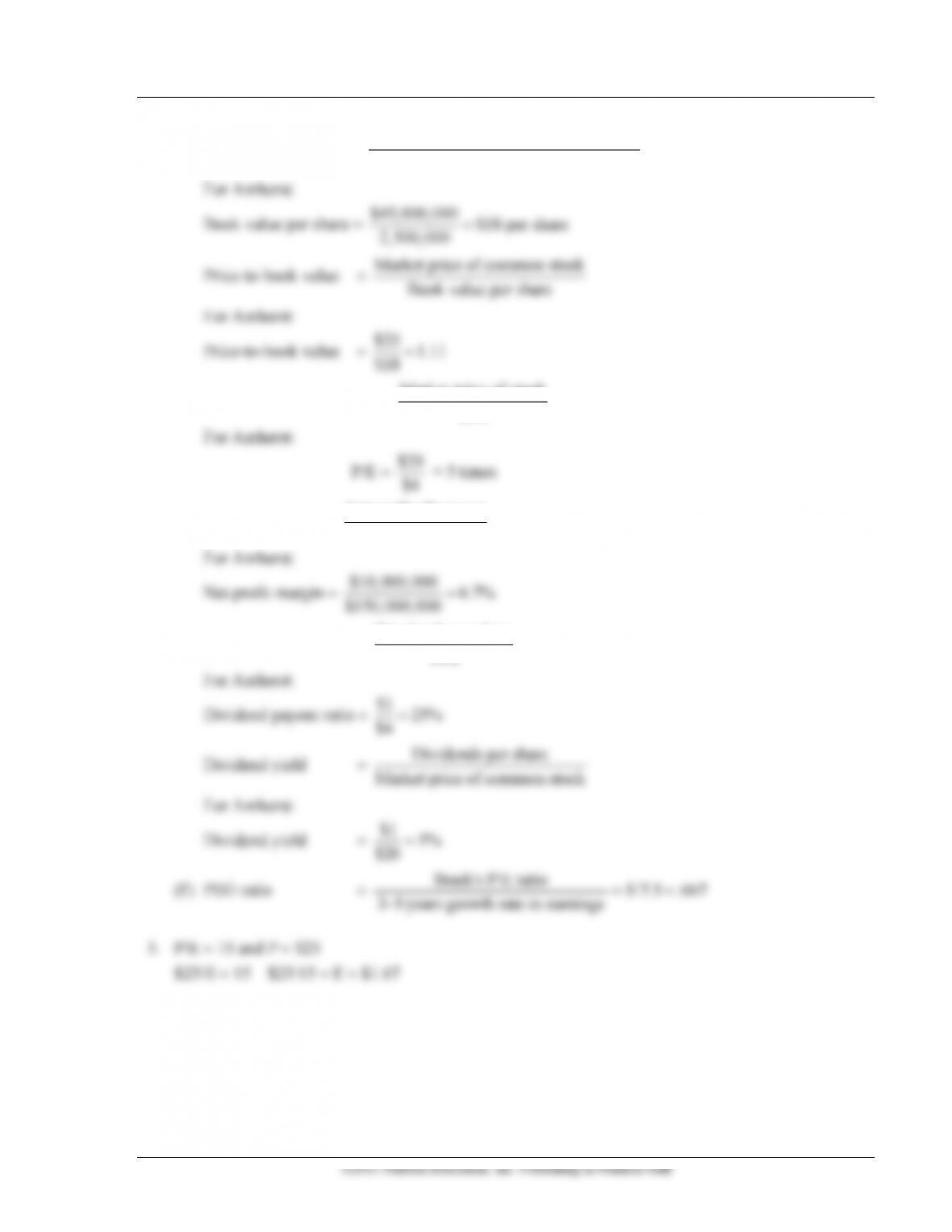
(b) Book value per share =
Stockholders’ equity
Number of common shares outstanding
$18
(c) Price/earnings (P/E) ratio =
Market price of stock
EPS
$4
(d) Net profit margin =
Net profit after taxes
Total revenues
$150,000,000
(e) Dividend payout ratio =
Dividends per share
EPS

©2011 Pearson Education, Inc. Publishing as Prentice Hall
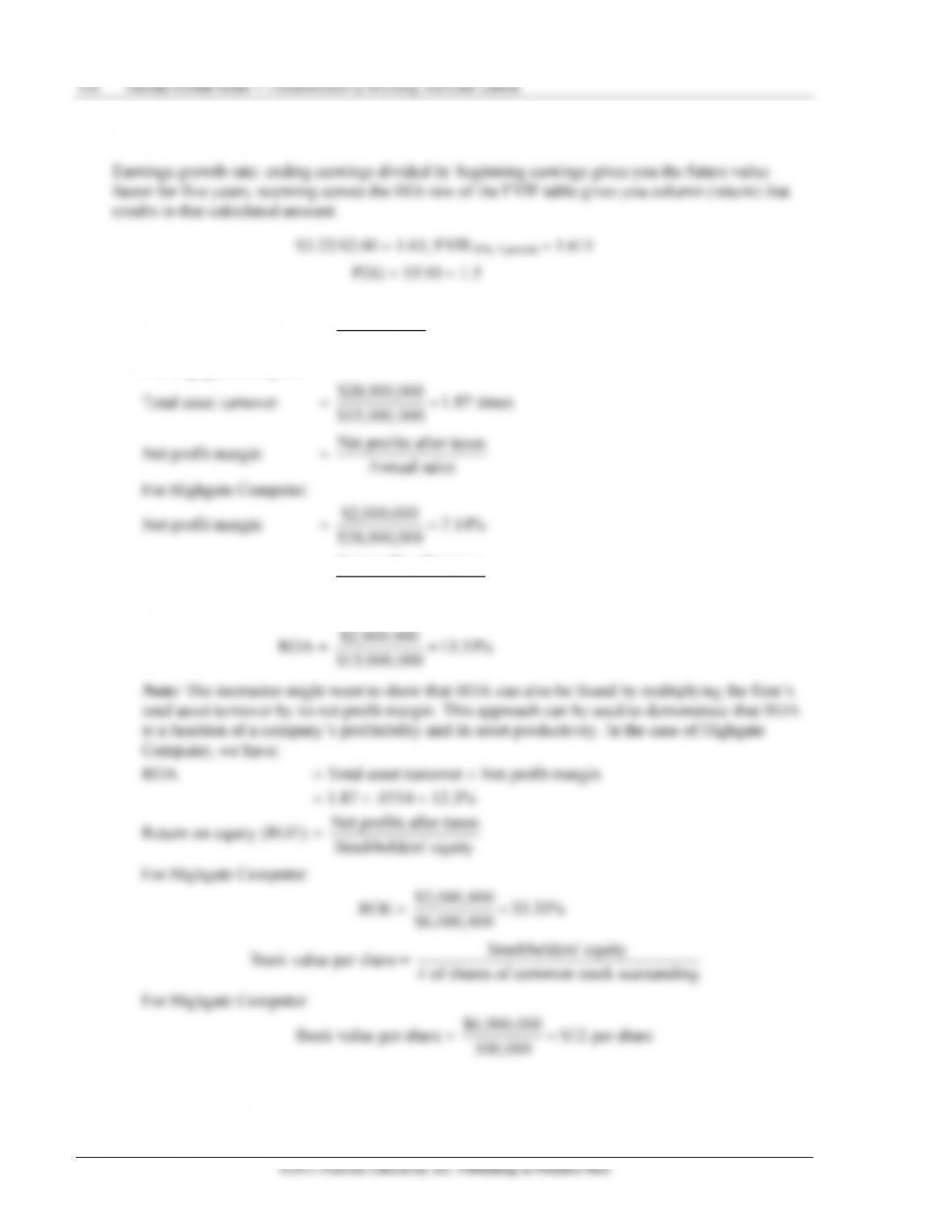
9. (a) (i) EPS =
Net profits after taxes Preferred dividends
Number of common shares outstanding
−
For Financial Learning Systems:
$6,850,000 $500,000 $2.54
−=
Market price of stock $93.75
=