112 Gitman/Joehnk/Smart • Fundamentals of Investing, Eleventh Edition
2. (a) Wednesday, April 9
3. Answers will vary with each student.
4. (a) A combination of growth and value stock in a 50-50 weighting such as Microsoft for growth
5. The three sources of return to U.S. investors from foreign stocks are the share of profit payments in
the form of dividends, the capital gain as the value of the stock increases in market price, and the
6. (a) A buy-and-hold strategy is a long-term program that seeks capital growth as well as preservation
(b) A current-income portfolio focuses on the current dividend yield of stocks. Safety of principal
(c) Long-term total return would emphasize more growth stock as well as a lesser percentage in
Chapter 6 Common Stocks 113
◼ Solutions to Problems
1. If a $50 stock splits 5 for 2, the new price of a share immediately after the split would be $20. Using
the approach noted in the chapter, we have:
If an investor owned 200 shares before the split, she would own 500 shares afterward:
The market value of her holdings, however, would be unchanged:
2. Commissions on trades. The investor began with $20,000 and made $1,000 on his trade of stock.
This totals $21,000. His balance, however, is $20,900. Therefore, Item 4 should be:
3. Book value = Total assets – Total debt – Preferred stock
For Kracked Pottery:
Book value = $2,500,000 $1,800,000 $200,000
$500,000
Book value
Book value per share = Number of shares of common stock outstanding
−−
=
For Kracked Pottery:
$500,000 $10
50,000
4. Market capitalization = Share price Number of shares outstanding
5. (a) Earnings per share (EPS) =
Net profits after taxes Preferred dividends
Number of shares of common stock outstanding
−
2,500,000
114 Gitman/Joehnk/Smart • Fundamentals of Investing, Eleventh Edition
©2011 Pearson Education, Inc. Publishing as Prentice Hall
(b) Dividend yield =
Cash dividends per share
Market price per share
For Med Tech Co.:
$2
Dividend yield 3.33%
$60
==
(c) Dividend payout ratio =
Dividends per share
EPS
For Med Tech Co.:
$2
Dividend payout ratio 33.8%
$5.92
==
6.
Initial Investment = 200 $50 =
$10,000
Sales Proceeds = 200 $55 =
$11,000
Dividends = $.25 4 200 =
$ 200
Total Proceeds = $200 + $11,000 =
$11,200
Net Proceeds Before Tax =
$ 1,200
Tax @ 15% = .15 $1,200
$ 180
Net Proceeds After Tax = $1,200 – $180 =
$ 1,020
7. (a) Book value = Total assets – Total debt – Preferred stock
For Truly Good Coffee:
Book value = $240M – $115M – $25M = $100M
$2.05
Chapter 6 Common Stocks 115
(e) Dividend yield on common stock =
Cash dividends per share
Market price per share
For Truly Good Coffee:
$.75 3.0%
$25.00
(f) Dividend yield on preferred stock =
Preferred dividends per share
Market price of preferred share
For Truly Good Coffee:
$2.00 6.5%
10. (a) If Wilfred sells his stock on March 20, he will be selling after the stock’s ex-dividend date
(which will occur on March 19), and, therefore, he will be the holder of record and is entitled to
11. The dividends paid under the two systems would be as follows:
Dividends Paid
Year
EPS
40% Payout
Ratio
Regular Dividend
of $1 per Share
2006
$1.40
$0.56
$1.00
2007
2.10
0.84
1.00
2008
1.00
0.40
1.00
2009
3.25
1.30
1.00
2010
0.80
0.32
1.00
Total Dividends
$3.42
$5.00
Total dividends are highest with regular dividends of $1 per share. Also, note how dividend
payments fluctuate with the fixed payout ratio procedure.
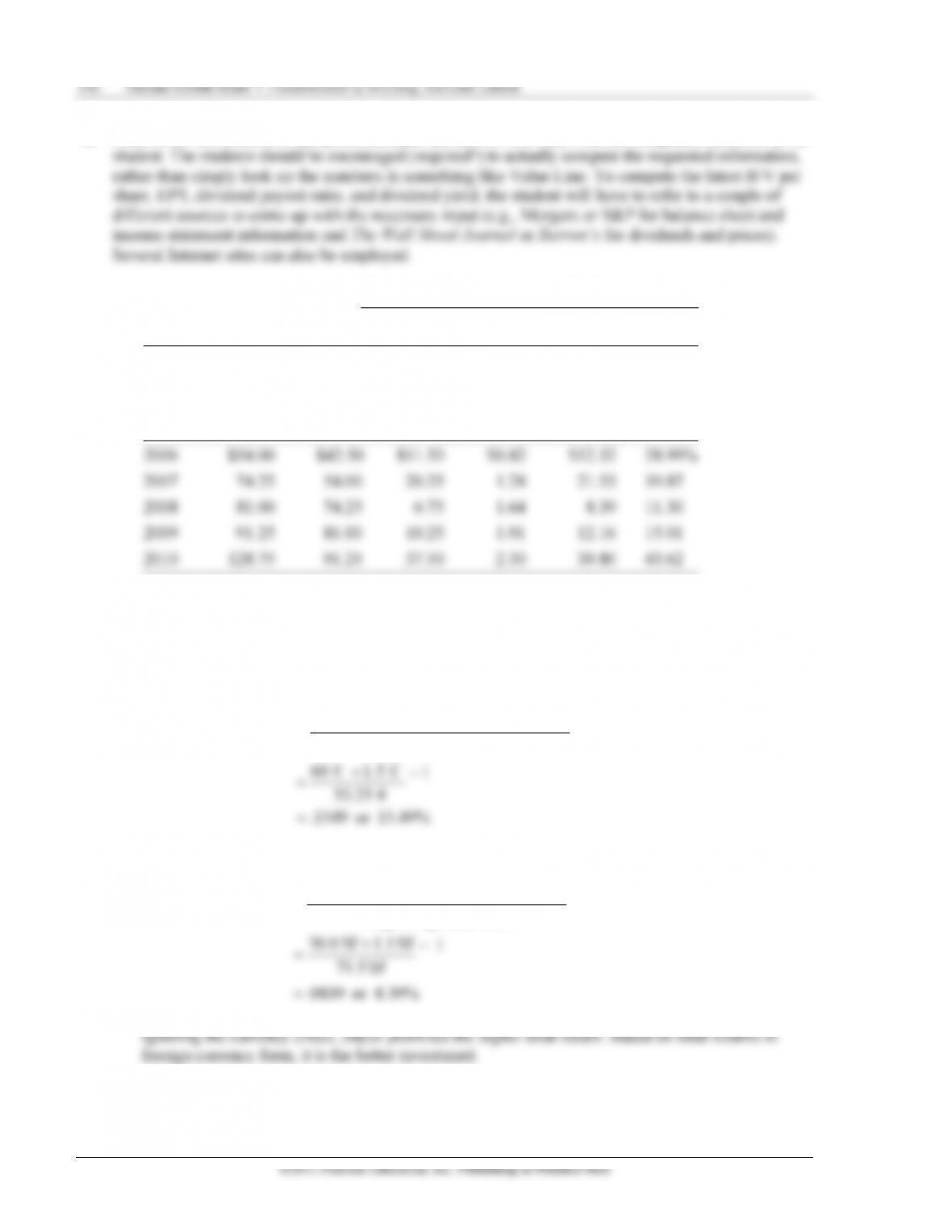
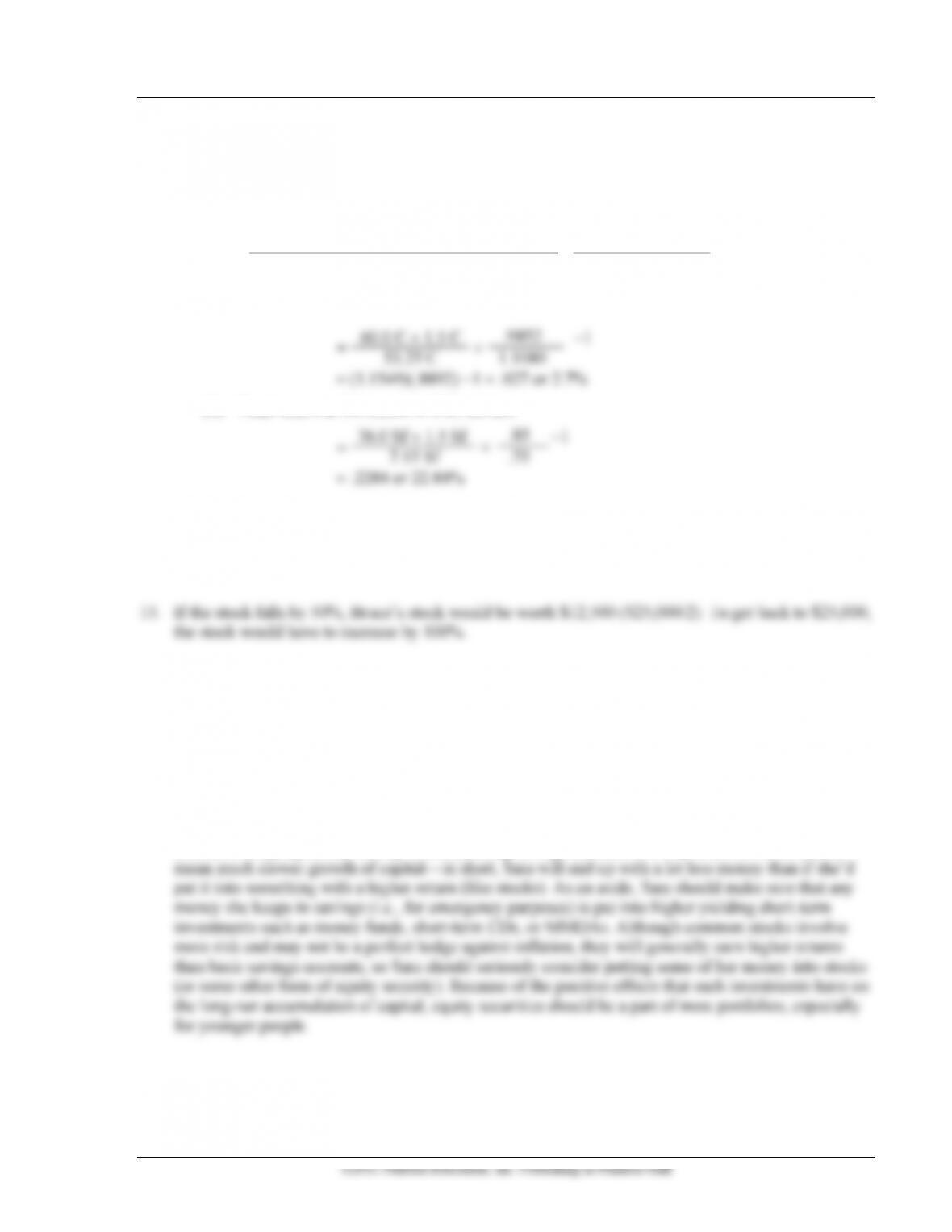
Chapter 6 Common Stocks 117
(b) Note: The euro depreciated, while the Swiss franc appreciated. Considering the currency effect:
(1) Total return to Bayer in U.S. dollars:
r
Exchange ate at
Ending value in euros and dividends in euros end of period 1
Beginning value in euros Exchange rate at
beginning of period
−
=
(2) Total return to Swisscom in U.S. dollars:
=
76.0 Sf + 1.5 Sf
.85
−1
7.15 Sf
.75
= .2284 or 22.84%
Exchange rates worked against the German investment because the higher returns were offset by an
appreciation in the dollar relative to the euro. Conversely, the dollar depreciated relative to the Swiss
franc, yielding an even higher total return on the Swiss stock. Given exchange rates, select the stock
issued by Swisscom.
◼ Solutions to Case Problems
Case 6.1 Sara Decides to Take the Plunge
The purpose of this case is to provide the student with the opportunity to identify investment needs,
establish investment goals, and design an investment program.
(a) Since Sara is so successful, she can easily provide for the necessities of life. Other than a minimum
savings account to meet emergency needs, her savings should not be held for the long haul in these
accounts. Keeping money tied up in low yielding savings accounts is costly since the lower yields
118 Gitman/Joehnk/Smart • Fundamentals of Investing, Eleventh Edition
(b) Because of her high current income, Sara does not need investments to provide income now. She
does need securities for capital accumulation and as a store of value (protect loss in purchasing
power due to inflation).
1. North Atlantic Swimsuit Company (NASS) might meet Sara’s needs, but it is a highly speculative
stock. The capital accumulation and storage of value benefits from this security are difficult to
2. Town and Country Computer best fills these needs. It is a classic growth firm: it has a long
record of growth and is a quality firm with excellent prospects. The modest dividend is
3. Southeastern Public Utility Company does not meet Sara’s needs; it has a high current dividend
and low growth prospects. Without at least average growth, the stock cannot serve as a store of
4. International Gold Mines may serve as a source of capital accumulation, but its price volatility
makes it questionable as a store of value. Certainly, its defensive characteristics make it attractive
during periods of high inflation when the price of gold is increasing. However, when inflation
(c) Sara should follow a buy-and-hold or a quality long-term growth strategy. A high-income strategy
does not fit her needs; she does not have the expertise to handle aggressive stock management
(although her investment adviser might help her here); and the speculative, short-term strategy does
Case 6.2 Wally Wonders Whether There’s a Place for Dividends
This case illustrates the common practice of changing investments in reaction to market changes. This case

Chapter 6 Common Stocks 119
©2011 Pearson Education, Inc. Publishing as Prentice Hall
(a) Wally’s existing plan is one of long-term growth, obtained by investing in quality issues. Given his
high income and the limited time he has to devote to his security holdings, this strategy (of quality
growth) seems appropriate for him.
120 Gitman/Joehnk/Smart • Fundamentals of Investing, Eleventh Edition
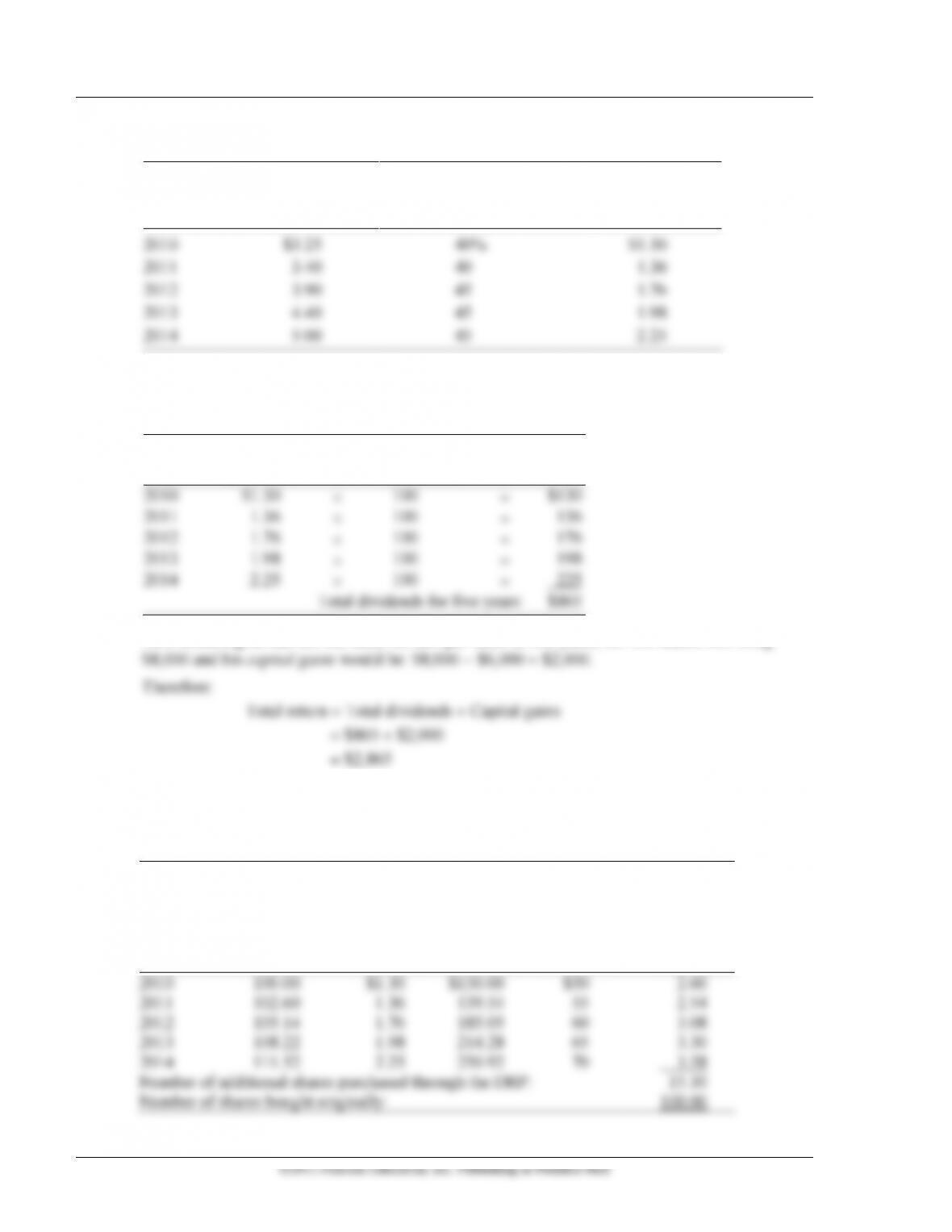
(b) 1. Expected dividends for Hydro-Electric:
Year
(1)
Expected EPS
(2)
Expected
Dividend Payout Ratio
(3)
(1) (2)
Expected Dividend
2010
$3.25
40%
$1.30
2011
3.40
40
1.36
2012
3.90
45
1.76
2013
4.40
45
1.98
2014
5.00
45
2.25
2. Wally could purchase 100 shares of Hydro-Electric stock ($6,000 investment/$60 per share).
Expected returns would be a function of dividends and capital gains. First, dividend income
over the five years would be:
Year
Dividends
per Share
100 Shares
=
Tota
l
2010
$1.30
100
=
$130
2011
1.36
100
=
136
2012
1.76
100
=
176
2013
1.98
100
=
198
2014
2.25
100
=
225
Total dividends for five years:
$865
Now assuming he can sell the stock for $80 per share in five years, his 100 shares will bring
3. If Wally joins the company’s Dividend Reinvestment Plan, he can obtain shares at reduced prices
and hence can achieve his goal of capital appreciation.
Wally will obtain additional shares as follows:
(1)
(2)
(3)
(4)
(5)
(6)
Year
No. of Shares
Held at
Beginning
of Year
Dividends
per Share
Total
Dividends
Purchase
Price
per Share
No. of Shares
Purchased
(4) + (5)
2010
100.00
$1.30
$130.00
$50
2.60
2011
102.60
1.36
139.54
55
2.54
2012
105.14
1.76
185.05
60
3.08
2013
108.22
1.98
214.28
65
3.30
2014
111.52
2.25
250.92
70
3.58
Number of additional shares purchased through the DRP:
15.10
Number of shares bought originally:
100.00
Chapter 6 Common Stocks 121
©2011 Pearson Education, Inc. Publishing as Prentice Hall
Total:
115.10
Using the Dividend Reinvestment Plan, Wally would have accumulated 15.10 additional shares,
for a total of 115.10 shares by the end of 2011. With the stock trading at $80 on December 31,
2014, his shares would be worth 115.10 $80 = $9,208.
Note: The figure shown in column (2) is the number of shares held at the beginning of the year;
this number will increase each year with the dividends reinvested. This increases the total
dividends received each year. Compare this answer with 2(b). Thus, dividend reinvestment plans
have a cascading effect.
(c) Wally would not be going to a different investment strategy if he buys the shares of Hydro-Electric;
◼ Answer to Chapter Opening Problem
(c) The drop in GE’s total market value is a little less than twice the amount saved by cutting dividends.
If the price investors were willing to pay for GE stock prior to the dividend cut reflected their
◼ Outside Project
Chapter 6 Just What Kind of Stock Is It, Anyway?
The text describes a number of different types of common stocks: blue chips, income stocks, growth
stocks, speculative, cyclical, defensive, and small-cap stocks. Each type can be characterized by its
sensitivity to the economy, which is an important market factor and which may be measured by the beta of
the company. They may also be characterized by their dividend yield. High yielding companies have fewer
investment opportunities, so they pay higher dividends and investors expect more of their return in the
form of dividends. The purpose of this project is to see if betas and dividend yields do, indeed, behave as
expected for the various types of stocks identified above.
Value Line publishes betas and dividend yields for about 1,700 companies. Using the companies listed in
the text and other similar companies that you can identify in Value Line, find the betas and dividend yields
for five companies in each of the seven stock categories defined above (i.e., find the betas and dividend
yields for five blue chips, five income stocks, five growth companies, five speculative stocks, five
cyclicals, five defensive, and five small-cap stocks). Next, calculate the average beta and average dividend
yield for each type of stock—that is, find the average beta and dividend yield for the five blue chip stocks,
then find the average beta and dividend yield for the five income stocks, etc. Now what conclusions can

122 Gitman/Joehnk/Smart • Fundamentals of Investing, Eleventh Edition
you draw about risk and return based on your observations for each type of stock?
Note: Be sure your information is current.