Chapter 5 Modern Portfolio Concepts 91
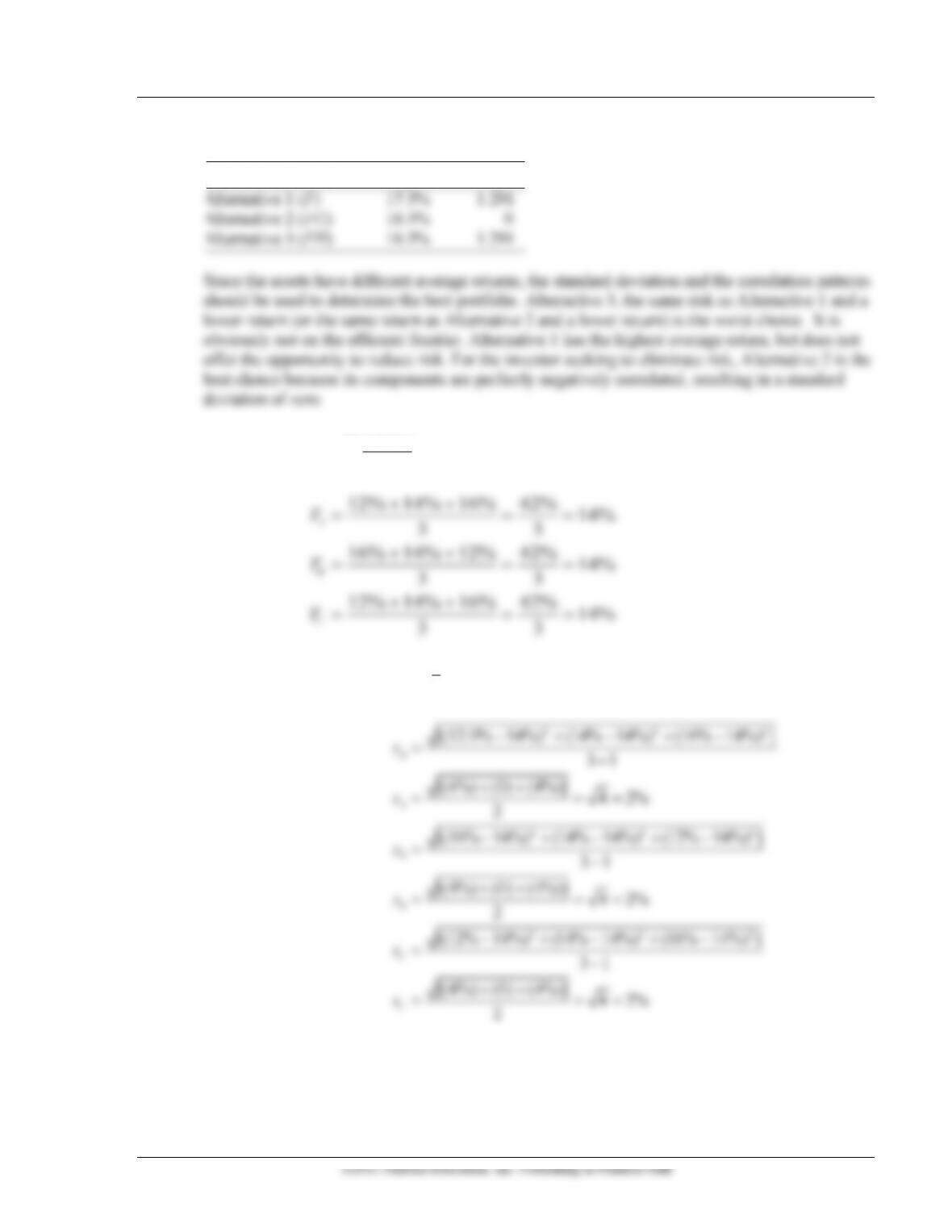
(c) Summary: rp: Average
Portfolio Return
rp
sp
Alternative 1 (F)
17.5%
1.291
Alternative 2 (FG)
16.5%
0
Alternative 3 (FH)
16.5%
1.291
Since the assets have different average returns, the standard deviation and the correlation patterns
should be used to determine the best portfolio. Alternative 3, the same risk as Alternative 1 and a
lower return (or the same return as Alternative 2 and a lower return) is the worst choice. It is
obviously not on the efficient frontier. Alternative 1 has the highest average return, but does not
offer the opportunity to reduce risk. For the investor seeking to eliminate risk, Alternative 2 is the
best choice because its components are perfectly negatively correlated, resulting in a standard
deviation of zero.
6. (a) Average return:
returns
3
r=
12% 14% 16% 42% 14%
33
16% 14% 12% 42% 14%
33
12% 14% 16% 42% 14%
33
A
B
C
r
r
r
++
= = =
++
= = =
++
= = =
(b) Standard deviation:
2
1
()
n
ii
i
s r r n
=
= − ( −)
[
[=
[
222
222
222
(12.0% 14%) (14% 14%) (16% 14%) ]
31
(4%) (0) (4%)] 4 2%
2
(16% 14%) (14% 14%) (12% 14%) ]
31
[(4%) (0) (4%)] 4 2%
2
[(12% 14%) (14% 14%) (16% 14%) ]
31
[(4%) (0) (4%)] 4 2%
2
A
A
B
B
C
C
s
s
s
s
s
s
− + − + −
=−
++
==
− + − + −
=−
++
= = =
− + − + −
=−
++
= = =
92 Gitman/Joehnk/Smart • Fundamentals of Investing, Eleventh Edition
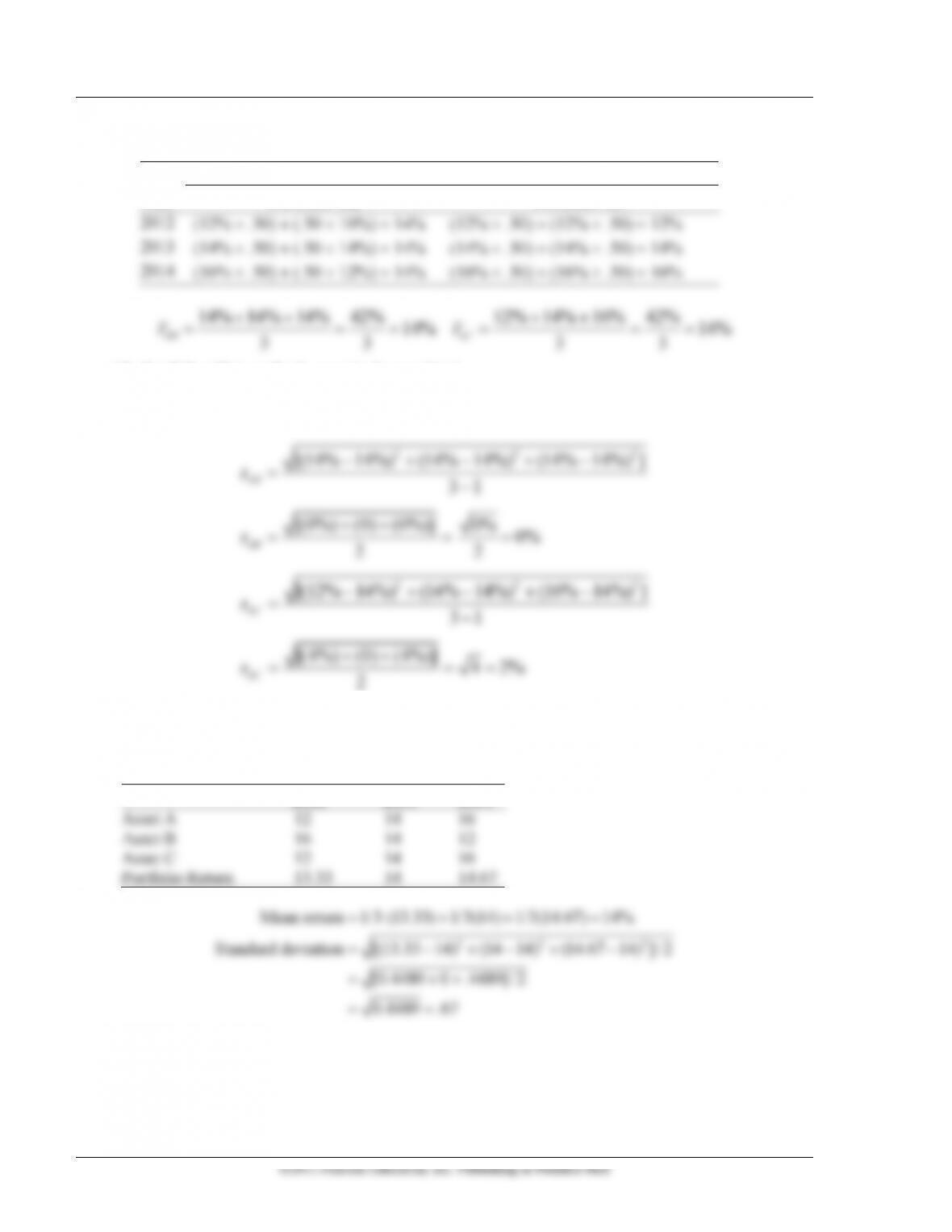
(c)
Portfolio Return
Year
Portfolio AB
Portfolio AC
2012
(12% .50) + (.50 16%) = 14%
(12% .50) + (12% .50) = 12%
2013
(14% .50) + (.50 14%) = 14%
(14% .50) + (14% .50) = 14%
2014
(16% .50) + (.50 12%) = 14%
(16% .50) + (16% .50) = 16%
14% 14% 14% 42% 12% 14% 16% 42%
14% 14%
3 3 3 3
AB AC
rr
+ + + +
= = = = = =
(d) Portfolio AB is perfectly negatively correlated.
Portfolio AC is perfectly positively correlated.
(e) Standard deviation of portfolios:
222
222
[(14% 14%) (14% 14%) (14% 14%) ]
31
[(0%) (0) (0%)] 0% 0%
22
[(12% 14%) (14% 14%) (16% 14%) ]
31
[(4%) (0) (4%)] 4 2%
2
AB
AB
AC
AC
s
s
s
s
− + − + −
=−
++
= = =
− + − + −
=−
++
= = =
(f) Portfolio AB is preferred: it provides the same return (14%) as Portfolio AC, but with less risk, as
measured by the standard deviation (sAB = 0%; sAC = 2%).
7.
2012
2013
2014
Asset A
12
14
16
Asset B
16
14
12
Asset C
12
14
16
Portfolio Return
13.33
14
14.67
2 2 2
Mean return 1/3 (13.33) 1/3(14) 1/3(14.67) 14%
Standard deviation [(13.33 14) (14 14) (14.67 14) ]/ 2
[0.4489 0 .4489]/ 2
0.4489 .67
= + + =
= − + − + −
= + +
==
The return would be the same with slightly higher risk. This is because the assets are no longer
perfectly negatively correlated. Two-thirds of the portfolio has one characteristic return pattern,
and one-third of the portfolio is constant over time.
©2011 Pearson Education, Inc. Publishing as Prentice Hall
14.
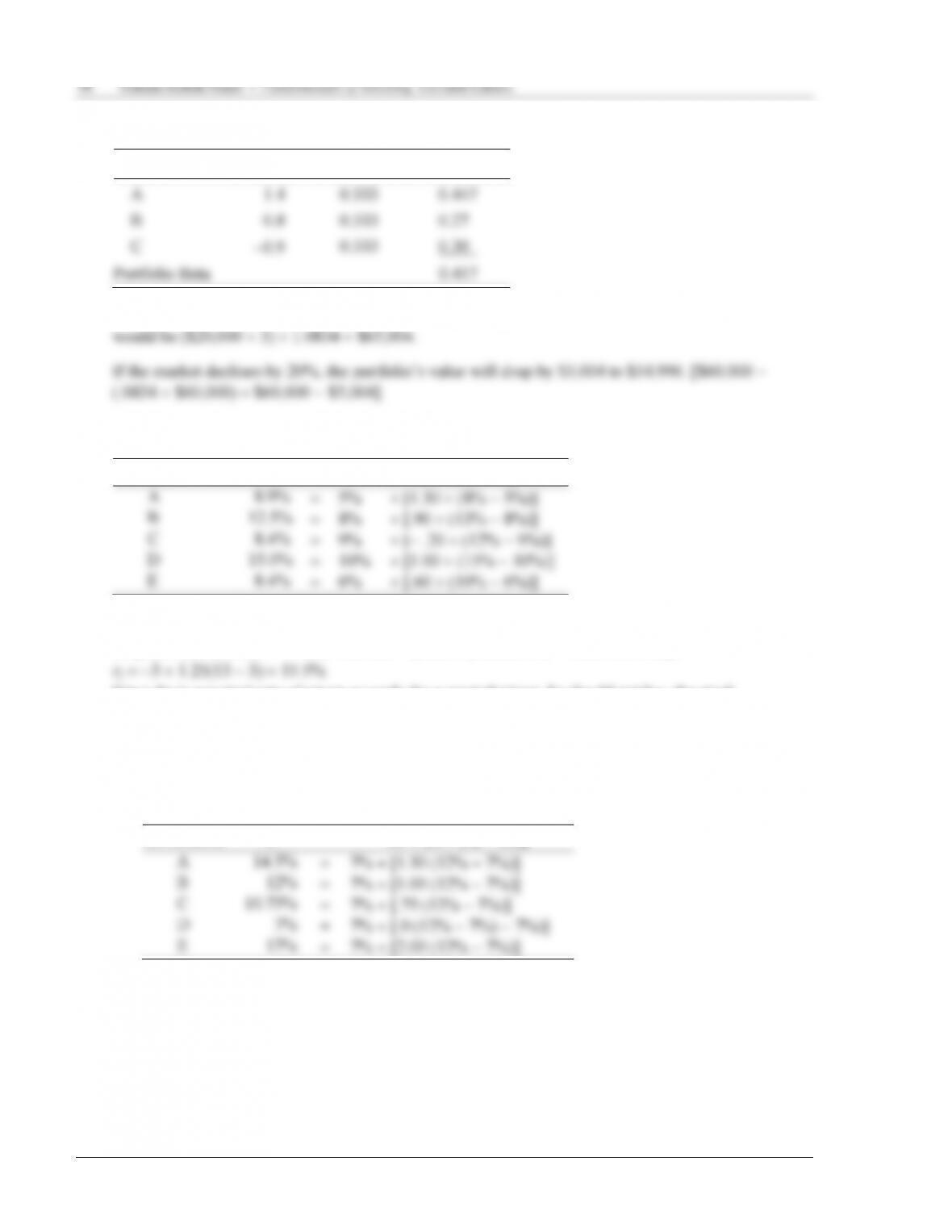
Security
Beta
Weight
Weighted
A
1.4
0.333
0.447
B
0.8
0.333
0.27
C
−0.9
0.333
0.30
Portfolio Beta
0.417
15. If the market rallied 20%, the portfolio should increase by 8.34 (.417 20)%. The portfolio’s value
16. Capital asset pricing model: ri = RF + [bi (rm − RF)]
Investment
ri
RF + [bi (rm −RF)]
A
8.9%
=
5% + [1.30 (8% − 5%)]
B
12.5%
=
8% + [.90 (13% − 8%)]
C
8.4%
=
9% + [− .20 (12% − 9%)]
D
15.0%
=
10% + [1.00 (15% − 10%)]
E
8.4%
=
6% + [.60 (10% − 6%)]
17. Using the CAPM, Jay’s required rate of return on the stock should be:
Required rate of return = − Risk-free rate + [Beta (Market rate − Risk-free rate)]
Since Jay’s required rate of return exceeds the expected return, he should not buy the stock.
18. If the risk-free rate is 7% and the market return is 12%:
(a) Investment E is the most risky because it has the highest beta, 2.00. Investment D, with a beta of
0, is the least risky.
(b) Capital asset pricing model: ri = RF + [bi (rm − RF)]
Investment
ri
RF + [bi (rm − RF)]
A
14.5%
=
7% + [1.50 (12% − 7%)]
B
12%
=
7% + [1.00 (12% − 7%)]
C
10.75%
=
7% + [.75 (12% − 7%)]
D
7%
=
7% + [.0 (12% − 7%) − 7%)]
E
17%
=
7% + [2.00 (12% − 7%)]
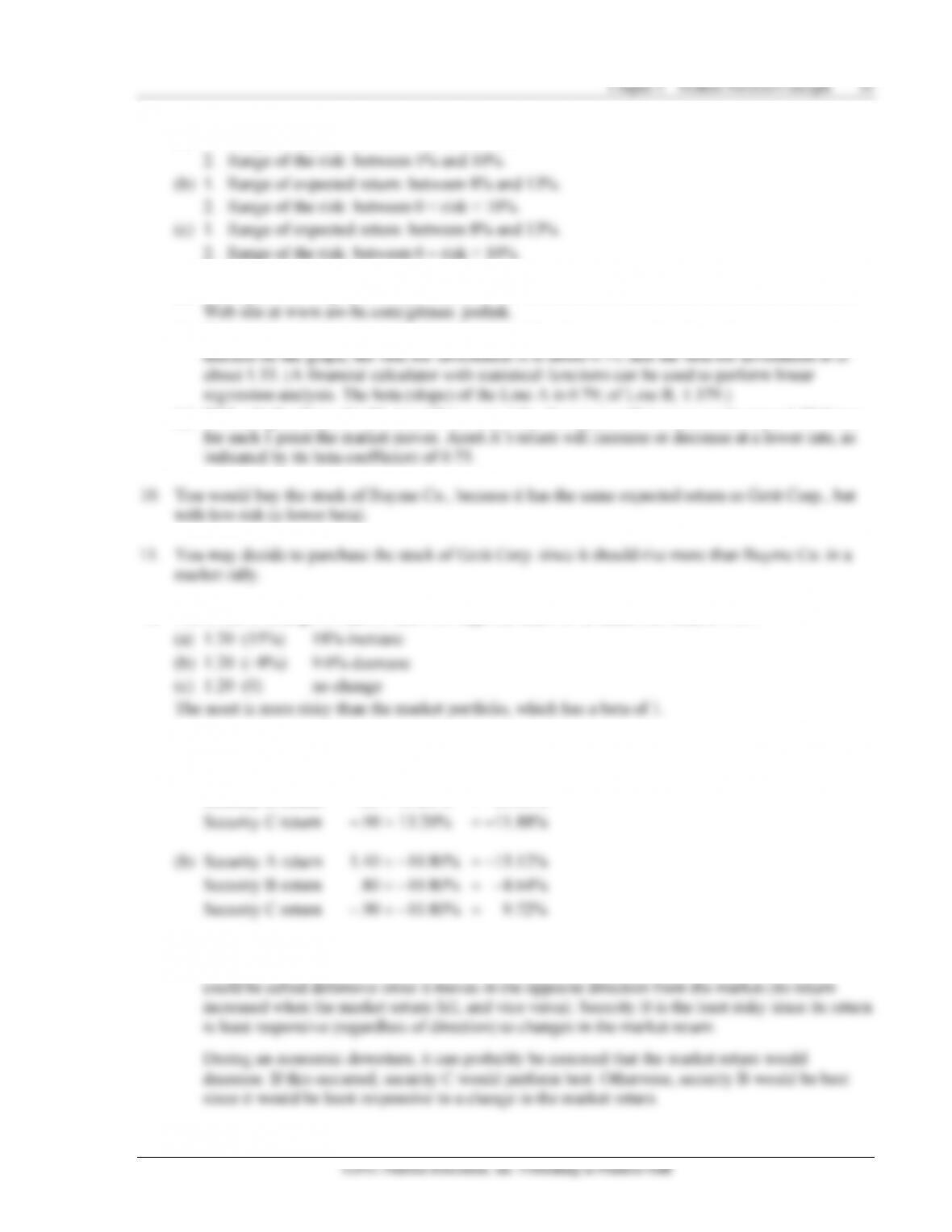
(c) The figure showing the security market line (SML) can be found on the book’s Web site at
www.pearsonhighered.com/gitman.
(d) Based on the above graph and the calculations, there is a linear relationship between risk and
return.
96 Gitman/Joehnk/Smart • Fundamentals of Investing, Eleventh Edition
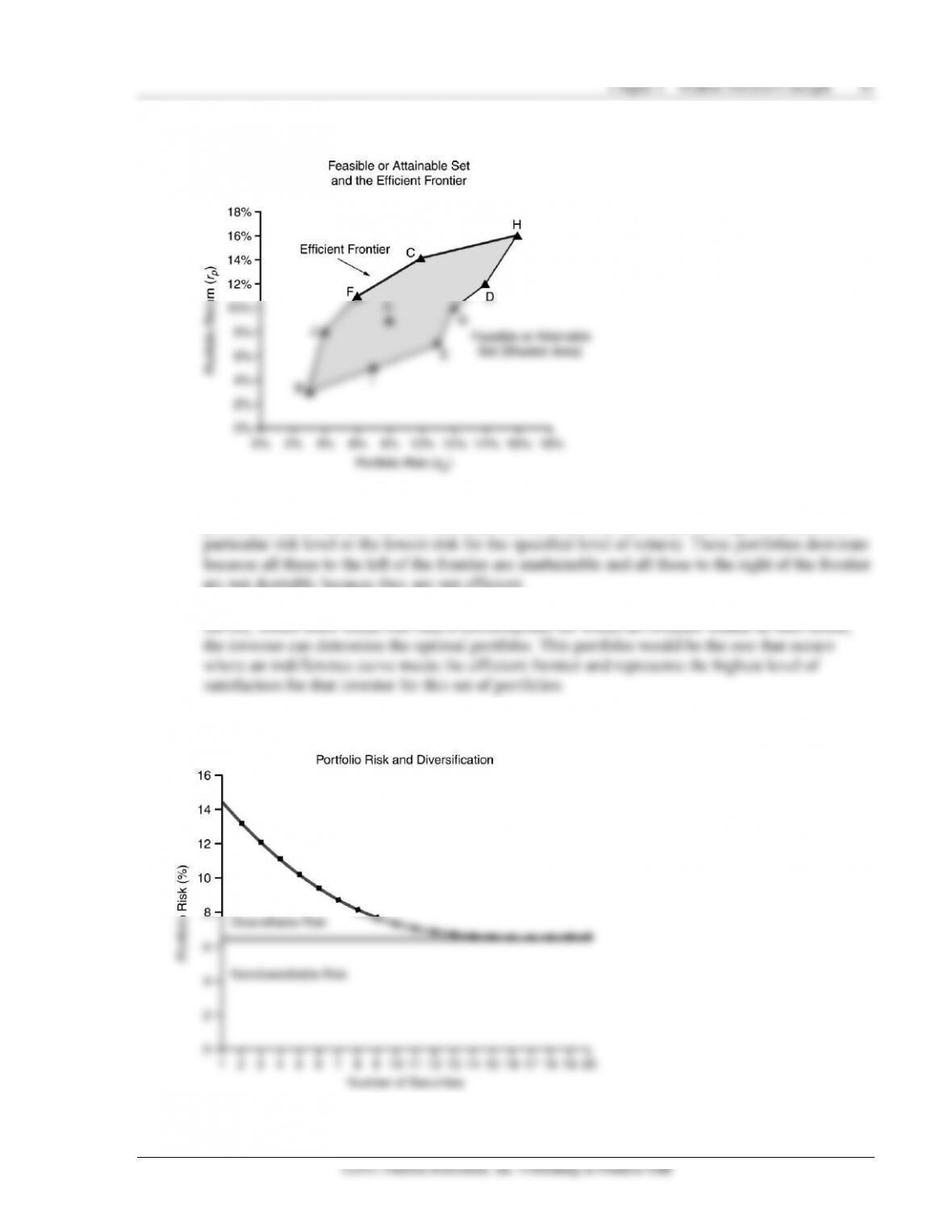
(c) Only non-diversifiable risk is relevant because, as shown by the graph, diversifiable risk can be
21. With a beta value of +1.5, portfolio A would be 1.5 times as responsive to changes in the market as
the market itself, while portfolio Z with a beta of −1.5 would also be 1.5 times as responsive, but in
22. (a)
Stock
Beta
Most risky
B
1.40
A
0.80
Least risky
C
−0.30
(b) and (c)
Stock
Beta
Increase in
Market Return
Impact on
Asset Return
Decrease in
Market Return
Impact on
Asset Return
A
0.80
0.12
0.096
−0.05
−0.04
B
1.40
0.12
0.168
−0.05
−0.07
C
−0.30
0.12
−0.036
−0.05
0.015
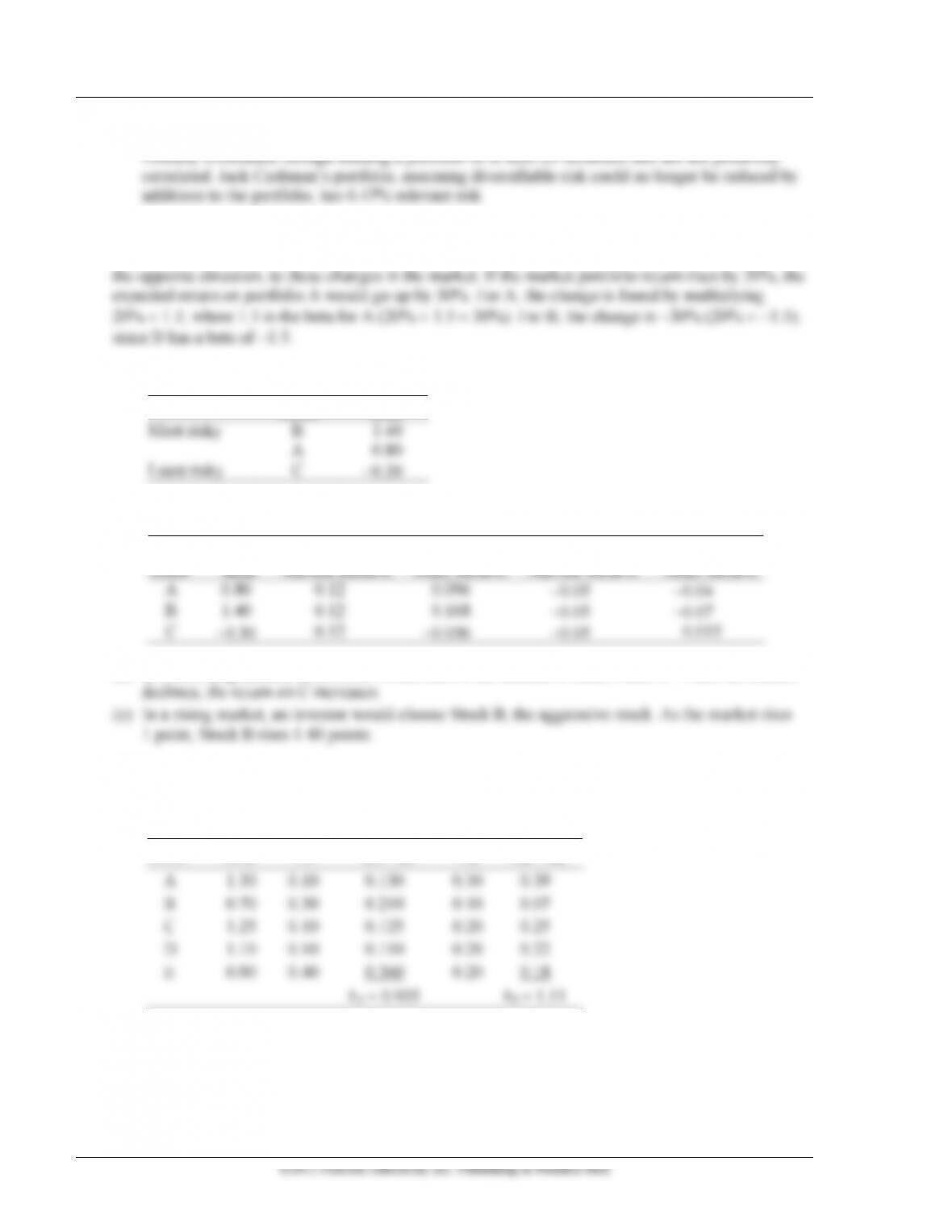
(d) In a declining market, an investor would choose the defensive stock, Stock C. While the market
23.
1
Portfolio betas:
n
p j j
i
b w b
=
=
(a)
Asset
Beta
wA
wA bA
wB
wB bB
A
1.30
0.10
0.130
0.30
0.39
B
0.70
0.30
0.210
0.10
0.07
C
1.25
0.10
0.125
0.20
0.25
D
1.10
0.10
0.110
0.20
0.22
E
0.90
0.40
0.360
0.20
0.18
bA = 0.935
bB = 1.11
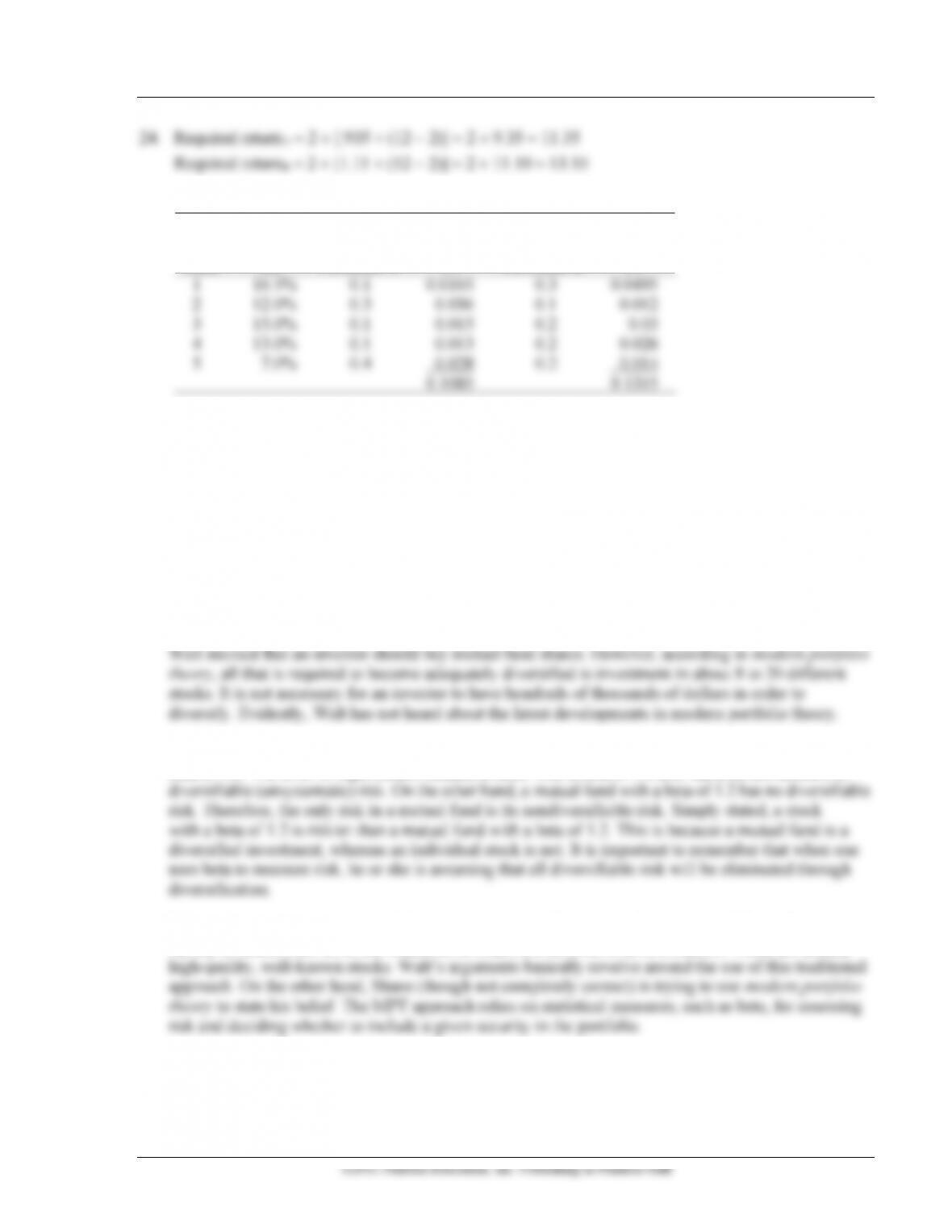
(b) Portfolio A is slightly less than the market (average risk), while Portfolio B is more risky than the
market. Portfolio B’s return will move more than Portfolio A’s for a given increase or decrease in
market risk. Portfolio B is the more risky.
Chapter 5 Modern Portfolio Concepts 97
©2011 Pearson Education, Inc. Publishing as Prentice Hall
24. Required returnA = 2 + [.935 (12 − 2)] = 2 + 9.35 = 11.35
Required returnB = 2 + [1.11 (12 − 2)] = 2 + 11.10 = 13.10
25.
[1]
[2]
[3]
[2 3]
[4]
[2 4]
Asset
Ra
% of
Portfolio A
Pr
% of
Portfolio B
Pr
1
16.5%
0.1
0.0165
0.3
0.0495
2
12.0%
0.3
0.036
0.1
0.012
3
15.0%
0.1
0.015
0.2
0.03
4
13.0%
0.1
0.013
0.2
0.026
5
7.0%
0.4
0.028
0.2
0.014
0.1085
0.1315
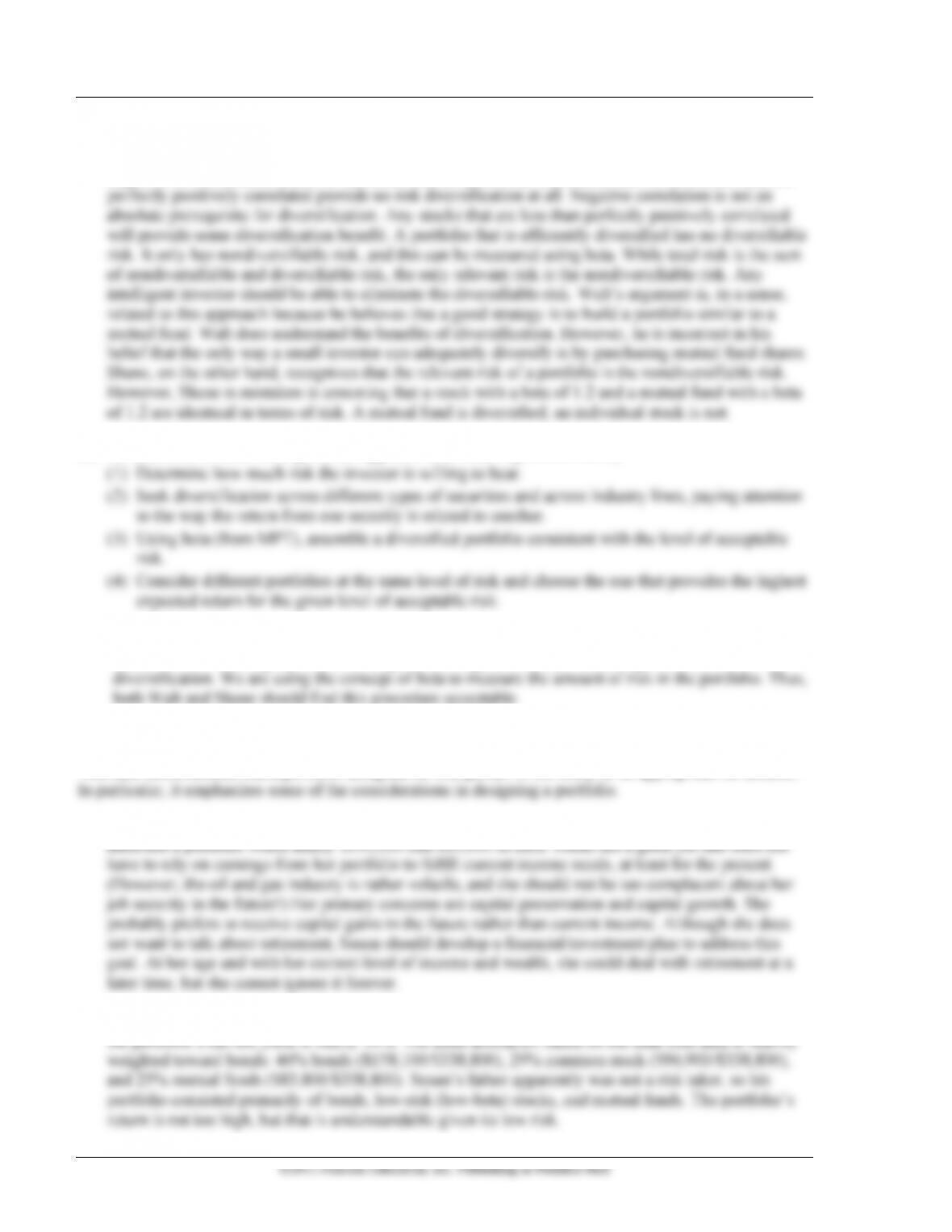
Portfolio B provides a return in excess (slightly) of the required rate of return, while Portfolio A does not.
Portfolio B represents a better risk/reward trade-off.
◼ Solutions to Case Problems
Case 5.1 Traditional Versus Modern Portfolio Theory: Who’s Right?
This case provides a basis for discussion of traditional and modern portfolio theory with emphasis on the
reconciliation of the two.
(a) Walt’s arguments rely on the traditional approach to portfolio management. He believes that by
building a large portfolio, the maximum benefits of diversification can be achieved. For this reason,
(b) Shane is incorrect in assuming that the stock with a beta of 1.2 is equivalent to a mutual fund with a
beta of 1.2. The error in logic occurs because a stock with a beta of 1.2 also has a certain amount of
(c) The traditional approach to portfolio management simply involves forming a portfolio with a large
variety of stocks from different industries to obtain the benefits of diversification. These are usually
98 Gitman/Joehnk/Smart • Fundamentals of Investing, Eleventh Edition
(d) Modern portfolio theory relies on statistical concepts. The use of the correlation coefficient and the
beta value are the most popular. Two securities that are negatively correlated tend to provide a greater
degree of diversification than two securities that are positively correlated, and two securities that are
(e) To reconcile the traditional portfolio approach and modern portfolio theory:
In using this four-step procedure, we are in effect reconciling the approaches suggested by Walt and
Shane. We are forming a portfolio (though not as large as a mutual fund) to get the benefits of
Case 5.2 Susan Lussier’s Inherited Portfolio: Does It Meet Her Needs?
This case demonstrates that a portfolio designed for one person is not likely to be appropriate for another.
(a) Susan’s financial position is quite strong: she has a regular $125,000 per year job and also has
(b) Reviewing Susan’s inherited portfolio indicates that current income was her father’s chief objective;
Chapter 5 Modern Portfolio Concepts 99
However, the same portfolio will result in an unduly high tax liability for Susan because of the
(c) Since current yield is not an important consideration for Susan, she should revise the portfolio to
include securities with low current yields and high capital appreciation potential. This will enable her
Within each asset category, she should hold higher-risk, capital-appreciation-oriented securities
rather than the income-oriented securities currently held. Since Susan is single and has adequate
(d) As discussed earlier, the inherited portfolio focuses on current income and capital preservation, rather
than Susan’s objectives of capital gains and tax shelter. She will want to adjust the portfolio to include
more capital appreciation securities, and she may also want to restructure the portfolio to meet
(e) The inherited portfolio is a very low-risk portfolio. As mentioned in the response to question (c), this
is not a good portfolio for Susan. What Susan really needs is a portfolio offering greater capital
appreciation and, consequently, lower taxable income. Susan should reallocate the assets in the
◼ Answer to Chapter Opening Problem
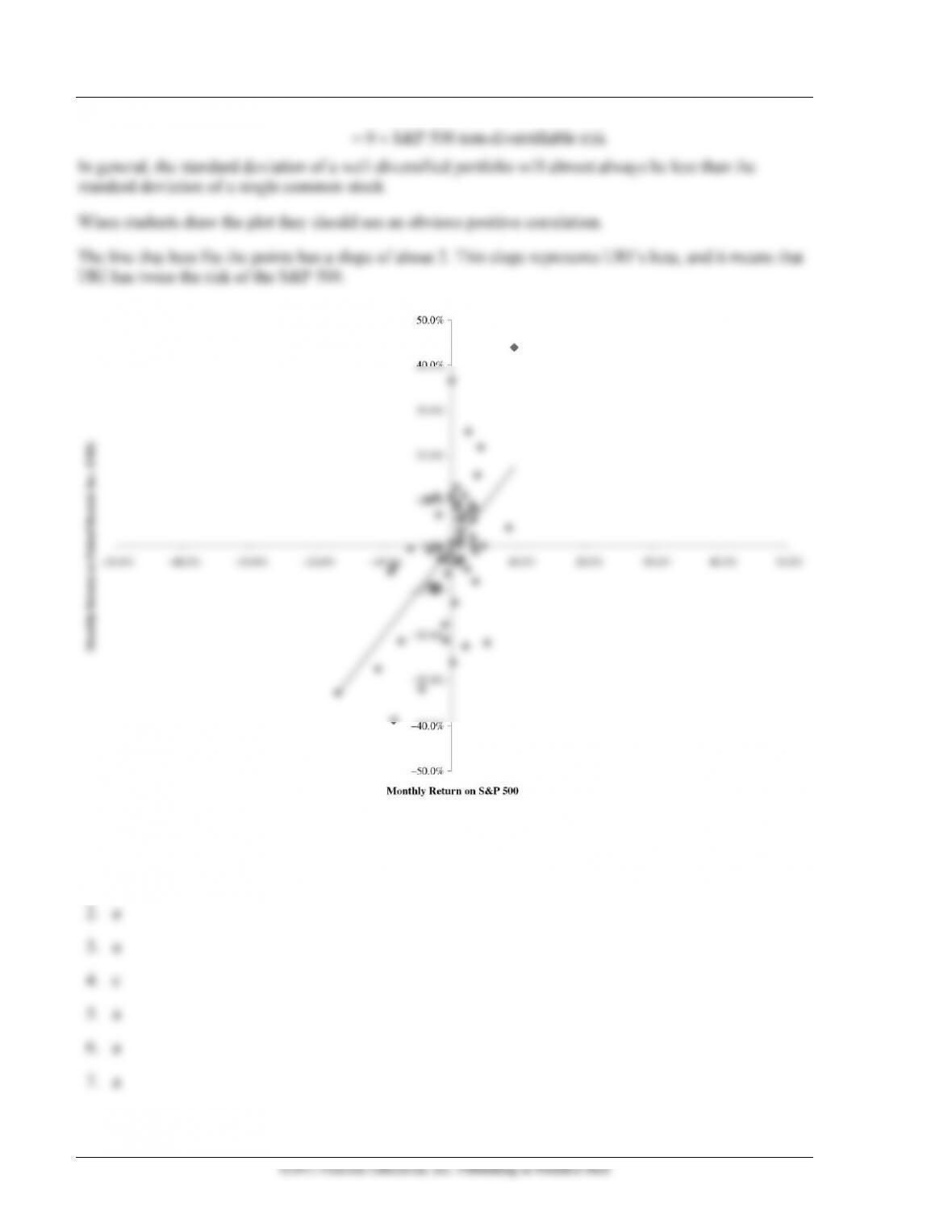
URI average return is −0.7% per month. S&P 500 average is −0.2% per month. For URI, the monthly
standard deviation is 15.3%, and for the S&P 500 it is 4.5%. The standard deviation is much higher for
URI because, as an undiversified investment, it contains both diversifiable and nondiversifiable risk:
100 Gitman/Joehnk/Smart • Fundamentals of Investing, Eleventh Edition
©2011 Pearson Education, Inc. Publishing as Prentice Hall
= 0 + S&P 500 non-diversifiable risk
In general, the standard deviation of a well-diversified portfolio will almost always be less than the
standard deviation of a single common stock.
When students draw the plot they should see an obvious positive correlation.
The line that best fits the points has a slope of about 2. This slope represents URI’s beta, and it means that
URI has twice the risk of the S&P 500.
◼ Answers to CFA Questions (Part II)
1. b

©2011 Pearson Education, Inc. Publishing as Prentice Hall
◼ Outside Project
Chapter 5 Your Dream Portfolio
Understanding your own attitude toward risk is very important when you are selecting investments for
inclusion in your portfolio. This project should help you consider what you would do if you came into
some money.
You bought a state lottery ticket last month, and yesterday you learned that you won one million dollars
after taxes. What would you do with the money? While there are certainly bills to be paid and things to
buy, assume that you will have at least $800,000 to invest. What goals do you wish to achieve with these
funds? State them clearly, develop an asset allocation scheme, and design a portfolio of stocks, bonds,
tangibles, and/or limited partnership investments that you feel would be consistent with achieving your
goals. Using current information and price quotations from The Wall Street Journal, local newspapers, and
the Internet, create your own dream portfolio.
Briefly explain the rationale for your asset allocation scheme and the reasons you included each specific
investment in the portfolio. Point out any concerns or reservations you might have relative to the portfolio
you created.