
Chapter 5
Modern Portfolio Concepts
◼ Outline
Learning Goals
I. Principles of Portfolio Planning
A. Portfolio Objectives
B. Portfolio Return and Standard Deviation
C. Correlation and Diversification
1. Correlation
2. Diversification
D. International Diversification
1. Effectiveness of International Diversification
2. Methods for International Diversification
3. Benefits of International Diversification
Concepts in Review
II. The Capital Asset Price Model (CAPM)
A. Components of Risk
B. Beta: A Popular Measure of Risk
1. Deriving Beta
2. Interpreting Beta
3. Applying Beta
C. The CAPM: Using Beta to Estimate Return
1. The Equation
2. The Graph: The Security Market Line (SML)
3. Some Closing Comments
Concepts in Review

80 Gitman/Joehnk/Smart • Fundamentals of Investing, Eleventh Edition
III. Traditional Versus Modern Portfolio Theory
A. The Traditional Approach
B. Modern Portfolio Theory
1. The Efficient Frontier
2. Portfolio Betas
a. Risk Diversification
b. Calculating Portfolio Betas
c. Interpreting Portfolio Betas
3. The Risk-Return Tradeoff: Some Closing Comments
C. Reconciling the Traditional Approach and MPT
Concepts in Review
Summary
Key Terms
Discussion Questions
Problems
Case Problems
5.1 Traditional Versus Modern Portfolio Theory: Who’s Right?
5.2 Susan Lussier’s Inherited Portfolio: Does It Meet Her Needs?
Excel with Spreadsheets
◼ Key Concepts
1. The concept of a portfolio, the importance of portfolio objectives, and the calculation of the return
and standard deviation of a portfolio
2. The effect of positive and negative correlation and diversification on portfolio return and risk;
demonstrating that diversification’s advantages are greater where correlation is lower
3. The aspects of international diversification, including effectiveness, methods, and benefits
4. Modern risk concepts and the use of beta to measure the relevant risk in order to assess potential
investments
5. The two basic approaches to portfolio management—traditional portfolio management versus
modern portfolio theory (MPT)

Chapter 5 Modern Portfolio Concepts 81
◼ Overview
This chapter discusses the fundamentals of planning and building a portfolio, with special attention paid to
return correlation and systematic risk.
1. The chapter begins with the definition and possible objectives of a portfolio. The instructor should
stress the concept of a risk-return tradeoff—in order to get more return, an investor must bear more
risk. The chapter emphasizes that one of the major benefits of owning a portfolio is risk reduction
through diversification. The student learns to calculate portfolio returns and the standard deviation
of a portfolio.
2. Using correlation, a statistical measure of the relationship between securities in a portfolio, and
diversification to reduce risk and increase return are discussed.
3. The opportunities for international investment are numerous; thus, the effectiveness, methods, and
benefits of international diversification are discussed.
4. Beta is a modern measure of risk. The graphic derivation of beta is demonstrated and can be used to
discuss the interpretation and use of beta. The instructor may wish to indicate some sources for
obtaining beta and demonstrate the computation of the required return in class.
5. While beta is a measure of risk, the link between risk and return is made using beta and the capital
asset pricing model (CAPM). The CAPM is graphically presented by the security market line (SML).
Understanding this model should enhance the student’s ability to grasp the true significance of the
risk-return tradeoff among assets. In addition, knowledge of differing investor risk preferences—
risk-indifferent, risk-averse, and risk-taking—should further enhance their understanding of the
risk-return trade-off.
6. Special attention is paid to the varying risk premiums across asset classes.
7. The next section compares traditional portfolio management with modern portfolio theory. The
traditional approach to portfolio construction emphasizes balancing the portfolio by selecting
investments from a broad cross section of industries, while modern portfolio theory relies on such
statistical concepts as expected returns, standard deviation, correlation, portfolio betas, and R2. It
might be helpful to note that MPT postulates a specific mathematical relationship between risk and
return. The beta equation shows such a relationship, where the bi measures the beta coefficient (the
non-diversifiable or systematic risk) for company i. The risk-return tradeoff bears the same
relationship.
◼ Answers to Concepts in Review
1. A portfolio is simply a collection of investments assembled to meet a common investment goal. An
82 Gitman/Joehnk/Smart • Fundamentals of Investing, Eleventh Edition
©2011 Pearson Education, Inc. Publishing as Prentice Hall
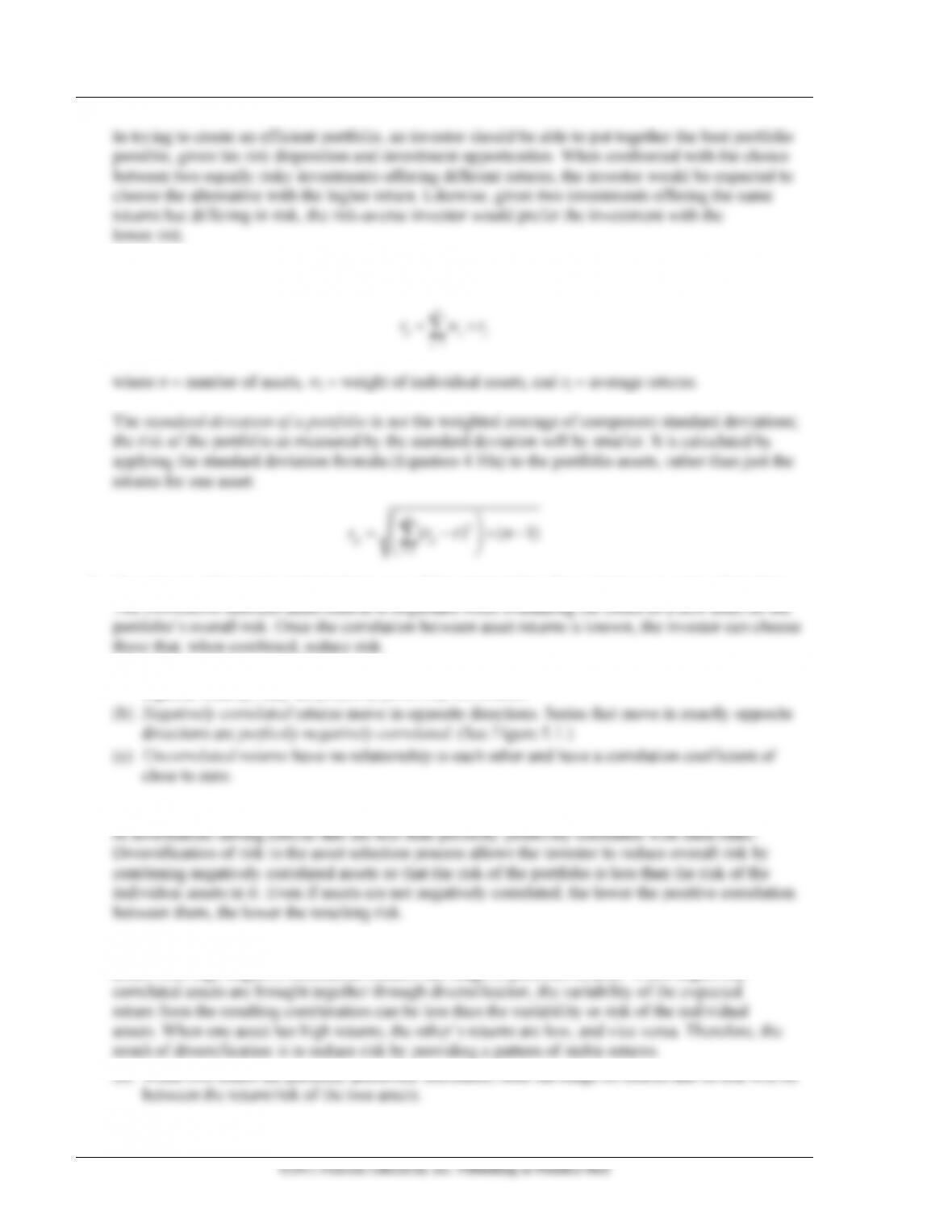
In trying to create an efficient portfolio, an investor should be able to put together the best portfolio
possible, given his risk disposition and investment opportunities. When confronted with the choice
between two equally risky investments offering different returns, the investor would be expected to
choose the alternative with the higher return. Likewise, given two investments offering the same
returns but differing in risk, the risk-averse investor would prefer the investment with the
lower risk.
2. The return of a portfolio is calculated by finding the weighted average of returns of the portfolio’s
component assets:
=
=
1
n
p j j
j
r w r
where n = number of assets, wj = weight of individual assets, and rj = average returns.
The standard deviation of a portfolio is not the weighted average of component standard deviations;
the risk of the portfolio as measured by the standard deviation will be smaller. It is calculated by
applying the standard deviation formula (Equation 4.10a) to the portfolio assets, rather than just the
returns for one asset:
=
= − −
2
1
( ) ( 1)
n
pp
i
s r r n
3. Correlation refers to the statistical measure of the relationship, if any, between a series of numbers.
(a) Returns on different assets moving in the same direction are positively correlated; if they move
together exactly, they are perfectly positively correlated.
4. Diversification is a process of risk reduction achieved by including in the portfolio a variety
5. Combining assets with high positive correlation increases the range of portfolio returns; combining
assets with high negative correlation reduces the range of portfolio returns. When negatively
(a) When two assets are perfectly positively correlated, both the range of returns and of risk will be

Chapter 5 Modern Portfolio Concepts 83
©2011 Pearson Education, Inc. Publishing as Prentice Hall
(b) With two uncorrelated assets, the range of return will be between the two assets’ returns and the
risk, between the risk of the most risky and the risk of the least risky, but greater than zero.
(c) The range of return for two perfectly negatively correlated assets will be between the returns of
6. International diversification can provide the benefits of higher returns and reduced risk. However,
whether an individual investor ultimately benefits from this kind of diversification depends on factors
such as resources, goals, sophistication, and psychology of the investor.
7. (a) Diversifiable (unsystematic) risk is the part of an investment’s risk that the investor can eliminate
(b) Non-diversifiable (systematic) risk refers to events or forces such as war, inflation, or political
8. Beta is a measure of systematic or non-diversifiable risk. It is found by relating the historical returns
on a security with the historical returns for the market. In general, the higher the beta, the riskier the
security.


Chapter 5 Modern Portfolio Concepts 85
As beta increases, so does the required return for a given investment. The risk premium,
12. Traditional portfolio management emphasizes “balancing” the portfolio. The traditional portfolio
includes a wide variety of stocks and/or bonds that emphasize interindustry diversification. The
13. Modern portfolio theory (MPT) is based on the use of statistical measures including mathematical
concepts such as correlation (of rates of return) and beta. Combining securities with negative or low
14. The efficient frontier is the site of all efficient portfolios (those with the best risk-return trade-off).

Chapter 5 Modern Portfolio Concepts 87
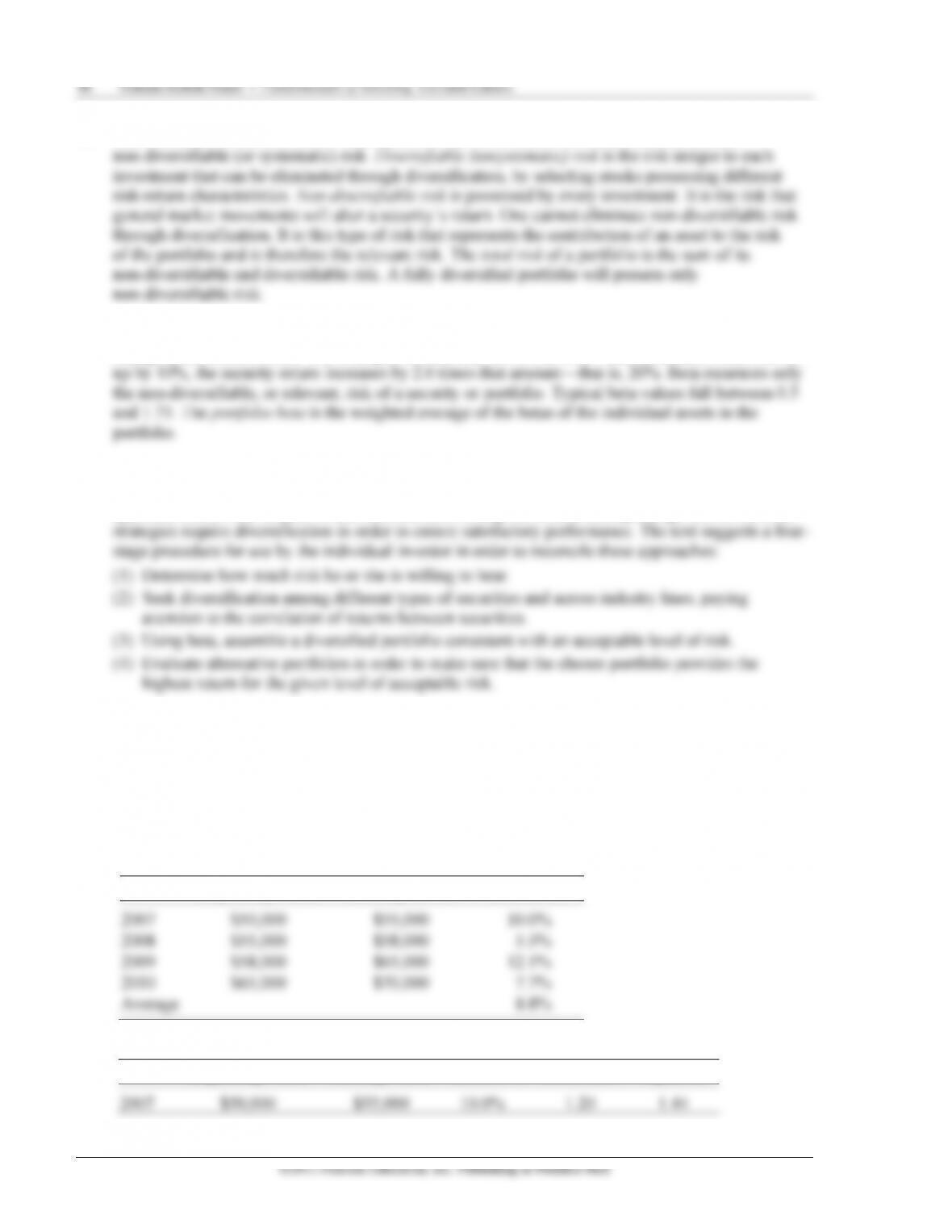
2008
$55,000
$58,000
5.5%
3.30
10.89
2009
$58,000
$65,000
12.1%
3.30
10.89
2010
$65,000
$70,000
7.7%
1.10
1.21
Average
8.8%
Total
24.43
Div n −1 (3)
8.143
Sp
2.854

88 Gitman/Joehnk/Smart • Fundamentals of Investing, Eleventh Edition
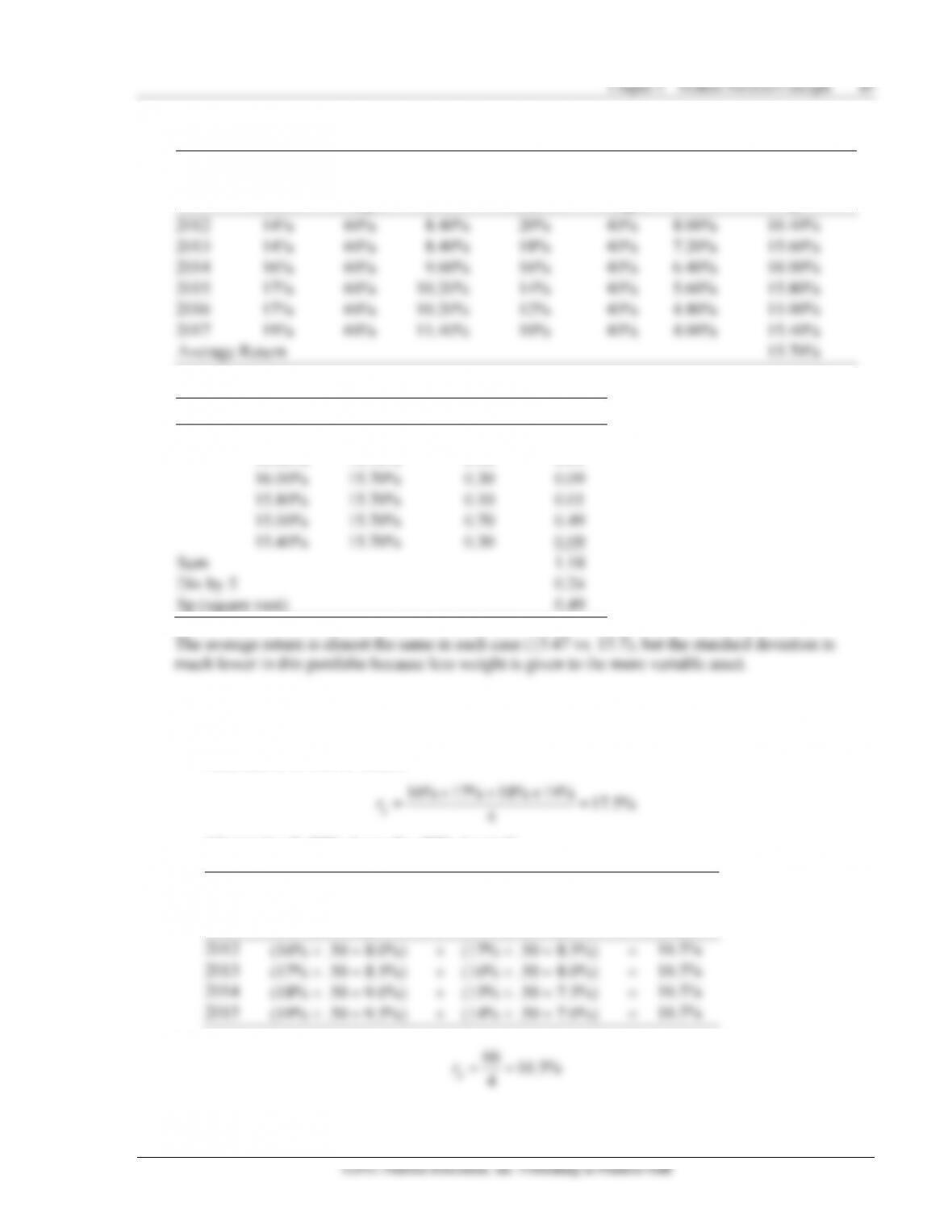
3. (a) Average portfolio return for each year: rp = (wL rL) + (wM rM )
Year
Asset L
(wL rL)
+
Asset M
(wM rM)
=
Expected
Portfolio Return
rp
2012
(14% .40 = 5.6%)
+
(20% .60 = 12.0%)
=
17.6%
2013
(14% .40 = 5.6%)
+
(18% .60 = 10.8%)
=
16.4%
2014
(16% .40 = 6.4%)
+
(16% .60 = 9.6%)
=
16.0%
2015
(17% .40 = 6.8%)
+
(14% .60 = 8.4%)
=
15.2%
2016
(17% .40 = 6.8%)
+
(12% .60 = 7.2%)
=
14.0%
2017
(19% .40 = 7.6%)
+
(10% .60 = 6.0%)
=
13.6%
(b) Portfolio return:
=
=
+++++
==
1
17.6 16.4 16.0 15.2 14.0 13.6 15.467
6
n
j
j
j
p
r w r n
r
p
(c) Standard deviation:
pp
i=1
s (r
= − −
2
) ( 1)
n
rn
222
222
2 2 2 2 2 2
[(17.6% 15.5%) (16.4% 15.5%) (16.0% 15.5%)
[(15.2% 15.5%) (14.0% 15.5%) (13.6% 15.5%) ]
61
[(2.1%) (.9%) (.5%) ( .3%) ( 1.5%) ( 1.9%) ]
5
(4.41% .81% .25% .09% 2.25% 3.61%)
5
11.42
5
p
p
p
p
s
s
s
s
= − + − + −
+ − + − + −
−
+ + + − + − + −
=
++++ +
=
==
2.284 1.511=
(d) The assets are negatively correlated.
(e) By combining these two negatively correlated assets, overall portfolio risk is reduced.

90 Gitman/Joehnk/Smart • Fundamentals of Investing, Eleventh Edition
Alternative 3: 50% Asset F + 50% Asset H
Year
Asset F
(wF rF)
+
Asset H
(wH rH)
=
Portfolio
Return rp
2012
(16.0% .50 = 8.0%)
+
(14% .50 = 7.0%)
=
15.0%
2013
(17.0% .50 = 8.5%)
+
(15% .50 = 7.5%)
=
16.0%
2014
(18.0% .50 = 9.0%)
+
(16% .50 = 8.0%)
=
17.0%
2015
(19.0% .50 = 9.5%)
+
(17% .50 = 8.5%)
=
18.0%
==
66 16.5%
4
p
r
(b) Standard deviation:
2
1
( ) ( 1)
n
Pi
i
s r r n
=
= − −
(1)
+
2 2 2
2 2 2 2
[(16.0% 17.5%) + (17.0% 17.5%) (18.0% 17.5%) (19.0% 17.5%)]
41
[( 1.5%) ( 0.5%) (0.5%) (1.5%) ]
3
(2.25% .25% .25% 2.25%)
3
51.667 1.291
F
F
F
F
s
s
s
s
− − + − + −
=−
− − + +
=
+++
=
= = =
(2)
222
2222
[(16.5% 16.5%) (16.5% 16.5%) (16.5% 16.5%) (16.5% 16.5%)]
41
[(0) (0) (0) (0) ] 0
3
FG
FG
s
s
− + − + − + −
=−
+++
==
(3)
2222
2 2 2 2
[(15.0% 16.5%) (16.0% 16.5%) (17.0% 16.5%) (18.0% 16.5%) ]
41
[( 1.5%) (.5%) (.5%) (1.5%) ]
3
FH
FH
s
s
− + − + − + −
=−
− + + +
=