Chapter 2
Securities Markets and Transactions
◼ Outline
Learning Goals
I. Securities Markets
A. Types of Securities Markets
1. The Primary Market
a. Going Public: The IPO Process
b. The Investment Banker’s Role
2. Secondary Markets
B. Broker Markets and Dealer Markets
1. Broker Markets
2. The New York Stock Exchange
a. Trading Activity
b. Listing Policies
3. NYSE Amex
4. Regional Stock Exchanges
5. Options Exchanges
6. Futures Exchanges
7. Dealer Markets
C. Alternative Trading Systems
D. General Market Conditions: Bull or Bear
Concepts in Review
II. Globalization of Securities Markets
A. Growing Importance of International Markets
B. International Investment Performance
C. Ways to Invest in Foreign Securities
D. Risks of Investing Internationally
Concepts in Review

Chapter 2 Securities Markets and Transactions 17
III. Trading Hours and Regulation of Securities Markets
A. Trading Hours of Securities Markets
B. Regulation of Securities Markets
1. Securities Act of 1933
2. Securities Exchange Act of 1934
3. Maloney Act of 1938
4. Investment Company Act of 1940
5. Investment Advisers Act of 1940
6. Securities Acts Amendments of 1975
7. Insider Trading and Fraud Act of 1988
8. Sarbanes-Oxley Act of 2002
Concepts in Review
IV. Basic Types of Securities Transactions
A. Long Purchase
B. Margin Trading
1. Essentials of Margin Trading
a. Magnified Profits and Losses
b. Advantages and Disadvantages of Margin Trading
2. Making Margin Transactions
a. Initial Margin
b. Maintenance Margin
3. The Basic Margin Formula
4. Return on Invested Capital
5. Uses of Margin Trading
C. Short Selling
1. Essentials of Short Selling
a. Making Money When Prices Fall
b. Who Lends the Securities?
c. Margin Requirements and Short Selling
d. Advantages and Disadvantages
2. Uses of Short Selling
Concepts in Review
Summary
Key Terms
Discussion Questions
Problems
Case Problems
2.1 Dara’s Dilemma: What to Buy?
2.2 Ravi Dumar’s High-Flying Margin Account
Excel with Spreadsheets

18 Gitman/Joehnk/Smart • Fundamentals of Investing, Eleventh Edition
◼ Key Concepts
1. The types of securities markets in which transactions are made
2. The operations, function, and nature of broker (organized securities exchanges) and dealer (the over-
the-counter) market
3. The importance of international securities markets and a discussion on the performance and risk
involved in these investments
4. General market conditions and extended hours trading
5. Regulation of the securities markets
6. The basic long transaction
7. The motives for margin transactions and the procedures for making them
8. Margin requirements, formulas for initial and maintenance margin, and the uses of margin trading
9. The short sale transaction, why one shorts securities, and the uses of short selling
◼ Overview
1. The text divides securities markets into money markets and capital markets. The instructor should
explain the difference.
2. Both primary and secondary transactions are carried out in capital markets. The instructor should
define these transactions for students and explain the role of the investment banker in the selling of
new securities (primary transactions).
3. The secondary markets include various broker markets and dealer markets. Broker markets include
the organized securities exchanges, while dealer markets include the Nasdaq, the National
Association of Securities Dealers Automated Quotation System, and over-the-counter (OTC)
markets. The instructor should emphasize the importance of the NYSE Amex among all these
markets. The instructor might also discuss these aspects of organized security exchanges: the
membership of an exchange; its listing policies; the role of the brokers, traders, and specialists;
trading activity; and the auctioning process.
4. The dealer markets are described next. The instructor should point out that the Nasdaq and OTC
markets are not physical institutions like the organized securities exchanges. Nasdaq includes larger
companies than the over-the-counter market, with companies listed on the OTC Bulletin Board being
larger than those included in the OTC Pink Sheets. The instructor should also point out that shares
normally traded in the broker markets may trade in the dealer market, in what is known as the third
market, while fourth market trades between institutions are completed using electronic
communications networks.
Chapter 2 Securities Markets and Transactions 19
5. The chapter then discusses the globalization of international securities markets, including a description
of investing in the foreign securities marketplace, how to buy foreign securities, and the risks of
international investment. Related issues are the existence of after-hours trading and the mergers of
stock markets foreshadowing the creation of a worldwide stock exchange, the NYSE Euronext.
6. In the next section, various regulations applicable to brokers, investment advisers, and stock exchanges
are described. The instructor need not dwell on this section at length; however, the instructor might
want to bring in any recent litigation or securities market trial that is being widely covered by the press.
Ethical issues and insider trading are interesting and serve to make a point about the challenges facing
those attempting to regulate the exchanges.
7. The text now moves to the different types of transactions, beginning with long purchases. The next
section deals extensively with margin trading, including the magnification of profits and losses, initial
and maintenance margin, and the formulas for their calculation. There are a number of review problems
and a case at the end of the chapter to aid the student in understanding the concept of margin.
8. The final section of the chapter deals with short selling, including the mechanics and uses of short
sales.
◼ Answers to Concepts in Review
1. (a) In the money market, short-term securities such as CDs, T-bills, and bankers’ acceptances are
traded. Long-term securities such as stocks and bonds are traded in the capital markets.
2. The investment banker is a financial intermediary who specializes in selling new security issues in
what is known as an initial public offering (IPO). Underwriting involves the purchase of the security
3. (a) (5) NYSE Amex is the second largest security exchange.
(b) (2) The Chicago Board of Trade (CBT) is a futures exchange on which both commodity
and financial futures are traded.
20 Gitman/Joehnk/Smart • Fundamentals of Investing, Eleventh Edition
(f) (1) The over-the-counter (OTC) is the market in which unlisted securities are traded.
4. The dealer market is really a system of markets spread all over the country and linked together by a
sophisticated telecommunication system. It accounts for about 40% of the total dollar volume of all
Trading in large blocks of outstanding securities, known as secondary distributions, also takes place
in the OTC market in order to reduce potential negative effects of such transactions on the price of
5. The third market consists of over-the-counter transactions made in securities listed on the NYSE or
6. A bull market is a favorable market normally associated with rising prices, investor optimism,
7. The globalization of securities markets is important because today investors seek out securities with
high returns in markets other than their home country. They may invest in companies based in
Mexico, Japan, Finland, Germany, and France than from investing in markets in the United States.
Chapter 2 Securities Markets and Transactions 21
8. To achieve some degree of international diversification, an investor can make foreign security
investments either indirectly or directly. An investor can diversify indirectly by investing in shares
9. The investor must be aware of the additional risks involved in buying foreign securities: country risk,
government policies, market regulation (or lack thereof), and foreign currency fluctuations. Investors
must consider risks beyond those in making any security transaction. In particular, investors in
10. The exchanges, Nasdaq, and electronic communications networks (ECNs) offer extended trading
sessions before and after regular hours. Most of the after-hours markets are crossing markets, in
11. (a) The Securities Act of 1933 requires companies to disclose all information relevant to new
(b) The Securities Exchange Act of 1934 established the SEC as the agency in charge of
(c) The Maloney Act of 1938 required that all trade associations be registered with the SEC and
22 Gitman/Joehnk/Smart • Fundamentals of Investing, Eleventh Edition
(d) The Investment Company Act of 1940 set certain rules and regulations for investment companies.
It also empowered the SEC to regulate their practices and procedures. Investment companies
were required to register with the SEC and fulfill certain disclosure requirements. The act
(e) The Investment Advisers Act of 1940 was passed to protect the public from potential abuses by
investment advisers. Advisers were required to register and file regular reports with the SEC. In
(f) The Securities Acts Amendments of 1975 were enacted to require the SEC and the securities
industry to develop a competitive national system for trading securities. The first step the SEC
(g) The Inside Trading and Fraud Act of 1988 established penalties for using nonpublic information
to make personal gain. An insider, which originally referred only to a company’s employees,
(h) The Sarbanes-Oxley Act of 2002 attempts to eliminate fraudulent accounting and regulate
information releases. Heavy penalties are applied to CEOs and financial officers who release
12. When an investor purchases a security in the hope that it will increase in value and can be sold later
for a profit, the investor is making a long purchase. The long purchase, the most common type of
Margin trading involves buying securities in part with borrowed funds. Therefore, investors can
use margin to reduce their money and use borrowed money to make a long purchase. Once the
13. When buying on margin, the investor puts up part of the required capital (perhaps 50 to 70% of the
total); this is the equity portion of the investment and represents the investor’s margin. The investor’s
Chapter 2 Securities Markets and Transactions 23
Through leverage, an investor can (1) increase the size of his or her total investment, or (2) purchase
the same investment with less of his or her own funds. Either way, the investor increases the potential
Margin trading has both advantages and disadvantages. Advantages: Margin trading provides the
investor leverage and the ability to magnify potential profits. It can also be used to improve current
14. In order to execute a margin transaction, an investor first must establish a margin account. Although
the Federal Reserve Board sets the minimum amount of equity for margin transactions, it is not
unusual for brokerage houses and exchanges to establish their own, more restrictive, requirements.
Once a margin account has been established, the investor must provide the minimum amount of
15. An investor attempting to profit by selling short intends to “sell high and buy low,” the reverse of the
24 Gitman/Joehnk/Smart • Fundamentals of Investing, Eleventh Edition
©2011 Pearson Education, Inc. Publishing as Prentice Hall
Equity capital must be put up by a short seller; the amount is defined by an initial margin requirement
that designates the amount of cash (or equity) the investor must deposit with a broker. For example, if
an investor wishes to sell (short) $4,000 worth of stock when the prevailing short sale margin
requirement is 50%, he or she must deposit $2,000 with the broker. This margin and the proceeds of
the short sale provide the broker with assurance that the securities can be repurchased at a later date,
even if their price increases.
16. In order to make a short sale, the investor must make a deposit with the broker that is equal to the
initial margin requirement. Maintenance margins are still the lowest allowed percentage of equity in
17. The major advantage of short selling is the chance to convert a price decline into a profit-making
situation. The technique can also be used to protect profits already earned and to defer taxes on those
◼ Suggested Answers to Discussion Questions
1. One reason for the large initial returns is the significant amount of hype surrounding new issues.
This was especially true in the late 1990s, during what is now described as the “tech–stock bubble.”
2. The main advantage of listing on the NYSE is the perception of greater prestige and public awareness
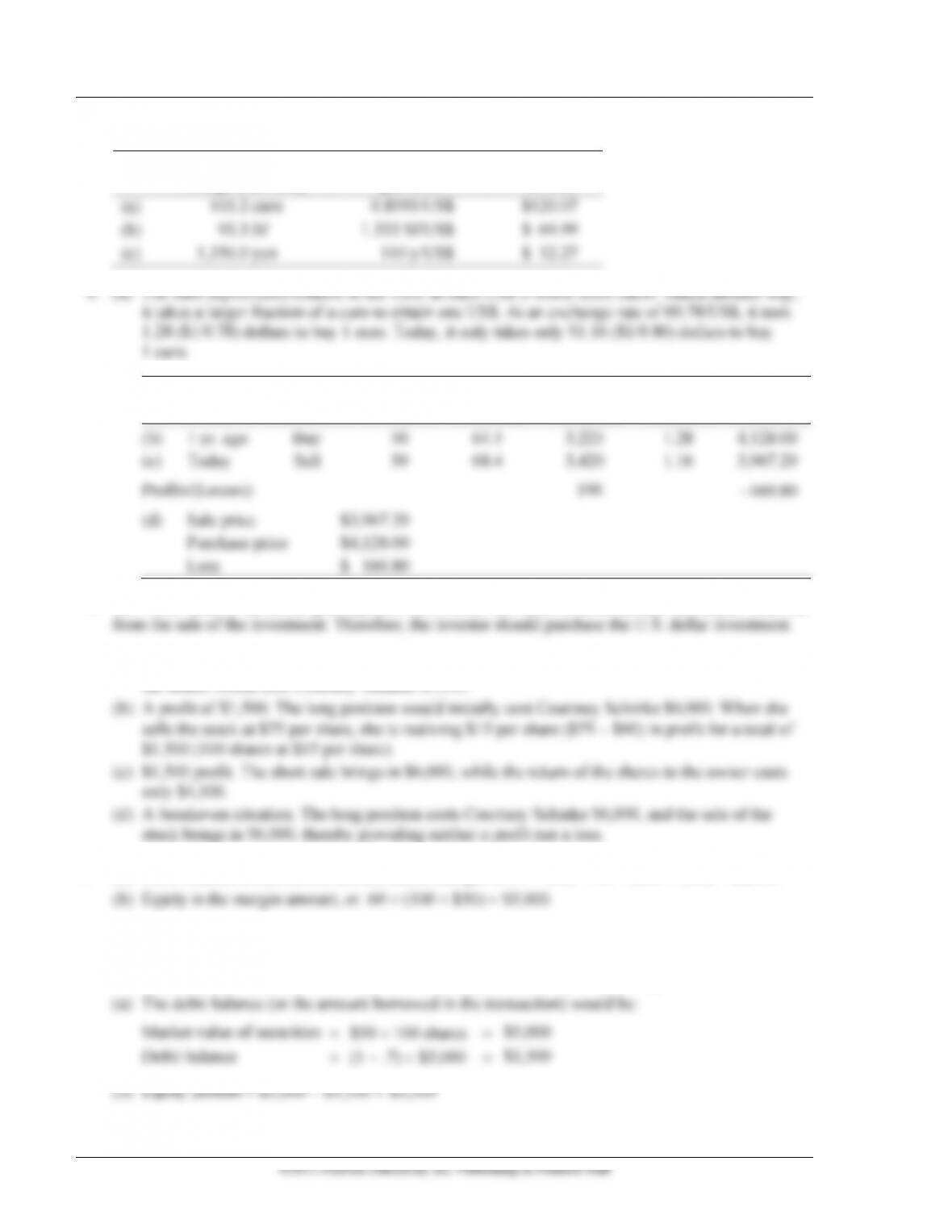
26 Gitman/Joehnk/Smart • Fundamentals of Investing, Eleventh Edition
3.
Share Price in
Foreign Currency
Exchange Rate
per US$
=
Share Price
in US$
(a)
103.2 euro
0.8595/US$
$120.07
(b)
93.3 Sf
1.333 Sf/US$
$ 69.99
(c)
1,350.0 yen
110 y/US$
$ 12.27
4. (a) The euro depreciated relative to the US$, as each US$ is worth more euros. Stated another way,
it takes a larger fraction of a euro to obtain one US$. At an exchange rate of €0.78/US$, it took
1.28 ($1/0.78) dollars to buy 1 euro. Today, it only takes only $1.16 ($1/0.86) dollars to buy
1 euro.
Date
Transaction
Number
of Shares
Price/
Share (€)
Transaction
Value (€)
Exchange
Rate/US$
Value in
US$
(b)
1 yr. ago
Buy
50
64.5
3,225
1.28
4,128.00
(c)
Today
Sell
50
68.4
3,420
1.16
3,967.20
Profits/(Losses):
196
−160.80
(d)
Sale price
$3,967.20
Purchase price
$4,128.00
Loss
$ 160.80
5. No. If the value of the dollar goes up, then the investor will receive fewer dollars for the yen received
6. (a) $1,000 loss. This is because her short sale would have realized $6,000, while the replacement of
the shares would cost Courtney Schinke $7,000.
7. (a) Debit balance is transaction amount minus margin. (100 $50) − .60 (100 $50) = $2,000.
8. Margin = (Value − Debit balance)/Value = [(100 $60) − $2,000] (100 $60) = 66.67%
9. If an individual purchases 100 shares of stock at $50 per share with a 70% margin:
$50 100 shares
(1 − .7) $5,000
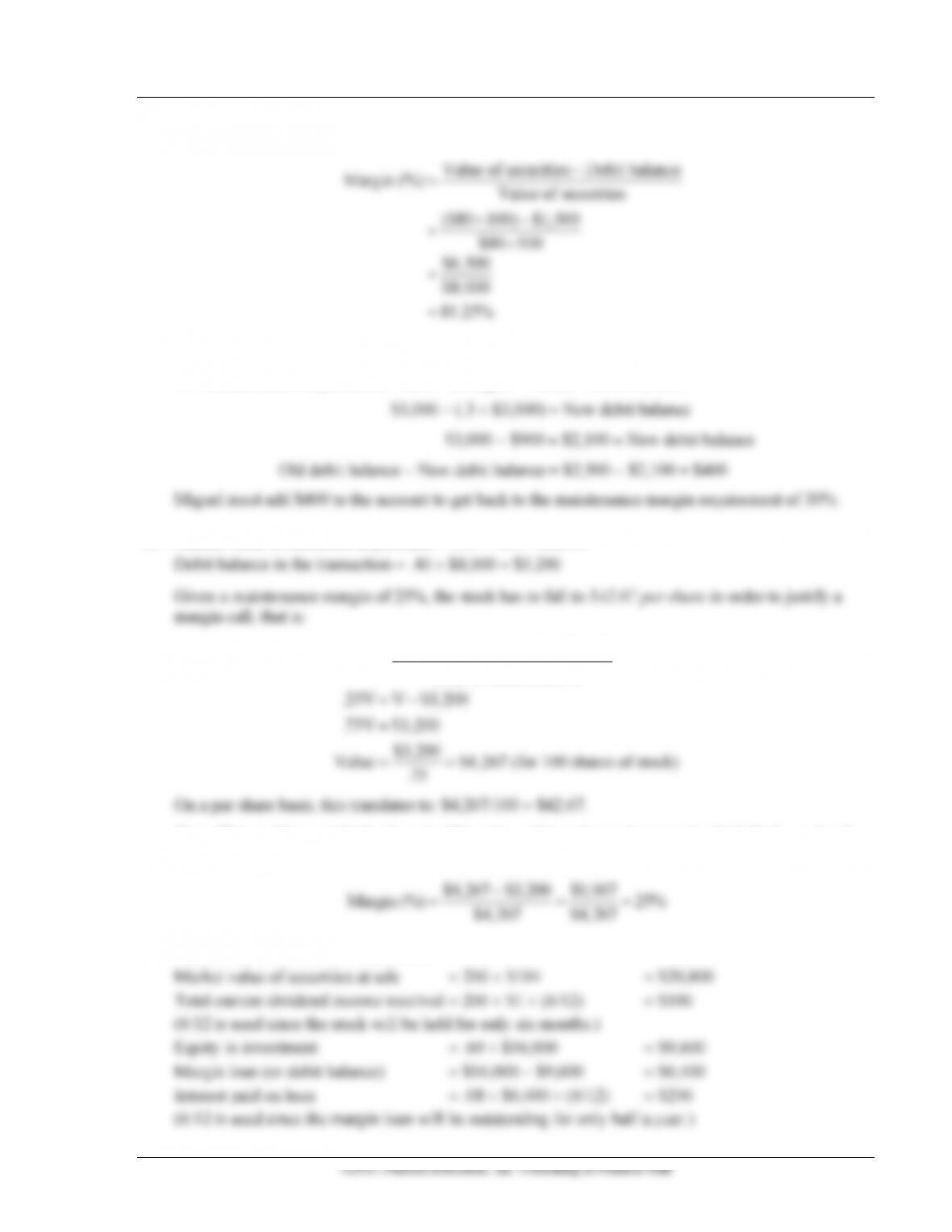
Chapter 2 Securities Markets and Transactions 27
(c) If the stock rises to $80, we would use the formula provided in the book to find the new margin:
−
=
−
=
=
=
Value of securities Debit balance
Margin (%) Value of securities
($80 100) $1,500
$80 100
$6,500
$8,000
81.25%
10. Miguel needs to cover a margin call. His margin is ($3,000 − $2,500) $3,000 = 16.7%, below the
30% maintenance requirement. Value − (Margin Value) = Debit balance:
11. Market value of securities at purchase = 100 $80 = $8,000
−
=
=−
=
==
Value of securities (V) $3,200
.25 Value of securities (V)
.25V V $3,200
.75V $3,200
$3,200
Value $4,267 (for 100 shares of stock)
.75
On a per share basis, this translates to: $4,267/100 = $42.67.
Note: This problem could also be solved by using a “hit-and-miss” approach which finds a value for
V in the margin (%) formula that results in a margin of 25%:
$4,267 $3,200 $1,067
Margin (%) 25%
$4,267 $4,267
−
= = =
12. Market value of securities at purchase = 200 $80 = $16,000
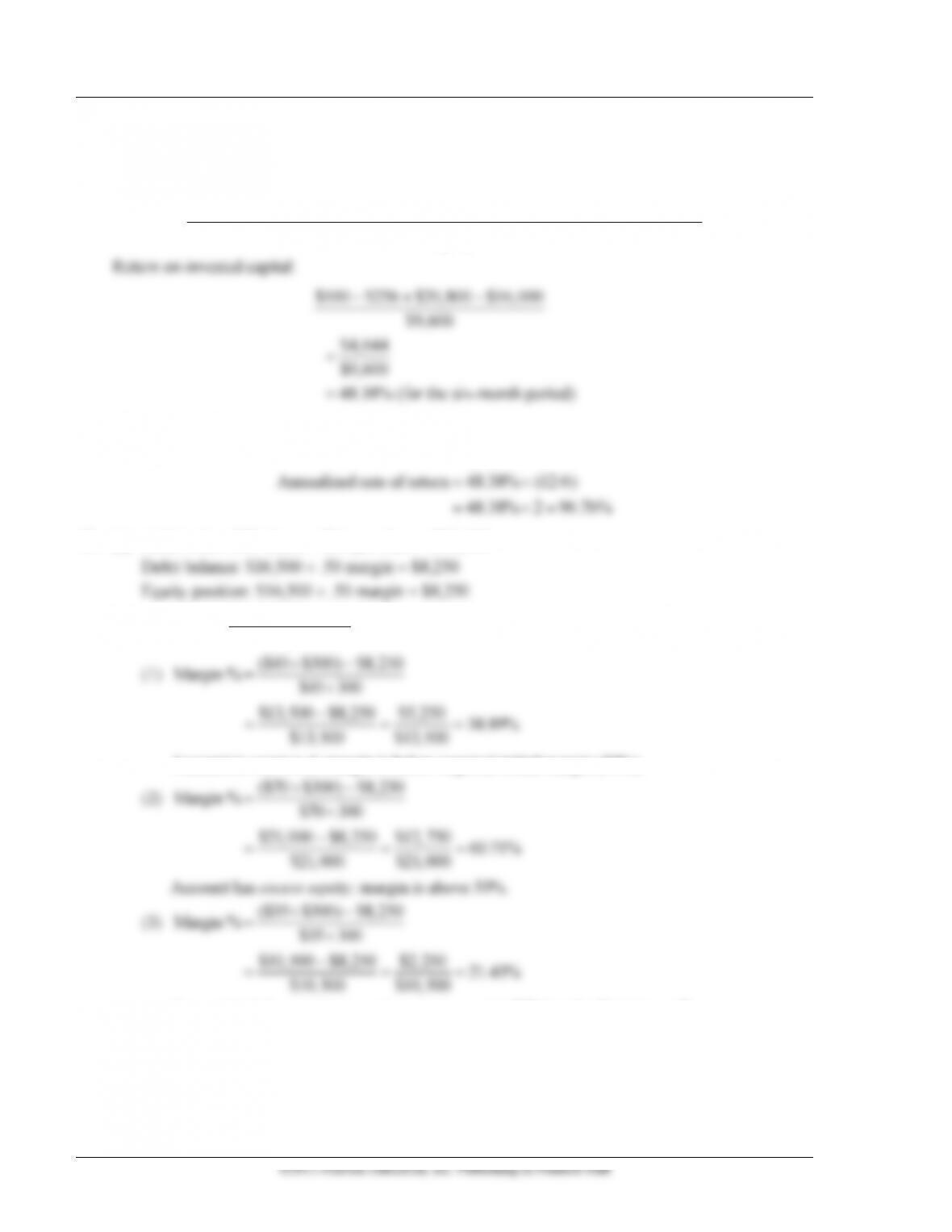
28 Gitman/Joehnk/Smart • Fundamentals of Investing, Eleventh Edition
Return on invested capital:
Market value
Market value
Total current
Total interest paid
of securities
of securities
income received
−
on margin loan
+
at sale
−
at purchase
Amount of equity invested
=
$9,600
48.38% (for the six-month period)
The annualized rate of return is found in the following manner:
Computed return (12/Number of months in holding period)
Annualized rate of return 48.38% (12/6)
48.38% 2 96.76%
=
= =
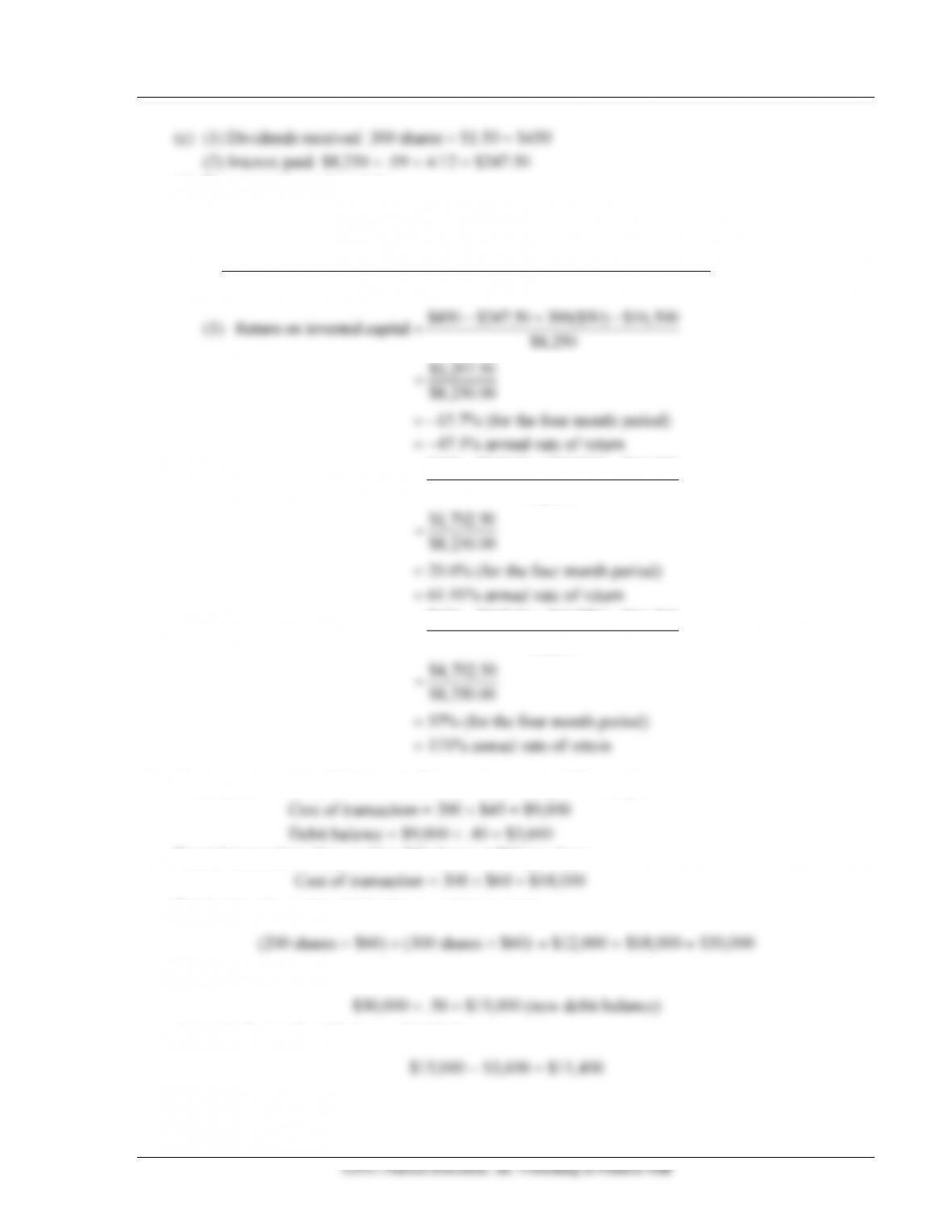
13. (a) Initial value: 300 shares $55 per share = $16,500
(b)
V Debit balance
Margin % V
−
=
($45 $300) $8,250
−
$13,500 $13,500
Account is restricted; margin is below required initial margin (50%).
($70 $300) $8,250
−
$10,500 $10,500
Account is below minimum maintenance margin (25%) and subject to a call.
Chapter 2 Securities Markets and Transactions 29
©2011 Pearson Education, Inc. Publishing as Prentice Hall
(c) (1) Dividends received: 300 shares $1.50 = $450
(2) Interest paid: $8,250 .09 4/12 = $247.50
(d) Return on invested capital =
Market value
Market value
Total current
Total interest paid
of securities
of securities
income received
−
on margin loan
+
at sale
−
at purchase
Amount of equity invested
Return on invested capital $8,250
=
$450 $247.50 300($50) $16,500
− + −
(2)
$450 $247.50 300($60) $16,500
Return on invested capital $8,250
− + −
=
$1,702.50
(3)
$450 $247.50 300($70) $16,500
Return on invested capital $8,250
− + −
=
$4,702.50
14. First transaction: Buy 200 shares at $45 per share, using 60% margin.
Second transaction: Buy another 300 shares at $60 per share.
Total value of securities held after second transaction:
Maximum amount of money that can be borrowed under the new 50% margin requirement:
Amount of unused credit in new debit balance:
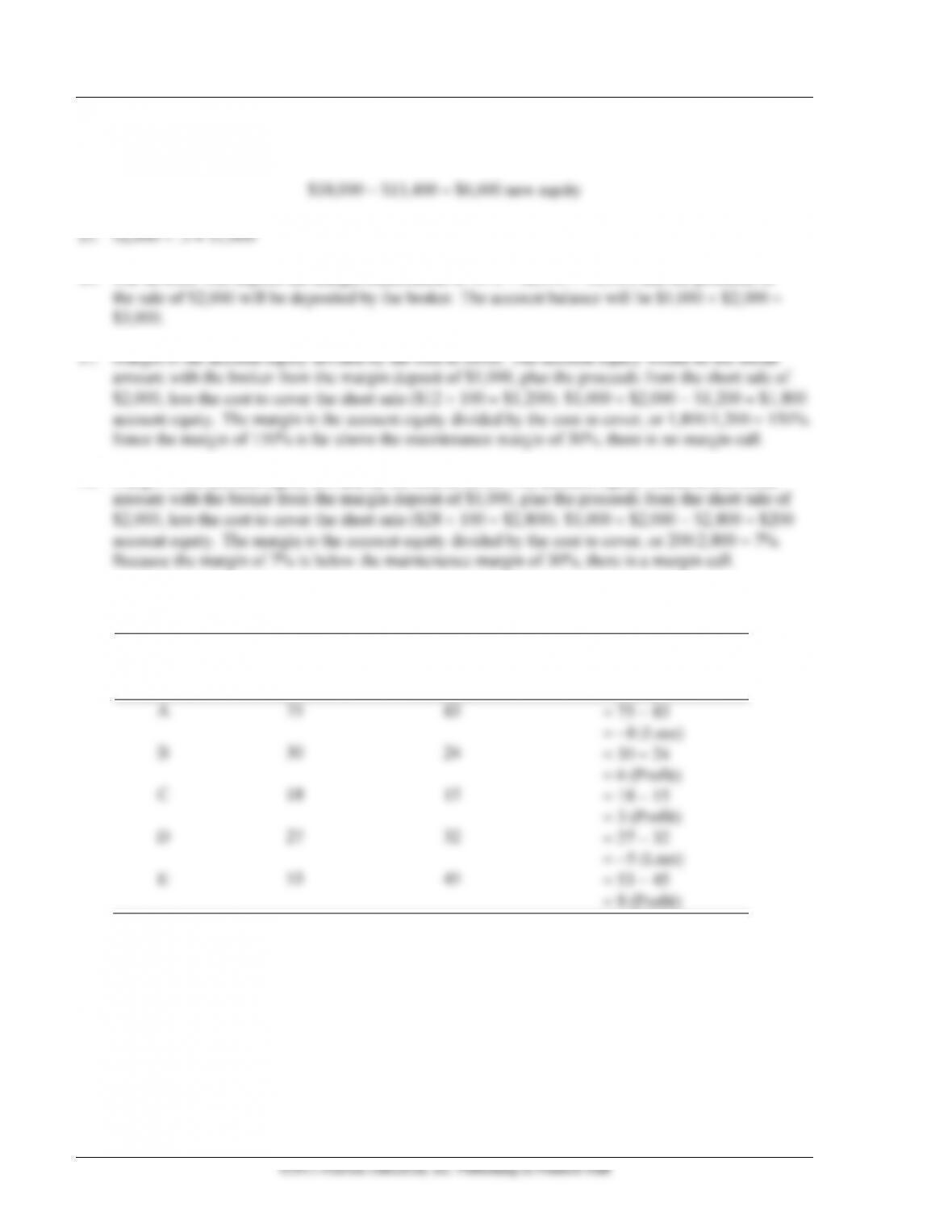
30 Gitman/Joehnk/Smart • Fundamentals of Investing, Eleventh Edition
Thus, since $11,400 is the amount that can be borrowed in the second transaction, the balance of the
investment must be provided by Mr. Edwards in the form of equity; that is:
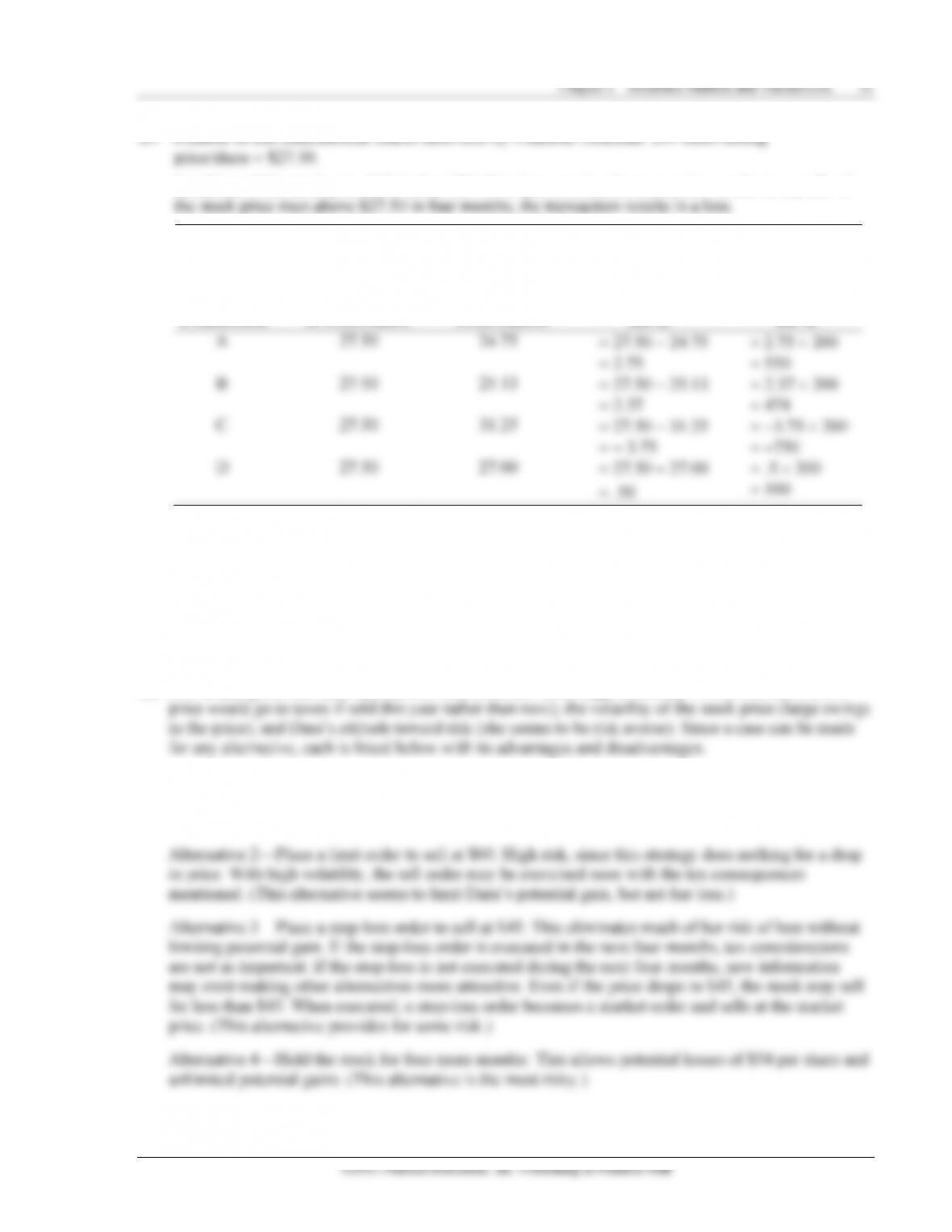
16. The investor will deposit the margin requirement of 50% $2,000 = $1,000, and the proceeds of
18. Margin is the account equity divided by the cost to cover. The account equity would be the initial
19. Intuition: If the stock price falls subsequent to a short sale, the transaction results in a profit. If the
stock price rises subsequent to a short sale, the transaction results in a loss.
Transaction
Stock Sold Short
at Price/Share
Stock Purchased to
Cover Short at
Price/Shares
Profit/Loss per Share
on Each Transaction
(in $)
A
75
83
= 75 − 83
= −8 (Loss)
B
30
24
= 30 − 24
= 6 (Profit)
C
18
15
= 18 − 15
= 3 (Profit)
D
27
32
= 27 − 32
= −5 (Loss)
E
53
45
= 53 − 45
= 8 (Profit)
©2011 Pearson Education, Inc. Publishing as Prentice Hall
Intuition: If the stock price falls below $27.50 in four months, the transaction results in a profit. If
Transaction
Stock Sold Short
at Price/Share
Stock
Purchased to
Cover Short at
Price/Shares
Profit/Loss per
Share on Each
Transaction
(in $)
Total
Profit/Loss
on Each
Transaction
(in $)
A
27.50
24.75
= 27.50 − 24.75
= 2.75
= 2.75 200
= 550
B
27.50
25.13
= 27.50 − 25.13
= 2.37
= 2.37 200
= 474
C
27.50
31.25
= 27.50 − 31.25
= − 3.75
= −3.75 200
= −750
D
27.50
27.00
= 27.50 − 27.00
= .50
= .5 200
= 100
◼ Solutions to Case Problems
Case 2.1 Dara’s Dilemma: What to Buy?
In this case, the student has to evaluate several alternatives, given a limited amount of information. The
instructor can expect a variety of answers for each question, which should provide for lively discussion
and high student interest.
(a) In evaluating the four alternatives, one must consider: taxes (approximately 11% of the current $54
Alternative 1—Sell now at $54 and buy bonds: Taxes of $6 more per share now rather than in four
months would have to be paid; no possibility would exist for gain or loss from future stock price
movements. (This is the lowest risk alternative.)
32 Gitman/Joehnk/Smart • Fundamentals of Investing, Eleventh Edition
Alternative 3 is probably the best choice here. Remember: many other considerations go into common
stock selection and management; these are discussed in Chapters 6 through 9.
If Alternative 3 were followed, the stop-loss order would not have been executed. Alternative 3 would
have helped Dara minimize her losses in the event of a price decline.
Case 2.2 Ravi Dumar’s High-Flying Margin Account
This case requires the student to review the concept of pyramiding. It also requires the student to review
the mechanics of margin trading and to evaluate the risk-return characteristics of a specific pyramiding
example.
(a) Pyramiding is a margin trading technique in which the investor uses the paper profits in his or her
margin account to acquire additional securities. Here, Ravi has a margin account with a margin of
(b) Ravi currently has an account with a market value of $75,000 and a debit balance of $30,000. His
margin position is:
V D $75,000 $30,000
Margin (%) 60%
V $75,000
−−
= = =
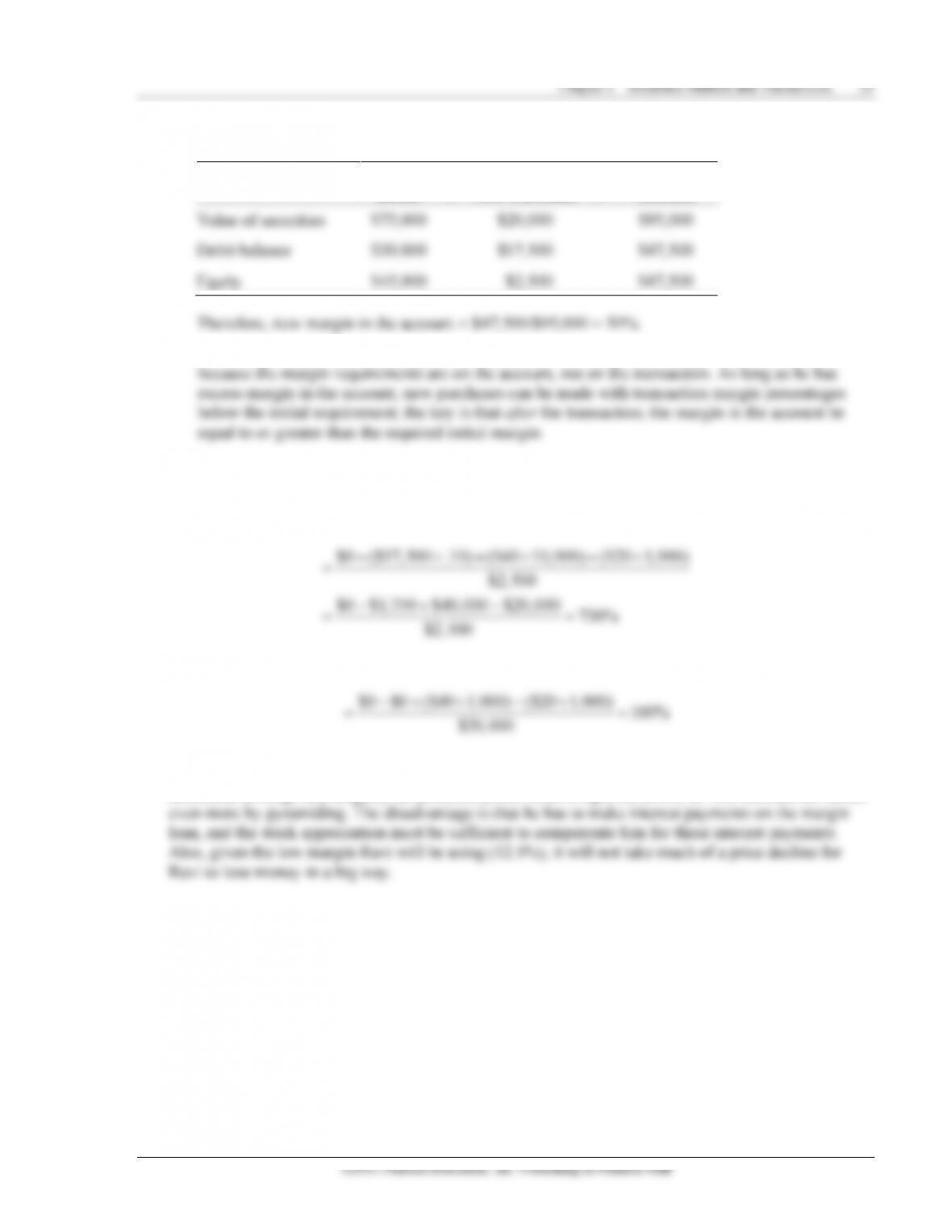
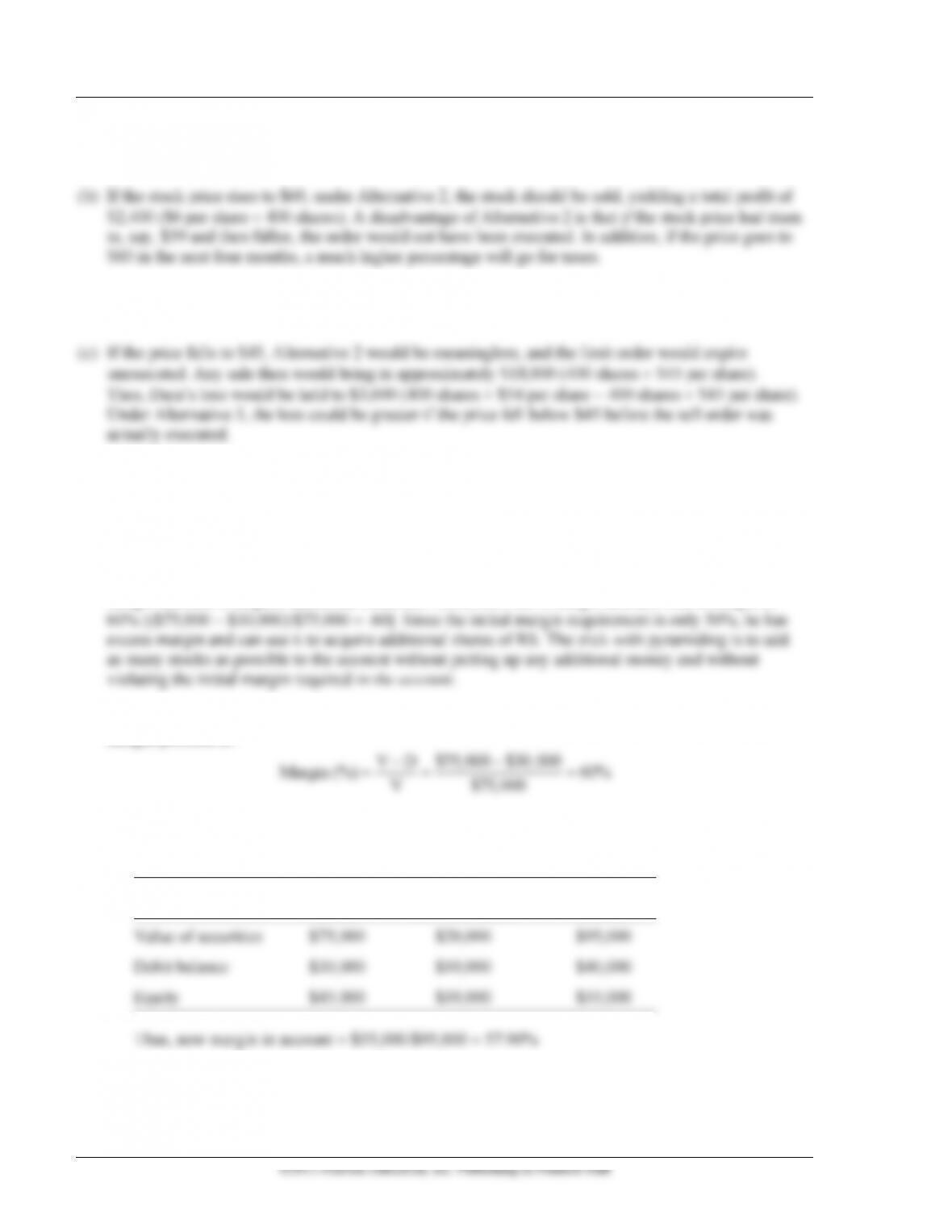
(c) If Ravi purchases 1,000 shares of RS (a $20,000 transaction):
1. Using $10,000 cash and $10,000 from a margin loan:
Initial
+
New Purchase
=
Total
Account
Value of securities
$75,000
$20,000
$95,000
Debit balance
$30,000
$10,000
$40,000
Equity
$45,000
$10,000
$55,000
Thus, new margin in account = $55,000/$95,000 = 57.90%