
Web Chapter 18
Real Estate and Other Tangible Investments
◼ Chapter Outline
Learning Goals
I. Investing in Real Estate
A. Investor Objectives
1. Investment Characteristics
2. Constraints and Goals
2. Supply
3. The Property
a. Restrictions on Use
b. Location
c. Site
d. Improvements
e. Property Management
4. Property Transfer Process
Concepts in Review
II. Real Estate Valuation
A. Estimating Market Value
2. The Comparative Sales Approach
3. The Income Approach
4. Using an Expert
B. Performing Investment Analysis
1. Market Value versus Investment Analysis
a. Retrospective versus Prospective
b. Impersonal versus Personal
c. Unleveraged versus Leveraged
d. NOI versus After-Tax Cash Flows

©2011 Pearson Education, Inc. Publishing as Prentice Hall
3. Calculating Yield
Concepts in Review
III. An Example of Real Estate Valuation
A. Set Investor Objectives
B. Analyze Important Features of the Property
C. Collecting Data on Determinants of Value
1. Demand
2. Supply
3. The Property
4. The Property Transfer Process
D. Perform Valuation of Investment Analysis
1. The Numbers
2. Cash Flow of Analysis
3. Proceeds from Sale
4. Discounted Cash Flow
5. Yield
E. Synthesize and Interpret Results of Analysis
Concepts in Review
IV. Real Estate Investment Securities
A. Real Estate Investment Trusts (REITs)
1. Basic Structure
2. Investing in REITs
B. Other Forms of Real Estate Investment
Concepts in Review
V. Other Tangible Investments
A. Tangibles as Investment Outlets
1. Investment Merits
B. Investing in Tangibles
1. Gold and Other Precious Metals
2. Gemstones
3. Collectibles
Concepts in Review

Web Chapter 18 Real Estate and Other Tangible Investments 329
Summary
Key Terms
Discussion Questions
Problems
Case Problems
18.1 Gary Sofer’s Appraisal of the Wabash Oaks Apartments
18.2 Analyzing Dr. Davis’s Proposed Real Estate Investment
◼ Key Concepts
1. Investing in real estate and setting investment objectives
2. Analysis of important features of real estate investments
3. Determinants of real estate value and the property transfer process
4. Techniques used to estimate market value
5. Considerations and procedures used to perform investment analysis
6. Demonstration of a complete real estate investment analysis of a small apartment building
7. Forms of real estate investment securities, including real estate investment trusts (REITs)
8. The investment characteristics and suitability of gold and other tangible assets, such as silver,
gemstones, and collectibles
◼ Overview
The role of real estate as an investment vehicle and the use of appropriate real estate investment analysis
techniques are the subjects of this chapter.
1. A real estate investor must consider how the investment characteristics of real estate differ and
establish appropriate investment constraints and goals.
2. To meaningfully evaluate the investment potential of real estate, the investor must analyze the
property’s important features. This analysis should include: (1) identification of the physical
property, (2) definition of the applicable property rights, (3) the time horizon for the investment,
and (4) the delineation of a geographic area.
3. The investor should ask a number of questions relative to determining a property’s value. Answering
these questions intelligently requires evaluation of four major determinants of value: demand, supply,
the property, and the property transfer process.
332 Gitman/Joehnk/Smart • Fundamentals of Investing, Eleventh Edition
©2011 Pearson Education, Inc. Publishing as Prentice Hall
(d) Improvements. Improvements—man-made additions to a site—should be accurately measured
and appropriately built in terms of traffic flow and accessibility. Also, amenities, style, and
construction quality are important in determining a property’s competitive edge.
(e) Property management. Investors should find the optimal level of management benefits for a
property at the lowest cost.
7. Real estate markets are not efficient because there is no good system for complete information
exchange among buyers and sellers, and among tenants and lessors. Also, real estate returns are
partially controlled by the property owners themselves. Profits and cash flows depend on how well
8. Market value is the prevailing price of a property, indicating how the market as a whole has assessed
the property’s worth. A real estate appraisal is the estimate of a property’s current market value based
9. The three valuation approaches commonly used by real estate appraisers are:
(1) Cost approach. Value based on the notion that an investor should not pay more for a property
10. Real estate investment analysis considers not only what similar properties have sold for, but also

Web Chapter 18 Real Estate and Other Tangible Investments 337
(b) One financial constraint is the risk-return relationship that is unique to each investor. Another
(c) The investor must decide the relevant time horizon. For a short-term investor, the quick drop in
2–4. Answers will vary according to student choices.
5. (a) Gold coins. Little or no collector value; quality and amount of gold in the coins are most critical
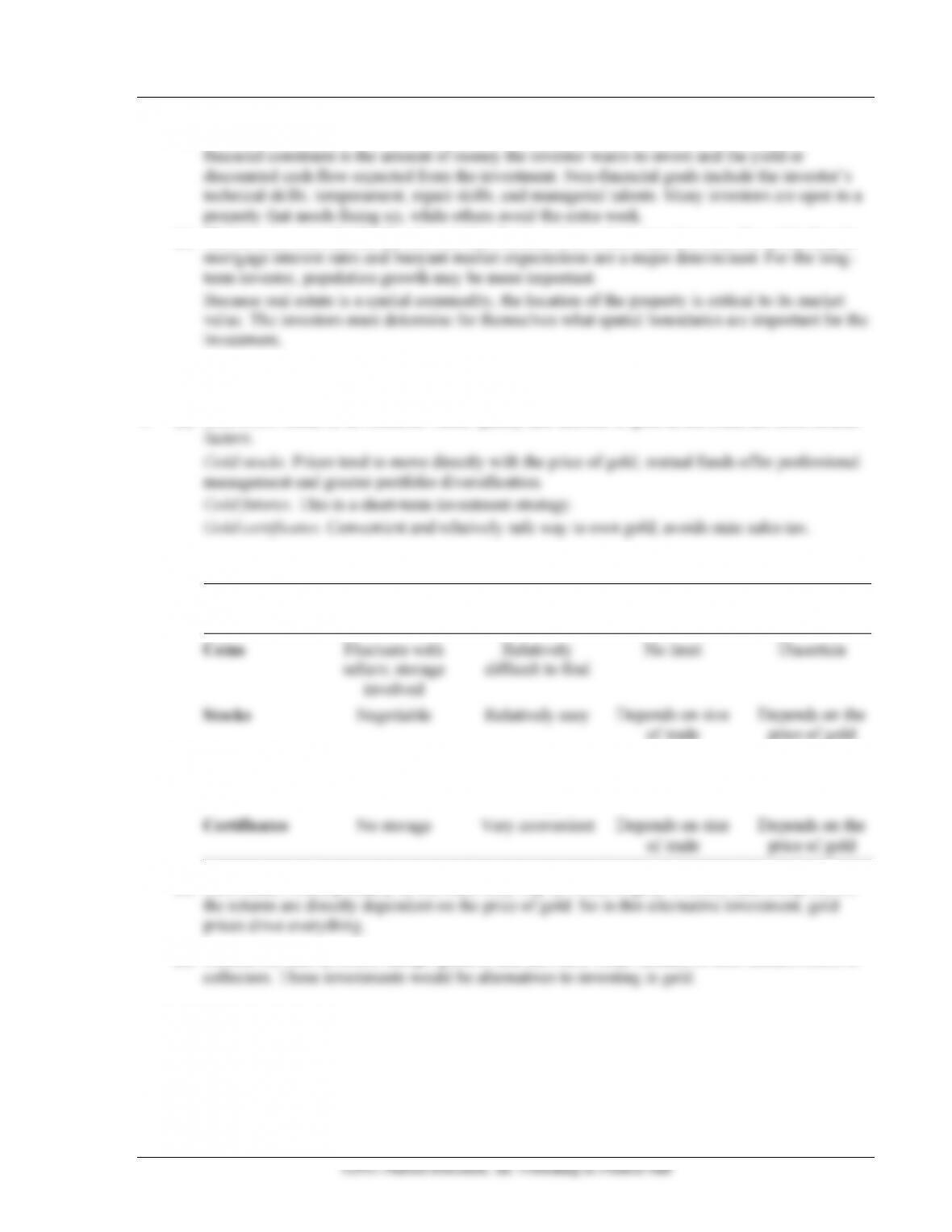
(b) Comparative grid:
Costs
Ease of
Purchase/Sale
Commissions
Potential
Returns
Coins
Fluctuate with
sellers; storage
involved
Relatively
difficult to find
No limit
Uncertain
Stocks
Negotiable
Relatively easy
Depends on size
of trade
Depends on the
price of gold
Futures
Fixed commission
Commodity
exchanges make
it easy
Fixed
Depends on the
price of gold
Certificates
No storage
Very convenient
Depends on size
of trade
Depends on the
price of gold
(c) Certificates would probably be the least risky way to invest in gold. In every case except coins,
(d) Collectives such as coins, stamps, posters, and cars have value because of their attractiveness to
338 Gitman/Joehnk/Smart • Fundamentals of Investing, Eleventh Edition
◼ Solutions to Problems
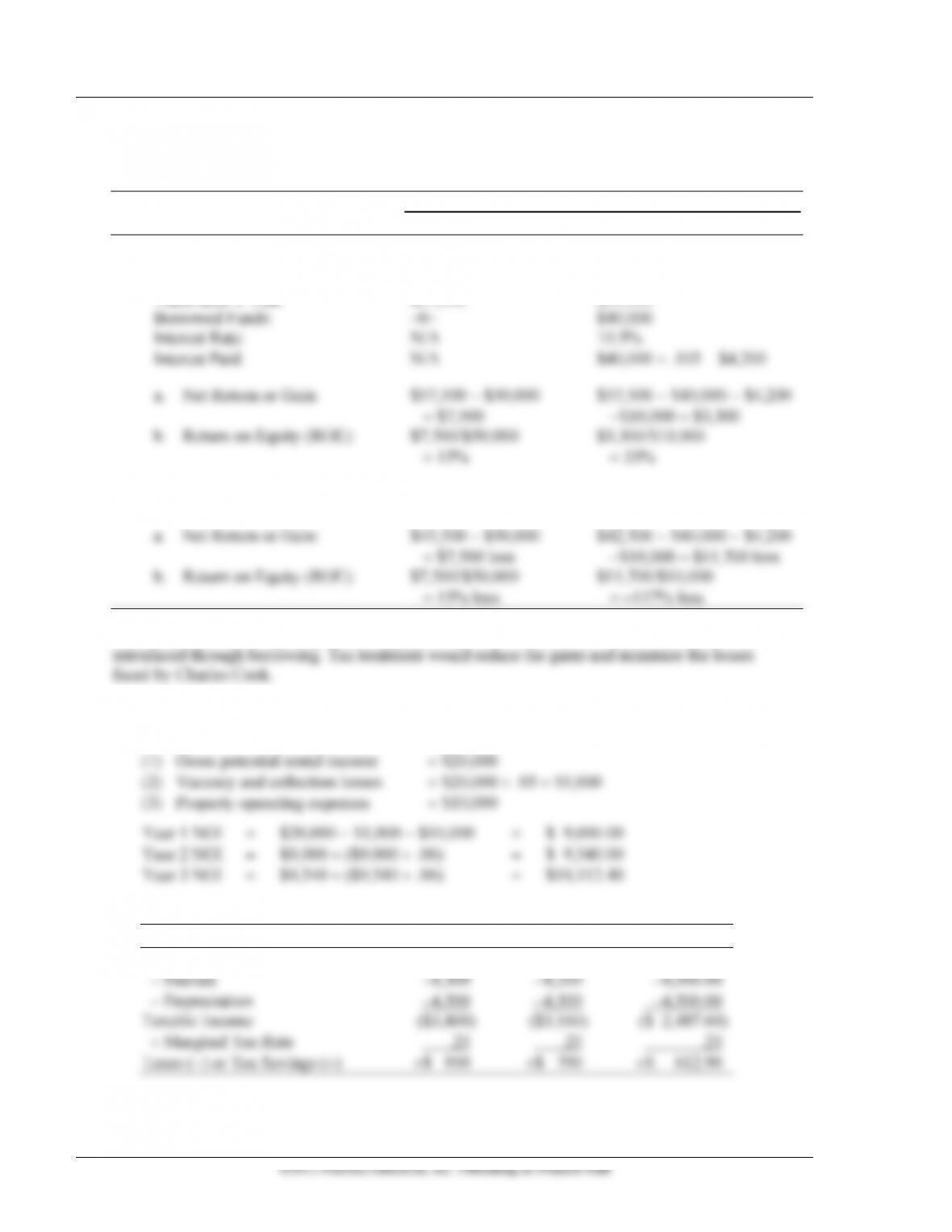
1.
Alternative
X Y
(I) $7,500 Appreciation
Initial Cash Outlay: $50,000 $50,000 .20 = $10,000
Value after 1 Year: $57,500 $57,500
(II) $7,500 Depreciation
Value after 1 Year: $42,500 $42,500
If the purchase is leveraged, gains are magnified but so are losses. There is obviously more risk
2. (a) Net operating income (NOI) = Gross rental income − Vacancy and collection losses − Property
operating expenses, including property taxes and insurance
(b) Year’s Income-Tax Computation
(1) (2) (3)
NOI $9,000 $9,540 $10,112.40
Web Chapter 18 Real Estate and Other Tangible Investments 339
Year’s After-Tax Cash Flow (ATCF) Computation
(1) (2) (3)
NOI $9,000 $9,540 $10,112.40
3. (a) Original Cost: $200,000 Annual Appreciation: 6%
Year Value
Forecast Sale Price: $252,495.39
Capital Gain
Recaptured Depreciation
(b) (Outstanding Mortgage Balance: $155,000)
4. (a)
3 4 R4 0
12
1 2 3 4
CF CF CF I
CF CF
NPV (1 ) (1 ) (1 ) (1 )r r r r
+−
= + + +
+ + + +
0
I
= $55,000 n = 4 r = 14% = 0.14
1 2 3 4
$6,200 $8,000 $8,300 $8,500 $59,000 $55,000
NPV (1 14) (1 14) (1 14) (1 14)
[$5,439 $6,156 $5,602 $39,965] $55,000
$57,162 $55,000
$2,162
+−
= + + +
+ + + +
= + + + −
=−
=
340 Gitman/Joehnk/Smart • Fundamentals of Investing, Eleventh Edition
(b)
Year 1 Year 2 Year 3 Year 4
(c) At a required rate of return of 14%, the net present value of the expected cash flows would equal
$2,162. Another way of looking at this value is that the present value of the forecast cash flows
◼ Solutions to Case Problems
Case 18.1 Gary Sofer’s Appraisal of the Wabash Oaks Apartments
This case gives the student the opportunity to discuss various factors involved in analyzing a prospective
real estate investment and to apply the analysis to an investment decision.
(a) First, Mr. Sofer must establish and/or assure conformance with his financial and nonfinancial
objectives when pursuing investment property. Second, he must be sure that the Wabash Oaks
Web Chapter 18 Real Estate and Other Tangible Investments 341
(b) Demand relates to the population segment that will rent an apartment in the complex. It relates to the
people who will want and use the facility. Gary must look at the tenants and determine who are the
(c) Gary should be aware that although the owner is probably not criminal or fraudulent, he or she is
trying to sell the apartment and, accordingly, will put his or her best foot forward to make the sale.
(d) Using the NOI from the owner’s income statement, Gary’s estimated capitalization rate of 9.62%,
and the income approach for determining market value, the estimated market value of the Wabash
Oaks Apartments would be:
Annual net operating income (NOI)
Market value (V) Market capitalization rate (R)
NOI $24,330 $18,380 *
$42,710
=
=+
=
*Mortgage payments are not considered an operating expense when calculating NOI.
R 9.62%
NOI $42,710
V $443,971
R .0962
=
= = =
342 Gitman/Joehnk/Smart • Fundamentals of Investing, Eleventh Edition
(e) To answer this question, adjust the owner’s income statement to reflect certain financial expectations.
Estimated rents will be $437.50 per month for one-bedroom units and $525 per month for two-
Reconstructed Income Statement (2007)
Gross Potential Income* $69,300
Less: Vacancy & Collection Losses at 4% 2,772
*[(6 $437.50) + (6 $525)] 12 months
R .0962
If Gary can purchase the apartments for $10,000 less than the original estimated market value, the
Case 18.2 Analyzing Dr. Davis’s Proposed Real Estate Investment
This case provides the student with an opportunity to use quantitative methodology to evaluate a real
estate investment.
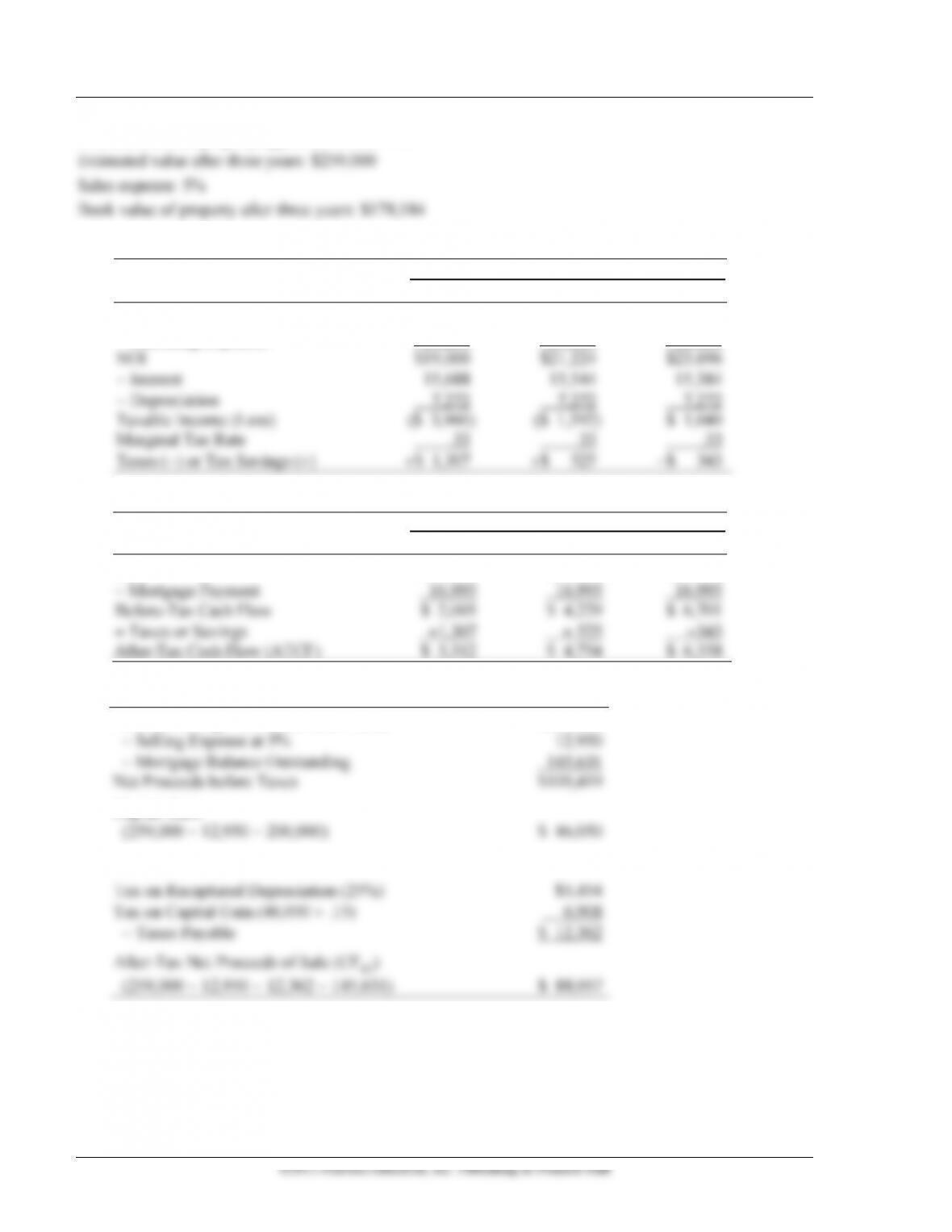
Summary of Key Facts:
Tax bracket: 33%

Web Chapter 18 Real Estate and Other Tangible Investments 343
©2011 Pearson Education, Inc. Publishing as Prentice Hall
Loan balance after three years: $145,631
344 Gitman/Joehnk/Smart • Fundamentals of Investing, Eleventh Edition
Estimated annual property appreciation rate: 9%
(a)
Years
(1) (2) (3)
Gross Rents $35,200 $38,720 $42,592
− Operating Expenses 16,200 17,496 18,896
After-Tax Cash Flows
Years
(1) (2) (3)
NOI $19,000 $21,224 $23,696
After-Tax Net Proceeds from Sale of the Building in Three Years (CFR3)
Forecast Selling Price (Estimated Value) $259,000
Capital Gain
Recaptured Depreciation (7,272 3) $ 21,816
Web Chapter 18 Real Estate and Other Tangible Investments 345
(b)
0
I
= $200,000 − $150,000 = $50,000
3 R3
12
0
1 2 3
1 2 3
CF CF
CF CF
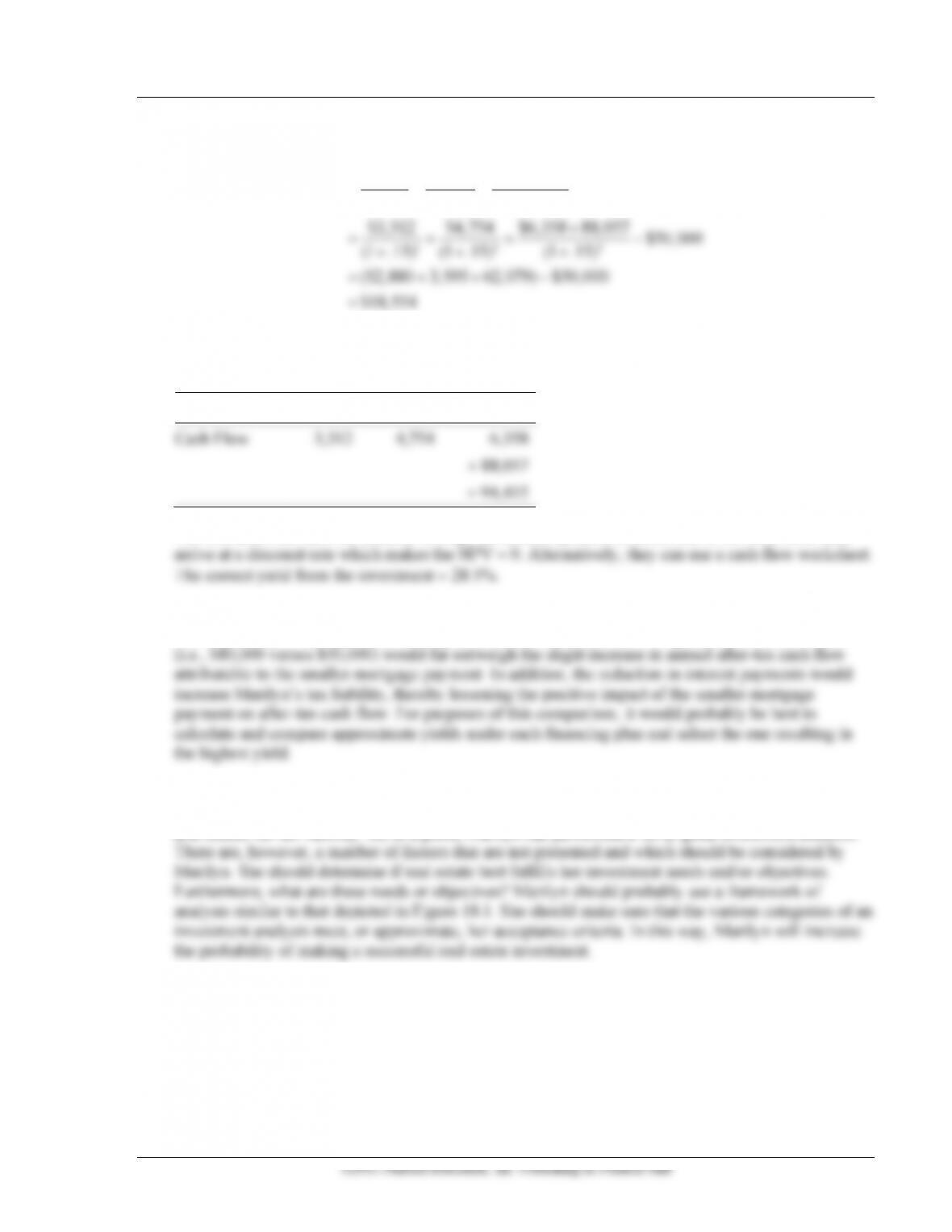
NPV (1 ) (1 ) (1 )
$3,312 $4,754 $6,358 88,057 $50,000
(1 .15) (1 .15) (1 .15)
($2,880 3,595 62,079) $50,000
$18,554
I
r r r
+
= + + −
+ + +
+
= + + −
+ + +
= + + −
=
The net present value is positive, and the investment is therefore acceptable.
(c)
Year 1
Year 2
Year 3
Cash Flow
3,312
4,754
6,358
+ 88,057
= 94,415
The instructor can take the students through an iterative process as described in the book until they
(d) By assuming the existing mortgage, Marilyn would not really increase her return. This financing
would probably work against increasing her rate of return since the 60% greater initial cash outlay
(e) Marilyn has accumulated relevant quantitative data and should be able to establish needed financial
parameters for use in the investment analysis. She also wants to diversify her investment portfolio
and reduce her tax liability. So, to a point, Marilyn has performed a fairly good investment analysis.

346 Gitman/Joehnk/Smart • Fundamentals of Investing, Eleventh Edition
◼ Outside Project
Chapter 18 Analyzing Local Real Estate Demand and Supply
Every day we participate in the economy and acquire information about the world around us. Sometimes
we do not fully appreciate how much valuable knowledge we really possess. The purpose of this project
is to analyze the real estate investment potential of your neighborhood.
The section in this chapter entitled “Determinants of Value” lists demand, supply, the property, and the
property transfer process as important factors in real estate valuation. Since we want to look at the
neighborhood, not a specific piece of property, an analysis of demand and supply is all that you need to
perform. Mortgage information can be obtained from a local mortgage lender such as a savings and loan
or bank. Depending on the size of the city you live in, the Sunday newspaper usually has an extensive
real estate section that includes mortgage information as well as other useful data and comments about
the local real estate market.
As you perform this analysis, follow the questions and comments in the text under “Demand” and “Supply”
and see how well you can do your own analysis based on your knowledge of trends in the area, the people
who live there, and what you observe about the desirability of real estate investment. Comment on the real
estate investment outlook in the area. You may want to augment your analysis with information available
from the local chamber of commerce or economic development agency.