Part Seven
Web Chapters
Part Seven Includes
Chapter 16 Investing in Preferred Stocks
Chapter 17 Tax-Advantaged Investments
Chapter 18 Real Estate and Other Tangible Investments

Web Chapter 16
Investing in Preferred Stocks
◼ Outline
Learning Goals
I. Preferred Stocks
A. Preferred Stocks as Investment Vehicles
1. Advantages and Disadvantages
2. Sources of Value
B. Issue Characteristics
2. Preferred Stock Provisions
Concepts in Review
II. Valuing and Investing in Preferreds
A. Putting a Value on Preferreds
1. Dividend Yield: A Key Measure of Value
2. Expected Return
3. Book Value
4. Fixed Charge Coverage
5. Agency Ratings
B. Investment Strategies
1. Looking for Yields
2. Trading on Interest Rate Swings
3. Speculating on Turnarounds
Concepts in Review
Summary
Discussion Questions
Key Terms
Problems
Case Problems
16.1 Penni Shows a Preference for Preferreds
Excel with Spreadsheets
Trading Online with OTIS

Web Chapter 16 Investing in Preferred Stocks 305
◼ Key Concepts
1. The fundamental aspects of preferred stock, including sources of value and risk
2. Basic rights and claims of preferred stockholders and some of the common characteristics found with
these securities
3. Various measures of investment suitability and several preferred stock investment strategies
◼ Overview
This Web chapter is about preferred stock.
1. Preferred stocks are defined. Preferred stocks usually have fixed dividend characteristics. It might
be pointed out that high current income is an advantage of this investment vehicle. Since most of the
preferred shares outstanding can be classified as debt on issuers’ financial reports (and tax deductible),
most preferred stock dividends do not qualify for the new preferential tax rate. It might be useful to
show how to read preferred stock quotations in the financial pages of the WSJ.
2. Issue characteristics, investor rights and claims, cumulative provisions, and call and sinking fund
provisions are considered. Cumulative provisions are important and distinctive features of preferred
stocks that should be explained in detail. Adjustable-rate preferreds and preference preferreds are
also introduced and briefly discussed.
3. The next section outlines some ways of evaluating preferred stock for investment purposes. At this
stage, the following concepts should be reviewed carefully: how to calculate the expected yield of a
particular stock, how to reach an investment decision regarding that stock, and what preferred stock
agency ratings mean and where to obtain them. The instructor should explain to the class that the
value of investment-grade preferred stocks fluctuates with the market rate of interest and demonstrate
the inverse relationship with a specific example.
◼ Answers to Concepts in Review
1. Preferred stocks are equity issues that hold a position senior to common stock. Even though preferred
shares are a form of equity, they are considered fixed-income securities because their level of current


308 Gitman/Joehnk/Smart • Fundamentals of Investing, Eleventh Edition
©2011 Pearson Education, Inc. Publishing as Prentice Hall
(f) Common stock presents the most risk to the investor. A risk-averse investor may not want to add
this level of risk to the portfolio and will find preferreds more acceptable.
2. Firms are not obligated to make preferred dividend payments. If conditions deteriorate in a firm to
the point where it needs to miss one or more of its preferred dividends payments, most preferred
◼ Solutions to Problems
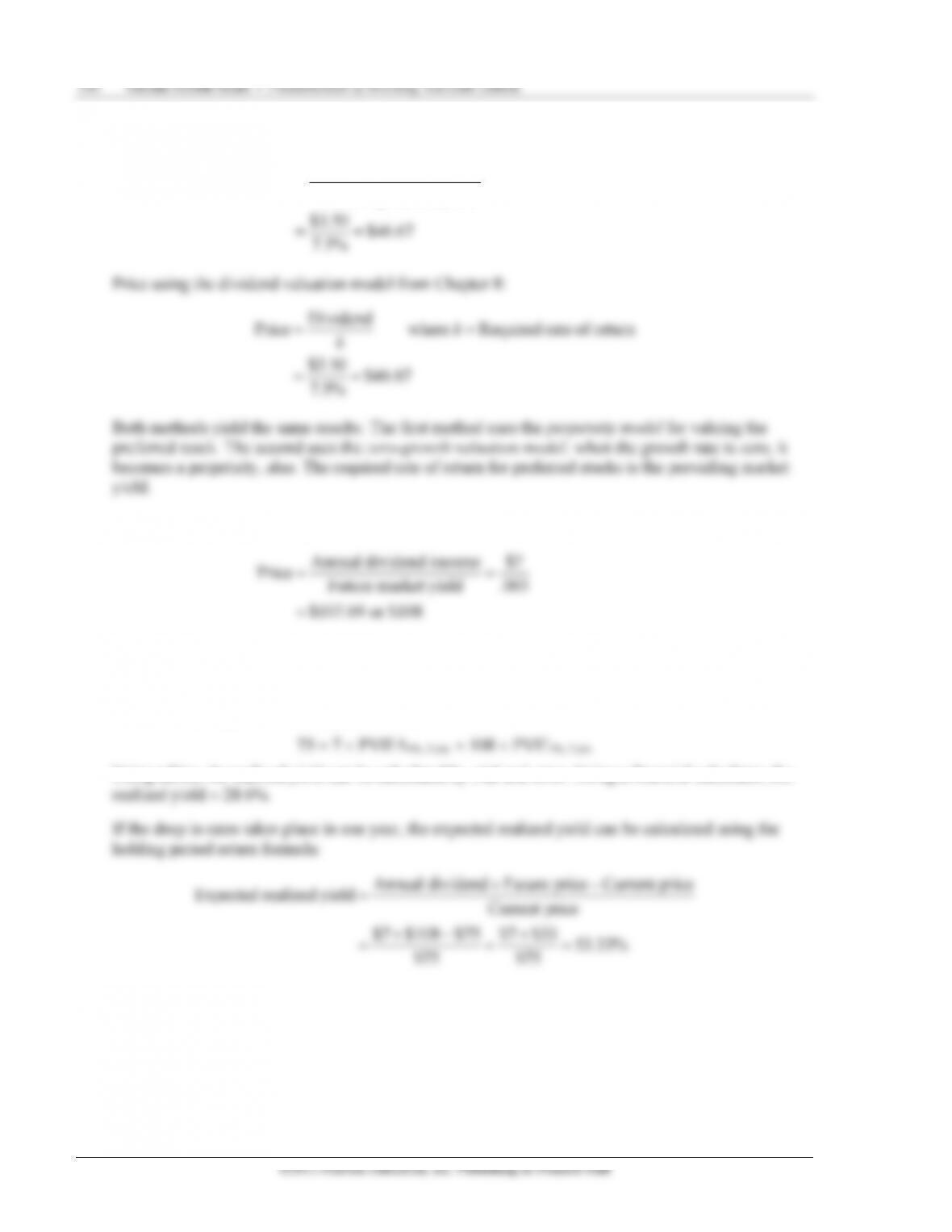
1. Dividend yield =
Annual dividend income
Preferred stock price
Price =
Annual dividend income
Prevailing market yield
.07
2.
Earnings before interest and taxes (EBIT)
Fixed charge coverage = Interest expense [Preferred dividends (.65)]+
40,000,000

Web Chapter 16 Investing in Preferred Stocks 309
Fixed charge coverage with EBITDA:
Earnings before interest and taxes (EBIT) Depreciation Amortization
= Interest expense [Preferred dividends (.65)]
40,000,000 5,500,000
$2,000,000 ($1,000,000 /.65)
45,500,000 12.86
$2,000,000 $1,538,462
++
+
+
=+
==
+times
Note: Since depreciation and amortization are noncash expenses, the firm actually has greater
coverage of its interest expense and preferred dividends.
3. Fixed charge coverage = EBIT/(Interest expense + Preferred dividends)
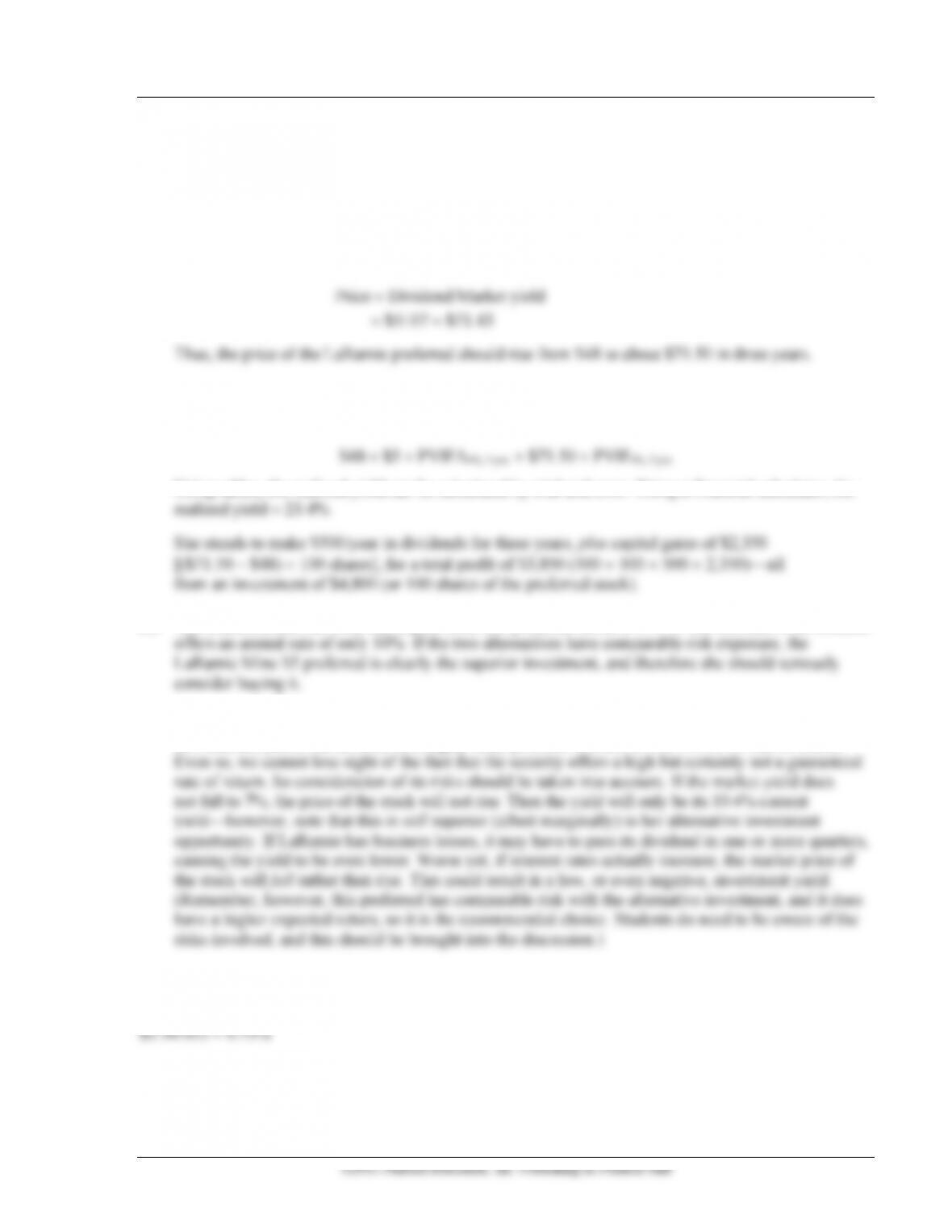
4. HPR = (Current income + Capital gains)/Initial investment
(a) Here, capital gains and dividends would be taxed at 15%.
The after-tax return is [(Dividends + Capital gains) .85]/Initial investment
5. The issue here is the tax rate on common stock dividends versus trust preferred stock dividends.
The common stock provides a higher return.
6. There is no set solution to this problem, since the answer will vary with the preferred stock chosen by
Web Chapter 16 Investing in Preferred Stocks 311
◼ Solutions to Case Problems
Case 16.1 Penni Shows a Preference for Preferreds
This case is designed to have the student make decisions about preferred stocks. Both computations and
discussions about the investment merits of preferreds are involved.
(a) Penni’s stockbroker expects the market yield to drop to 7% in two years.
(b) Expected realized yield:
Let r% be the expected realized yield. We have:
Using tables, the realized yield can be calculated by trial and error. Using a financial calculator, the
(c) The realized yield Ms. Jock can expect from this preferred stock is 35.3%. Her alternative investment
(d) While this may be a quality preferred stock, the way it is being used (speculating on interest rate
movements) places the investor in a highly risky position. It offers a very attractive rate of return.
◼ Answer to Chapter Opening Problem