Part Six
Derivative Securities
Part Six Includes
Chapter 14 Options: Puts and Calls
Chapter 15 Commodities and Financial Futures

Chapter 14
Options: Puts and Calls
◼ Outline
Learning Goals
I. Put and Call Options
A. Basic Features of Puts and Calls
1. A Negotiable
2. Seller versus Buyer
3. How Puts and Calls Work
4. Advantages and Disadvantages
B. Options Markets
1. Conventional Options
2. Listed Options
C. Stock Options
1. Stock Option Provisions
a. Strike Price
b. Expiration Date
2. Put and Call Transactions
Concepts in Review
II. Options Pricing and Trading
A. The Profit Potential from Puts and Calls
B. Intrinsic Value
1. In-the-Money/Out-of-the-Money
2. Time Value and Option Prices
C. What Drives Option Prices?
1. Option-Pricing Models
D. Trading Strategies
E. Buying for Speculation
1. Speculating with Calls
2. Speculating with Puts
F. Hedging: Modifying Risks
1. Protective Puts: Limiting Capital Loss
2. Protective Puts: Protecting Profits

Chapter 14 Options: Puts and Calls 271
G. Enhancing Returns: Options Writing and Spreading
1. Writing Options
a. Naked Options
b. Covered Options
2. Spreading Options
a. Option Straddles
Concepts in Review
III. Stock-Index and Other Types of Options
A. Stock-Index Options: Contract Provisions
1. Putting a Value on Stock-Index Options
a. Full Value versus Fractional Value
B. Investment Uses
1. Index Options as Hedging Vehicles
2. A Word of Caution
C. Other Types of Options
1. Options on Exchange-Traded Funds
2. Interest Rate Options
3. Currency Options
4. LEAPS
Concepts in Review
Summary
Key Terms
Discussion Questions
Problems
Case Problems
14.1 The Franciscos’ Investment Options
14.2 Luke’s Quandary—To Hedge or Not to Hedge
Excel with Spreadsheets
◼ Key Concepts
1. The world of puts and calls and their popularity in the investment community
2. Option contract pricing and valuation
3. The risk and return behavior of various put and call investment strategies
4. The increasing number of different kinds of listed options, including LEAPS, options on stock market
indexes, ETFs, debt securities, and foreign currencies

272 Gitman/Joehnk/Smart • Fundamentals of Investing, Eleventh Edition
◼ Overview
Different types of options (puts and calls, rights and warrants) are discussed in this chapter.
1. Students sometimes have difficulty distinguishing between options and securities, so time should be
spent providing a clear explanation. Options represent a contract or an agreement to buy (or sell) a
security in the future, whereas owning a security means owning a part of a company (as in the case of
owning a stock) or having a position in a loan (as in the case of a bond).
2. The chapter next discusses put and call options. Students should understand the difference between
put and call options and how they work. The distinction between the maker and the buyer should also
be made clear. Examples that compute the prices of put and call options might be worked out in class.
The distinction between in-the-money and out-of-the-money options should be explained, and the
students should develop an ability to read and understand option quotations listed in the financial
pages.
3. The factors driving option prices should be explained next, along with a brief introduction to some of
the basic option pricing models.
4. After the basic characteristics of puts and calls have been reviewed, attention shifts to listed stock
options. Pricing systems, valuation concepts, and trading strategies are all discussed in detail. It
would be good at this point to emphasize to the class the strategies of speculation, hedging, covered
call writing, and spreading since these are all viable techniques for the individual investor.
5. Stock-index options are next. Their characteristics and valuation are covered in detail, as are some of
the possible uses of these options. Information about the recent prices of the prominent stock-index
options should be shared with the class. The students should understand that since the creation of
stock-index options, it is now possible to “trade the market” as a whole and that this presents great
opportunities for both risk reduction (as in the case of hedging stock portfolios) and return
enhancement. But as we’ve learned, it has also created some problems, as in the market volatility
that comes with certain types of program trading and the “triple witching hour.” Options on
exchange-traded funds allow investors to focus on preferred segments of “the market.”
6. Interest rate and foreign currency options are then discussed, along with LEAPS. It would probably
be useful to explain to the class the pricing and valuation systems used with these securities.
Especially important is how the concepts of bond valuation (from Chapter 11) come into play with
interest rate options.
◼ Answers to Concepts in Review
1. Puts and calls are negotiable options issued in bearer form that allow the holder to sell (put) or buy

Chapter 14 Options: Puts and Calls 275
When an option has a positive fundamental value (the stock price is higher than the strike price in
Chapter 14 Options: Puts and Calls 277
(c) Index options are issued with monthly rather than quarterly expiration dates, and expiration dates
go out only three months rather than nine months (as is the practice with equity options).
(d) When hedging with index options, you can protect an entire portfolio rather than only one stock.
13. Stock-index options can be used to hedge or speculate. An investor can protect a portfolio of common
stocks against a poor market by buying puts on one of the stock market indexes. That way, the
investor’s portfolio is hedged: if the market goes up, only the cost of puts is lost, but if the market
14. If an investor holds a well-balanced portfolio of common stocks, he may want to hedge his position
with a stock-index option under two conditions: the first condition is if he expects a market decline;

Chapter 14 Options: Puts and Calls 279
◼ Suggested Answers to “Ethics in Investing” Questions
Executive Stock Options: A Case of Free Lunch (on Web)
Should employee stock options be expensed?
Answer:
Lack of expensing of executive options creates a false impression that a company can create a new form of
compensation that does not cost the company anything. According to this argument shared by a majority
◼ Suggested Answers to Discussion Questions
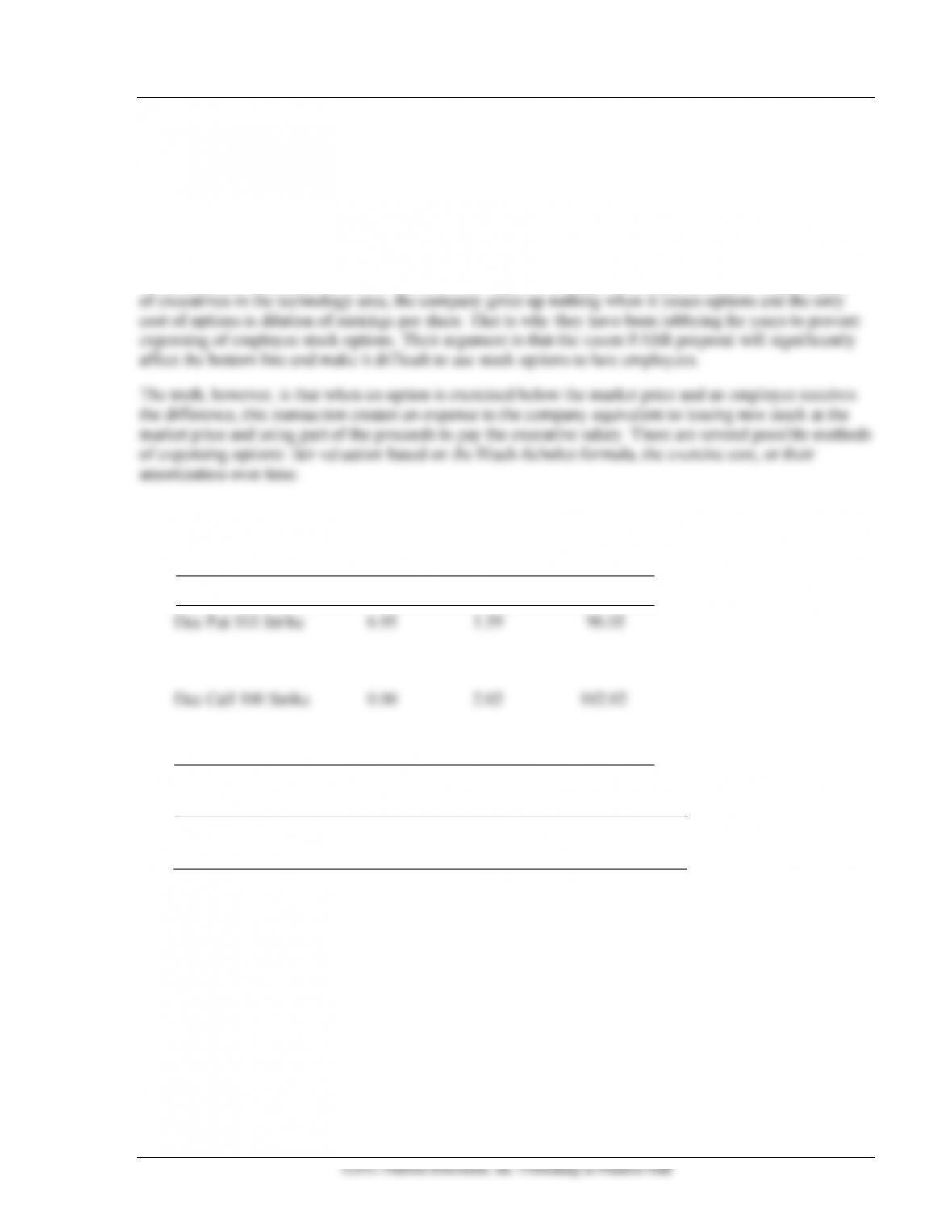
1.
Premium
Time Premium
Breakeven
Dec Put 103 Strike
6.95
1.59
96.05
Dec Call 100 Strike
0.00
2.02
102.02
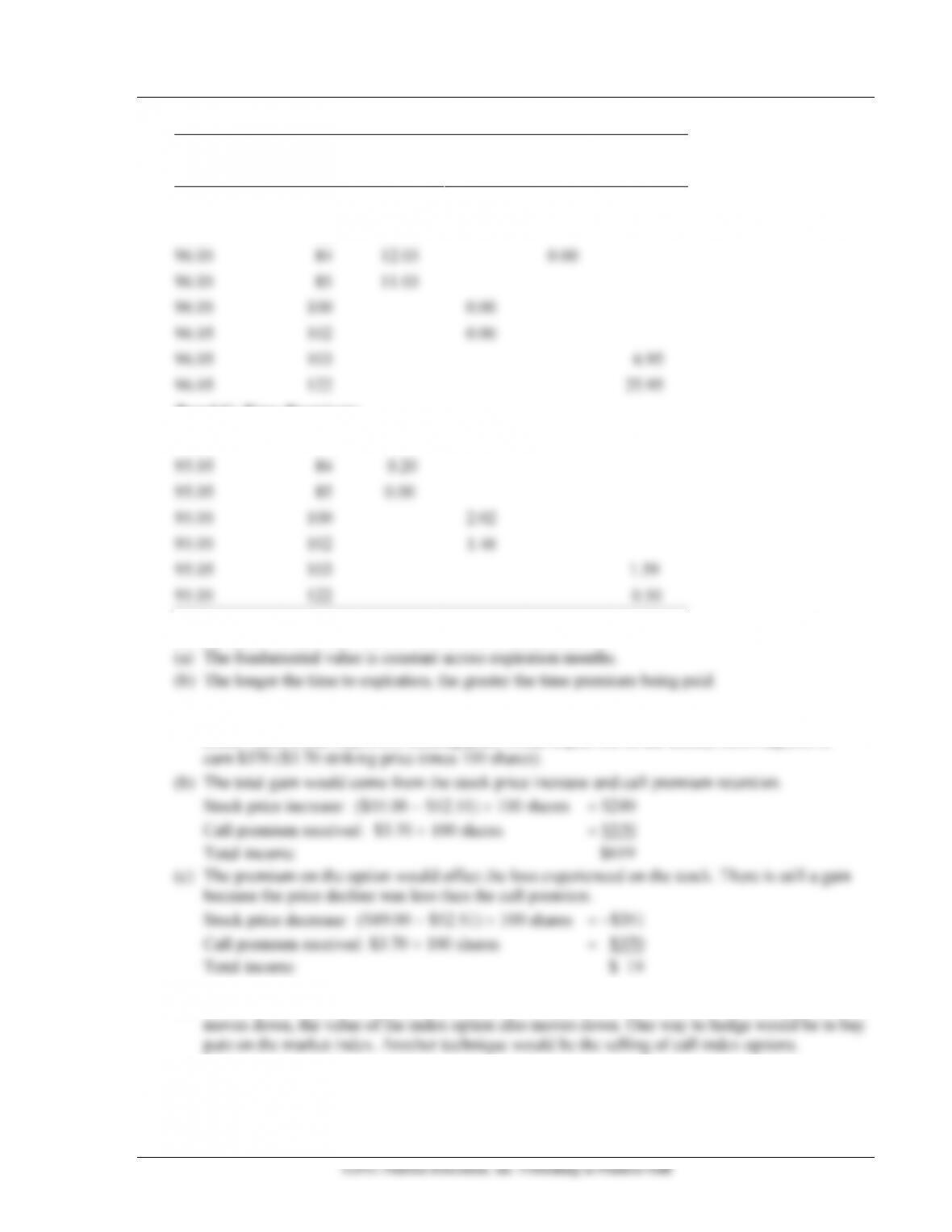
2. Put and Call Components for Actively Traded OEX Options
Underlying
Strike
Call Options
Put Options
Index Value
Price
Sep
Dec
Sep
Dec+

280 Gitman/Joehnk/Smart • Fundamentals of Investing, Eleventh Edition
Panel A: Quoted Option Price
96.05
83
13.15
96.05
84
12.25
0.03
96.05
85
11.00
96.05
100
2.02
96.05
102
1.46
96.05
103
96.05
122
8.54
26.45
(Continued)
Chapter 14 Options: Puts and Calls 281
Underlying
Strike
Call Options
Put Options
Index Value
Price
Sep
Dec
Sep
Dec+
Panel B: Underlying Fundamental Values
96.05
83
13.05
96.05
84
12.05
0.00
96.05
85
11.05
96.05
100
0.00
96.05
102
0.00
96.05
103
6.95
96.05
122
25.95
Panel C: Time Premiums
95.05
83
0.10
95.05
84
0.20
95.05
85
0.00
95.05
100
2.02
95.05
102
1.46
95.05
103
1.59
95.05
122
0.50
Several observations can be made based on this information:
3. (a) The stock price is currently at $52.51. There is no gain on the shares, but thankfully no loss
either. Also, a call with a $55 striking price would expire out of the money, allowing you to
4. (a) A stock-index option is a put or a call written on a specific market index. When the market index