Chapter 11 Bond Valuation 215
The 25-year factor in Table B.3 that’s equal (or close) to 0.116 is 9%, which lies at the intersection of
25 years and 9%. (Note: Using the approximate yield equation results in a promised yield of only
6.33%, a figure that isn’t even close to the real promised yield—which illustrates why approximate
yield is not a very accurate measure of return for zero-coupon bonds.)
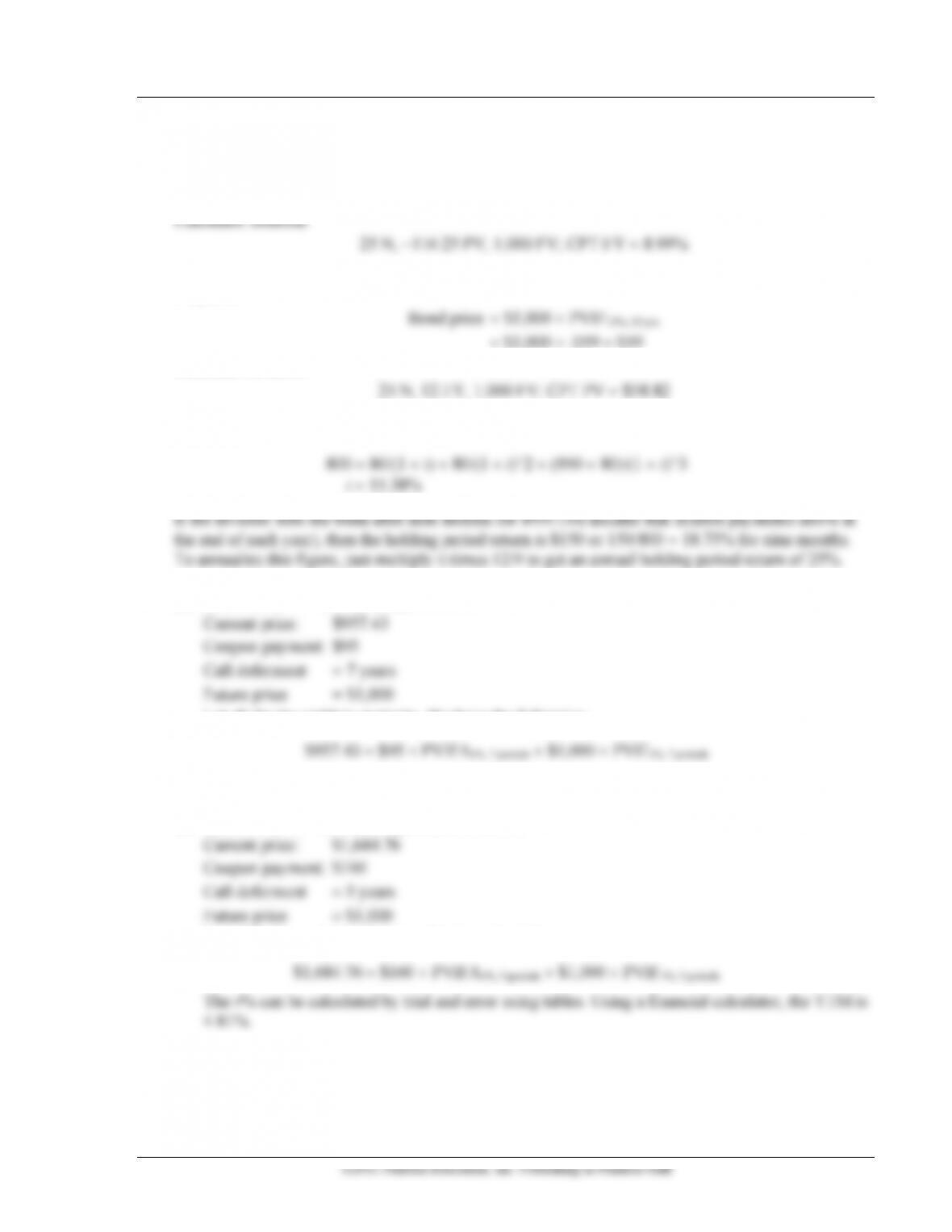
To find the price of this zero-coupon bond, find the present value at 12% of $1,000 (par value) in
25 years:
Calculator solution:
16. The realized yield is the interest rate, i, that solves the following equation:
17. (a) Bond terms: 9.5%, 20 years, priced at $957.43
Let r% be the yield-to-maturity. We have the following:
The r% can be calculated by trial and error using tables. Using a financial calculator, the YTM is
11.37%.
(b) Bond terms: 16%, 15 years, priced at $1,684.76
Let r% be the yield-to-maturity. We have the following:
216 Gitman/Joehnk/Smart • Fundamentals of Investing, Eleventh Edition
(c) Bond terms: 5.5%, 18 years, priced at $510.65
Let r% be the yield-to-maturity. We have the following:
The r% can be calculated by trial and error using tables. Using a financial calculator, the YTM is
35.89%.
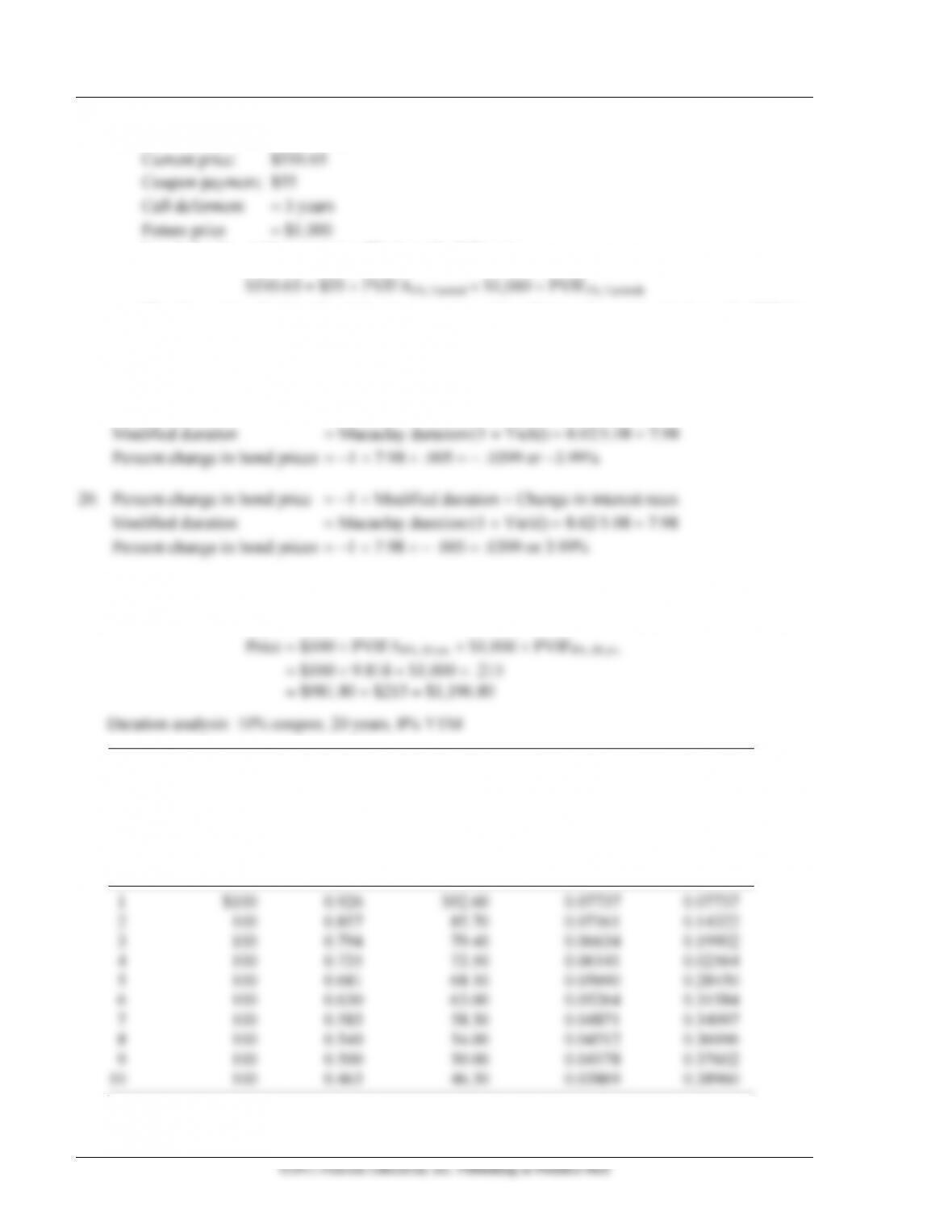
18. Modified duration = Macaulay duration/(1 + Yield) = 9.5/1.075 = 8.84
19. Percent change in bond price = −1 Modified duration Change in interest rates
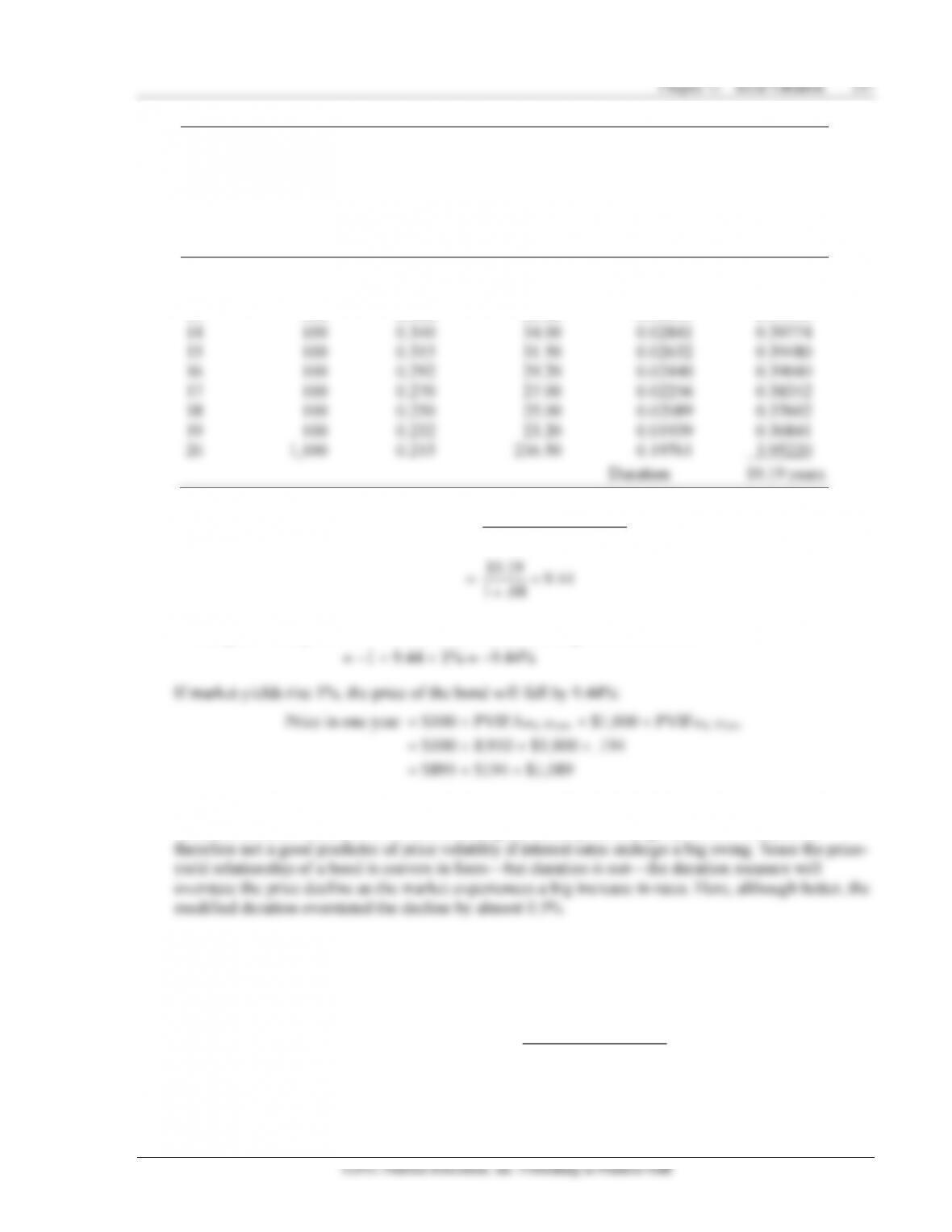
21. To calculate the duration of the bond, first calculate the bond’s current market price:
Bond terms: 10% coupon, 20 years, 8% YTM
(1)
(2)
(3)
(4)
(5)
(6)
Year
Weighted
Annual
Cash Flow
PVIF
(8%)
Present Value
of Cash Flows
PC (Ct)
Divided by
Current Price
of the Bond
Time-
Relative
Cash Flow
(t)
(C)
(2) (3)
4/$1,196.80
(1) (5)
1
$100
0.926
$92.60
0.07737
0.07737
2
100
0.857
85.70
0.07161
0.14322
3
100
0.794
79.40
0.06634
0.19902
4
100
0.735
73.50
0.06141
0.02564
5
100
0.681
68.10
0.05690
0.28450
6
100
0.630
63.00
0.05264
0.31584
7
100
0.583
58.30
0.04871
0.34097
8
100
0.540
54.00
0.04512
0.36096
9
100
0.500
50.00
0.04178
0.37602
10
100
0.463
46.30
0.03869
0.38960
(Continued)
218 Gitman/Joehnk/Smart • Fundamentals of Investing, Eleventh Edition
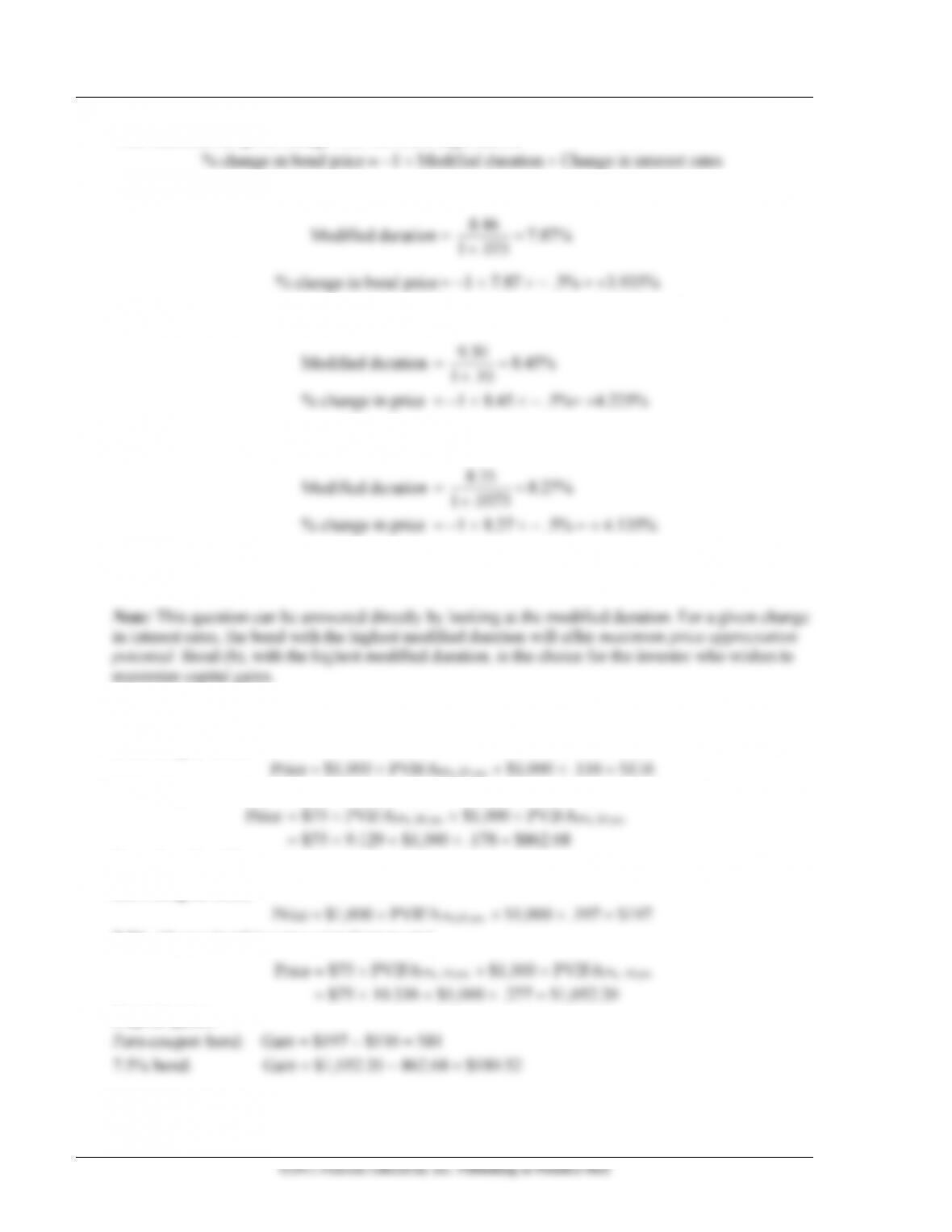
Then calculate the price change with the following formula:
(a) Bond with duration of 8.46 years with YTM of 7.5%:
8.46 7.87%
(b) Bond with duration of 9.30 years with YTM of 10%:
9.30 8.45%
(c) Bond with duration of 8.75 years with YTM of 5.75%:
8.75 8.27%
Bond (b) offers the potential for maximum capital appreciation. To maximize gains, this bond should
be selected over the others.
23. Current price of the bonds at 9% market interest:
Zero-coupon bond:
7.5%, 20-year bond (assume annual payments):
Prices based on 7% rate in one year:
Zero-coupon bond:
7.5%, 19-year bond (assume annual payments):
Capital gains:
Chapter 11 Bond Valuation 219
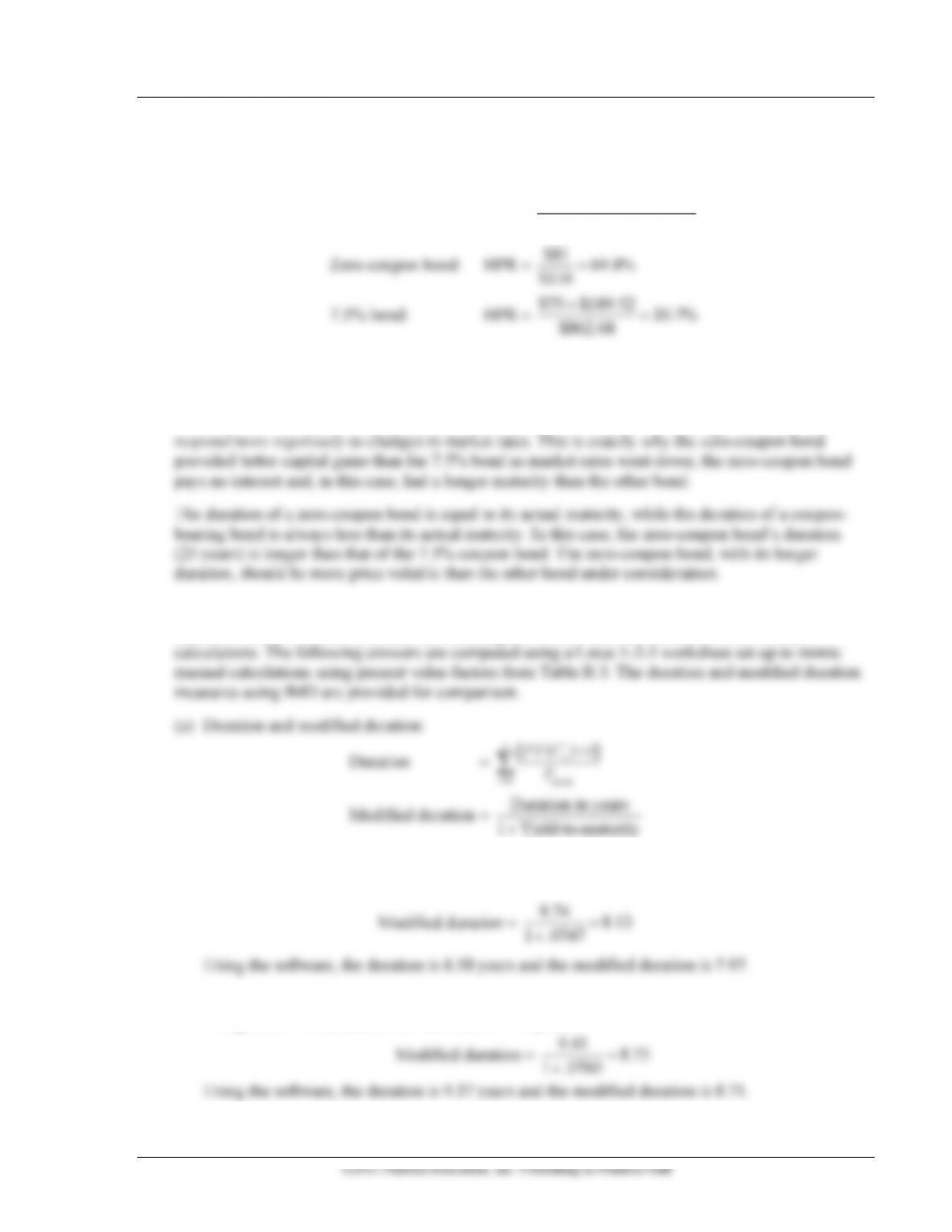
To maximize capital gains per bond, buy the 7.5%, 20-year bond; but this doesn’t take into account
the big difference in the amount (cost) invested. To do that, we should compare holding period
returns:
HPR =
Interest Capital gains
Purchase price
+
$81 69.8%
$862.68
Based on holding period return the conclusion remains unchanged. Stacy should purchase the
zero-coupon bond.
We know from Chapter 10 that prices of bonds with lower coupons and/or longer maturities will
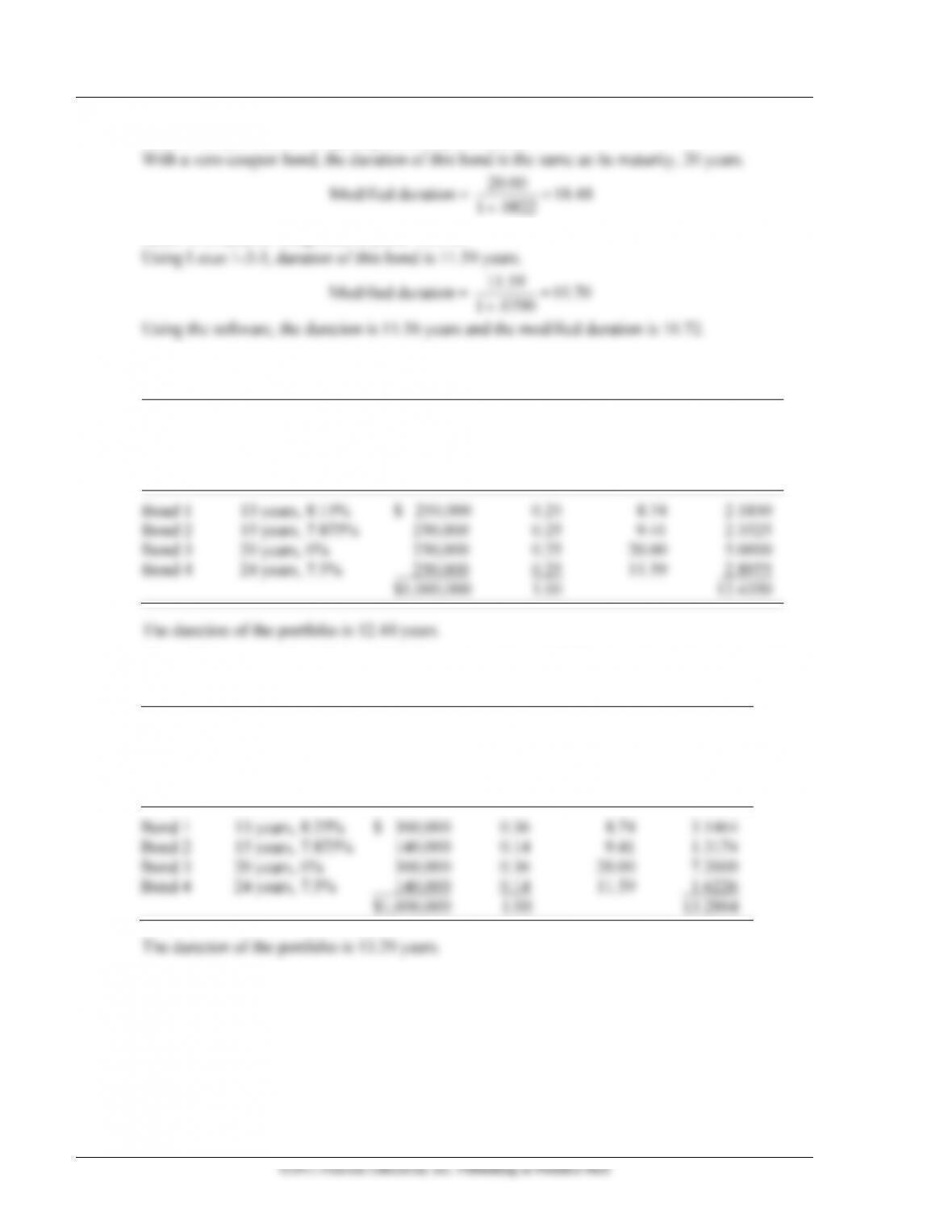
24. The duration and modified duration can be calculated using the IMD software. It gives the precise
duration measure because it avoids the rounding-off errors which are inevitable with manual
1 Yield-to-maturity+
Bond 1: 13 years, 8.25, priced to yield 7.47%:
Using Lotus 1-2-3, duration of this bond is 8.74 years.
8.74 8.13
Bond 2: 15 years, 7.88, priced to yield 7.60%:
Using Lotus 1-2-3, duration of this bond is 9.41 years.
9.41 8.75
220 Gitman/Joehnk/Smart • Fundamentals of Investing, Eleventh Edition
Bond 3: 20 years, zero-coupon, priced to yield 8.22%:
1 .0822 =
+
Bond 4: 24 years, 7.5, priced to yield 7.90%:
(b) When Elliot invests $250,000 in each of the four bonds, the weighted average duration of the
portfolio is:
(1)
(2)
Bond
Particulars
(3)
Amount
Invested
(4)
Weight
(5)
Bond
Duration
(6)
Weighted
Duration
(4) (5)
Bond 1
13 years, 8.15%
$ 250,000
0.25
8.74
2.1850
Bond 2
15 years, 7.875%
250,000
0.25
9.41
2.3525
Bond 3
20 years, 0%
250,000
0.25
20.00
5.0000
Bond 4
24 years, 7.5%
250,000
0.25
11.59
2.8975
$1,000,000
1.00
12.4350
The duration of the portfolio is 12.44 years.
(c) When Elliot invests $360,000 each into Bonds 1 and 3, and $140,000 each into Bonds 2 and 4,
the weighted average duration of the bond portfolio is:
(1)
(2)
Bond
Particulars
(3)
Amount
Invested
(4)
Weight
(5)
Bond
Duration
(6)
Weighted
Duration
(4) (5)
Bond 1
13 years, 8.25%
$ 360,000
0.36
8.74
3.1464
Bond 2
15 years, 7.875%
140,000
0.14
9.41
1.3174
Bond 3
20 years, 0%
360,000
0.36
20.00
7.2000
Bond 4
24 years, 7.5%
140,000
0.14
11.59
1.6226
$1,000,000
1.00
13.2864
The duration of the portfolio is 13.29 years.
(d) Portfolio (c) has a higher duration than portfolio (b). If rates are about to rise, then it is safer to
invest in portfolio (b) because this would be less price-volatile than the other portfolio.
Chapter 11 Bond Valuation 221
◼ Solutions to Case Problems
Case 11.1 The Bond Investment Decisions of Dave and Marlene Carter
In this case, the student is asked to evaluate two bond trading opportunities—one involves using bonds to
speculate on short-term interest rate movements, and the other deals with a bond swap.
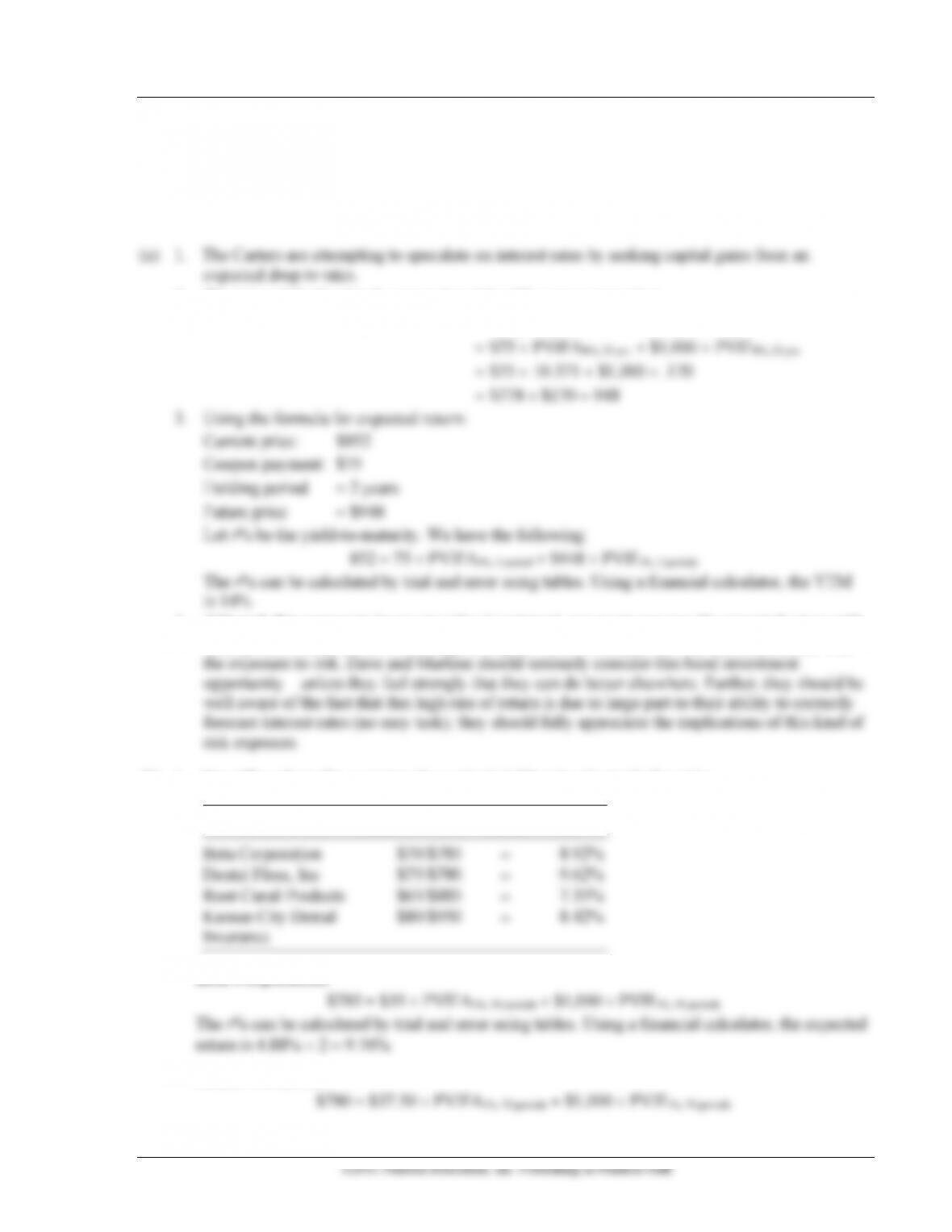
2. The price of the bond in 2 years (when it has 23 years to maturity):
Price of bond = Coupon (PVIFA) + Maturity value (PVIF)
4. Although this appears to be an attractive investment, one must compare the expected return with
other possible alternatives. Presuming the expected rate of return (of 14%) is commensurate with
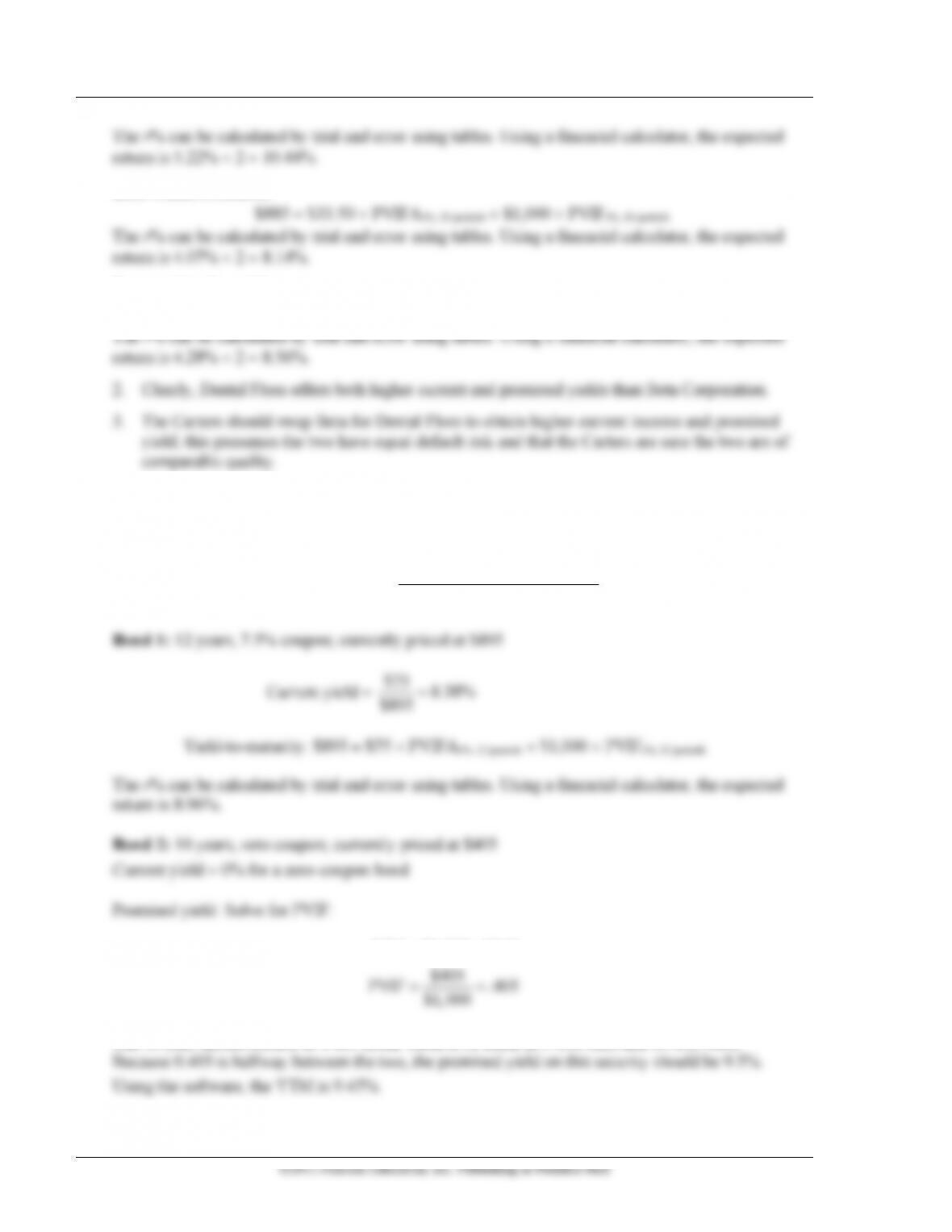
(b) 1. We will evaluate the current and promised yields using the text’s formulas.
Current Yield = Annual Interest/Current Price
Beta Corporation
$70/$785
=
8.92%
Dental Floss, Inc
$75/$780
=
9.62%
Root Canal Products
$65/$885
=
7.35%
Kansas City Dental
Insurance
$80/$950
=
8.42%
Beta Corporation:
Dental Floss, Inc:
222 Gitman/Joehnk/Smart • Fundamentals of Investing, Eleventh Edition
©2011 Pearson Education, Inc. Publishing as Prentice Hall
The r% can be calculated by trial and error using tables. Using a financial calculator, the expected
return is 5.22% 2 = 10.44%.
Root Canal Products:
Kansas City Dental Insurance:
$950 = $40 PVIFAr%, 34 periods + $1,000 PVIFr%, 34 periods
Case 11.2 Grace Decides to Immunize Her Portfolio
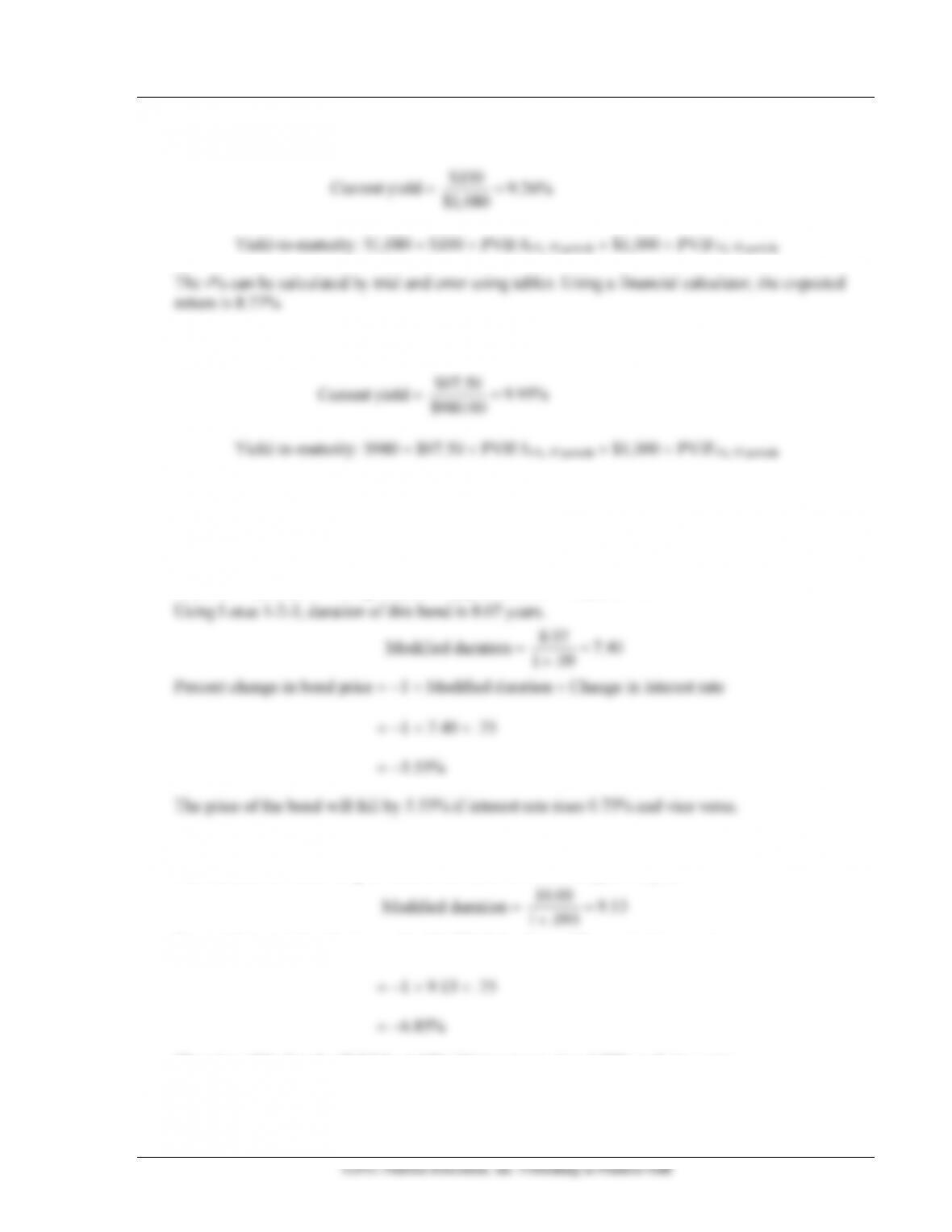
(a) Current and promised yield calculations:
Current yield =
Annual interest income
Current market price of bond
$ $ ,
$.
$,
405 1 000 PVIF
405
PVIF 405
1 000
=
==
The 10-year factors closest to 0.405 (from Table B.3) occur at 9% (0.422) and 10% (0.386).
Chapter 11 Bond Valuation 223
Bond 3: 10 years, 10% coupon; currently priced at $1,080
$100 9.26%
Bond 4: 15 years, 9.75% coupon; currently priced at $980
$97.50 9.95%
The r% can be calculated by trial and error using tables. Using a financial calculator, the expected
return is 10%.
(b) Duration and price volatility
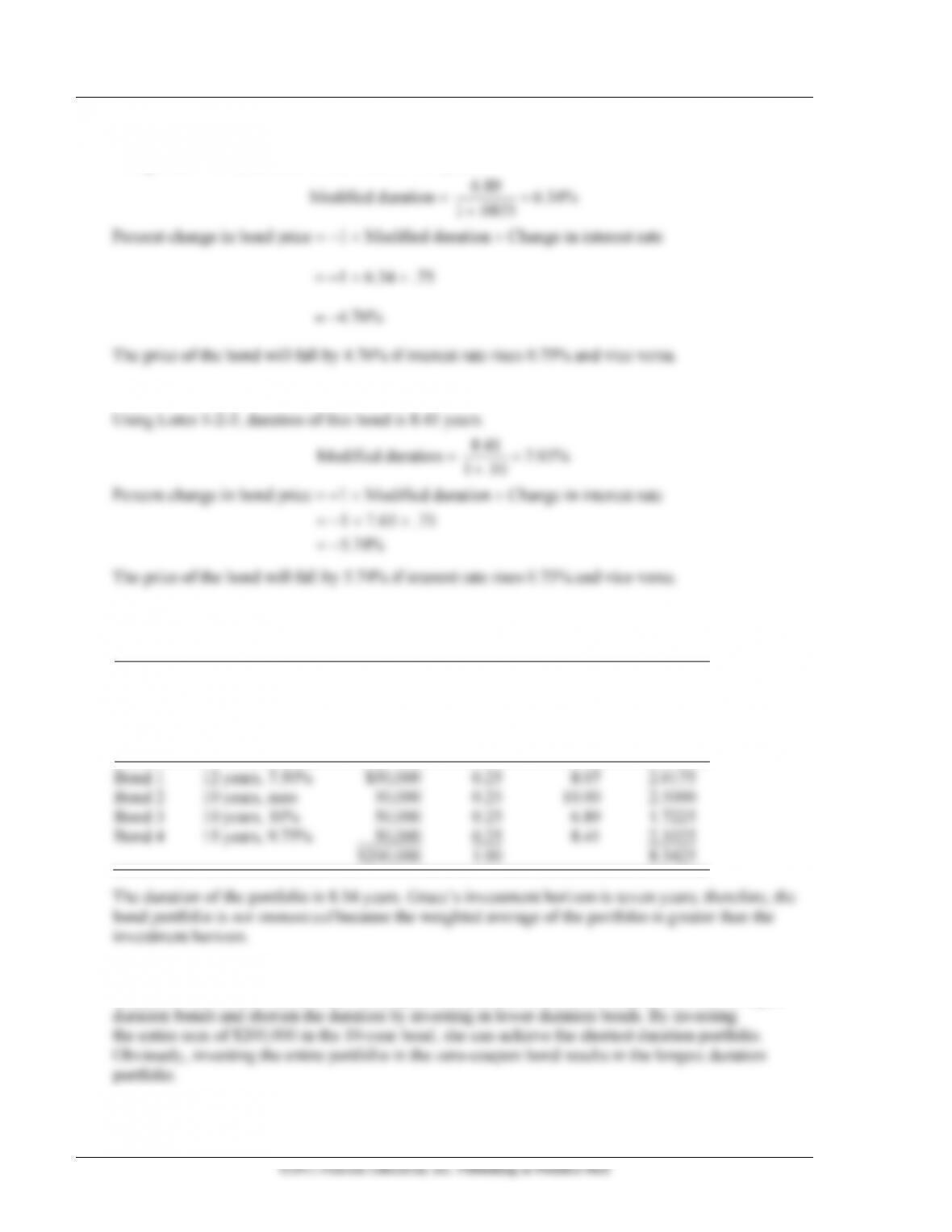
Bond 1: 12 years, 7.5% coupon; currently priced at $895 to yield 9%
Bond 2: 10 years, zero coupon; currently priced at $405 to yield 9.5%
The duration of a zero-coupon bond is the same as its maturity, or 10 years.
10.00 9.13
1 .095 =
+
Percent change in bond price = −1 Modified duration Change in interest rate
The price of the bond will fall by 6.85% if interest rate rises 0.75% and vice versa.
224 Gitman/Joehnk/Smart • Fundamentals of Investing, Eleventh Edition
Bond 3: 10 years, 10% coupon; currently priced at $1,080 to yield 8.75%
Using Lotus 1-2-3, duration of this bond is 6.89 years.
6.89 6.34%
Bond 4: 15 years, 9.75% coupon; currently priced at $980 to yield 10%
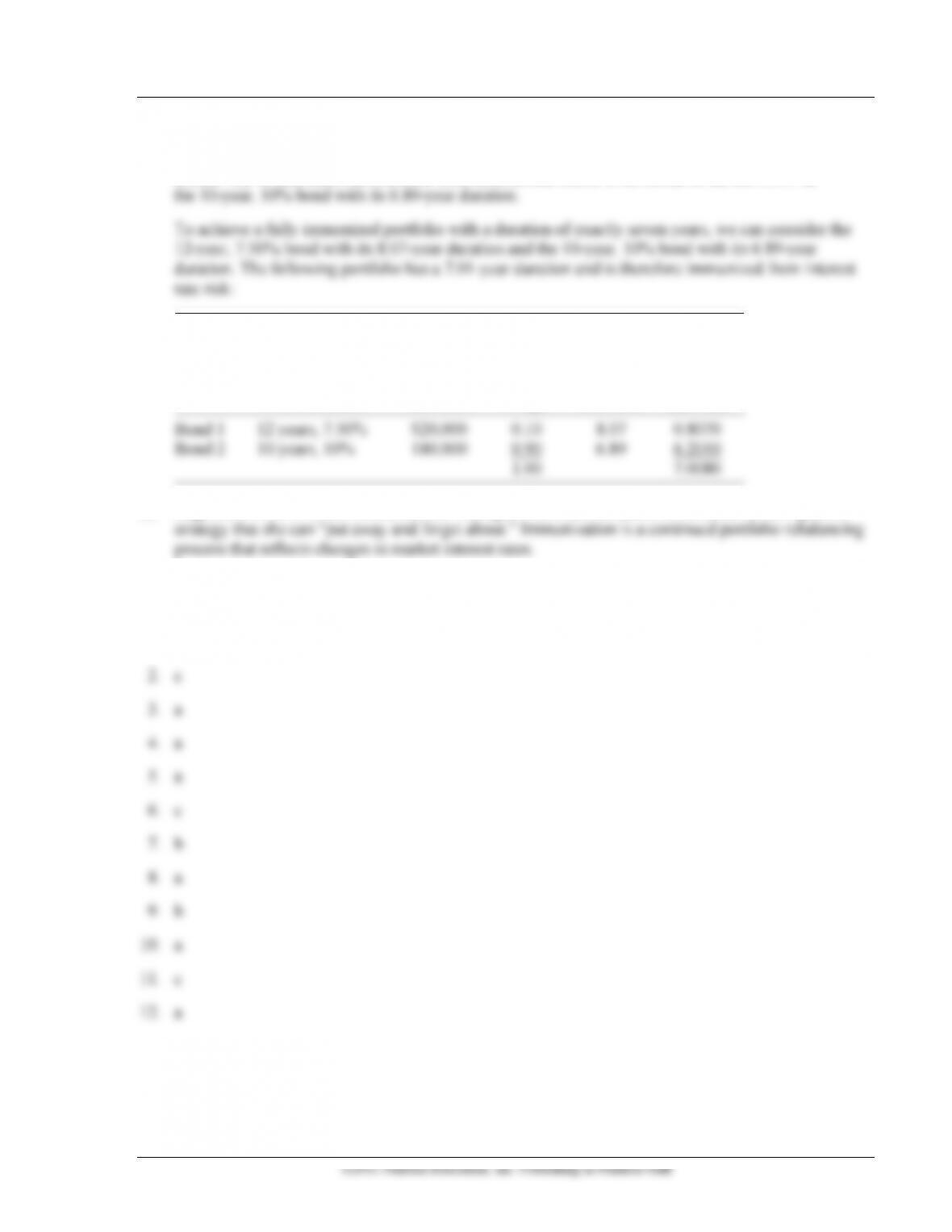
(c) When Grace invests $50,000 in each of the four bonds, the weighted average duration of the bond
portfolio would be:
(1)
(2)
Bond
Particulars
(3)
Amount
Invested
(4)
Weight
(5)
Bond
Duration
(6)
Weighted
Duration
(4) (5)
Bond 1
12 years, 7.50%
$50,000
0.25
8.07
2.0175
Bond 2
10 years, zero
50,000
0.25
10.00
2.5000
Bond 3
10 years, 10%
50,000
0.25
6.89
1.7225
Bond 4
15 years, 9.75%
50,000
0.25
8.41
2.1025
$200,000
1.00
8.3425
The duration of the portfolio is 8.34 years. Grace’s investment horizon is seven years; therefore, the
bond portfolio is not immunized because the weighted average of the portfolio is greater than the
investment horizon.
(d) The bond with the highest duration is the zero-coupon bond (10 years). The bond with the lowest
duration is the 10%, 10-year bond. To lengthen the portfolio’s duration, Grace can invest in higher
Chapter 11 Bond Valuation 225
(e) Grace is planning to cash out of the bond portfolio in about seven years and wants to immunize the
portfolio. To do so, we must find a portfolio with a weighted average duration of seven years. The
easiest way to immunize her portfolio from interest rate risk is to invest all of the $200,000 in
(1)
(2)
Bond
Particulars
(3)
Amount
Invested
(4)
Weight
(5)
Bond
Duration
(6)
Weighted
Duration
(4) (5)
Bond 1
12 years, 7.50%
$20,000
0.10
8.07
0.8070
Bond 2
10 years, 10%
180,000
0.90
6.89
6.2010
1.00
7.0080
(f) Regardless of how Grace immunizes her bond portfolio, immunization is not meant to be a passive
◼ Answers to CFA Questions (Part IV)
1. b

226 Gitman/Joehnk/Smart • Fundamentals of Investing, Eleventh Edition
◼ Outside Project
Chapter 11 Realized Returns on Bonds versus Their Promised Yields
What kind of returns have investors earned lately? How do last year’s realized returns stack up against the
yields (i.e., yields-to-maturity) promised at the time of purchase? Realized returns on bonds are of interest
to investors because past performance may give clues to the current trends and may suggest possible trend
shifts. The purpose of this project is to look at holding period returns for the past year on bonds.
Obtain a Wall Street Journal that’s approximately one year old and select four corporate bonds that are
traded on the New York Stock Exchange (make sure they’re nonconvertible). Select maturities of 5 years,
10 years, 15 years, and 20 years. Record the prices, coupons, and maturities of your four bonds; also
determine the promised yield for each issue. Now, look up the same bonds today. Calculate the holding
period return actually realized for each security over the past year. Note the effect of coupon and maturity
on each bond’s return. Contrast the promised yield of each bond with its realized return. How do you
explain the difference?