Chapter 11
Bond Valuation
◼ Outline
Learning Goals
I. The Behavior of Market Interest Rates
A. Keeping Tabs on Market Interest Rates
B. What Causes Interest Rates to Move?
C. The Term Structure of Interest Rates and Yield Curves
1. Types of Yield Curves
2. Plotting Your Own Curves
3. Explanations of the Term Structure of Interest Rates
a. Expectations Hypothesis
b. Liquidity Preference Theory
c. Market Segmentation Theory
d. Which Theory Is Right?
4. Using the Yield Curve in Investment Decisions
Concepts in Review
II. The Pricing of Bonds
A. The Basic Bond Valuation Model
B. Annual Compounding
C. Semiannual Compounding
Concepts in Review
III. Measures of Yield and Return
A. Current Yield
B. Yield-to-Maturity
1. Using Semiannual Compounding
2. Yield Properties
3. Finding the Yield on a Zero
C. Yield-to-Call
D. Expected Return
E. Valuing a Bond
Chapter 11 Bond Valuation 201
Concepts in Review
202 Gitman/Joehnk/Smart • Fundamentals of Investing, Eleventh Edition
IV. Duration and Immunization
A. The Concept of Duration
B. Measuring Duration
2. Duration for a Portfolio of Bonds
C. Bond Duration and Price Volatility
D. Effective Duration
E. Uses of Bond Duration Measures
1. Bond Immunization
Concepts in Review
V. Bond Investment Strategies
A. Passive Strategies
B. Trading on Forecasted Interest Rate Behavior
C. Bond Swaps
Concepts in Review
Summary
Key Terms
Discussion Questions
Problems
Case Problems
11.1 The Bond Investment Decisions of Dave and Marlene Carter
11.2 Grace Decides to Immunize Her Portfolio
Excel with Spreadsheets
◼ Key Concepts
1. The important role that interest rates play in the bond investment process and the basic determinants
of market rates
2. The term structure of interest rates and yield curves
4. The concept of duration, including effective duration, and its measurement; how duration is applied
in immunizing bond portfolios
5. Various types of bond investment programs and the ways debt securities can be used by investors;
employment of bond ladders is a passive strategy, whereas buying high duration bonds prior to
interest rate drops would be a more active and risky strategy
Chapter 11 Bond Valuation 203
◼ Overview
1. Interest rates are an integral component of the bond valuation process. Some class time should be
spent discussing the economics of interest rates. The various forces that drive interest rates should be
covered next. In this context, the instructor can introduce the term structure of interest rates.
2. The text then presents three different explanations of the term structure of interest rates: the
Expectations hypothesis, the liquidity preference theory, and the market segmentation theory.
The discussion of this important topic should include yield curves, how they are plotted, and their
use in making investment decisions.
3. The next section discusses the bond valuation process. It shows how, given the market rate of interest
and other details regarding the bond (such as the maturity, coupon, and face value), it is possible to
compute the “correct” price of the bond. An example showing this computation should be worked
out in class, including how fluctuations in the market interest rates induce changes in the price of the
bond. The magnitude of price changes depends on the amount of change in the market interest rate,
as well as on the maturity and coupon of the bond.
4. The concepts of bond yields and returns, along with the computation and use of current yield,
promised yield, yield-to-call, and expected yield, are discussed next. The instructor may wish to
demonstrate the trial-and-error procedure and to calculate the yield-to-maturity using tables. It is also
important to emphasize that what matters to investors is the return from the bond, not its yield.
5. Bond duration is one of the most important concepts in bond valuation and investing. After
demonstrating the shortcomings of yield-to-maturity, the concept and measurement of duration can
be illustrated. In this regard, the instructor can work out an example to illustrate how duration and
modified duration aid investors in gauging a bond’s price volatility. Instead of being used to forecast
price changes, price changes are calculated and employed in the process of calculating effective
duration.
6. Bond immunization is presented next. This technique preserves the value of a bond portfolio. Bond
immunization involves constructing a bond portfolio with a weighted average duration that matches
the investor’s investment horizon.
7. Bond investment strategies can be either active or passive. Passive investment strategies include
buy-and-hold and bond ladders. Trading on interest rate swings and bond swaps are considered
active strategies. The instructor might point out the advantages and disadvantages (risks) of each
technique.
8. One interesting teaching strategy is to start out with a bond priced at par and show the decline/rise
from an interest rate decrease/increase of the same magnitude. Due to convexity, bond prices will
rise faster than they decline!
204 Gitman/Joehnk/Smart • Fundamentals of Investing, Eleventh Edition
◼ Answers to Concepts in Review
1. There is no single market rate of interest applicable to all segments of the bond market. Instead, a
2. The behavior of interest rates is perhaps the single most important element in determining the level of
return from a bond investment program. Interest rates affect the level of current income earned by
3. The term structure of interest rates is the relationship between the interest rate or yield and the time
to maturity for any class of similar risk securities. The yield curve is just a graphic representation of
risk, a flat yield curve implies that inflation rates are expected to decline.
4. Analyzing the changes in yield curves over time provides investors with information about future
interest rate movements and how they can affect price behavior and comparative returns. For
example, if over a specific time period, the yield curve begins to rise sharply, it usually means that
Chapter 11 Bond Valuation 205
©2011 Pearson Education, Inc. Publishing as Prentice Hall
Even among longer-term maturities, the spread between different longer-term maturities should be
considered before making a decision to invest. For example, if the spread between 10 and 30-year
maturities is not large enough (say, less than 20 basis points), then the investor should favor the
10-year bond because he would not gain enough to compensate for investing in the much riskier
30-year maturity. In any case, the investor would have to consider his or her own risk tolerance to
determine whether the risk premium was sufficient for the additional risk of buying longer-term
securities.
5. Bond prices are driven by market yields. In the marketplace, the appropriate yield at which the bond
should sell is determined first, and then that yield is used to find the price of the bond. The yield is a
6. Bonds are usually priced using semiannual compounding because in practice, most bonds pay interest
7. Current yield is a measure of a bond’s current income. It is the amount of current income a bond
provides relative to its prevailing market price. Yield-to-maturity is a more complete measure
8. When we are dealing with semi-annual cash flows, to be technically correct, we should find the
bond’s “effective” annual yield. However, the market convention for finding the annual yield is to
9. The reinvestment of interest income is an important consideration because it is this rate that an
investor must earn on each of the interim cash throw-offs in order to realize a return equal to or
208 Gitman/Joehnk/Smart • Fundamentals of Investing, Eleventh Edition
©2011 Pearson Education, Inc. Publishing as Prentice Hall
(c) (1) An insurance company that must rely on predictable income streams
(2) An investor who wants to maximize yield
(3) An individual or institution that is not as conservative
(4) An investor who has a buy-and-hold investment strategy and a specific date at which the
funds will be needed
5. Answers will vary with each student.
◼ Solutions to Problems
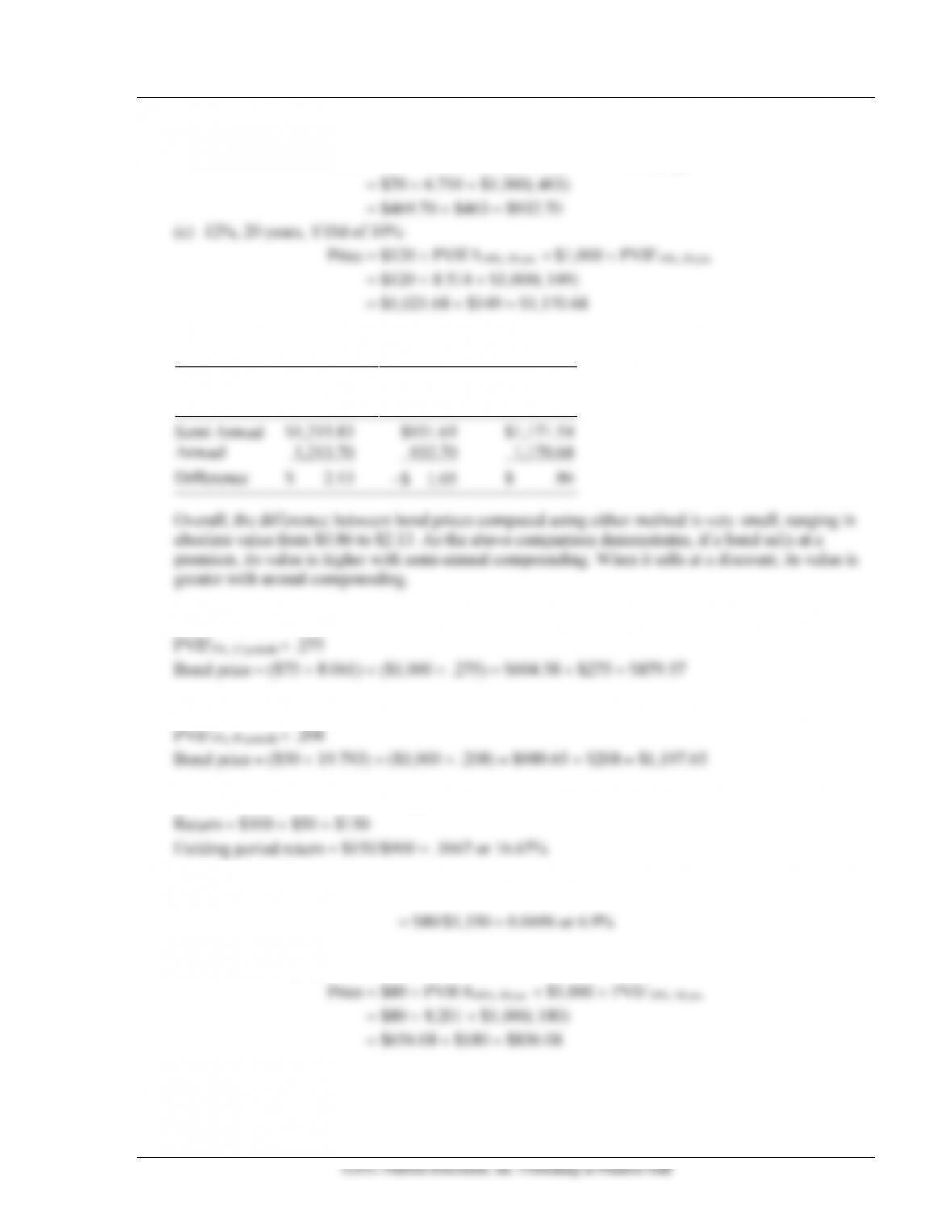
1. Bond A: $1,000 par value, 5% coupon, 15-year life, priced to yield 8%
Bond B: $1,000 par value, 7.5% coupon, 20-year life, priced to yield 6%
2. Bond prices using semiannual compounding:
(a) 10.5%, 15 years, YTM of 8%:
Price = $52.50 PVIFA4%, 30 yrs. + $1,000 PVIF4%, 30 yrs.
= $52.50 17.292 + $1,000(.308)
= $907.83 + $308 = $1,215.83
Chapter 11 Bond Valuation 209
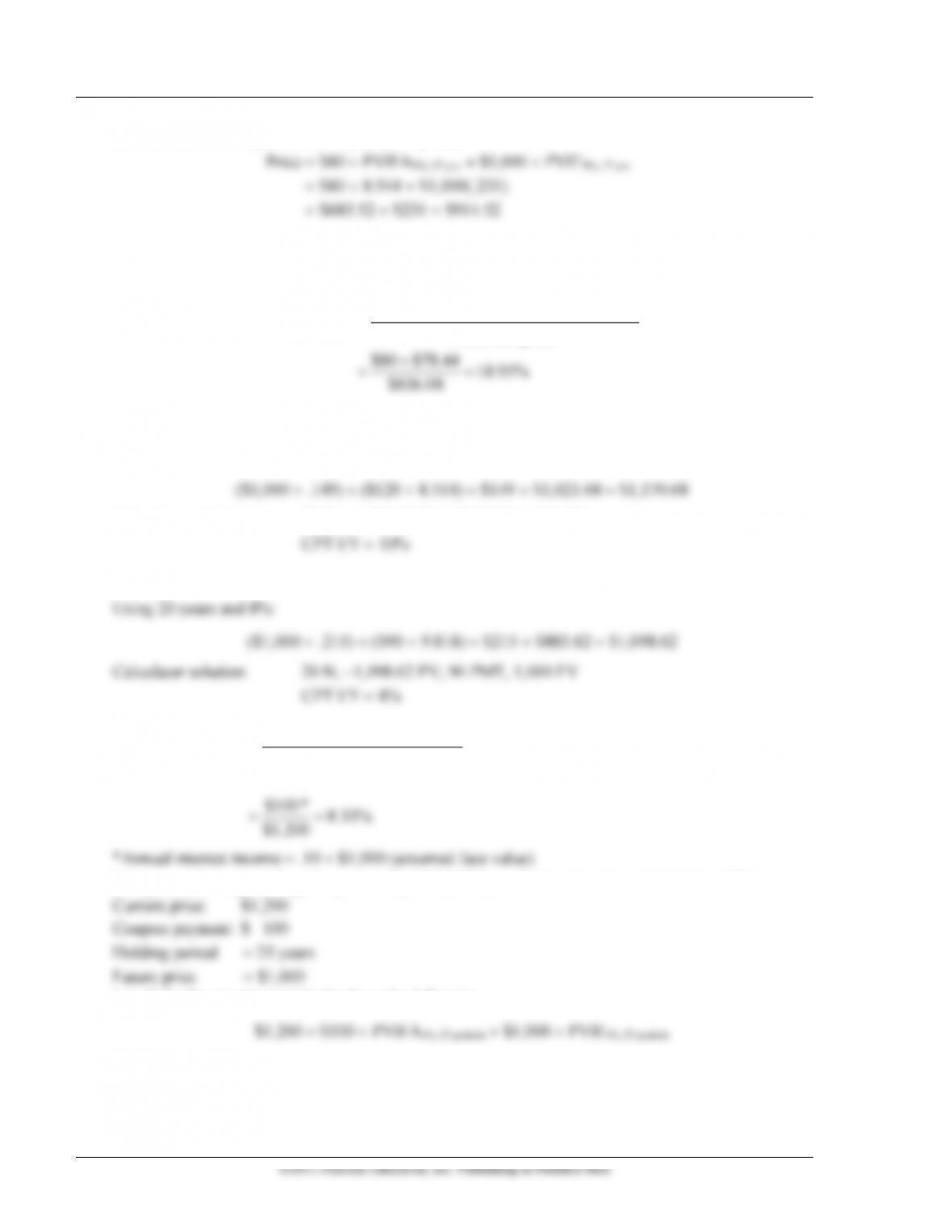
(b) 7%, 10 years, YTM of 8%:
Price = $70 PVIFA8%, 10 yrs. + $1,000 PVIF8%, 10 yrs.
The price difference using the two compounding methods is:
(a)
(b)
(c)
Premium
Discount
Premium
Semi Annual
$1,215.83
$931.65
$1,171.54
Annual
1,213.70
932.70
1,170.68
Difference
$ 2.13
−$ 1.05
$ .86
Overall, the difference between bond prices computed using either method is very small, ranging in
absolute value from $0.86 to $2.13. As the above comparison demonstrates, if a bond sells at a
premium, its value is higher with semi-annual compounding. When it sells at a discount, its value is
greater with annual compounding.
3. PVIFA9%, 15 periods = 8.061
4. PVIFA4%, 40 periods = 19.793
5. Return = Interest income + Price appreciation
6. Current yield is equal to annual income divided by current price
7. Price of bond today (8%, 18 years, 10% yield):
210 Gitman/Joehnk/Smart • Fundamentals of Investing, Eleventh Edition
Price of bond in one year (8%, 17 years, 9% yield):
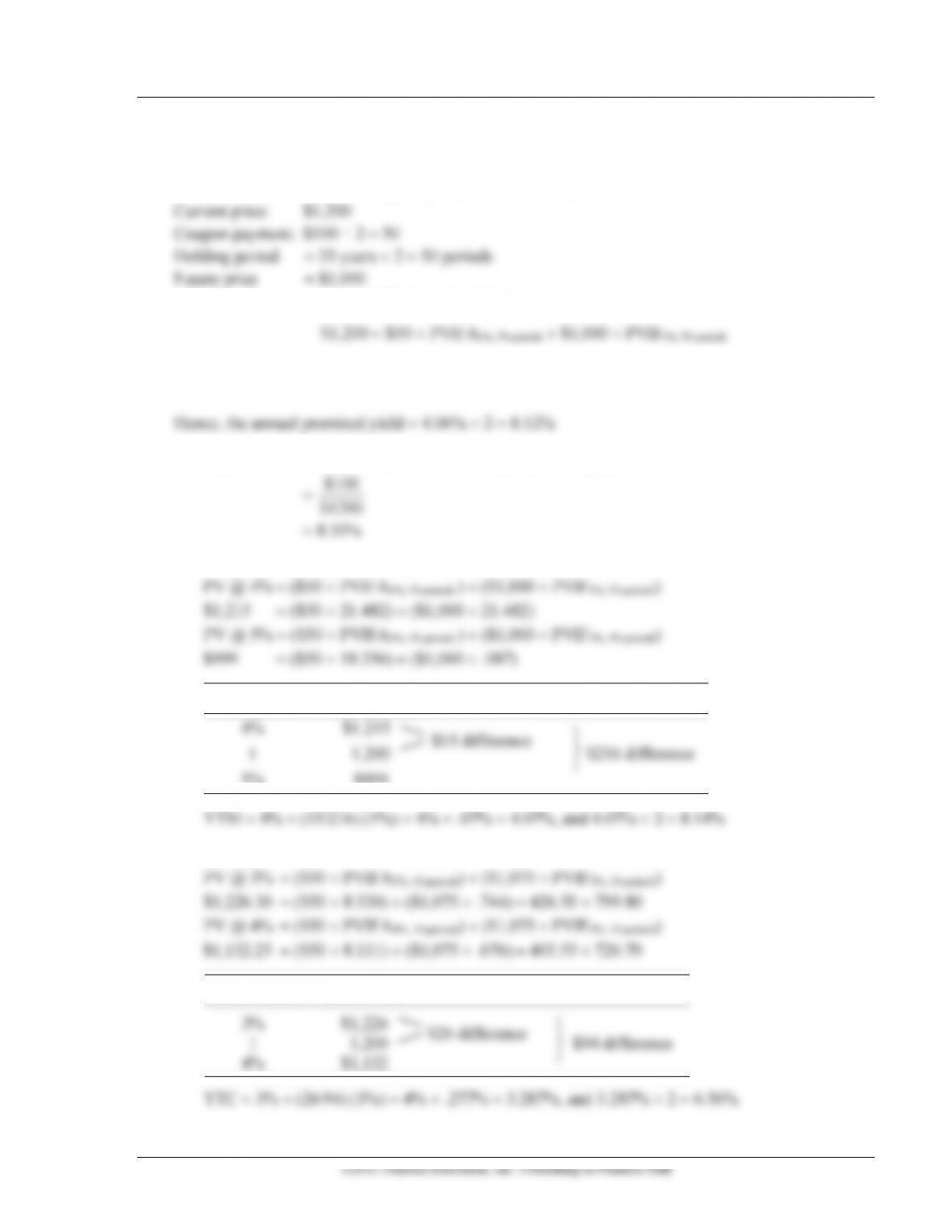
If the investor’s expectations are accurate, the price of the bond should go up by $78.44
($914.52 − $836.08) over the next year. The holding period return will be:
HPR
Annual interest income + Capital gains
Purchase price
=
$80 $78.44 18.95%
$836.08
+=
8. $1,170.68 = (1,000 PVIFx%, 20 periods) + ($120 PVIFAx%, 20 periods)
Using 20 years and 10%:
Calculator solution: 20 N, −1,170.58 PV, 120 PMT, 1,000 FV
9. $1,098.62 = (1,000 PVIFx%, 20 periods) + ($90 PVIFAx%, 20 periods)
10. Current yield
Annual interest income
Current market price of bond
=
$100 * 8.33%
Using annual compounding, the promised yield (YTM) on the bond can be calculated as follows:
Let r% be the promised yield. We have the following:
Chapter 11 Bond Valuation 211
The r% can be calculated by trial and error using tables. Using a financial calculator, the promised
yield is 8.1%.
Using semiannual compounding, the promised yield (YTM) on the bond can be calculated as follows:
Let r% be the promised yield. We have the following:
The r% can be calculated by trial and error using tables. Using a financial calculator, the promised
semi-annual yield is 4.06%.
11. (a) Current yield = Annual interest income/Current market price of the bond
$100
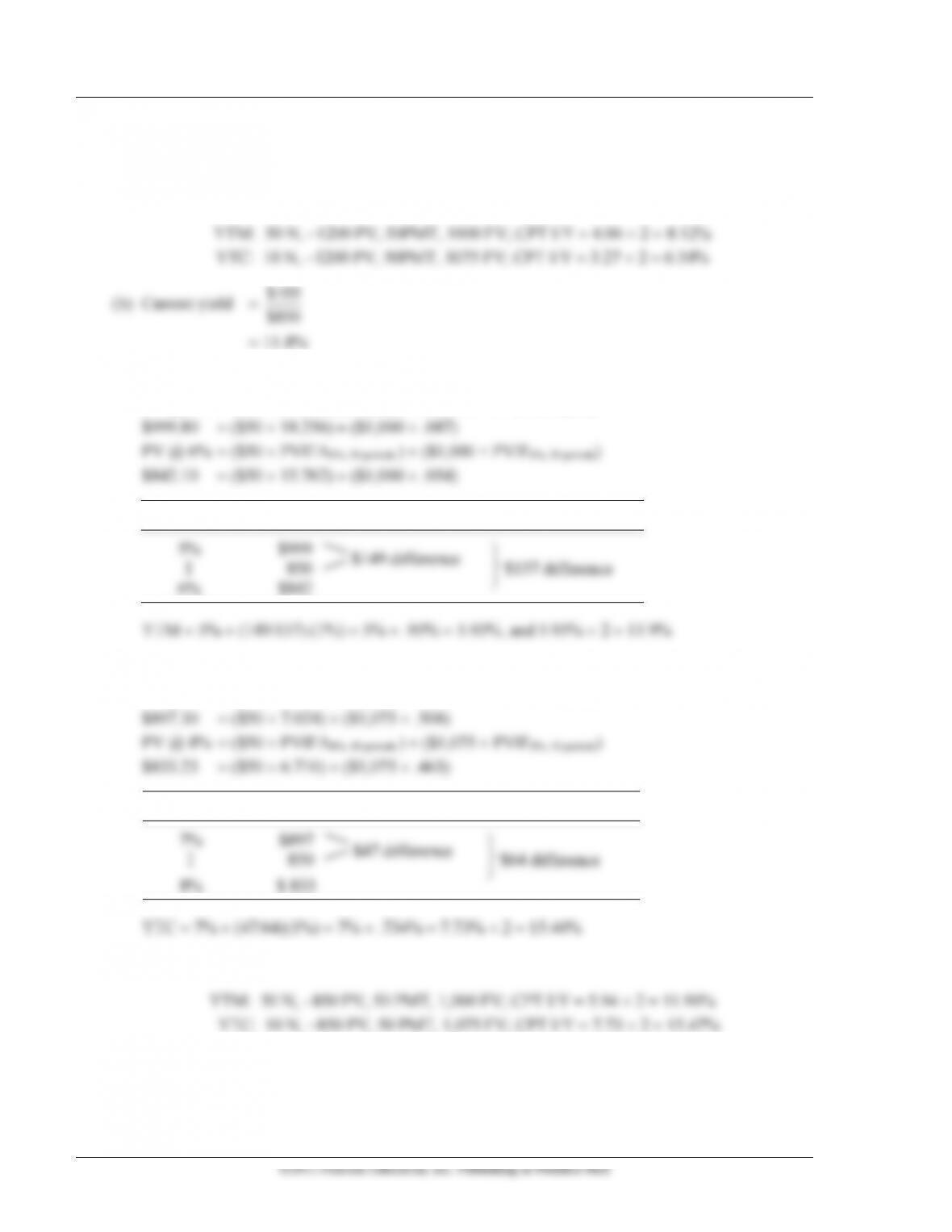
Yield-to-maturity (using interpolation) for a market price of $1,200:
Interest Rate
Bond Price
4%
$1,215
$15 difference
I
1,200
$216 difference
5%
$999
Yield-to-call:
Interest Rate
Bond Price
3%
$1,226
$26 difference
I
1,200
$94 difference
4%
$1,132
YTC = 3% + (26/94) (1%) = 4% + .277% = 3.287%, and 3.287% 2 = 6.56%
212 Gitman/Joehnk/Smart • Fundamentals of Investing, Eleventh Edition
Thus, the YTC on this bond is 6.56% while the YTM is 8.14%. Bond traders would compare
both rates. Since the convention is to use the lower more conservative measure of yield as the
appropriate indicator of value, we would use the YTC of 6.56%.
Calculator solution:
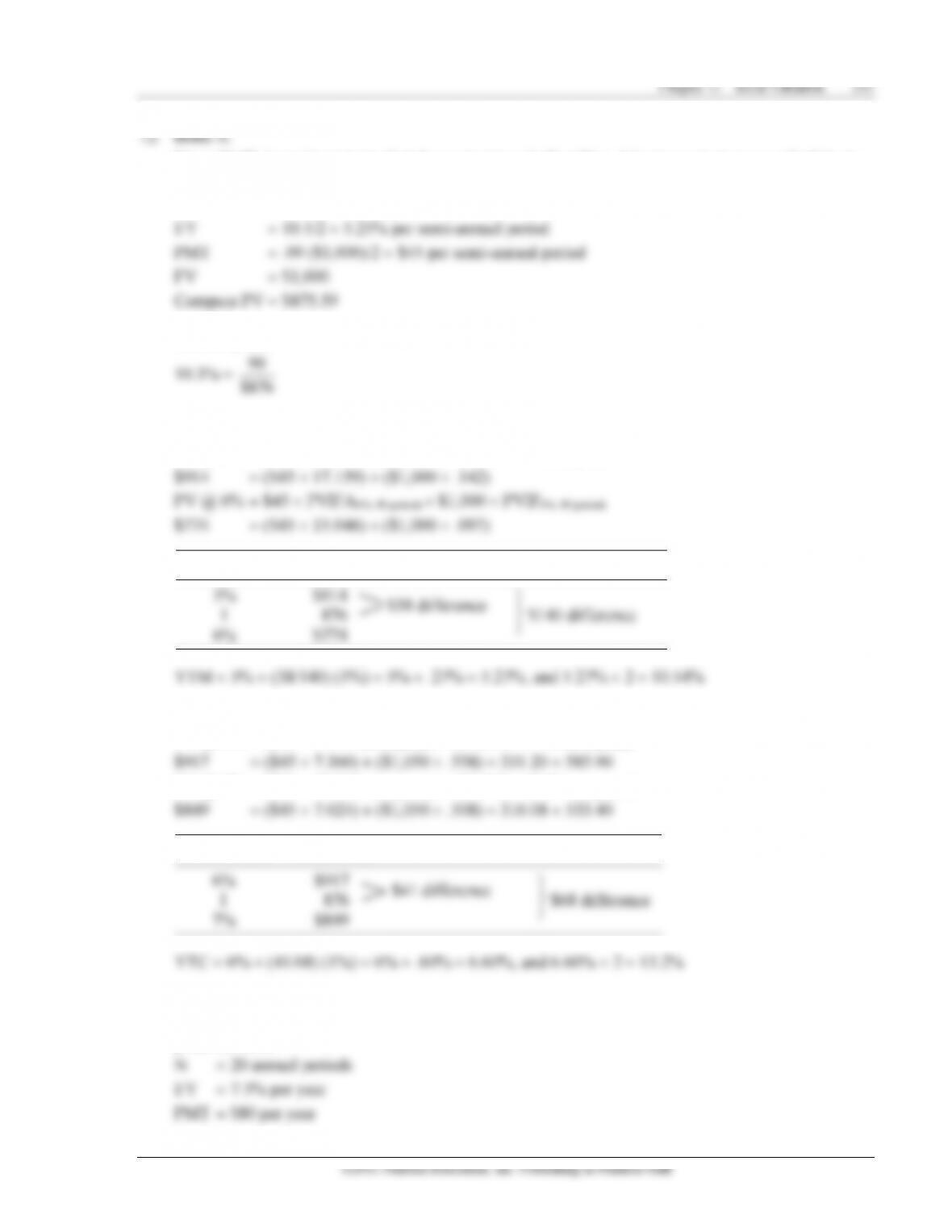
Yield-to-maturity (using interpolation) for a market price of $850:
PV @ 5% = ($50 PVIFA5%, 50 periods ) + ($1,000 PVIF5%, 50 periods)
Interest Rate
Bond Price
5%
$999
$149 difference
I
850
$157 difference
6%
$842
Yield-to-call (using interpolation) for a market price of $850:
PV @ 7% = ($50 PVIFA7%, 10 periods ) + ($1,075 PVIF7%, 10 periods)
Interest Rate
Bond Price
7%
$897
$47 difference
I
850
$64 difference
8%
$ 833
Calculator solution:
©2011 Pearson Education, Inc. Publishing as Prentice Hall
Since 10.5% is an interest rate that does not appear in the tables, it is necessary to use a calculator to
price the bond.
N = 20 2 = 40 semi-annual periods
Current yield:
90
$876
Yield-to-maturity:
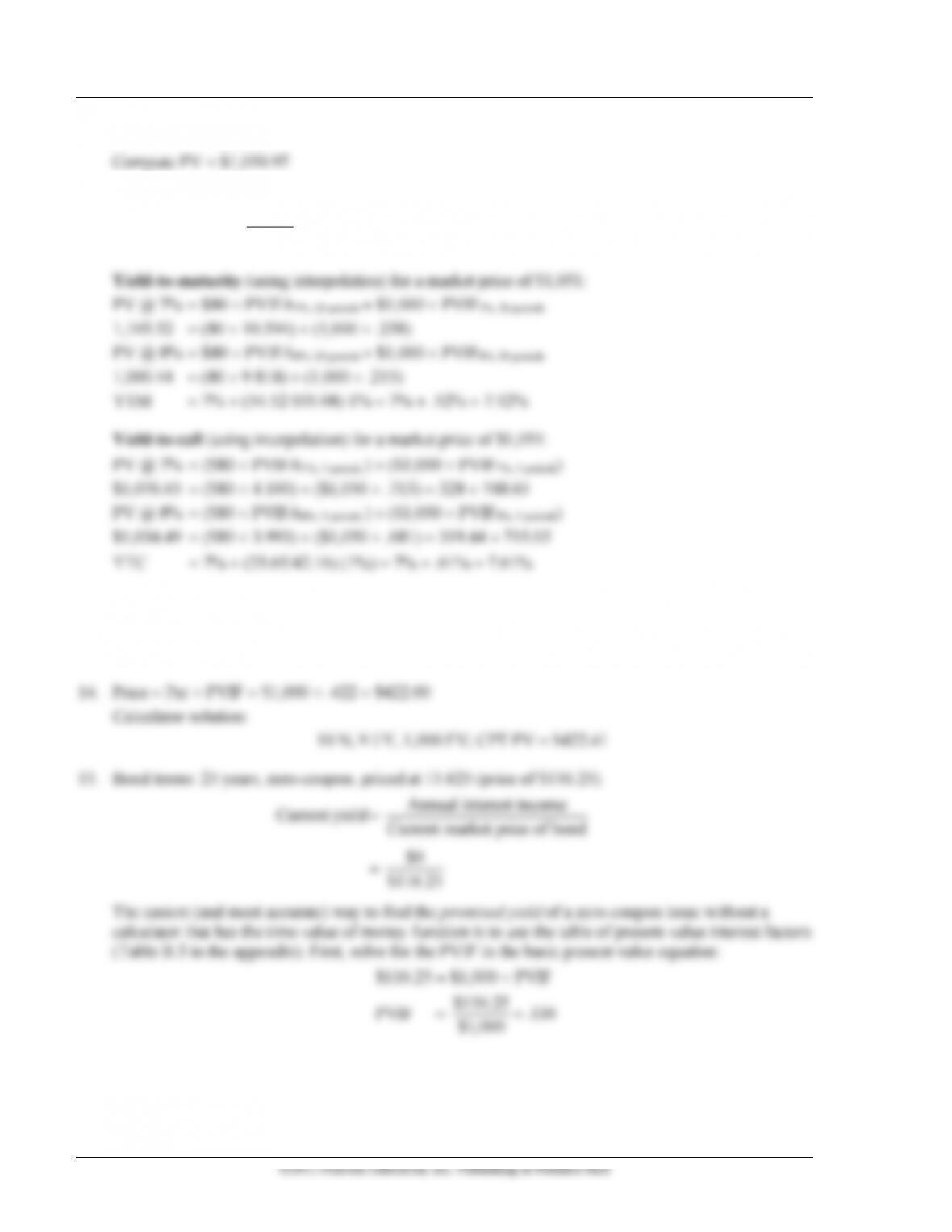
PV @ 5% = $45 PVIFA5%, 40 periods + $1,000 PVIF5%, 40 periods
Interest Rate
Bond Price
5%
$914
$38 difference
I
876
$140 difference
6%
$774
YTM = 5% + (38/140) (1%) = 5% + .27% = 5.27%, and 5.27% 2 = 10.54%
Yield-to-call (using interpolation) for a market price of $876:
PV @ 6% = ($45 PVIFA6%, 40 periods ) + ($1,050 PVIF6%, 40 periods)
PV @ 7% = ($45 PVIFA7%, 10 periods ) + ($1,050 PVIF7%, 10 periods)
Interest Rate
Bond Price
6%
$917
$41 difference
I
876
$68 difference
7%
$849
YTC = 6% + (41/68) (1%) = 6% + .60% = 6.60%, and 6.60% 2 = 13.2%
Bond B:
Since 7.5% is an interest rate that does not appear in the tables, it is necessary to use a calculator to
price the bond.
214 Gitman/Joehnk/Smart • Fundamentals of Investing, Eleventh Edition
FV = $1,000
Current yield:
7.6% =
$80
$1,051
13. PVIF = Price/Par = .209. PVIF of .209 for 15 years = 11%.
Calculator solution:
15 N, −209 PV, 1,000 FV; CPT I/Y = 11%