Part Four
Investing in Fixed-Income Securities
Part Four Includes
Chapter 10 Fixed-Income Securities
Chapter 11 Bond Valuation

Chapter 10
Fixed-Income Securities
◼ Outline
Learning Goals
I. Why Invest in Bonds?
A. Putting Bond Market Performance in Perspective
1. Historical Returns
2. Bonds versus Stocks
B. Exposure to Risk
1. Interest Rate Risk
2. Purchasing Power Risk
3. Business/Financial Risk
4. Liquidity Risk
5. Call Risk
Concepts in Review
II. Essential Features of Bonds
A. Bond Interest and Principal
B. Maturity Date
C. Principles of Bond Price Behavior
D. Pricing a Bond
E. Call Features—Let the Buyer Beware!
F. Sinking Funds
G. Secured or Unsecured Debt
H. Bond Ratings
1. How Ratings Work
2. What Ratings Mean
Concepts in Review

Chapter 10 Fixed-Income Securities 183
III. The Market for Debt Securities
A. Major Market Segments
1. Treasury Bonds
a. Inflation-Protection Securities
2. Agency Bonds
3. Municipal Bonds
a. Tax Advantages
b. Taxable Equivalent Yields
4. Corporate Bonds
B. Specialty Issues
1. Zero-Coupon Bonds
2. Mortgage-Backed Securities
a. Collateralized Mortgage Obligations
4. Asset-Backed Securities
5. Junk Bonds
C. A Global View of the Bond Market
1. U.S.-Pay versus Foreign-Pay Bonds
a. Dollar-Denominated Bonds
b. Foreign-Pay Bonds
Concepts in Review
IV. Convertible Securities
A. Convertibles as Investment Outlets
1. Convertible Notes and Bonds
2. Conversion Privilege
3. LYONS
B. Sources of Value
C. Measuring the Value of a Convertible
1. Conversion Value
a. Conversion Premium
b. Payback Period
2. Investment Value
Concepts in Review
Summary
Key Terms
Discussion Questions
Problems
Case Problems
10.1 Max and Veronica Develop a Bond Investment Program
10.2 The Case of the Missing Bond Ratings
Excel with Spreadsheets

184 Gitman/Joehnk/Smart • Fundamentals of Investing, Eleventh Edition
◼ Key Concepts
1. Historical returns in the bond market and comparison to stock returns
2. Current income and capital gains components of bond returns, including the fixed nature of coupon
payments and inverse relationship between bond returns and interest rates
3. The types of risks to which bond investors are exposed; call features may result in the early exercise
of bonds with relatively high coupon payment streams
4. The basic features of bonds and the principles of bond price behavior, including the impact of coupon
payments and bond maturity on the inverse relationship between interest rates and bond prices
5. The many types of bonds currently available and the wide array of investment objectives they can
fulfill; Treasury bonds, agency bonds, municipal bonds, and corporate bonds are examined
7. Bond ratings and the way they work
8. Basic features and characteristics of convertible securities are presented; conversion values and
investment values are compared
◼ Overview
Bonds are an important type of investment due to the attractive investment opportunities they offer to
investors and the size of the bond market. This chapter examines various features of bonds and bond
ratings.
1. Why invest in bonds? Investors choose bonds because they provide interest income and an opportunity
for capital gains. The instructor should indicate to the class that, due to the certainty of interest
income from bonds, many investors perceive greater safety in bond investments than in stock
investments. This, however, is not the only reason for investing in bonds.
2. To put bond returns into perspective (and to clear up possible misconceptions along the way),
some time should be spent reviewing the historical performance of bond yields and bond returns;
Table 10.1 can be used for this purpose, as it shows yields and returns for the 47-year period from
1962 to 2008. Take some time to contrast bond yields with bond returns. It’s important to drive home
the point that bond yield is not the same thing as bond return. While the former is a measure of the
yield promised on a bond, the latter is a measure of the return actually realized over a given holding
period, and it includes both interest income and capital gains (or losses). Finally, you might want to
close this discussion by contrasting stock returns (Table 6.1) with bond returns (Table 10.1),
emphasizing not only differences in returns, but also differences in risk. The “Markets Diary” section
of The Wall Street Journal or similar publication will help update the values found in the text.
3. Fixed-income securities are also exposed to various types of risks. The instructor should outline the
five major types of risks to which bonds are exposed: interest rate risk, purchasing power risk,
business/financial risk, liquidity risk, and call risk. It should be emphasized that even though
Treasury bonds are issued by the U.S. government and are free of default risk, they are very much
subject to interest rate risk, the single most important force in the bond market.


186 Gitman/Joehnk/Smart • Fundamentals of Investing, Eleventh Edition
Bonds make an attractive investment outlet because of their versatility. They can provide a

188 Gitman/Joehnk/Smart • Fundamentals of Investing, Eleventh Edition
©2011 Pearson Education, Inc. Publishing as Prentice Hall
A bond can be freely callable but nonrefundable for a certain number of years. In this case, a
nonrefunding or a deferred refunding issue can still be called and prematurely retired for any reason
other than refunding.
6. The difference between a premium bond and a discount bond illustrates the inverse relationship
between bond prices and market interest rates. A premium bond sells for more than its par value,
7. A percent of par quotation indicates that the issue is trading at the quoted percent of the par value of
the obligation. For example, a percent of par quotation of 98 on a $1,000 par value obligation means
8. Bond ratings are grades that are assigned to bond issues on the basis of extensive, professionally
conducted financial analysis to designate investment quality. Ratings basically point to the default
risk of an issue. Higher ratings mean that issues are investment grade. Lower ratings mean that issues
9. From an individual investor perspective, bond ratings relieve the drudgery of evaluating the quality of
the bond. Individuals can depend on agency ratings as a viable measure of the creditworthiness of the
issuer and the issuer’s default risk. Over time, the rating agencies have done an excellent job of
10. Bonds are securities that promise to pay a stated amount of annual interest over the life of an issue,

Chapter 10 Fixed-Income Securities 189
(a) Treasury bonds are debt securities issued by the U.S. federal government to meet the ever-
increasing needs of the federal budget. Advantages: High quality or low default risk (backed by
the full faith and credit of the U.S. government); very popular instruments that have a well–
(c) Municipal bonds are debt securities issued by states, counties, cities, and other political
subdivisions like school districts and water and sewer districts. Advantages: Interest on most
municipals is exempt from federal income tax and usually the state or local tax of the issuing
11. (a) Zero-coupon bonds have no interest or coupon payments. They are sold at a deep discount from
their par values, and then they increase in value over time at a compound rate of return so that at
(c) Junk bonds are low-rated, high-yielding, speculative securities issued primarily by corporations
(there’s also a smaller, but still sizable, market for “high–yield” junk municipals). In the past,

190 Gitman/Joehnk/Smart • Fundamentals of Investing, Eleventh Edition
(d) Yankee bonds are bonds issued by foreign governments or corporations or by so-called
supranational agencies like the World Bank and the International Monetary Fund. These bonds
12. Bondholders dislike inflation, as increases in inflation increase nominal interest rates, thus reducing
bond prices. So the U.S. government issues bonds (i.e., TIPS) that are protected against unexpected
13. Asset-backed securities (ABS) are debt issues secured by a pool of bank loans, leases, and other
assets. These other assets include credit card bills, computer leases, truck rentals, and royalty fees.
14. Dollar-denominated bonds have their cash flows (interest payment and principal repayments)
denominated in dollars. On the other hand, foreign-pay bonds have their cash flows denominated in
some foreign currency.

Chapter 10 Fixed-Income Securities 191
Because U.S.-pay bonds are dollar-denominated, there is no currency exchange risk for an
15. A convertible debenture is a long-term, unsecured corporate bond carrying the provision that within
a stipulated time period, the bond may be converted into a certain number of shares of the issuing
16. The equity kicker feature of a convertible security gives the investor an opportunity to participate in
the potential price performance of the underlying common stock. When the market price of the
17. The convertible receives value from both its bond and stock properties. At the minimum, the security
is worth what it earns as a fixed-income security (present value of interest and face value at maturity).
18. Conversion value is an indication of what a convertible issue would trade for if its price were based
on its stock value. It is equal to the conversion ratio times the current stock price. Conversion parity
192 Gitman/Joehnk/Smart • Fundamentals of Investing, Eleventh Edition
◼ Suggested Answers to Discussion Questions
1. (a) The difference between the two decades is due to the rise in the interest rates during the early
1980s, which in turn increased the yields for bonds.
2. (a) Agency bonds: bonds issued by government agencies that are high-quality securities
3. There are no investment products in the world that are purely risk-free, yet the markets like to think
of a risk-free asset for comparison purposes, especially to determine the risk premium for risky
4. (1) f (6) c
(4) d (9) h
5. Convertible securities start out as bonds (or even preferred stock) and end up as shares of common
stock. Before conversion, the bonds are usually unsecured debt obligations and subordinated to other
Chapter 10 Fixed-Income Securities 195
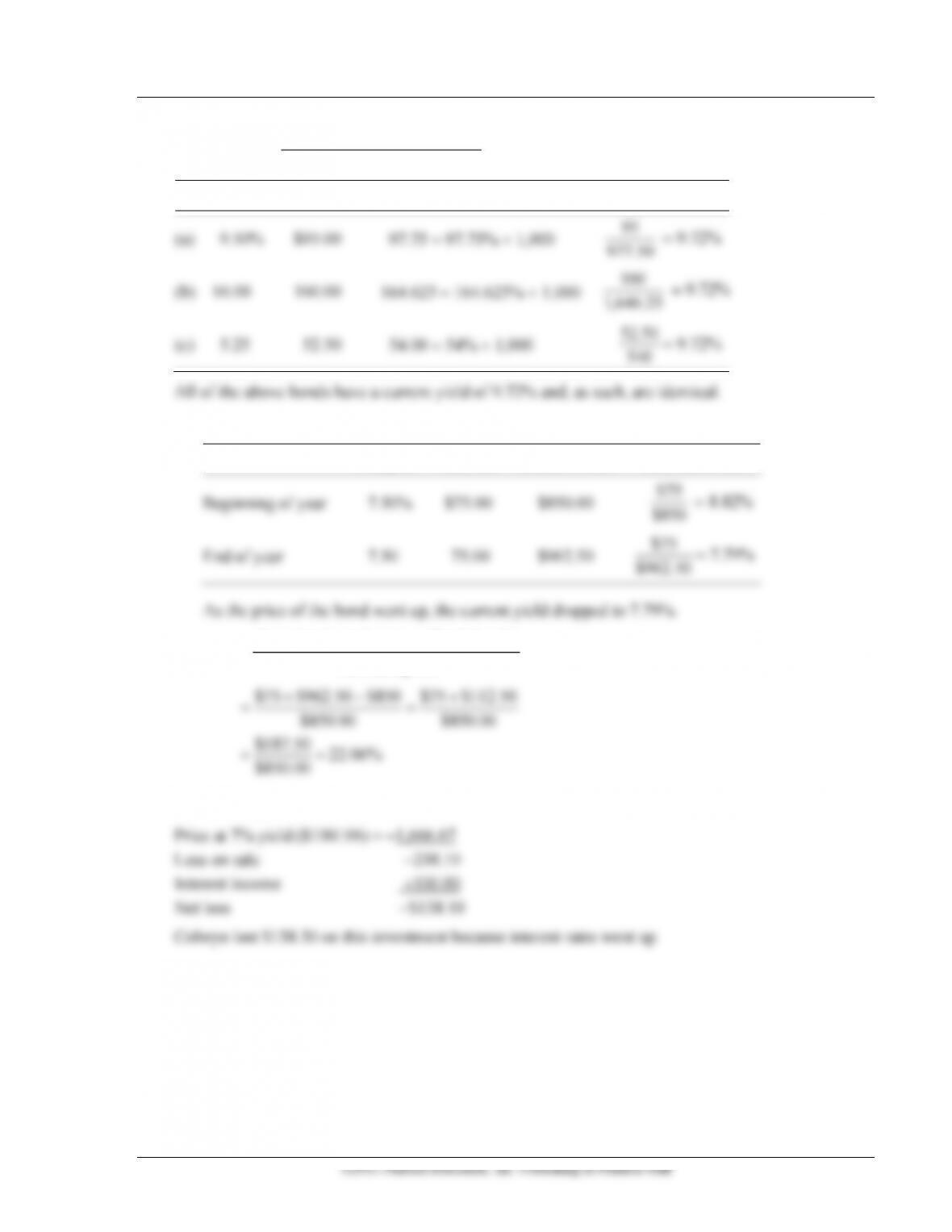
8. Current yield
Annual interest income
Current market price of bond
=
Coupon
Interest
Market Price
Current Yield
(a) 9.50%
$95.00
97.75 = 97.75% 1,000
95
977.50
= 9.72%
(b) 16.00
160.00
164.625 = 164.625% 1,000
160
1,646.25
= 9.72%
(c) 5.25
52.50
54.00 = 54% 1,000
52.50
540
= 9.72%
All of the above bonds have a current yield of 9.72% and, as such, are identical.
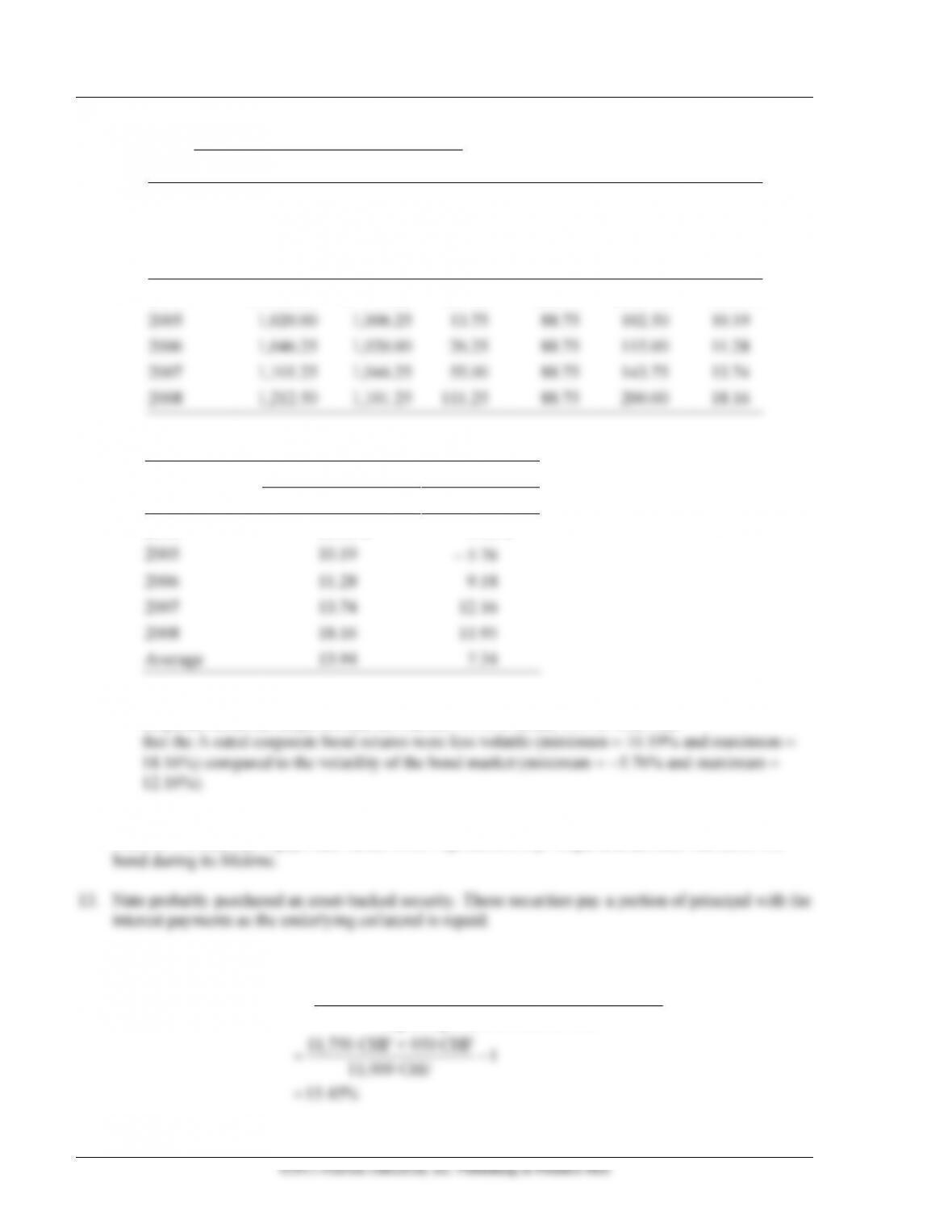
9. (a)
Coupon
Interest
Market Price
Current Yield
Beginning of year
7.50%
$75.00
$850.00
$75
$850
= 8.82%
End of year
7.50
75.00
$962.50
$75
$962.50
= 7.79%
As the price of the bond went up, the current yield dropped to 7.79%.
(b) HPR
Annual interest income Capital gains
Purchase price
+
=
$75 $962.50 $850 $75 $112.50
$850.00 $850.00
$187.50 22.06%
$850.00
+ − +
==
==
10. Price at 7% yield ($100/.07) = $1,428.57
196 Gitman/Joehnk/Smart • Fundamentals of Investing, Eleventh Edition
11. (a)
Annual interest income + Capital gains
HPR Price at beginning of year
=
(1)
(2)
(3)
(4)
(5)
(6)
Year
Ending
Price
Beginning
Price
Capital
Gain
(1) − (2)
Annual
Income
Total
Return
(3) + (4)
HPR
(5) (2)
2004
$1,006.25
$ 941.25
$65.00
$88.75
$153.75
16.33%
2005
1,020.00
1,006.25
13.75
88.75
102.50
10.19
2006
1,046.25
1,020.00
26.25
88.75
115.00
11.28
2007
1,101.25
1,046.25
55.00
88.75
143.75
13.74
2008
1,212.50
1,101.25
111.25
88.75
200.00
18.16
(b) Evaluation of return performance:
Annual HPR (%)
Year
A-Rated Corporate
Bond Market
2004
16.33%
9.16%
2005
10.19
− 5.76
2006
11.28
9.18
2007
13.74
12.16
2008
18.16
11.95
Average
13.94
7.34
Looking at the average HPRs over the five-year period, we can conclude that the A-rated
corporate bond has outperformed the market: 13.94% versus 7.34%. Also note
12. $20,000. A zero-coupon bond trades at a discount to face value and pays no interest during its
lifetime. At maturity, it pays face value, which represents the principal and accrued interest on the
14. (a) Total return in Swiss francs:
Ending value of bond in CHF + Dividends in CHF
Total return 1
Beginning value of bond in CHF
11,750 CHF + 950 CHF 1
11,000 CHF
15.45%
=−
=−
=

Chapter 10 Fixed-Income Securities 197
(b) Total return in U.S. dollars:
Ending value of bond in CHF + Dividends in CHF
Total return Beginning value of bond in CHF
Exchange rate at end of holding period 1
Exchange rate at beginning of period
(11,750 CHF + 950
r
Total eturn
=
−
= CHF) .8000 1
11,000 CHF .6329
1.4594 1
45.94%
−
=−
=
15. (a) If you buy each for $10,000 and sell each for $10,000, the profit will be the interest you earn,
17. Common stock: $850/$25 = 34 shares
18. Convertible bond: $1,000 face value, 6% coupon, 20-year maturity, convertible into 20 shares;

198 Gitman/Joehnk/Smart • Fundamentals of Investing, Eleventh Edition
(e)
Payback period
=
Conversion premium (in $)
Annual interest Annual dividend
income from income from
convertible bond underlying CS
−
=
$100 $100
$60 (20 .75) $60 $15
=
− −
= 2.2 years
(f)
Investment value = Value as a straight (nonconvertible) bond
= $60 PVIFA8%, 20 YRS. + $1,000 PVIF8%, 20 YRS.
= $60 9.818 + $1,000 .215
= $589.08 + $215 = $804.08
So the convertible is selling near its floor, or its value as a bond.
19. Price of convertible in one year will be 10% over the conversion value.
Conversion value = Price of stock Conversion ratio
Now with $5,000, an investor can buy five bonds priced at $1,000 each. Therefore:
Given the convertible is selling at a price of $1,000, which includes a 25% conversion premium:
(A factor of 1.25 is used in this formula since, with a 25% conversion premium, the price of the
convertible will be equal to 125% of the conversion value.)
Conversion value
Price of underlying common stock Security’s conversion ratio
$800/20 $40/share
=
==
Note: This problem shows that, while the price of the convertible went up by 65% over the course