
Operations Planning and Scheduling ⚫ CHAPTER 10 ⚫
10–21
4
1
3
1
5
2
3
3
3
1
3
0
4
1
2
4
2
0
2
0
3
1
2
5
1
0
2
0
2
0
1
6
0
0
1
0
1
0
1
7
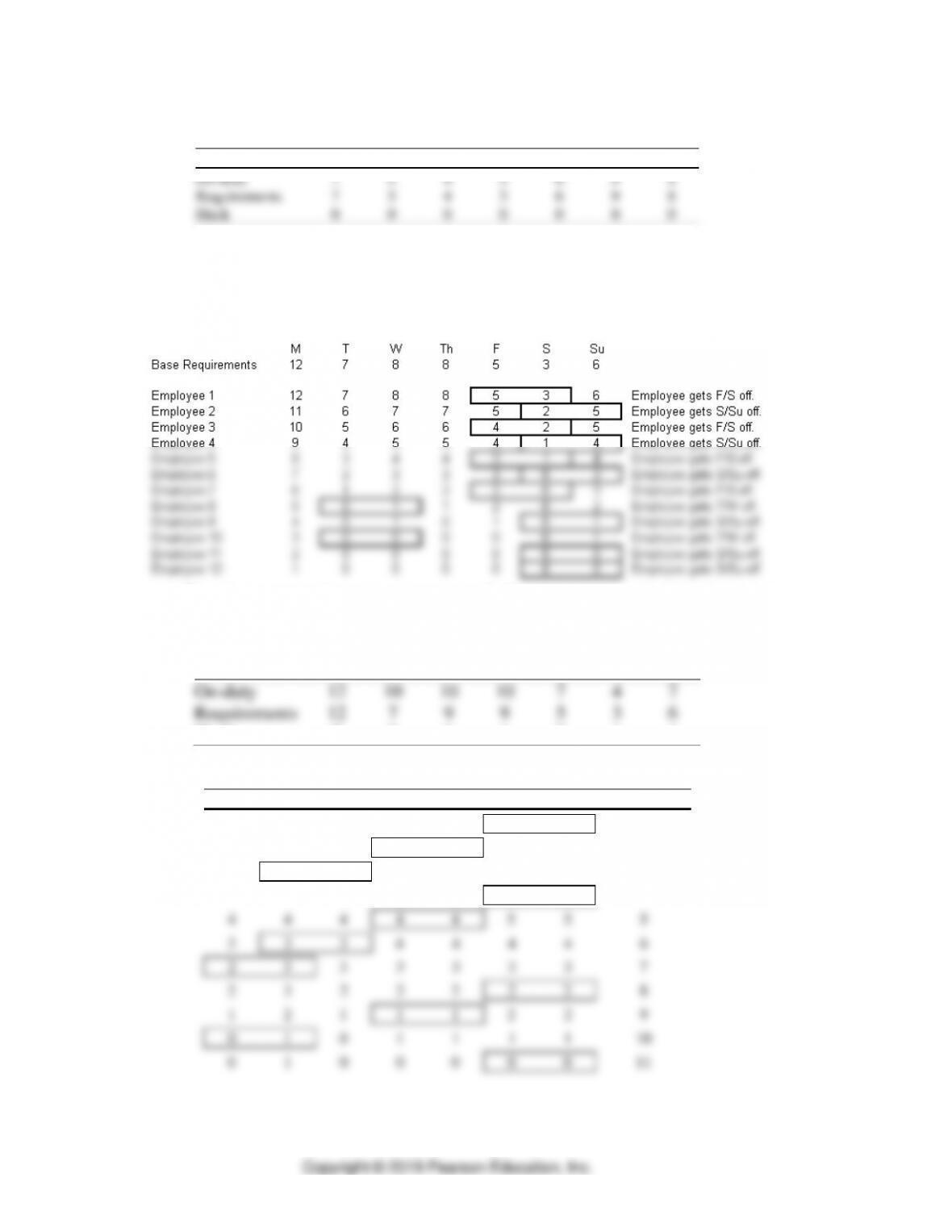
The number of employees is 7. They are scheduled to take the boxed days off.
14. Cara Ryder’s ski school needs 11 instructors.
a. Alternative 1. The heuristic does have a number of different solutions.
M
T
W
Th
F
S
Su
Instructor
7
5
4
5
6
9
8
1
6
5
4
5
5
8
7
2
2
5
4
4
5
5
7
6
3
5
4
4
4
4
6
5
4
4
4
4
4
3
5
4
5
3
3
4
4
3
4
3
6
3
3
3
3
2
3
3
7
2
2
2
2
2
3
3
8
2
2
2
1
1
2
2
9
1
1
1
1
1
2
1
10
1
1
0
0
0
1
0
11
b. Instructors are scheduled to take the boxed days off in the solution shown in part
(a).
M
T
W
Th
F
S
Su
On-duty
7
5
4
5
6
9
8
Requirements
7
5
4
5
6
9
8
Slack
0
0
0
0
0
0
0
Alternative 2 (Optional)
M
T
W
Th
F
S
Su
Instructor
7
5
4
5
6
9
8
1
6
5
4
5
5
8
7
2
5
4
4
5
5
7
6
3
5
4
4
4
4
6
5
4
4
3
4
4
4
5
4
5
4
3
3
3
3
4
4
6
3
3
3
3
2
3
3
7
2
2
2
2
2
3
3
8
2
2
2
1
1
2
2
9
1
1
1
1
1
2
1
10
1
1
0
0
0
1
1
11
⚫ PART 2 ⚫ Managing Customer Demand
10–22
Instructors are scheduled to take the boxed days off.
M
T
W
Th
F
S
Su
On-duty
7
5
4
5
6
9
8
Requirements
7
5
4
5
6
9
8
Slack
0
0
0
0
0
0
0
15. The environmentally progressive mayor of Cambridge, Colorado.
a. We used Workforce Scheduler Solver in OM Explorer to arrive at the minimum
number of collectors. For each employee, the sentences on the right show his or her
two off-days.
The minimum number of employees is 12. However, many schedules (particular
assignments of on-duty periods) are possible.
b. The work schedule for the analysis in part (a) is to assign employees the
stipulated days off.
On-duty
12
10
10
10
7
4
7
Requirements
12
7
9
9
5
3
6
Slack
0
3
1
1
2
1
1
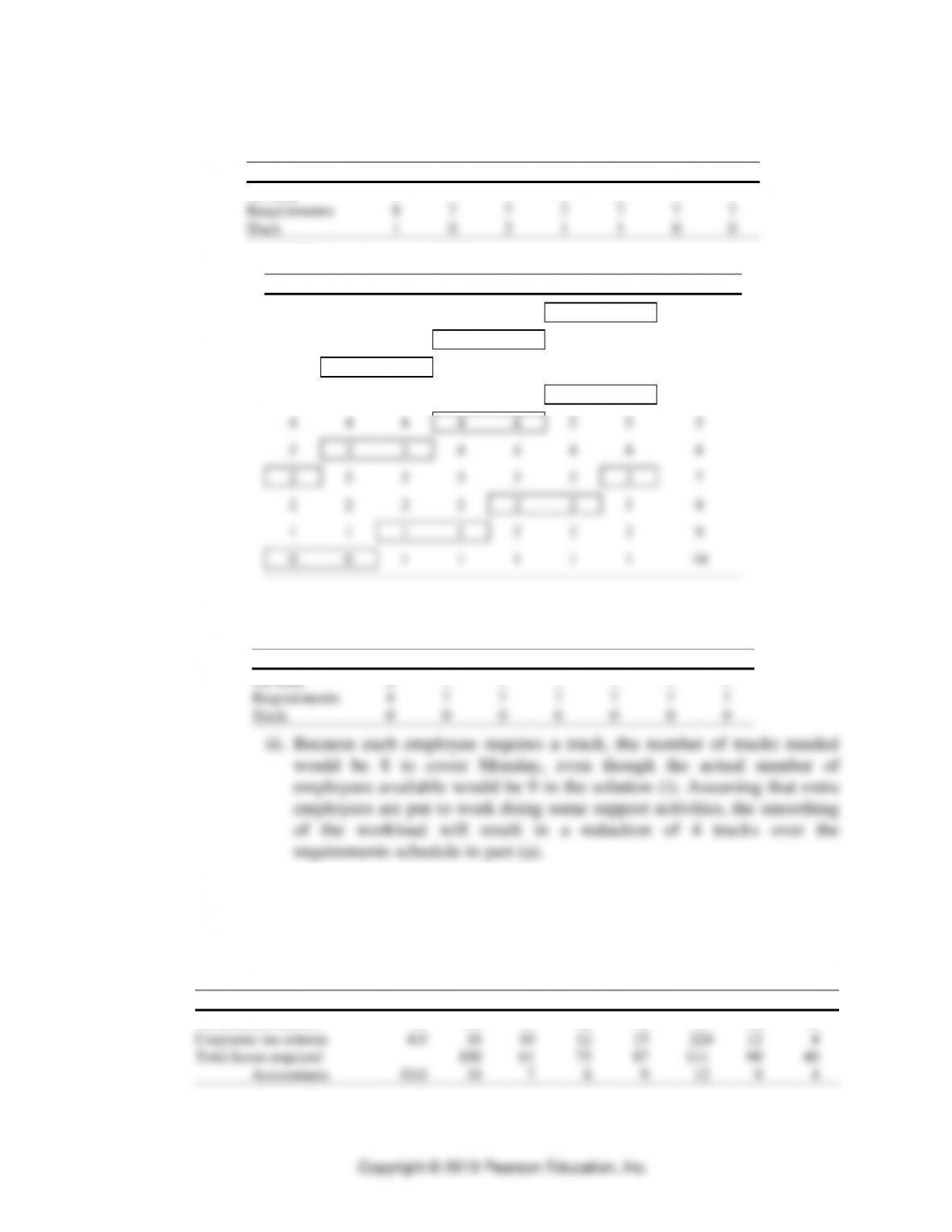
c. We can use the heuristic method again to find whether we can get by with fewer
employees. One solution follows.
M
T
W
Th
F
S
Su
Employee
8
7
7
7
7
7
7
1
7
6
6
6
6
7
7
2
6
5
5
6
6
6
6
3
5
5
5
5
5
5
5
4
4
4
4
4
4
5
5
5
3
3
3
4
4
4
4
6
2
3
3
3
3
3
3
7
2
3
2
2
2
2
2
8
1
2
1
1
1
2
2
9
0
1
0
1
1
1
1
10
0
1
0
0
0
0
0
11
Operations Planning and Scheduling ⚫ CHAPTER 10 ⚫
10–23
i. Only 11 employees would be needed now. Total slack generated from
this work schedule is:
M
T
W
Th
F
S
Su
On-duty
9
7
9
8
8
7
7
Requirements
8
7
7
7
7
7
7
Slack
1
0
2
1
1
0
0
ii. With preference to S-Su pairs.
M
T
W
Th
F
S
Su
Employee
8
7
7
7
7
7
7
1
7
6
6
6
6
7
7
2
6
5
5
6
6
6
6
3
5
5
5
5
5
5
5
4
4
4
4
4
4
5
5
5
3
3
3
4
4
4
4
6
2
3
3
3
3
3
3
7
2
2
2
2
2
2
3
8
1
1
1
1
2
2
2
9
0
0
1
1
1
1
1
10
The number of employees needed is reduced to 10, and no slack is generated
from this solution.
M
T
W
Th
F
S
Su
On-duty
8
7
7
7
7
7
7
Requirements
8
7
7
7
7
7
7
Slack
0
0
0
0
0
0
0
16. Little 6, Inc.
As shown in the following table, the number of accountants required each day is a
function of the number of each type of return to be prepared. For example, on Tuesday
the demand for an accountant’s time is (14×1.5 hrs)+(10×4.0 hrs) = 61 hrs. Since each
accountant can work no more than 10 hours per day, 7 accountants are needed.
Time
M
T
W
Th
F
S
Su
Personal tax returns
1.5
24
14
18
18
10
28
16
Corporate tax returns
4.0
16
10
12
15
224
12
4
Total hours required
100
61
75
87
111
90
40
Accountants
10.0
10
7
8
9
12
9
4

⚫ PART 2 ⚫ Managing Customer Demand
10–24
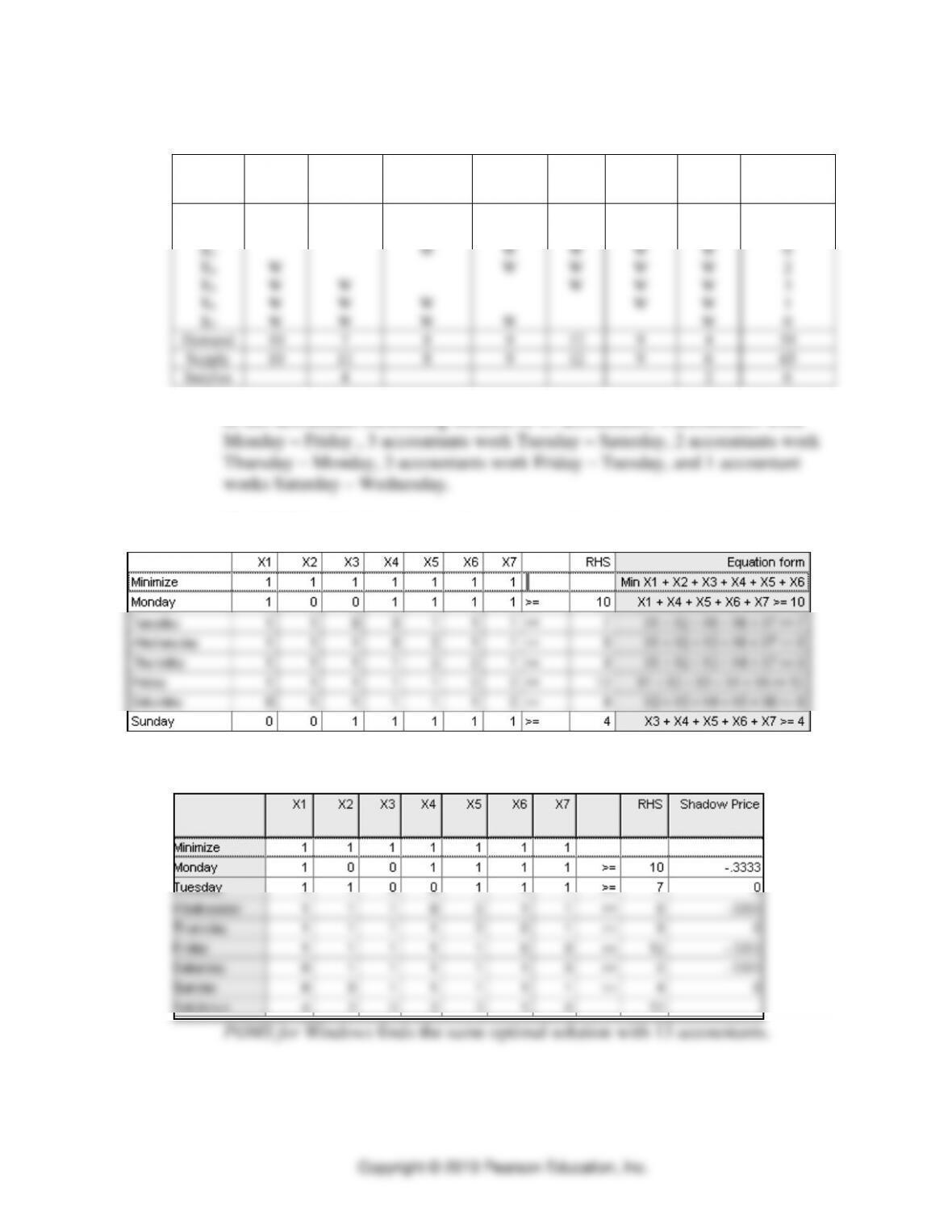
a. The following table provides definitions for the Linear Programming
decision variables (“W” indicates a work day). Thus, accountants assigned
to schedule X1 will work Monday – Friday
Decision
Variable
Monday
Tuesday
Wednesday
Thursday
Friday
Saturday
Sunday
X1
X2
X3
X4
X5
X6
X7
W
W
W
W
W
W
W
W
W
W
W
W
W
W
W
W
W
W
W
W
W
W
W
W
W
W
W
W
W
W
W
W
W
W
W
Demand
10
7
8
9
12
9
4
Operations Planning and Scheduling ⚫ CHAPTER 10 ⚫
10–25
One optimal solution is provided in the following table
Decision
Variable
Monday
Tuesday
Wednesday
Thursday
Friday
Saturday
Sunday
Number of
Accountants
Scheduled
X1
X2
X3
X4
X5
X6
X7
W
W
W
W
W
W
W
W
W
W
W
W
W
W
W
W
W
W
W
W
W
W
W
W
W
W
W
W
W
W
W
W
W
W
W
4
3
0
2
3
1
0
Demand
10
7
8
9
12
9
4
59
Supply
10
11
8
9
12
9
6
65
Surplus
4
2
6
In this accountant-minimizing solution of 13 accountants, 4 accountants work
The POM for Windows Linear Programming formulation for part a:
The POM for Windows Linear Programming solution for part a:
⚫ PART 2 ⚫ Managing Customer Demand
10–26
b. Linear Programming decision variable definitions (“W” indicates a work
day) and objective function coefficients.
Decision
Variable
Monday
Tuesday
Wednesday
Thursday
Friday
Saturday
Sunday
Payrate
X1
X2
X3
X4
X5
X6
X7
W
W
W
W
W
W
W
W
W
W
W
W
W
W
W
W
W
W
W
W
W
W
W
W
W
W
W
W
W
W
W
W
W
W
W
$1,200
$1,300
$1,450
$1,450
$1,450
$1,450
$1,350
The solution is provided in the following table
In this payroll-minimizing solution, 4 accountants work Monday – Friday, 3
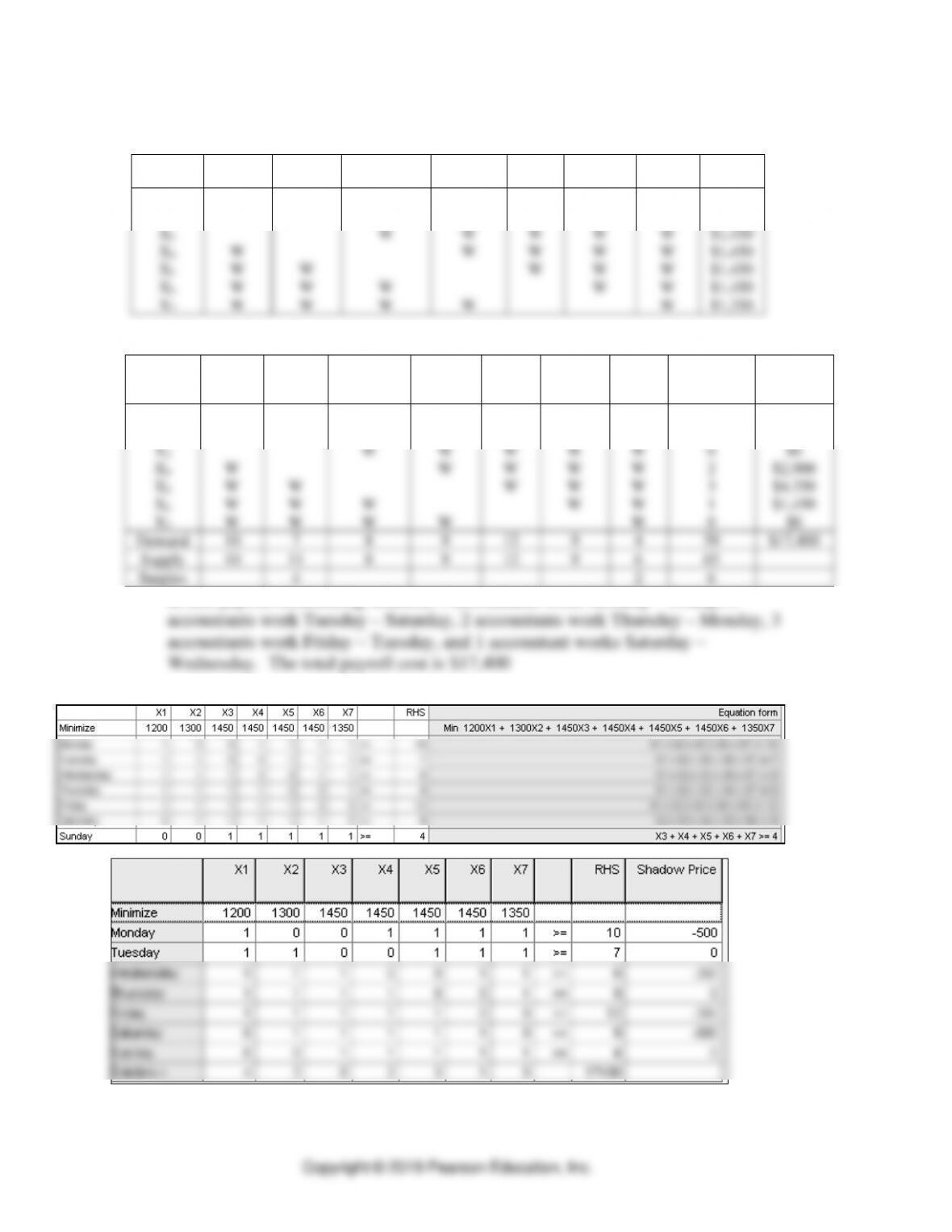
The POM for Windows Linear Programming formulation and solution for part b:
Decision
Variable
Monday
Tuesday
Wednesday
Thursday
Friday
Saturday
Sunday
Number of
Accountants
Scheduled
Weekly
Payroll
Cost
X1
X2
X3
X4
X5
X6
X7
W
W
W
W
W
W
W
W
W
W
W
W
W
W
W
W
W
W
W
W
W
W
W
W
W
W
W
W
W
W
W
W
W
W
W
4
3
0
2
3
1
0
$4,800
$3,900
$0
$2,900
$4,350
$1,450
$0
Demand
10
7
8
9
12
9
4
59
$17,400
Supply
10
11
8
9
12
9
6
65
Surplus
4
2
6

Operations Planning and Scheduling ⚫ CHAPTER 10 ⚫
10–27
POMS for Windows finds the same optimal solution with 13 accountants and a
total payroll cost of $17,400.
c. Linear Programming decision variable definitions (“W” indicates a work
day) and objective function coefficients. Variable X8 has been included to
represent the part-time employees available to work Friday – Sunday.
Decision
Variable
Monday
Tuesday
Wednesday
Thursday
Friday
Saturday
Sunday
Payrate
X1
X2
X3
X4
X5
X6
X7
X8
W
W
W
W
W
W
W
W
W
W
W
W
W
W
W
W
W
W
W
W
W
W
W
W
W
W
W
W
W
W
W
W
W
W
W
W
W
W
$1200
$1300
$1450
$1450
$1450
$1450
$1350
$800
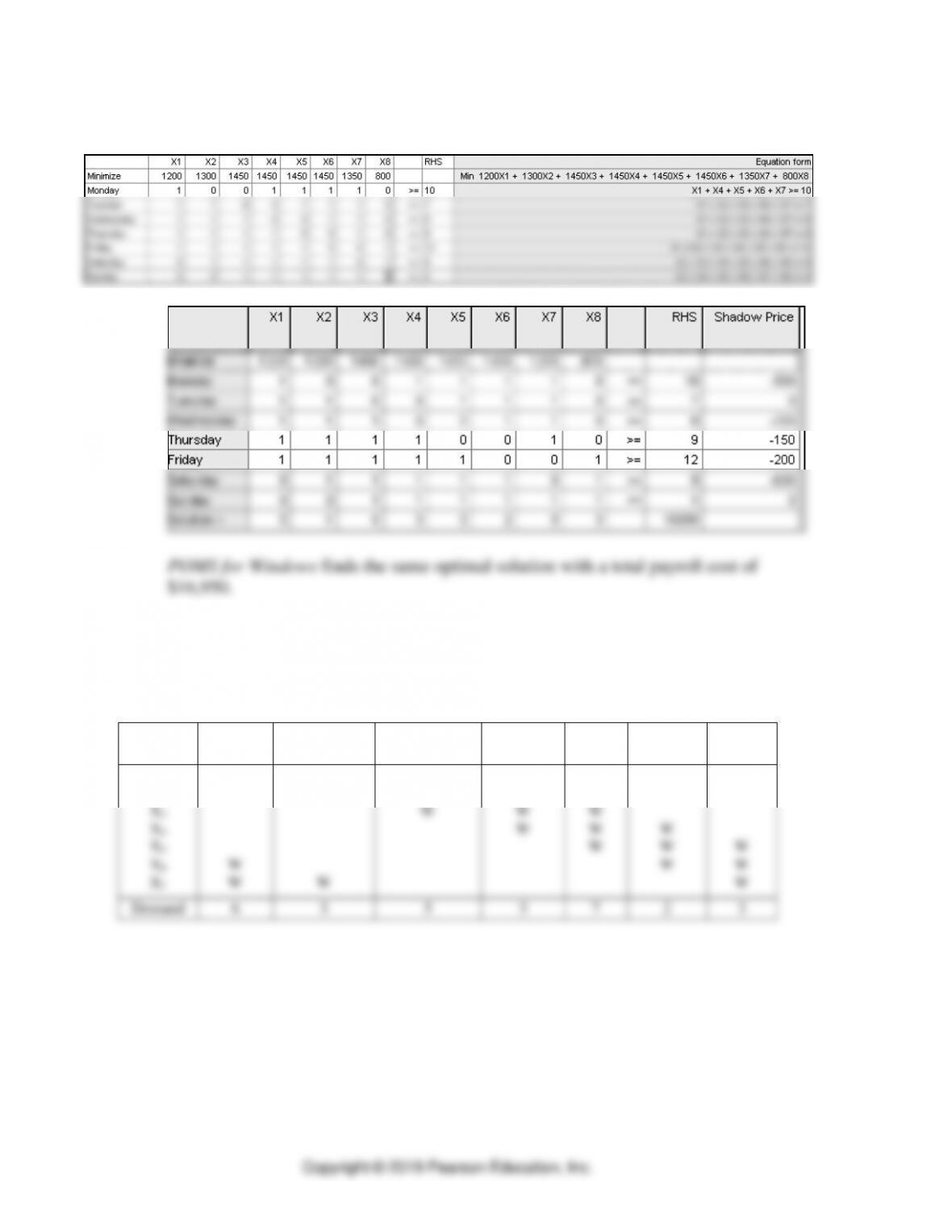
The solution is provided in the following table
In this payroll-minimizing solution, 5 accountants work Monday – Friday, 1
Decision
Variable
Monday
Tuesday
Wednesday
Thursday
Friday
Saturday
Sunday
Number of
Accountants
Scheduled
Weekly
Payroll
Cost
X1
X2
X3
X4
X5
X6
X7
X8
W
W
W
W
W
W
W
W
W
W
W
W
W
W
W
W
W
W
W
W
W
W
W
W
W
W
W
W
W
W
W
W
W
W
W
W
W
W
5
1
0
3
0
2
0
3
$6,000
$1,300
$0
$4,350
$0
$2,900
$0
$2,400
Demand
10
7
8
9
12
9
4
59
$16,950
Supply
10
8
8
9
12
9
8
64
Surplus
1
4
5
⚫ PART 2 ⚫ Managing Customer Demand
10–28
The POM for Windows Linear Programming formulation and solution for part c:
17. Return to Problem 13.
The following table provides definitions for the Linear Programming decision variables
(“W” indicates a work day). Thus, loading dock workers assigned to schedule X1 will
work Monday – Wednesday.
Decision
Variable
Monday
Tuesday
Wednesday
Thursday
Friday
Saturday
Sunday
X1
X2
X3
X4
X5
X6
X7
W
W
W
W
W
W
W
W
W
W
W
W
W
W
W
W
W
W
W
W
W
Demand
6
3
5
3
7
2
3
Operations Planning and Scheduling ⚫ CHAPTER 10 ⚫
10–29
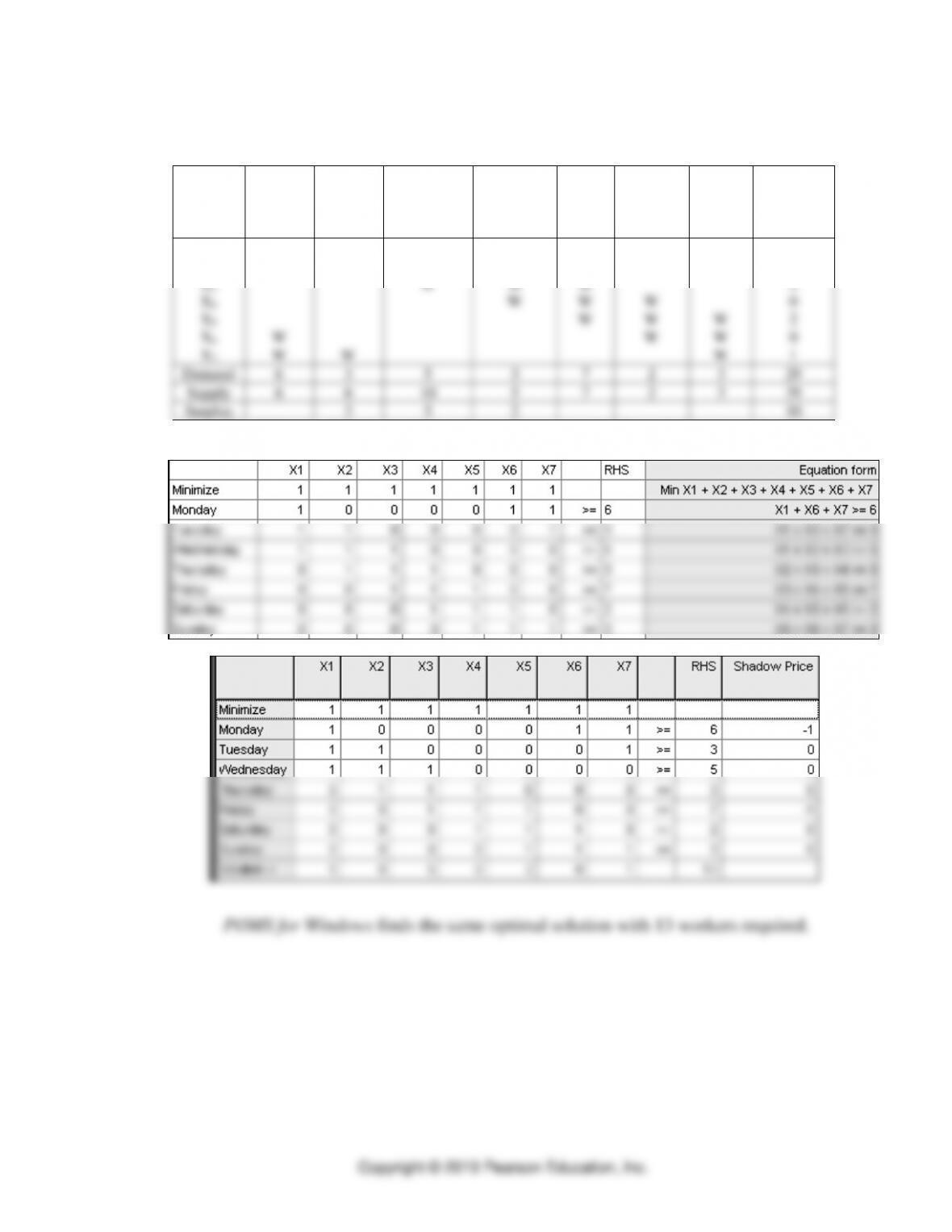
The solution is provided in the following table. 13 workers are required.
Decision
Variable
Monday
Tuesday
Wednesday
Thursday
Friday
Saturday
Sunday
Number
of
Loaders
Scheduled
X1
X2
X3
X4
X5
X6
X7
W
W
W
W
W
W
W
W
W
W
W
W
W
W
W
W
W
W
W
W
W
5
0
5
0
2
0
1
Demand
6
3
5
3
7
2
3
29
Supply
6
6
10
5
7
2
3
39
Surplus
3
5
2
10
The POM for Windows Linear Programming model formulation and solution:

⚫ PART 2 ⚫ Managing Customer Demand
10–30
18. Hickory Company
a. Schedules for two rules
FCFS rule:
Customer
Sequence
Hr Since
Order
Arrived
Start
Time
(hr)
Machine
Time
(hr)
Finish
Time
(hr)
Due
Date
(hr)
Past
Due
(hr)
Flow
Time
(hr)
1
6
0
+
10
=
10
12
0
16
2
5
10
+
3
=
13
8
5
18
3
3
13
+
15
=
28
18
10
31
4
1
28
+
9
=
37
20
17
38
5
0
37
+
7
=
44
21
23
44
4438311816 ++++
5
EDD rule:
Customer
Sequence
Hr Since
Order
Arrived
Start
Time
(hr)
Machine
Time
(hr)
Finish
Time
(hr)
Due
Date
(hr)
Hr
Past
Date
Flow
Time
(hr)
2
5
0
+
3
=
3
8
0
8
1
6
3
+
10
=
13
12
1
19
3
3
13
+
15
=
28
18
10
31
4
1
28
+
9
=
37
20
17
38
5
0
37
+
7
=
44
21
23
44
443831198++++
5
b. The EDD rule is better than FCFS on both average flow time (28.0 vs. 29.4) and
Operations Planning and Scheduling ⚫ CHAPTER 10 ⚫
10–31
19. Website designer
a. Schedules for two rules
FCFS rule:
Customer
Sequence
Day
Order
Arrived
Start
Time
(days)
Processing
Time
(days)
Finish
Time
(days)
Due
Date
Days
Past
Date
Flow
Time
(days)
A
180
190
+
20
=
210
216
0
30
B
182
210
+
12
=
222
240
0
40
C
184
222
+
28
=
250
256
0
66
D
187
250
+
24
=
274
248
26
87
E
188
274
+
32
=
306
290
16
118
Average
8.4
68.2
Average flow time =
5
11887664030 ++++
= 68.2 days
Average days past due =
0 0 0 26 16
5
+ + + +
= 8.4 days
EDD RULE:
Customer
Sequence
Day
Order
Arrived
Start
Time
(days)
Processing
Time
(days)
Finish
Time
(days)
Due
Date
Days
Past
Date
Flow
Time
(days)
A
180
190
+
20
=
210
216
0
30
B
182
210
+
12
=
222
240
0
40
D
187
222
+
24
=
246
248
0
59
C
184
246
+
28
=
274
256
18
90
E
188
274
+
32
=
306
290
16
118
Average
6.8
67.4
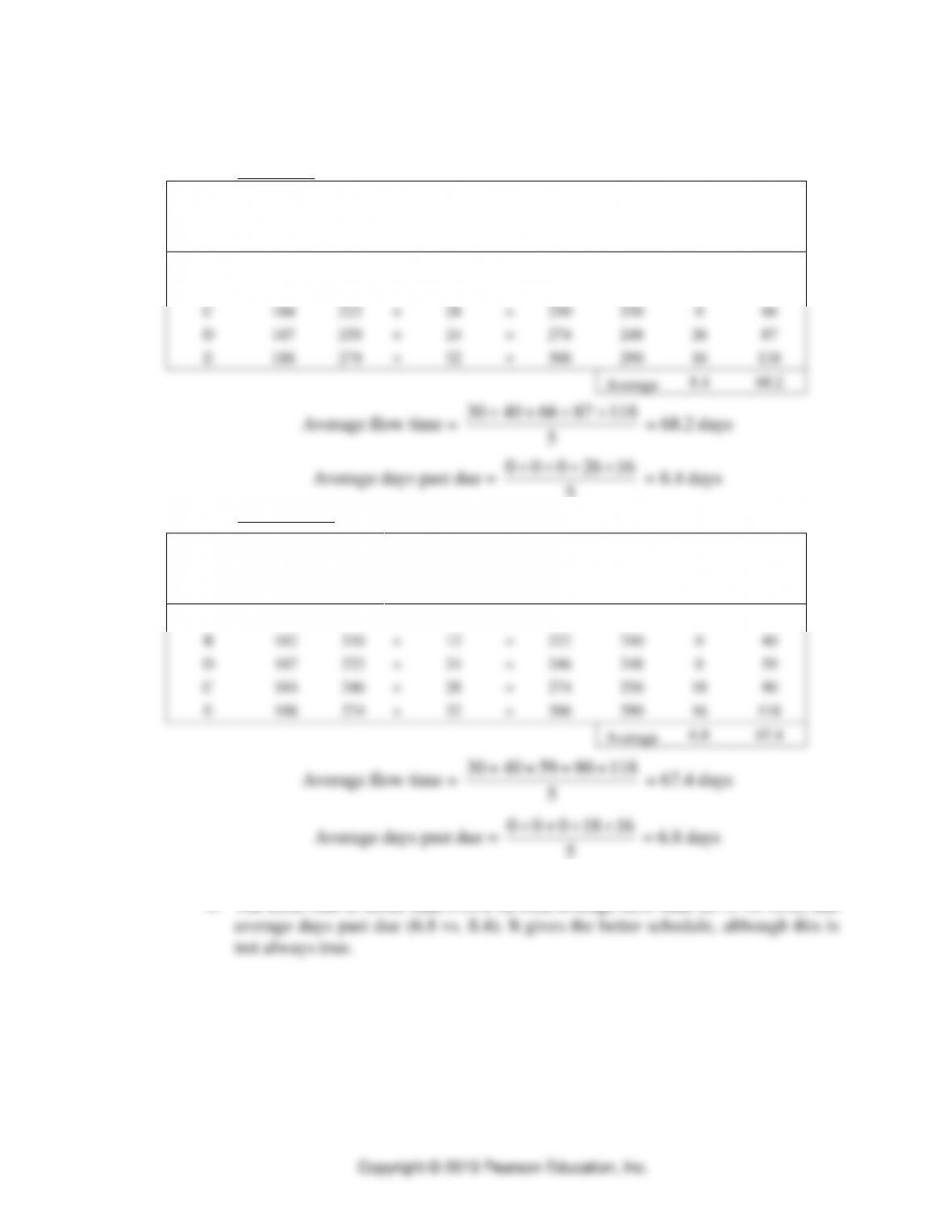
Average flow time =
5
11890594030 ++++
= 67.4 days
Average days past due =
0 0 0 18 16
5
+ + + +
= 6.8 days
b. The EDD rule is better than FCFS on both average flow time (67.4 vs. 68.2) and

⚫ PART 2 ⚫ Managing Customer Demand
10–32
20. Mowry Machine Shop
a. Schedules for two rules
FCFS rule:
Customer
Sequence
Day
Order
Arrived
Start
Time
(days)
Processing
Time
(days)
Finish
Time
(days)
Due
Date
Days
Past
Date
Flow
Time
(days)
A
12
23
+
10
=
33
45
0
21
B
13
33
+
8
=
41
36
5
28
C
15
41
+
4
=
45
42
3
30
17
45
+
4
=
49
39
10
32
22
49
+
3
=
52
53
0
30
Average flow time =
5
3032302821 ++++
= 28.2 days
Average days past due =
5
010350 ++++
= 3.6 days
EDD rule:
Customer
Sequence
Day
Order
Arrived
Start
Time
(days)
Processing
Time
(days)
Finish
Time
(days)
Due
Date
Days
Past
Date
Flow
Time
(days)
B
13
23
+
8
=
31
36
0
18
17
31
+
4
=
35
39
0
18
C
15
35
+
4
=
39
42
0
24
A
12
39
+
10
=
49
45
4
37
22
49
+
3
=
52
53
0
30
Average flow time =
5
3037241818 ++++
= 25.4 days
Average days past due =
5
04000 ++++
= 0.8 days
b. The EDD rule is better than FCFS on both average flow time (25.4 vs. 28.2) and

Operations Planning and Scheduling ⚫ CHAPTER 10 ⚫
10–33
CASE: MEMORIAL HOSPITAL *
A. Synopsis
Memorial Hospital is a 265-bed regional hospital serving western North Carolina.
The hospital is segmented into eight major care areas for the purpose of allocating
nursing staff. Darlene Fry, Director of Nursing, is facing the annual problem of
planning the nurse staffing levels for the upcoming year. Information pertaining to
average patient census across the eight care areas as well as target patient-to-nurse
ratios is presented. Students are also provided with sufficient cost data to help
Darlene develop for next year a staffing plan that conforms to the mission and
objectives of the hospital.
B. Purpose
The primary objective of the case is to have students develop a nurse staffing plan for
Memorial Hospital next year. Parameters and data to allow students to use both
demand and supply options to developing a feasible staffing plan are provided in the
case. Available options that you should expect students to use and discuss in their
plan include:
❑ Hiring and firing/layoff
❑ Overtime and undertime
❑ Use of temporary nurses (i.e., subcontracting)
❑ Use of vacations
❑ Cross-training to be able to assign nurses across different care areas
❑ Offering new services such as HMOs for preventive medical care to keep skilled
nurses employed
Students should be expected to address the trade-offs presented by the hospital’s
stated objectives, the costs of different options, and the projected demands for nursing
services.
Students should also be able to begin to see the issues that are faced in the more
detailed scheduling of personnel.
C. Analysis
Darlene faces several trade-offs to meet her three key objectives: maximizing
customer service, minimizing costs, and minimizing workforce fluctuations. In
general, maximizing customer service requires, on average, a larger nursing staff,
which may possibly cause a direct trade-off with cost minimization. Minimizing
workforce fluctuations requires some combination of overstaffing during slow
months and using overtime or temp workers during heavy months.
* This case was prepared by Dr. Brooke Saladin, Wake Forest University, as a basis for classroom
discussion.

⚫ PART 2 ⚫ Managing Customer Demand
10–34
Darlene can follow one of the three general staffing strategies—chase, modified
level, or mixed.
Students must first establish some guidelines for their analysis along with any
simplifying assumptions. Some reasonable assumptions would be:
❑ The nurses in the seven care areas (ignoring surgery in this analysis) are
interchangeable due to cross-training. This level of aggregation may be too much
of a simplification assumption for some students, who instead break them down
into clusters of wards. For example, one way to disaggregate would be to have
❑ Nurse requirements will be rounded up to the nearest full-time equivalent (FTE).
A different approach is rounding to the nearest integer, either up or down.
Students will differ as to how and when they convert to integer numbers. The
rounding assumption, coupled by the level of aggregation of the workforce, can

Operations Planning and Scheduling ⚫ CHAPTER 10 ⚫
10–35
❑ Some allowance needs to be made for paid vacations. A plausible assumption is
that vacation periods of four weeks (1/13 of a year) per full-time nurse can be
❑ Nurses can be given up to 10 hours per week of unpaid undertime, working only
Given these assumptions, some preliminary analysis can be done on the relative
attractiveness of the reactive alternatives. Three comparisons are given following:
1. Hire/layoff versus temps
$400 hire temp = $3/hr premium
2. Overtime versus temps
It is less expensive to use temporary nurses than to use an FTE nurse on overtime.
3. Hire/layoff versus overtime
These three comparisons suggest that a low-cost solution would avoid excessive
overtime, giving preference to temps, undertime, and vacation timing. Hiring and
There are several ways to get the requirements row. Here are two approaches,
illustrated for the Intensive Care (ICU) ward in the month of January:

⚫ PART 2 ⚫ Managing Customer Demand
10–36
1. Divide the average daily patient census per month in Table 15.5 by the patients
per nurse required in Table 15.4, getting the number of nurses needed round the
clock, 7 days per week. For ICU, it is 13/2 = 6.5. Multiply this number by 168
2. Another approach is to determine the total number of nurse hours needed each
month, and then dividing by the regular time capacity made available over a
Using such logic, students will develop a projection of nurse requirements over the
planning horizon, and then generate a number of feasible staffing plans using
D. Recommendations
Obviously, the recommendations from the students will vary widely depending on the
assumptions made and importance attributed to various qualitative factors. As the
assumptions are relaxed, the staffing plan becomes more complex and difficult to
develop.
E. Teaching Suggestions: As an Experiential Exercise
This case makes for an excellent team-based experiential exercise, spread over two
days. It might take 45 minutes in the first day, and 30 minutes in the second day.
Day 1
Before the first day, have the class read over the case and ask each team to bring at
least one laptop to class. When the session begins, get the teams to puzzle over the
requirements and costs, with the goal to get them into using OM Explorer’s Sales and
Operations Planning With Spreadsheets Solver. They can talk about likely strategies
and perhaps try out several ones before the end of the class. In getting agreement on
the requirements, make sure that they understand the need for 24-hour care (must
provide for round-the-clock staffing). They must also decide how much to aggregate