Chapter
1 Using Operations To Create Value
Course Introduction
1. Today’s objectives:
a. What are the course requirements?
b. What is OM? OM deals with processes that produce services and goods that people use
every day.
TEACHING TIP
Ask the students to share their ideas on a business they would like to start. Discuss the major
OM, Accounting, Finance, Human Resources, Management Information Systems, and Marketing
decisions.
c. Why study OM?
2. Course objectives:
a. Primary goal of this textbook is to gain an understanding of how to make operations a
competitive weapon
b. Strategy and analysis
3. Syllabus
a. Go over course outline
b. Performance measures
c. Office hours and other administration
d. Questions
e. Nature of assignments
TEACHING TIP
Introduce with Disney. The operational planning at Disney provides one example of designing
processes for competitive operations.
1. Operations management deals with the systematic design, direction, and control of processes.
a. “A process is an activity or group of activities that takes one or more inputs, transforms
them, and provides one or more outputs for its customers.”
b. An “Operation is a group of resources performing all or part of one or more processes.”
c. “Supply chain management is the synchronization of a firm’s processes with those of
its suppliers and customers to match flow of materials, services, and information with
customer demand.”

1. Role of Operations in an Organization
1. Operations serve as an excellent career path to upper management positions in many
organizations because operations managers are responsible for key decisions that affect the
success of the organization.
2. Operations is one of several functions within an organization
a. Cross-functional coordination is essential to effective management
b. Operations plays an important role in meeting global competition
3. Historical Evolution and Perspectives
a. James Watt invented the steam engine in 1785.
b. With the invention of the cotton gin in 1794, Eli Whitney introduced the concept of inter-
changeable parts.
c. The foundations of modern manufacturing and technological breakthroughs were also
inspired by the creation of a mechanical computer by Charles Babbage in the early part of
the nineteenth century.
d. Scientific management of operations and supply chain management was further improved
upon by Frederick Taylor in 1911
e. First is the invention of the assembly line for the Model T car by Henry Ford in 1909
f. Alfred Sloan in the 1930s introduced the idea of strategic planning for achieving product
proliferation and variety
g. Toyota Production System in 1978, Taiichi Ohno laid the groundwork for removing
wasteful activities from an organization.
h. The 1980s were characterized by wide availability of computer aided design (CAD),
computer aided manufacturing (CAM), and automation.
2. Process View
Departments within an organization typically have their own set of objectives and a set of
resources with capabilities to meet those objectives. The concept of a process is much broader: a
process can have its own set of objectives where the work flow may cross different department
boundaries, and require resources from several departments.
1. Any process has inputs and outputs
a. Inputs can include a combination of human resources (workers and managers), capital
(equipment and facilities), purchased materials and services, land, and energy.
b. Processes provide outputs to customers. Outputs could be services (that can take the form
of information) or a tangible product.
c. Customer-supplier relationships
• Every process and every person within an organization has customers
External customers
Internal customers
• Every process and every person in an organization also relies on suppliers

External suppliers
Internal suppliers
d. Inputs and outputs vary, depending on the service or product (examples)
• Jewelry store
Inputs: merchandise, the store building, registers, the jeweler, and customers
Outputs: to the external customers are services and sold merchandise
• Factory manufacturing blue jeans
Inputs: denim, machines, the plant, workers, managers, and services by outside
consultants
Outputs: clothing and supporting services
2. Nested processes
a. Process within a process
b. Interconnectivity within a business
c. Nature of each process’s inputs and outputs
d. Greater detail in Chapter 4 “Process Analysis”
3. Service and Manufacturing Processes
a. Ratio of services to manufacturing jobs
b. Differences
• Nature of output
• Degree of customer contact
c. Similarities
• Customers expect good service and good products
3. A Supply Chain View
The strategic view is that processes must add value for customers throughout the supply chain;
reinforcing the link between processes and performance. This includes a firm’s internal processes
with those of external customers and suppliers.
1. Core processes
a. Supplier relationship process
b. New service/product development process
c. Order fulfillment process
d. Customer relationship process
2. Support processes
a. provide vital resources and inputs to the core processes
b. capabilities
c. other inputs that allow core processes to function

3. Supply Chain Processes
a. Adding value with process innovation in supply chains
• Outsourcing
• Warehousing
• Sourcing
• Customer Service
• Logistics
• Cross-docking
4. Operations Strategy
1. Operations strategy
a. Specifies the means by which operations implements corporate strategy and helps to
build a customer-driven firm.
b. It links long-term and short-term operations decisions to corporate strategy and develops
the capabilities the firm needs to be competitive.
2. Corporate strategy
a. Environmental scanning
b. Developing core competencies
• Workforce
• Facilities
• Market and financial know-how
• Systems and technology
c. Developing core processes
d. Developing global strategies
• Strategic alliance
• Locating abroad.
3. Market analysis
a. Market segmentation
b. Needs assessment
• Service or Product Needs. Attributes of the service or product, such as price, quality,
and degree of customization.
• Delivery System Needs. Attributes of the processes and the supporting systems, and
resources needed to deliver the service or product, such as availability, convenience,
courtesy, safety, accuracy, reliability, delivery speed, and delivery dependability.
• Volume Needs. Attributes of the demand for the service or product, such as high or
low volume, degree of variability in volume, and degree of predictability in volume.
• Other Needs. Other attributes, such as reputation and number of years in business,
after-sale technical support, ability to invest in international financial markets, and
competent legal services.
5. Competitive Priorities and Capabilities
1. Competitive priorities are the critical operational dimensions a process or supply chain must
possess to satisfy internal or external customer, both now and in the future.
2. Competitive capabilities are the cost, quality, time, and flexibility dimensions that a process
or supply chain actually processes and is able to deliver. An abbreviated list with examples is
provided here.
Dimension
Definition
Example
Low-cost
operations
Delivering a service or product at
the lowest cost possible.
Costco achieves low costs by designing all
processes for efficiency.
Top
quality
Delivering an outstanding service
or product.
Rolex is known globally for top-quality
precision timepieces
Consistent
quality
Producing services or products
that meet design specifications on
a consistent basis.
McDonald’s standardizes work methods, staff
training processes, and procurement to achieve
consistency.
Delivery
speed
Quickly filling customer orders
Dell engineered processes to deliver reliable
and inexpensive computers with short lead
times.
On-time
delivery
Meeting delivery-time promises
United Parcel Service (UPS) uses expertise in
logistics and warehousing processes to deliver
on-time.
Development
speed
Quickly introducing new services
or products.
Zara is known by its ability to bring fashions
from the runway to market quickly
Customization
Satisfying unique needs of
customers
Ritz Carlton customizes services to individual
customers.
Variety
A wide assortment of services or
products.
Amazon.com uses information technology
along with order fulfillment processes to deliver
a vast variety of items to customers.
Volume
flexibility
Accelerating or decelerating the
rate of production
The United States Post Office (USPS) can
have severe demand peak fluctuations.
TEACHING TIP
Application of Organizational Capabilities – Zara. Leveraging development speed for gaining
competitive advantage provides one example of companies using their competitive capabilities.
3. Order winners and qualifiers
a. Order winner is a criterion that customers use to differentiate the services or products of
one firm from those of another, such as cost, quality, time, and flexibility
b. Order qualifier is the minimal requirement for doing business in a particular market
segment.

4. Using competitive priorities: an airline example (two market segments: first-class passengers
and coach passengers)
a. Customer relationships
• Top quality: High levels of customer contact and lounge service for the first-class
passengers
• Consistent quality: The information and service must be error free
• Delivery speed: Customers want immediate information regarding flight schedules
and other ticketing information
• Variety: The process must be capable of handling the service needs of all market
segments and promotional programs
b. New service development
• Developing speed: It is important to get to the market fast to preempt the competition
• Customization: The process must be able to create unique services
• Top quality: New services must be carefully designed because the future of the
airline industry depends on them
c. Order fulfillment
• Low-cost operations: Airlines compete on price and must keep operating costs in
check
• Top quality: High quality meal and beverage service delivered by experienced cabin
attendants ensures that the service provided to first–class passengers is kept top notch.
• Consistent quality: Once the quality level is set, it is important to achieve it every
time
• On-time delivery: The airline strives to arrive at destinations on schedule, otherwise
passengers might miss connections to other flights
• Variety: Maintenance operations are required for a variety of aircraft models
d. Supplier relationship
• Low-cost operations: Costs of acquiring inputs must be kept to a minimum to allow
for competitive pricing
• Consistent quality: Quality of the inputs must adhere to the required specifications.
In addition, information provided to suppliers must be accurate
• On-time delivery: Inputs must be delivered to tight schedules
• Variety: Many different inputs must be acquired, including maintenance items, meals
and beverages.
• Volume flexibility: The process must be able to handle variations in supply quantities
efficiently
5. Identifying Gaps Between Competitive Priorities and Capabilities
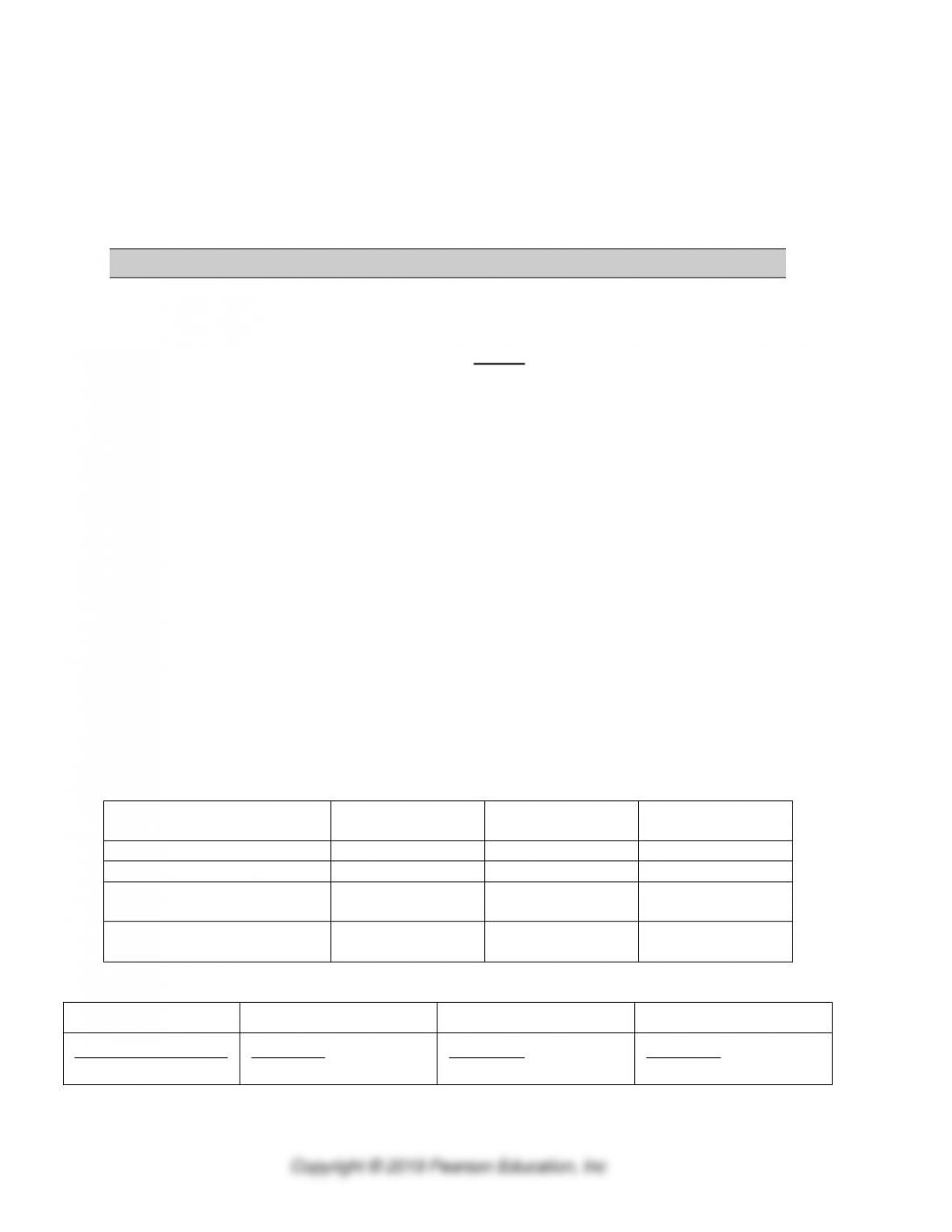
a. Operations strategy translates service or product plans and competitive priorities for each
market segment into decisions affecting the supply chains that support those market
segments.
b. Once managers determine the competitive priorities for a process, it is necessary to assess
the competitive capabilities of the process.
6. Addressing the Trends and Challenges in Operations Management
1. Productivity improvement
a. The value of outputs produced is divided by the value of input resources.
Productivity= Output
Input
b. In the United States, while there are signs of improvement, service sector productivity
gains have been much lower than those in the manufacturing sector.
c. Use Example 1.1: Productivity Calculations to give students the chance to make their
own productivity calculations.
d. Productivity measures – two approaches
• Single factor
In example 1.1, the single (input) factor is employee hours
• Multifactor
In example 1.1, the multiple (input) factors are labor cost, materials cost, and
overhead costs.
e. Managers must examine productivity from the level of the value chain, i.e., the collective
performance of individual processes.
f. Additional examples are provided as Solved Problems
g. Application 1.1
This Yr.
Last Yr.
Year Before Last
Factory unit sales ($)
2,762,103
2,475,738
2,175,447
Employment (hrs)
112,000
113,000
115,000
Sales of manufactured
products ($)
$49,363
$40,831
—
Total manufacturing cost of
sales ($)
$39,000
$33,000
—
• Calculate the year-to-year labor productivity.
This Yr.
Last Yr.
Year Before Last
employment
salesunitfactory
hr/66.24$
000,112
103,762,2 =
hr/91.21$
000,113
738,475,2 =
hr/91.18$
000,115
447,175,2 =

• Calculate the multifactor productivity.
This Yr.
Last Yr.
tmfgtotal
productsmfgofsales
cos
27.1
000,39$
363,49$=
24.1
000,33$
831,40$=
2. Global competition
a. Firms can increase their market penetration by locating their production facilities in
foreign countries because it gives them a local presence that reduces customer aversion to
buying imports
b. Five developments have stimulated the need for sound global strategies
• Improved transportation and communication technology
• Loosened regulations on financial institutions
• Increased demand for imported services and goods
• Reduced import quotas and other international trade barriers
European Union (EU)
North American Free Trade Agreement (NAFTA)
• Comparative cost advantages
c. Comparative cost advantage
• What role does China play in globalization today?
• What role does India play?
d. Disadvantages of globalization
• Relinquish proprietary technology
• Political risks
• Employee skills may be lower in foreign countries
TEACHING TIP
Managerial Practice 1.1: “Japanese Earthquake and its Supply Chain Impact.” Japanese
earthquake disaster exposes supply chain weakness: reliance on small concentrated network of
suppliers. Economic losses have been felt worldwide.
3. Ethical, and workforce diversity and environmental issues
a. Decisions about the design and operations of production systems consider the
environment, ethics, and workplace diversity issues
TEACHING TIP
Discuss examples such as: toxic waste, poisoned drinking water, poor air quality, and climate
change.
4. The Internet of Things

a. The impact of IoT on Operations as objects embedded with software, sensors and
actuators collect and exchange data
b. Some applications
• Product design and development
• Health care
• Preventative maintenance
• Inventory management
• Logistics
• City management
c. Concerns and Barriers
• Technology
• Privacy
• Security
• Organizational roles
7. Developing Skills for Your Career
1. Developing skills to understand how organizations meet challenges by better design of its
operating processes and supply chains.
a. The management of processes and supply chains goes beyond designing them; it requires
the ability to ensure they achieve their goals.
b. All effective operations decisions follow from a sound operations strategy.
c. The text has three major parts:
• Part 1: “Managing Processes”
Focus on analyzing processes and how they can be improved to meet the goals of
the operations strategy.
• Part 2: “Managing Customer Demand”
Focus of this part of the book is on effectively forecasting and managing
customer demand.
• Part 3: “Managing Supply Chains”
Focus of Part 3 is on supply chains involving processes both internal and external
to the firm and the tools that enhance their execution.
2. Adding Value with Process Innovation
a. Each part of an organization, not just the operations function, must design and operate
processes that are part of a supply chain and deal with quality, technology, and staffing
issues.
b. Each function of an organization has its own identity and yet is connected with operations
through shared processes.