
Electronic copy available at: http://ssrn.com/abstract=2021733
Discussion
Papers
Banking of Surplus Emissions
Allowances
Does the Volume Matter?
Karsten Neuhoff, Anne Schopp, Rodney Boyd, Kateryna Stelmakh and Alexander Vasa
1196
Deutsches Institut für Wirtschaftsforschung 2012

Opinions expressed in this paper are those of the author(s) and do not necessarily reflect views of the institute.
IMPRESSUM

Banking of surplus emissions allowances
– does the volume matter?
Karsten Neuhoff1, Anne Schopp1, Rodney Boyd2,
Kateryna Stelmakh2, Alexander Vasa2
March 8, 2012
In the European Emission Trading scheme the supply of allowances exceeds
emissions – cumulating, according to our estimates, in a surplus of 2.7 billion

Banking of emissions allowances – does the volume matter?
March 2012
Page 2
1. Introduction
by 2013. Despite the volume of unused allowances, the carbon price has not fallen to zero, and remained
in the order of 10–15 €/tCO2 between 2009 and summer 2011. This is largely because market participants
by then expected a future scarcity of allowances. Accordingly, these participants banked unused
allowances for use in future years. As a result of banking, the current carbon price is often interpreted as
an indicator for the stringency of European emission reduction targets till 2020 and beyond.
Whether the drop in carbon prices reflects changing expectations about future carbon prices, or reflects
higher discounts applied to these expectation matters for public and private decision makers. Carbon
In order to pursue our hypothesis that the drop in carbon price is due to increased discount rates applied
to future carbon prices and whether the volume of banking matters, we pursued semi–structured
The power sector banks allowances to hedge power sales, typically selling power one to four
years ahead of production and securing costs for fuels and carbon at the same time. We estimate
for 2012 that the power sector has the flexibility to bank between 0.5 to 1.8 billion emission
Banking of emissions allowances – does the volume matter?
March 2012
Page 3
2012.
example, by power companies to hedge their future power sales. The allowances held by banks
therefore do not increase the total volume of allowances banked in the emission trading scheme.
would be prepared to pursue speculative investments in carbon if rates of return exceed 10 or
15%. This is consistent with evidence we find from other commodity markets in which similar
rates of return are required by speculative investors.
Across all sectors, interview partners made a clear distinction between banking of allowances for hedging
purposes and as speculative investment. This implies that once the hedging needs for allowances are
This step change of discounting of future carbon prices has not been previously identified in the literature.
Thus, we answer the question raised with the title of the paper: whether the volume of surplus allowances
matters for discounting of future carbon prices. According to our quantification, the increasing supply of
allowances exceeded the hedging demand by 2011, and could explain the drop in the carbon price at the
end of 2011. However, within the uncertainties of our analysis, it would also be possible that the hedging
Our analysis has two policy implications:

Banking of emissions allowances – does the volume matter?
March 2012
Page 4
2. The evolution of EU ETS surplus
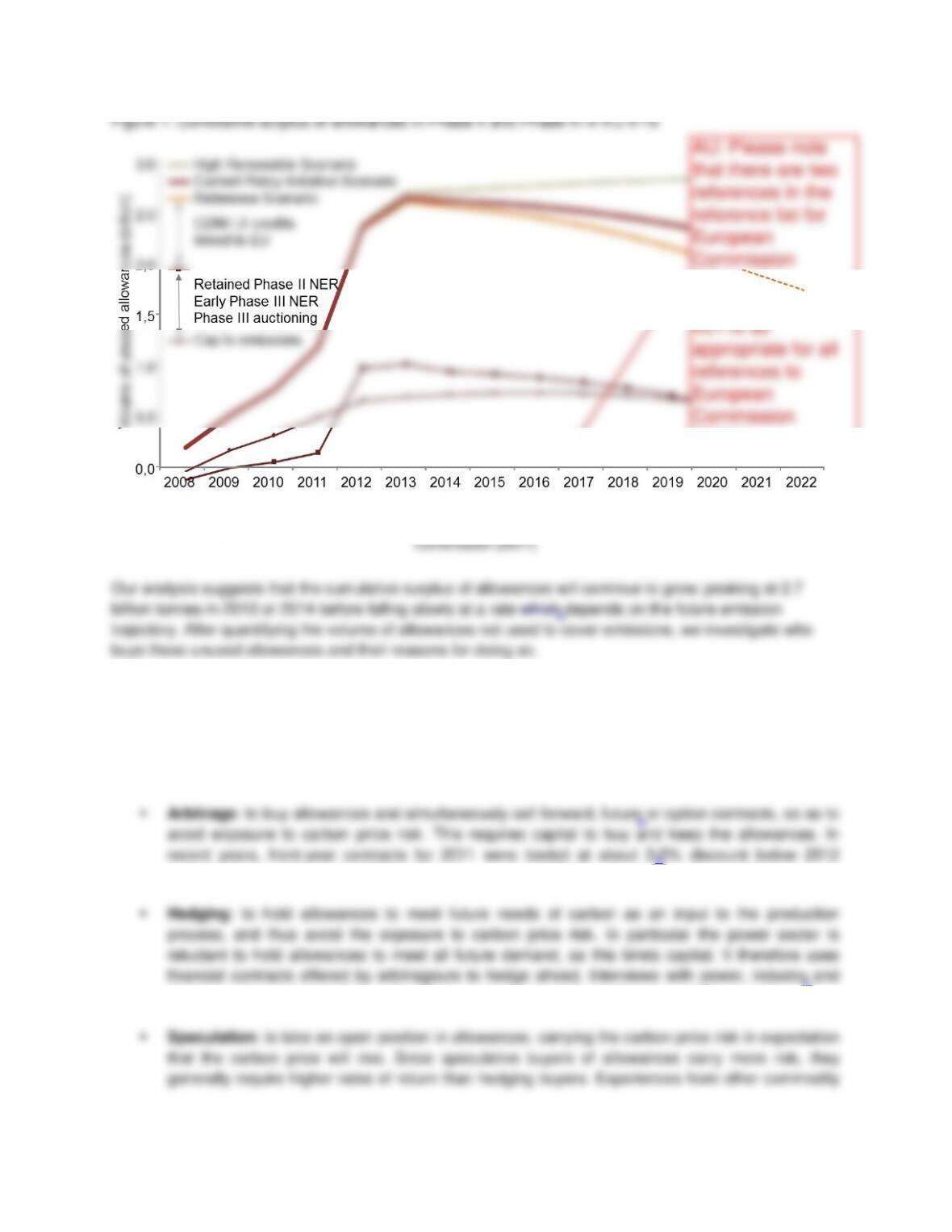
Since 2008, a surplus of allowances in the EU ETS has accumulated and is expected to increase further
(Figure 1). The surplus results in part from the financial and economic crisis, since industrial production,
Not all allowances are provided for free to the ETS participants, but enter the carbon market through
auctions. Since several auctions of Phase II (2008–2012) and Phase III (2013–2020) allowances take
place between 2011 and 2013, the volume of unused allowances further increases in these years. In
Banking of emissions allowances – does the volume matter?
March 2012
Sources: European Parliament and Council (2009); IGES (2011); UNEP Risoe (2011); CITL (2011); European
3. The demand for surplus of allowances
A positive carbon price suggests that a demand exists to hold unused emissions allowances for later use
in future years (banking). Comparable to other commodities, there are three main reasons for banking
allowances:
contracts, and contracts for 2012 at 7% premium below 2013 contracts (see Annex C).
finance actors confirmed discounts of future prices are applied in the order of 5% per year.
that the carbon price will rise. Since speculative buyers of allowances carry more risk, they
generally require higher rates of return than hedging buyers. Experiences from other commodity
AU: Please note
that there are two
references in the
reference list for
European
Commission
(2011). Please
update 2011a and
2011b as
appropriate for all
references to
European
Commission
(2011).
Banking of emissions allowances – does the volume matter?
March 2012
Page 6
markets suggest that speculative buyers generally expect returns in the range of 10–15% per
annum (see Annex A).
lower.
We have identified three principle actors that bank allowances: power generators, industry and financial
Power generators
2012.
Power generators thus hold allowances beyond compliance needs to hedge carbon for future use. They
have some flexibility on the amount of hedging. In the interviews two main factors were reported to have
increase. We did not model this effect, as in recent years the carbon price was usually significantly below
the price that would, for example, motivate a shift from coal to gas as base–load generation.
example, should power generators sell 15% of power three years ahead of time, then they can decide
whether to allocate these sales to a carbon–intensive generation asset and thus to acquire the

Banking of emissions allowances – does the volume matter?
March 2012
Page 7
2012.
In the interviews it was reported, that power companies do not invest in significant amounts of allowances
beyond the hedging need.
Industry actors
Industry actors received 569 million free allowances over what they needed to cover emissions between
International Financial Reporting Standards (IFRS). IFRS allows firms to place a value on allowances
allocated for free at zero in their books. Profits are then reported in the quarter when allowances are sold
at market prices, or can be attributed to the production process when the zero valued allowances are
reduces the amount of unused allowances that are retained because of transaction costs, and reduces
the number of allowances that need to be retained to cover uncertainties in emission patterns.
11 CERs. This increases ownership of allowances, but was reported to be focused on direct compliance
needs. These activities did therefore not directly impact on the demand–supply balance.

Banking of emissions allowances – does the volume matter?
March 2012
Page 8
commodity will be sold should the price drop below a pre–defined threshold. Thus, some value of the
commodity is secured for the firm while at the same time, forgoing the opportunity to recover losses with
increasing prices.
the subsequent months. One major actor reported that this strategy has been pursued since Phase I.
the clarification of benchmarks for free allowance allocation during 2011, uncertainties about future
allowance needs, and thus their hedging needs, declined.
The drivers for banking strategies point to a reduction of blunt banking and a shift towards instant sale of
unused allowances. Allowances are thus only retained where they allow for hedging future carbon costs.
As most, or in several instances all, carbon costs are covered for the next few years with the free
Financial actors
investments that require almost 100% of their own capital. It was reported in all interviews that banks do
not pursue significant volumes of speculative investment in EU ETS allowances.
acquire and bank allowances. The demand from the financial sector to bank allowances for arbitrage
purposes is thus already accounted for in the power and industrial sector analysis.
Banking of emissions allowances – does the volume matter?
March 2012
Page 9
4. Quantification of demand–supply balance
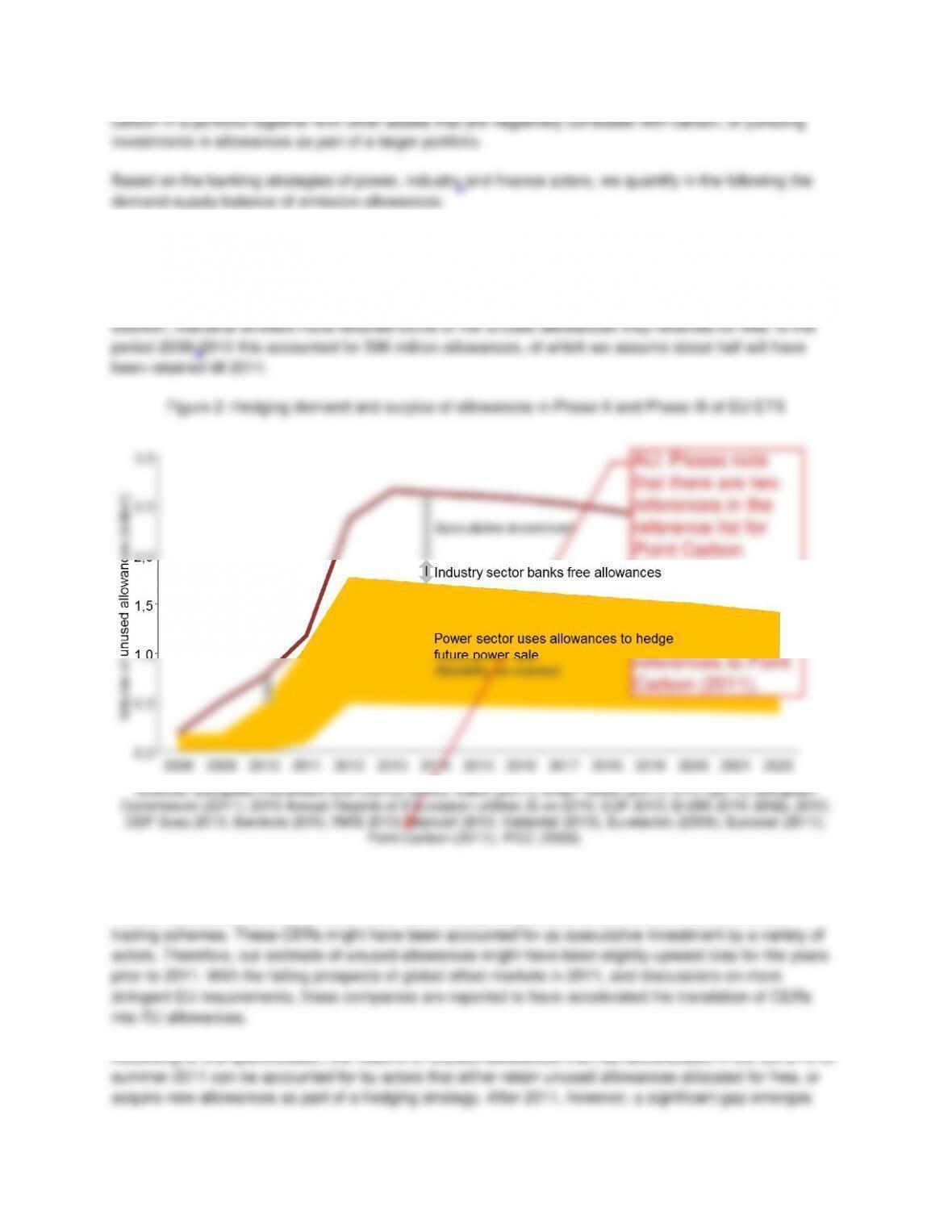
In Figure 2 we compare the potential hedging demand against our estimate of allowance surpluses. Over
the last three years, hedging demand from power generators increased in line with the surplus. In
One uncertainty results from the significant share of the volume of unused allowances attributed to
offsets. It was reported that in the early years many of these offsets credits (CERs) were not translated
into EU allowances (EUAs) so as to retain the flexibility for potential sale of CERs to other emission
acquire new allowances as part of a hedging strategy. After 2011, however, a significant gap emerges
AU: Please note
that there are two
references in the
reference list for
Point Carbon
(2011). Please
update 2011a and
2011b as
appropriate for all
references to Point
Carbon (2011).