Reducing End-of-life Waste: Repair, Recondition, Remanufacture or
Recycle?
Dr Andrew M King*
Lecturer in Engineering Design
Department of Mechanical Engineering
University of Bristol
Bristol, BS8 1TR
United Kingdom
Email: andrew.king@bris.ac.uk
Tel: 44 (0) 117 928 8213
* Corresponding author
Dr Winnie Ijomah
Research Officer
Dept of Mechanical Engineering
University of Bath
Bath, BA2 7AY
United Kingdom
Email: enxwli@bath.ac.uk
Tel: 44 (0) 1225 386355
Abstract
Between 1980 and 1997, municipal waste in OECD countries increased by around 40%. The European
Union has responded by introducing two major policies: a landfill directive and legislation on extended
producer responsibility (EPR). EPR is the logical extension of the “polluter pays” principle and rests on the
argument that environmental impacts are substantially determined at the point of design where key choices
are made—on materials, processing, finishing technology, etc.—that is, with the producer.
This paper further explains the context of this new legislation and describes, compares and then contrasts
the four alternative strategies to reducing end-of-life waste: repairing, reconditioning, remanufacturing, or
recycling. It also introduces a more robust definition of remanufacturing, validated by earlier research,
which differentiates it from repair and reconditioning.
From a consideration of the different factors involved, it concludes that remanufacturing may well be the
best strategy. This is based on the fact that it enables the embodied energy of virgin production to be
maintained and also preserves the intrinsic “added value” of the product for the manufacturer.
1. The Context
1.1 The waste problem
Between 1980 and 1997, municipal waste in OECD countries increased by around 40%. Perhaps most
1. Firstly, it results in the permanent loss of material and energy resources. The potential loss of resource
1997). However, whilst it is widely agreed that natural resources will become more expensive due to
2. Secondly, as the current landfill sites are filling up, this leads to pressure to use new sites with the loss
3. And thirdly, the additional waste left in these landfill sites increases air, water, and land pollution. For
1.2 The policy solution
In the early 1990s some European Union member states, notably the Netherlands, Germany, and Sweden
developed their own national policy measures to deal with their growing waste problems. However, in order
to provide a workable single market throughout the EU (such that production and trade measures were
1. waste reduction (such as extending product durability),
3. waste recovery (such as raw material recycling), and lastly
4. waste landfill (as the last resort).
Extended Producer Responsibility (EPR) is defined by the OECD as “the principle that manufacturer and
importers of products should bear a significant degree of responsibility for the environmental impacts of
2003). Electronic and electrical waste contains substances that may have a damaging impact on the
environment when it is disposed of either in landfill sites or by incineration. In addition, the volume of
2. improving and maximizing recycling, re-use and other forms of recovery of wastes from end–of-life
electrical and electronic equipment, and
3. minimizing the impact on the environment from their treatment and disposal.
A recent analysis on the likely effect of the WEEE Directive in the UK concludes that it may only reduce
Municipal Solid Waste (MSW) by 0.1% because high levels of WEEE waste is already recycled
(PriceWaterhouseCoopers, 2002). But this overlooks the fact that end–of-life waste also generates
Copyright © 2019 Pearson Education, Inc.
Although the Directive gives 11 categories of electronic and electrical waste, a recent study of present waste
levels found that large household appliances (such as fridges, cookers, and washing machines) and IT
equipment (such as PCs, mainframes, printers, and copiers) accounted for 43% and 39% respectively
(ICER, 2000). The study also found that whilst 88% of large household appliances were recycled, only 40%
(approximately) of IT equipment is currently recycled. The principal reasons given for this difference were
firstly that it is easier to separate large appliances in the waste stream and secondly that it is harder to
separate out the ferrous metal from IT equipment.
2. The Practical Solutions
In order to achieve a step change in practice, designers need to consider the entire “lifecycle” of a product
from raw material extraction, through manufacturing, product use, and final disposal. And from doing this,
2.1 Repairing
The most logical approach to closing the loop on product use is simply to repair and extend the product’s
life. However, whilst this is intrinsically a simple concept, its practice is low and little research has been
undertaken to understand this closed loop option. Repairing is simply the correction of specified faults in a
product. Generally, the quality of repaired products is inferior to those of remanufactured and reconditioned
Copyright © 2019 Pearson Education, Inc.
different/additional features). Planned obsolescence is one way in which capitalist markets generate a
demand for new sales; B Earl Puckett, former head of Allied Stores Corporation said “We must accelerate
obsolescence … It is our job to make women unhappy with what they have … We must make them so
unhappy that their husbands can find no happiness or peace in their excessive savings” (Packard V, 1963).
Indeed, a growing body of literature cites the fact that consumerism is the dominant social paradigm to be
the fundamental cause of the world’s sustainability problems (Halliday S V, 2002). This is seen to be
encouraged by a culture of individualism and a relaxation in credit controls (Cooper T, 1994). In contrast to
this view, planned obsolescence (and the consumerism it generates) has been defended “as an engine of
technological progress” (Fishman, Gandal, & Shy, 1993). Although flawed in terms of economic efficiency
and environmental sustainability, the argument that planned obsolescence represents progress is often
politically expedient (Cooper T, 2002).
2.2 Reconditioning
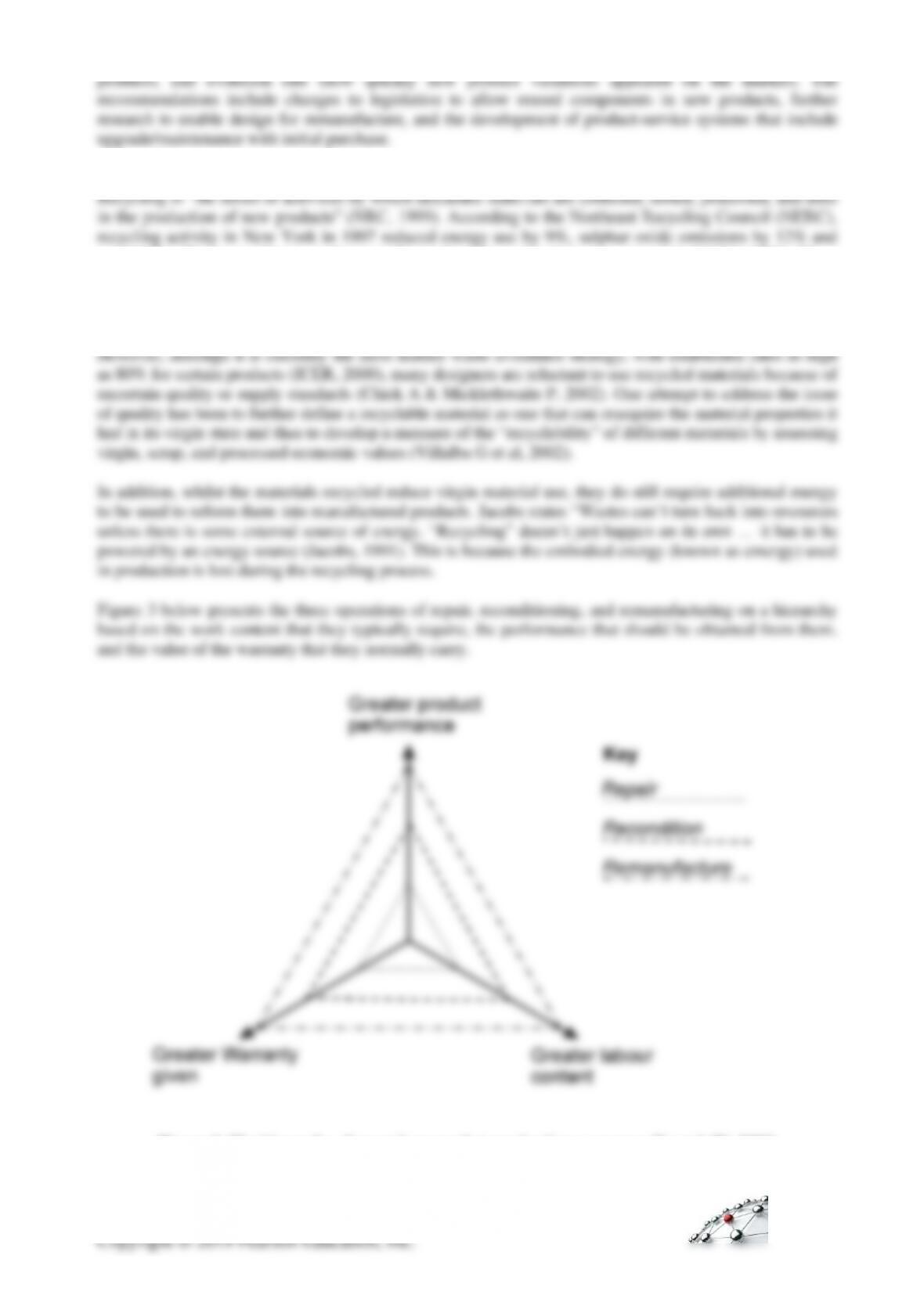
Reconditioning involves less work content than remanufacturing, but more than that of repairing. This is
because reconditioning usually requires the rebuilding of major components to a working condition that is
generally expected to be inferior to that of the original model. All major components that have failed or that
2.3 Remanufacturing
Remanufacturing is the only process where used products are brought at least to Original Equipment
Manufacturer (OEM) performance specification from the customer’s perspective and, at the same time, are
given warranties that are equal to those of equivalent new products (Ijomah W, 2002). The reasoning here
being that if a remanufactured product has quality equal to that of a new equivalent then its warranty must
Copyright © 2019 Pearson Education, Inc.
Ijomah et al. describe current remanufacturing activity by the following activities (Ijomah W et al., 1998):
1. Receive the “core”, that is the parts of the product to be remanufactured. The term “core” is used, as
typical remanufactured parts are larger core items of the product.
2. Strip and clean the core into individual elements. As the used parts may be dirty, they are
dismantled and appropriately cleaned. A visual inspection would discard badly damaged elements.
3. Estimate and quote remanufacturing costs. As many remanufacturing companies are sub–
5. Build, test, and dispatch. Finally, the remanufactured components are reassembled (together with
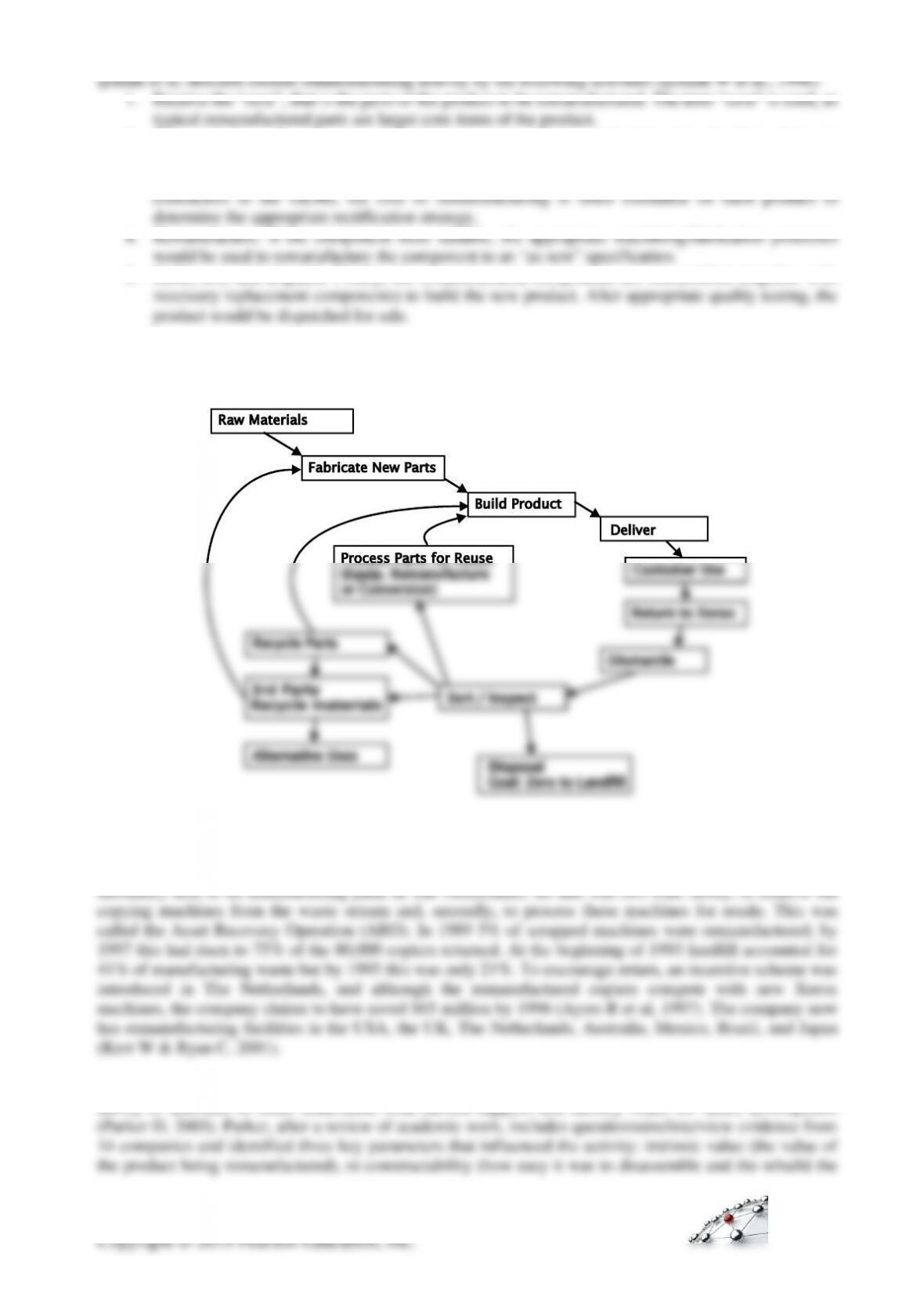
Arguably the most well-known (and certainly the most referred to) example of remanufacturing is that of
photocopiers made by Rank-Xerox; their process is shown in figure (Xerox, 2003).
Figure 2: Xerox’s equipment recovery and parts reuse/recycle process (Xerox, 2003)
In 1987, Rank-Xerox started a new program called “asset recovery” and created a new, wholly owned
Aware of the growing interest in remanufacturing within the UK, Oakdene Hollins undertook a UK-wide
survey of activities to better understand what current happens and identify issues for future development
Copyright © 2019 Pearson Education, Inc.
product), and evolution rate (how quickly new product variations appeared on the market). The
recommendations include changes to legislation to allow reused components in new products, further
research to enable design for remanufacture, and the development of product-service systems that include
upgrade/maintenance with initial purchase.
2.3 Recycling
saved 2.7 million tons of iron ore from needing to be extracted to form new materials (NERC, 1999). Thus,
it is clear that it is environmentally better to recycle materials rather than take them to a landfill site. Indeed,
for aluminum, the energy saving can be as high as 91% by recycling scrap compared with the process of
using the primary raw material, bauxite (Ogilvie S M, 1992).
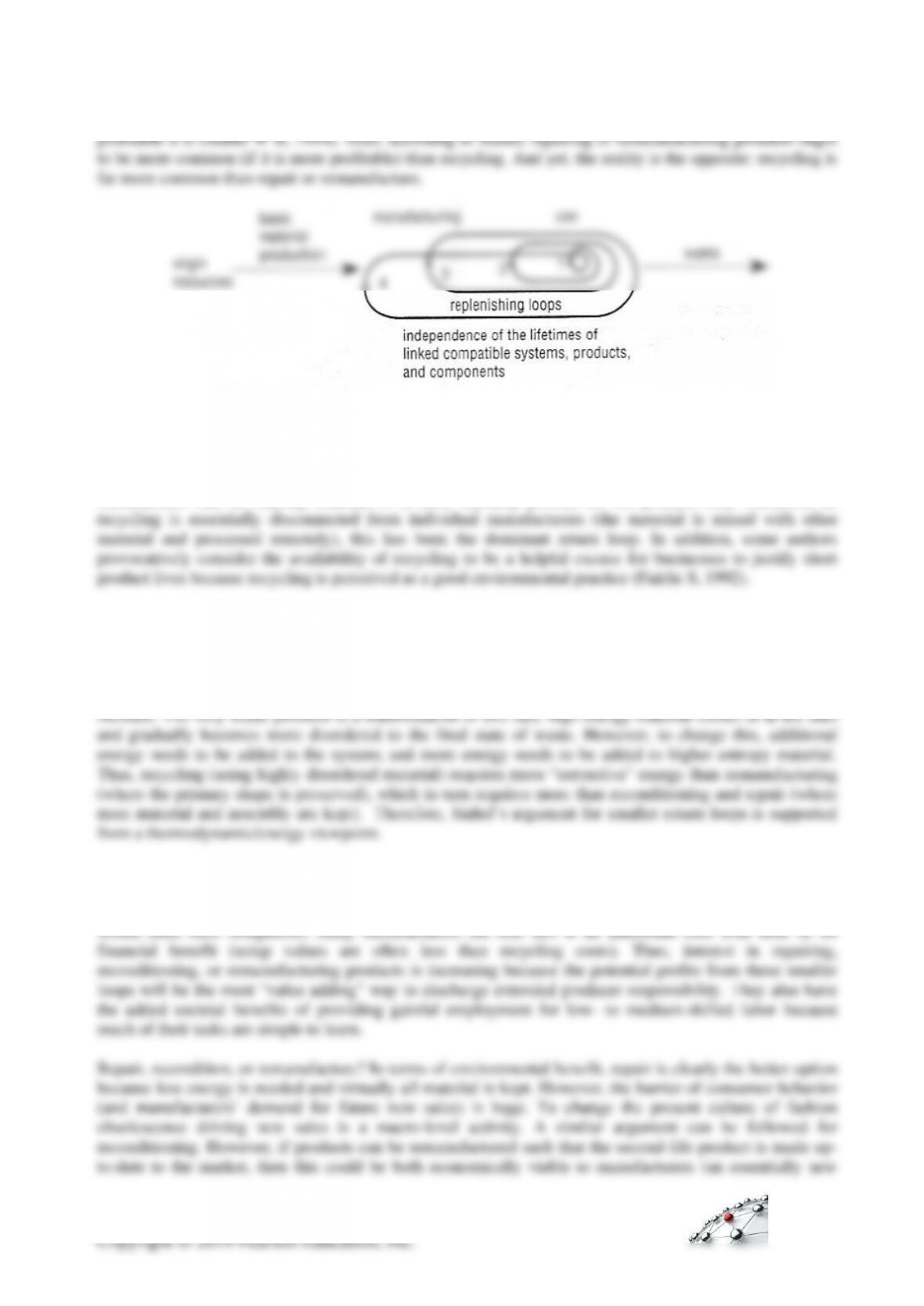
3. Discussion: Which Return Loop Is “Best”?
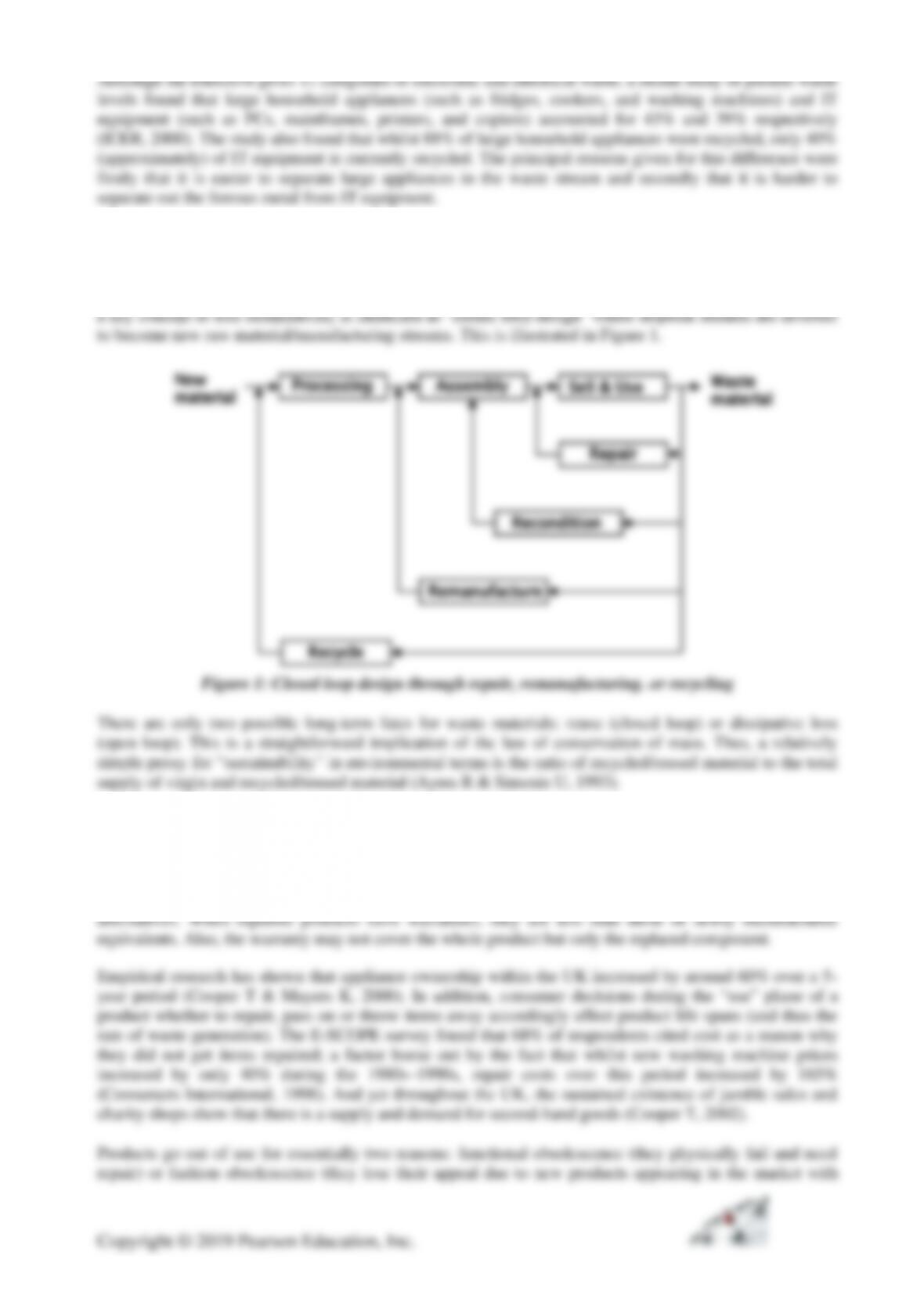
Returning to the idea of closing loops, Stahel states that the smaller the loop, as shown in Figure 3, the more
Figure 3: Self-replenishing system loops: 1 = reuse, 2 = repair, 3= remanufacture, 4 = recycle
According to Stahel, the reason for this reality has been due to a lack of product lifetime liability. Until the
recent introduction of extended producer responsibility legislation (such as the WEEE directive) a
manufacturer had no liability (outside of a short warranty period) for the product sold. Therefore, as
Another way of understanding these issues is through the first two laws of thermodynamics. The first law
states that no energy or material can either be created or destroyed, merely transformed. This promotes the
idea of closed loops to transform material back into useful products rather than into useless (and harmful)
waste. However, the second law of thermodynamics shows that this transforming process itself requires
additional energy. The second law states that for a closed system, the entropy (disorder) will always
So, what will promote a move toward remanufacturing, reconditioning, and/or repair? The answer is
extended producer responsibility legislation. With the introduction of such legislation, manufacturers are
now liable for their products through and beyond their end–of-use life. Whilst a strategy to ensure recycling
product is made) and desirable to consumers. As shown earlier, remanufacturing could lead to lower waste
levels and require less energy than recycling making it a micro-level solution to the growing waste problem.
But clearly, the most fundamental barrier at present is the lack of a credible and stable demand for
remanufactured products. This was seen to be the greatest policy barrier to initiate new remanufacturing
Conclusion
This paper has compared and contrasted four different waste avoidance strategies, namely: repairing,
reconditioning, remanufacturing, and recycling. Stahel’s argument for smaller return loops has been
discussed and supported from a thermodynamic/energy viewpoint. Thus, recycling (using highly disordered
References
AEA Technology (1997), Recovery of WEEE: Economic and Environmental Impacts, AEA Technology, Abingdon,
Oxon. UK June 1997.
Ayres R & Simonis U (1993), Industrial Metabolism, University Press, Tokyo, Japan, 1993.
Ayres R et al (1997), Eco-Efficiency, Asset Recovery and Remanufacturing, European Management Journal, Vol. 15,
No. 5, pp 557-574, 1997.
Cooper T (2002), Attached to this World? Waste and “the most materialistic of the great religions”, Consumption,
Copyright © 2019 Pearson Education, Inc.
Consumers International (1998), Green guidance: how consumer organisations can give better advice on putting
sustainable consumption into practice, Consumers International, ISBN 1-902391-09-8, pp 14–31.
DARP (2003), DARP (Devon Appliance Recycling project) Environmental: WEEE Remarket Final Report, 2003
http://www.darpenvironmental.com/downloads/weeeremarketfinalreport.pdf (accessed February 10, 2004).
DEFRA (2003a), Municipal Waste Management Survey 2001/02, Summary,
www.defra.gov.uk/environment/statistics/wastats/mwb0102/wbsummary.htm (visited October 10,
2003).
DEFRA (2003b), Press Release: Living close to a landfill site cuts property values,
1–19.
276–283.
Fishman A, Gandal N, & Shy O (1993), Planned Obsolescence as an engine of technological progress, The Journal of
Jacobs (1991), The Green economy: environment, sustainable development and the politics of the future, London:
Pluto Press, 1991, pp 110–116.
Kerr W & Ryan C (2001), Eco-efficiency gains from remanufacturing. A case study of photocopier remanufacturing at
Fuji Xerox Australia, Journal of Cleaner Production, Vol. 9, pp 75–81, 2001.
King AM & Burgess SC (2004), Understanding the barriers to remanufacturing: restoring used products to a like–
new condition. Submitted to International Design Conference—DESIGN 2004 Dubrovnik, May 18–21, 2004.
Lund R (1985), Remanufacturing: The experience of the United States and implications for developing countries.
Ogilvie S M (1992), A review of the environmental impact of recycling, Warren Spring Laboratory, Stevenage UK.
Packard V (1963), The Waste Makers, Longmans, 1961, pp 68–77.
Parker D (2003), Remanufacturing in the UK: A significant contributor to sustainable development? Oakdene Hollins
101–123.
Welsh D (2002), Sustainable Development: Meeting the Challenge, Visiting Professor Lecture, University of Bristol,

Copyright © 2019 Pearson Education, Inc.
Xerox (2003), Environment, Health & Safety Progress Report 2003, Xerox. www.xerox.com.
Villalba G et al (2002), A proposal to quantify the recyclability of materials, Resources, Conservation and Recycling,
Vol. 37, Issue 1, 2002, pp 39–53.