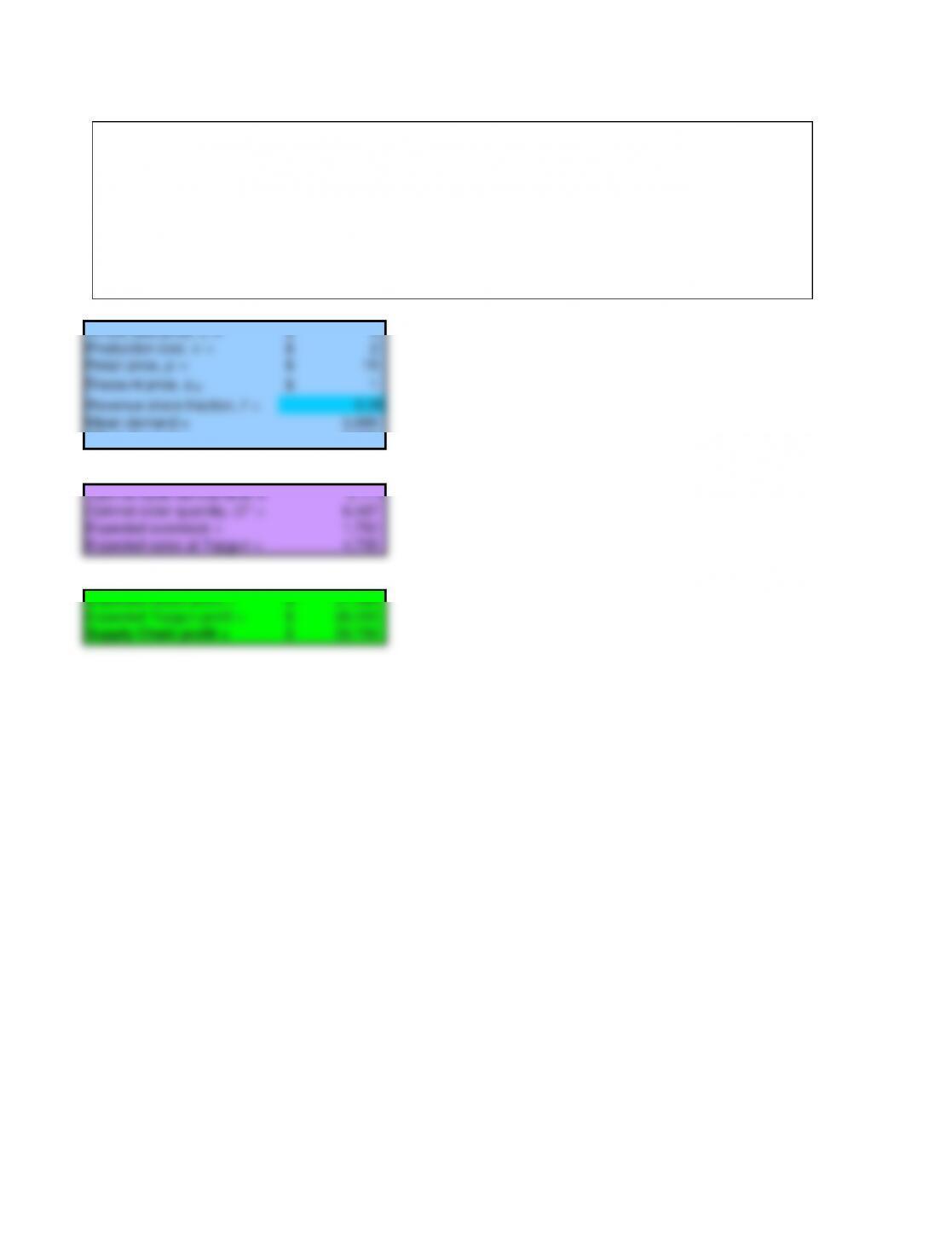
Inputs
Whole sale price, c = 3$
Production cost, v = 2$
Retail price, p = 15$
Discount price, sR1$
Revenue share fraction, f = 0.35
Mean demand = 5,000
SD of demand = 2,000
Topgun’s Response
Optimal cycle service level = 0.771
Optimal order quantity, O* = 6,487
Expected overstock = 1,752
Expected sales at Topgun = 4,735
Output
Expected studio profit = 31,344$
Expected Topgun profit = 28,455$
Supply Chain profit = 59,799$
Topgun Records and several movie studios have decided to sign a revenue-sharing contract for CDs. Each CD
costs the studio $2 to produce. The CD will be sold to Topgun for $3. Topgun, in turn, prices a CD at $15 and
forecasts demand to be normally distributed, with a mean of 5,000 and a standard deviation of 2,000. Any unsold
CDs are discounted to $1, and all sell at this price. Topgun will share 35 percent of the revenue with the studio,
keeping 65 percent for itself.
a. How many CDs should Topgun order?
b. How many CDs does Topgun expect to sell at a discount?
c. What is the profit that Topgun expects to make?
d. What is the profit that the studio expects to make?
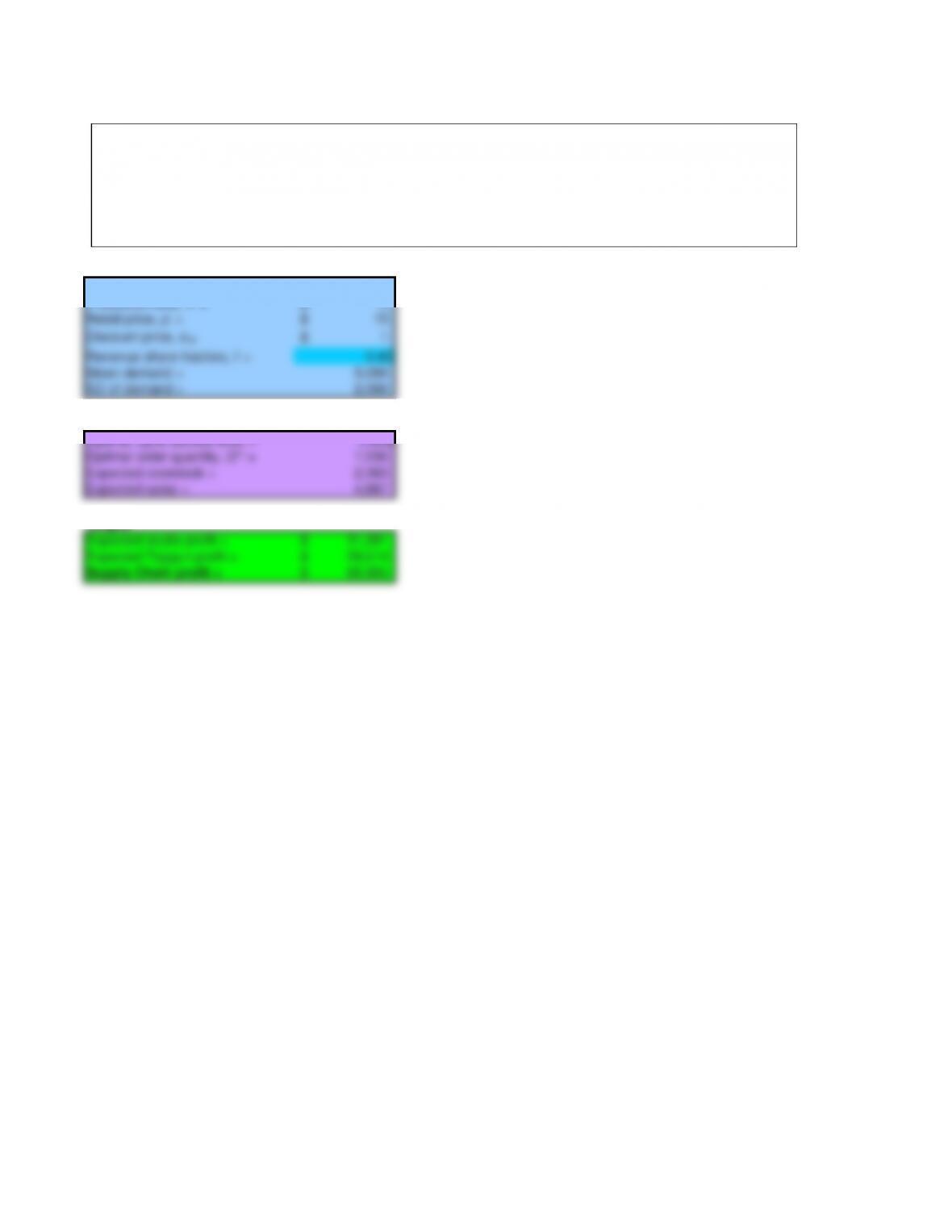
Inputs
Whole sale price, c = 2$
Production cost, v = 2$
Retail price, p = 15$
Discount price, sR1$
Revenue share fraction, f = 0.43
Mean demand = 5,000
SD of demand = 2,000
Topgun’s Response
Optimal cycle service level = 0.868
Optimal order quantity, O* = 7,230
Expected overstock = 2,363
Expected sales = 4,867
Output
Expected studio profit = 31,391$
Expected Topgun profit = 29,514$
Supply Chain profit = 60,905$
Topgun Records and several movie studios have decided to sign a revenue-sharing contract for CDs. Each CD costs
the studio $2 to produce. The CD will be sold to Topgun for $3. Topgun, in turn, prices a CD at $15 and forecasts
demand to be normally distributed, with a mean of 5,000 and a standard deviation of 2,000. Any unsold CDs are
discounted to $1, and all sell at this price. Topgun will share 35 percent of the revenue with the studio, keeping 65
percent for itself.
e. Repeat parts (a)–(d) if the studio sells the CD for $2 (instead of $3) but gets 43 percent of revenue.