Problem 13-15
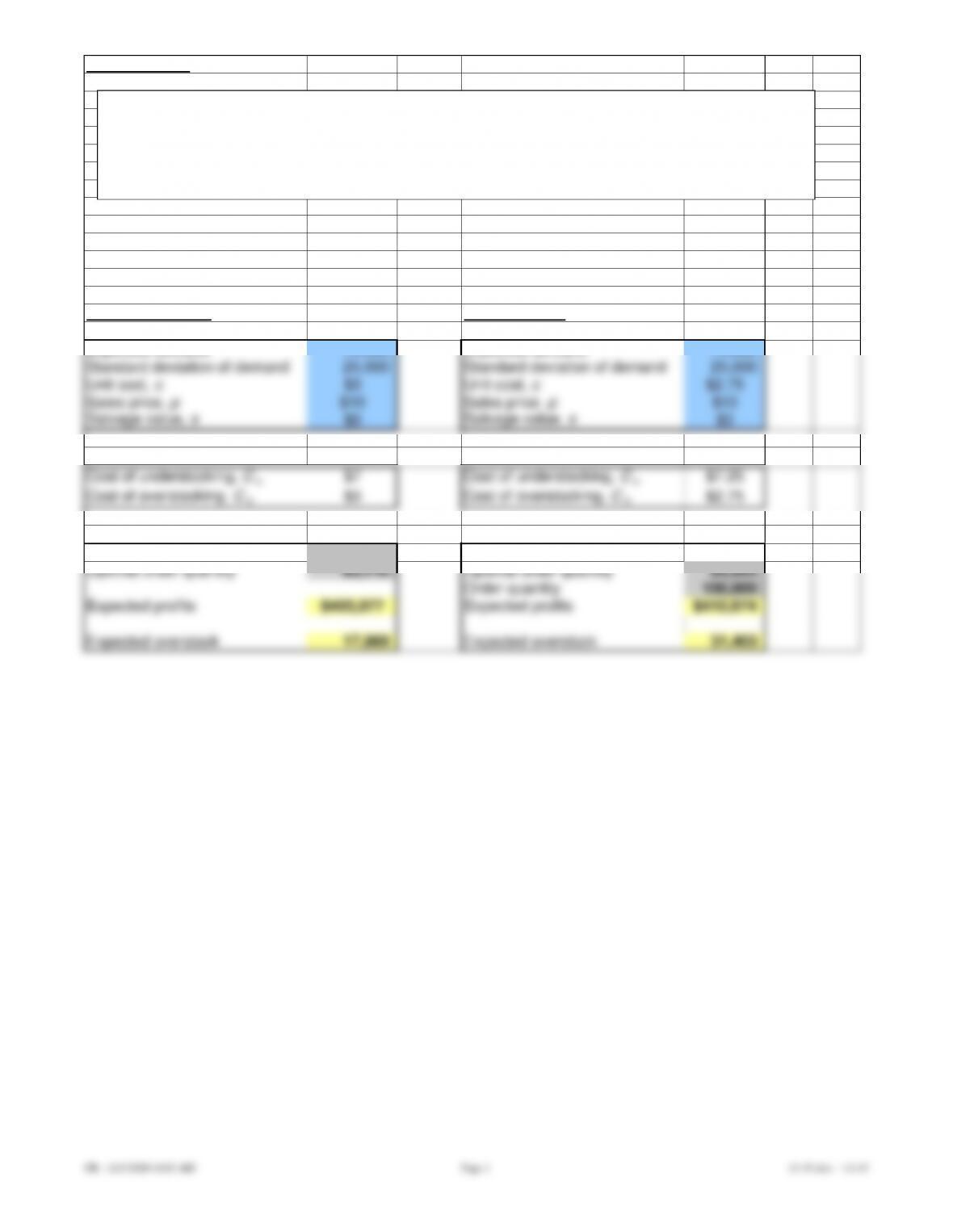
Without Discount With Discount
Inputs Inputs
Expected demand 70,000 Expected demand 70,000
Standard deviation of demand 25,000 Standard deviation of demand 25,000
Unit cost, c$3 Unit cost, c$2.75
Sales price, p$10 Sales price, p$10
Salvage value, s$0 Salvage value, s$0
Cost of understocking, Cu$7 Cost of understocking, Cu$7.25
Cost of overstocking, Co$3 Cost of overstocking, Co$2.75
Outputs Outputs
Optimal cycle service level 0.7000 Optimal cycle service level 0.725
Optimal order quantity 83,110 Optimal order quantity 84,944
Order quantity 100,000
Expected profits $403,077 Expected profits $410,974
Expected overstock 17,869 Expected overstock 31,403
A publisher is printing calendars for the coming year. Demand for calendars is normally distributed, with a mean of 70,000 and a standard
deviation of 25,000. The cost per calendar is $3, and they are sold for $10 each. All unsold calendars are recycled at the end of January.
a. How many calendars should the publisher have printed? What is the expected profit?
b. The printer has offered to discount the printing cost to $2.75 per calendar if the publisher orders at least 100,000. What should the
publisher do?