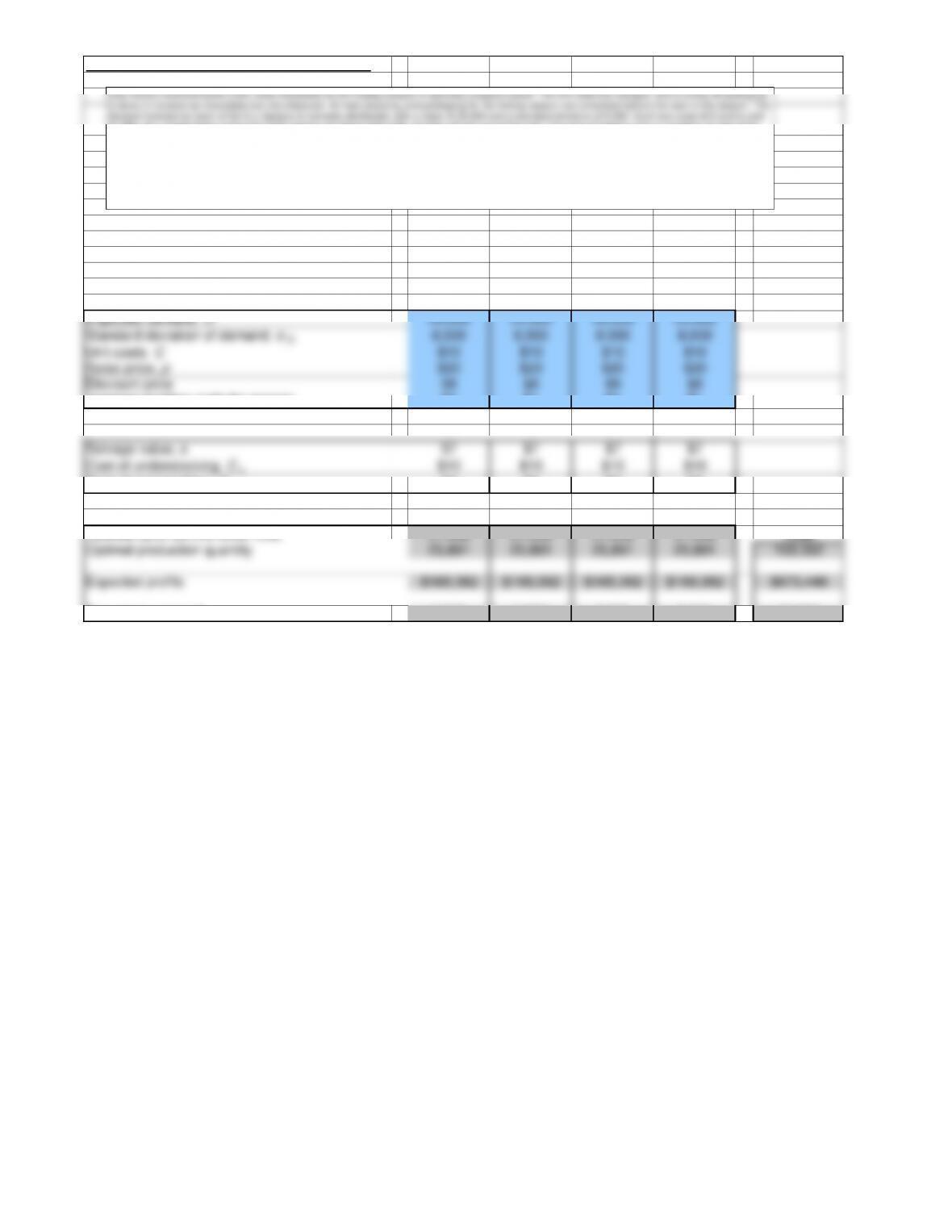
Exercise 13-12: Lake Grove Confectionaries
Inputs Box 1 Box 2 Box 3 Box 4
Expected demand, D20,000 20,000 20,000 20,000
Standard deviation of demand, σD8,000 8,000 8,000 8,000
Unit costs, C$10 $10 $10 $10
Sales price, p$20 $20 $20 $20
Discount price $8 $8 $8 $8
Inventory holding costs for season $1 $1 $1 $1
Salvage value, s$7 $7 $7 $7
Cost of understocking, Cu$10 $10 $10 $10
Cost of overstocking, Co$3 $3 $3 $3
Outputs
Optimal cycle service level, CSL 0.7692 0.7692 0.7692 0.7692 Total
Optimal production quantity 25,891 25,891 25,891 25,891 103,562
Expected profits $168,362 $168,362 $168,362 $168,362 $673,446
Expected overstock 6,965 6,965 6,965 6,965 27,860
Lake Grove Confectionaries (LGC) sells chocolates for the holiday season in specially designed boxes. The firm sells four designs, and currently all packaging
is done in the plant as chocolates are manufactured. All manufacturing and packaging for the holiday season are completed before the start of the season. The
demand forecast for each of the four designs is normally distributed, with a mean of 20,000 and a standard deviation of 8,000. Each box costs $10 and is sold
for $20. Any unsold boxes at the end of the season are discounted to$8, and they all sell out at this price. The cost of holding a box in inventory for the entire
season before selling it at a discount is $1.
a. How many boxes of each design should LGC manufacture?
b. What is the expected profit from this policy?
c. How many boxes does LGC expect to sell at a discount?
CR – 12/3/2020 10:03 AM Page 1 13-12.xlsx – ex 13.12 a,b,c
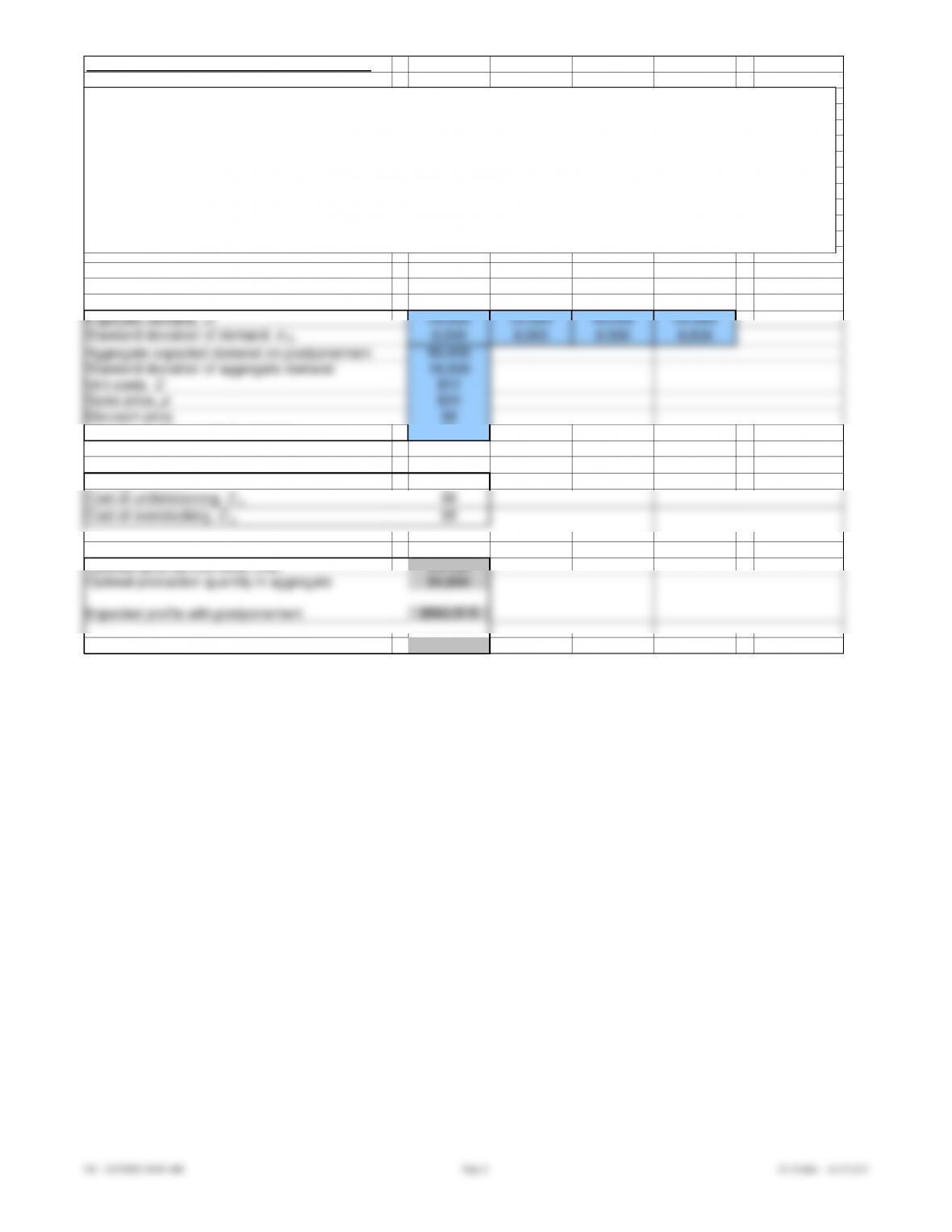
Exercise 13-12: Lake Grove Confectionaries
Inputs Box 1 Box 2 Box 3 Box 4
Expected demand, D20,000 20,000 20,000 20,000
Standard deviation of demand, σD8,000 8,000 8,000 8,000
Aggregate expected demand on postponement 80,000
Standard deviation of aggregate demand 16,000
Unit costs, C$12
Sales price, p$20
Discount price $8
Inventory holding costs for season $1
Salvage value, s$7
Cost of understocking, Cu$8
Cost of overstocking, Co$5
Outputs
Optimal cycle service level, CSL 0.6154
Optimal production quantity in aggregate 84,694
Expected profits with postponement $560,515
Expected overstock sold at discount 9,003
Lake Grove Confectionaries (LGC) sells chocolates for the holiday season in specially designed boxes. The firm sells four designs, and currently all packaging is done in the plant
as chocolates are manufactured. All manufacturing and packaging for the holiday season are completed before the start of the season. The demand forecast for each of the four
designs is normally distributed, with a mean of 20,000 and a standard deviation of 8,000. Each box costs $10 and is sold for $20. Any unsold boxes at the end of the season are
discounted to$8, and they all sell out at this price. The cost of holding a box in inventory for the entire season before selling it at a discount is $1.
d. An option being considered by LGC is to separate chocolate production from packaging. Chocolates will be produced before the start of the season, but packaging will be
done on an express line as orders come in. The express line and separation of steps adds $2 to the cost of production. How many boxes of chocolates should LGC manufacture if it
decides to postpone packaging? What is the expected profit? How many boxes will LGC sell at a discount if it uses postponement?
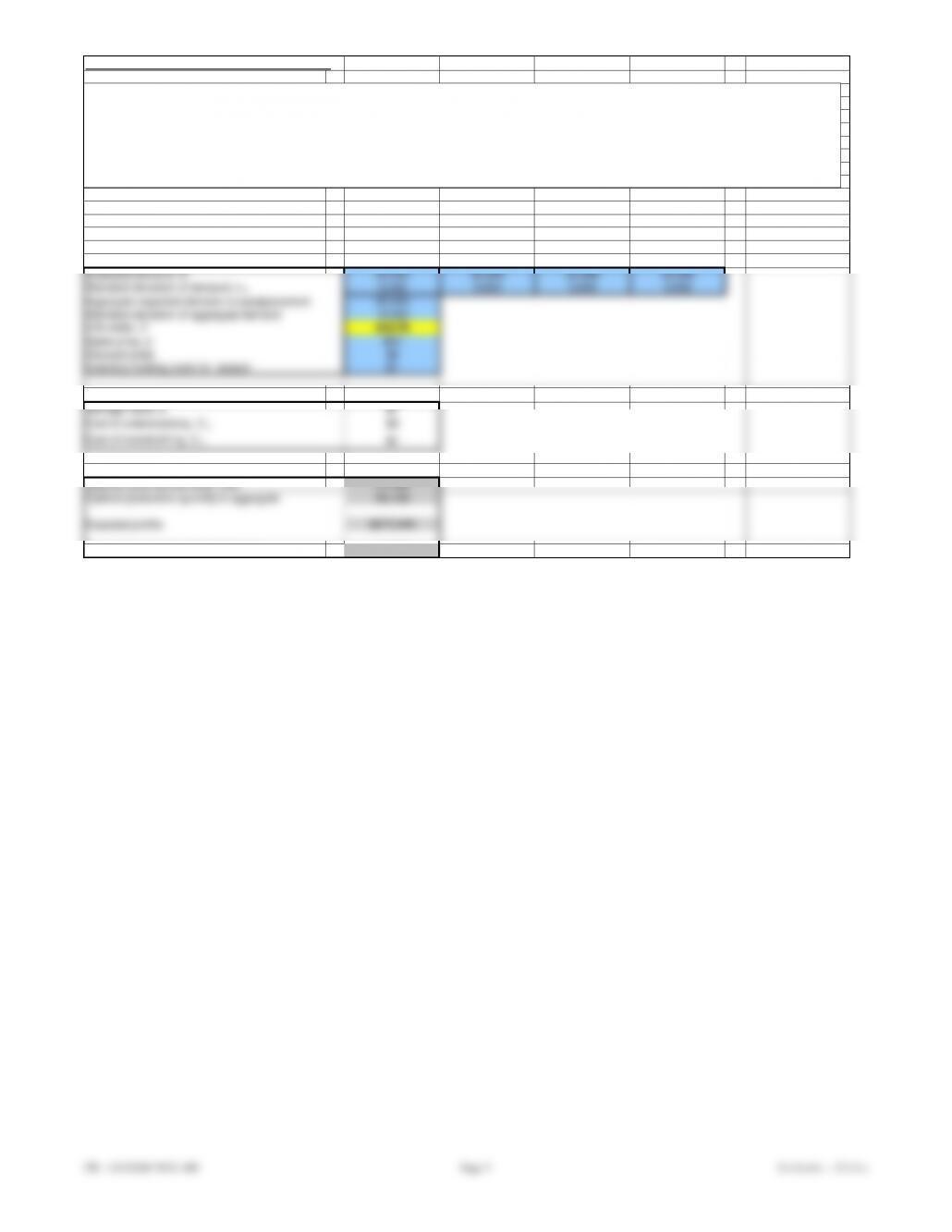
Exercise 12-12: Lake Grove Confectionaries
Inputs Box 1 Box 2 Box 3 Box 4
Expected demand, D20,000 20,000 20,000 20,000
Standard deviation of demand, σD8,000 8,000 8,000 8,000
Aggregate expected demand on postponement 80,000
Standard deviation of aggregate demand 16,000
Unit costs, C$10.70
Sales price, p$20
Discount price $8
Inventory holding costs for season $1
Salvage value, s$7
Cost of understocking, Cu$9
Cost of overstocking, Co$4
Outputs
Optimal cycle service level, CSL 0.7154
Optimal production quantity in aggregate 89,108
Expected profits $673,446
Expected overstock sold at discount 11,944
Lake Grove Confectionaries (LGC) sells chocolates for the holiday season in specially designed boxes. The firm sells four designs, and currently
all packaging is done in the plant as chocolates are manufactured. All manufacturing and packaging for the holiday season are completed before
the start of the season. The demand forecast for each of the four designs is normally distributed, with a mean of 20,000 and a standard deviation
of 8,000. Each box costs $10 and is sold for $20. Any unsold boxes at the end of the season are discounted to$8, and they all sell out at this
price. The cost of holding a box in inventory for the entire season before selling it at a discount is $1.
e. At what additional cost of postponement (instead of the current $2) would LGC be indifferent between operating with and without