1
Chapter 11: Managing Economies of Scale in the Supply Chain: Cycle Inventory
Exercise Solutions
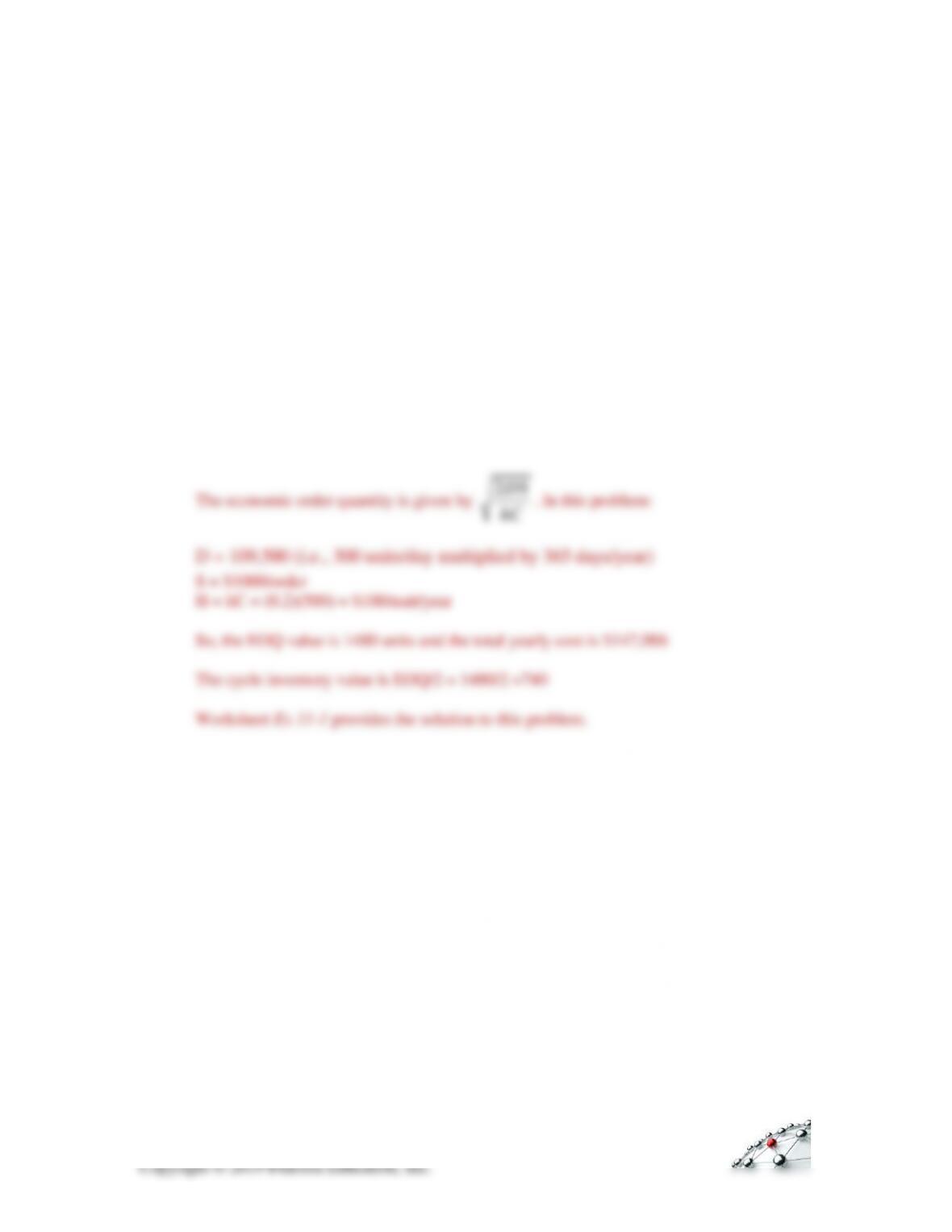
1. Harley-Davidson has its engine assembly plant in Milwaukee and its motorcycle
assembly plant in Pennsylvania. Engines are transported between the two plants using
trucks, with each trip costing $1,000. The motorcycle plant assembles and sells 300
motorcycles each day. Each engine costs $500, and Harley incurs a holding cost of 20
percent per year. How many engines should Harley load onto each truck? What is the
cycle inventory of engines at Harley?
DS2
2
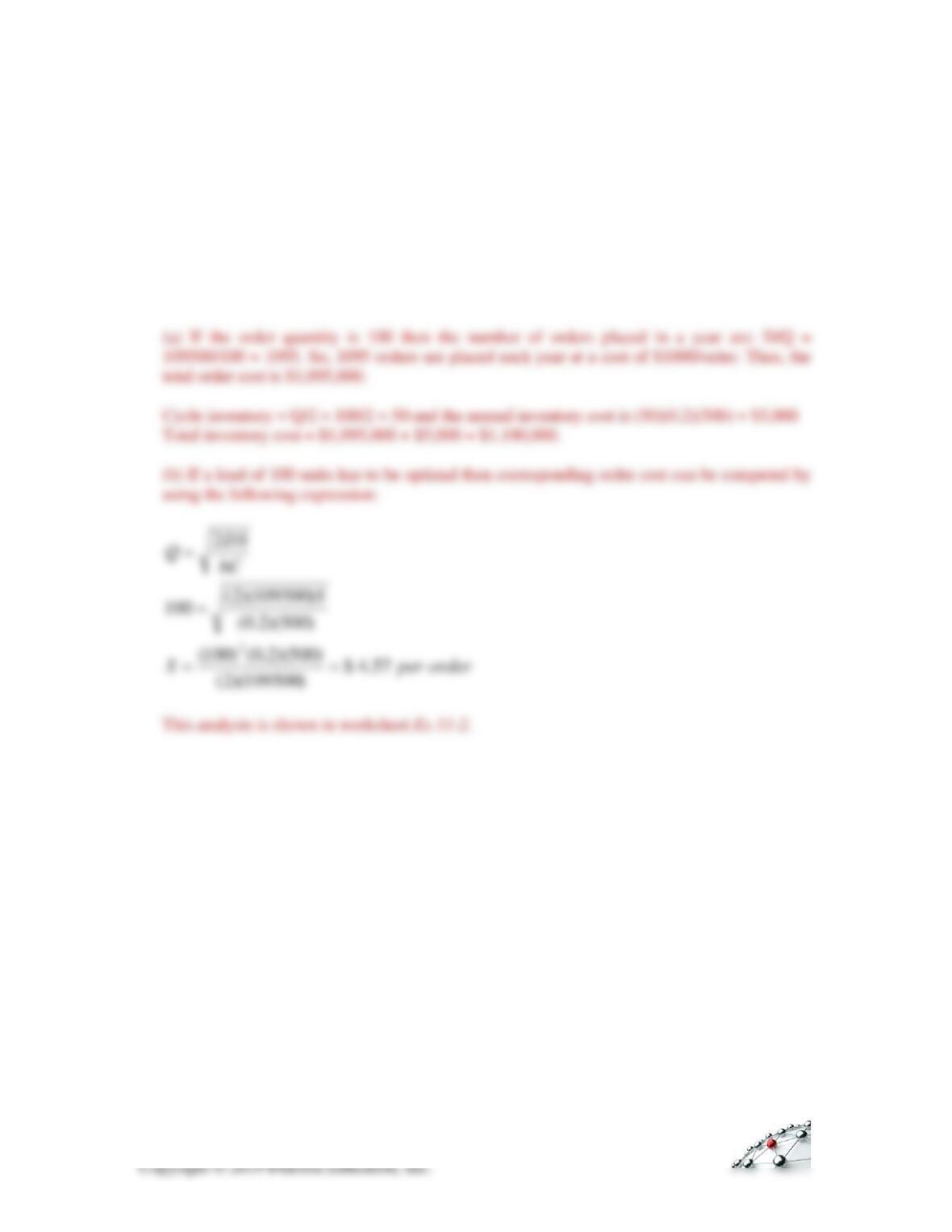
2. As part of its initiative to implement just-in-time (JIT) manufacturing at the
motorcycle assembly plant in Exercise 1, Harley has reduced the number of engines
loaded on each truck to 100. If each truck trip still costs $1,000, how does this
decision impact annual inventory costs at Harley? What should the cost of each truck
be if a load of 100 engines is to be optimal for Harley?
3
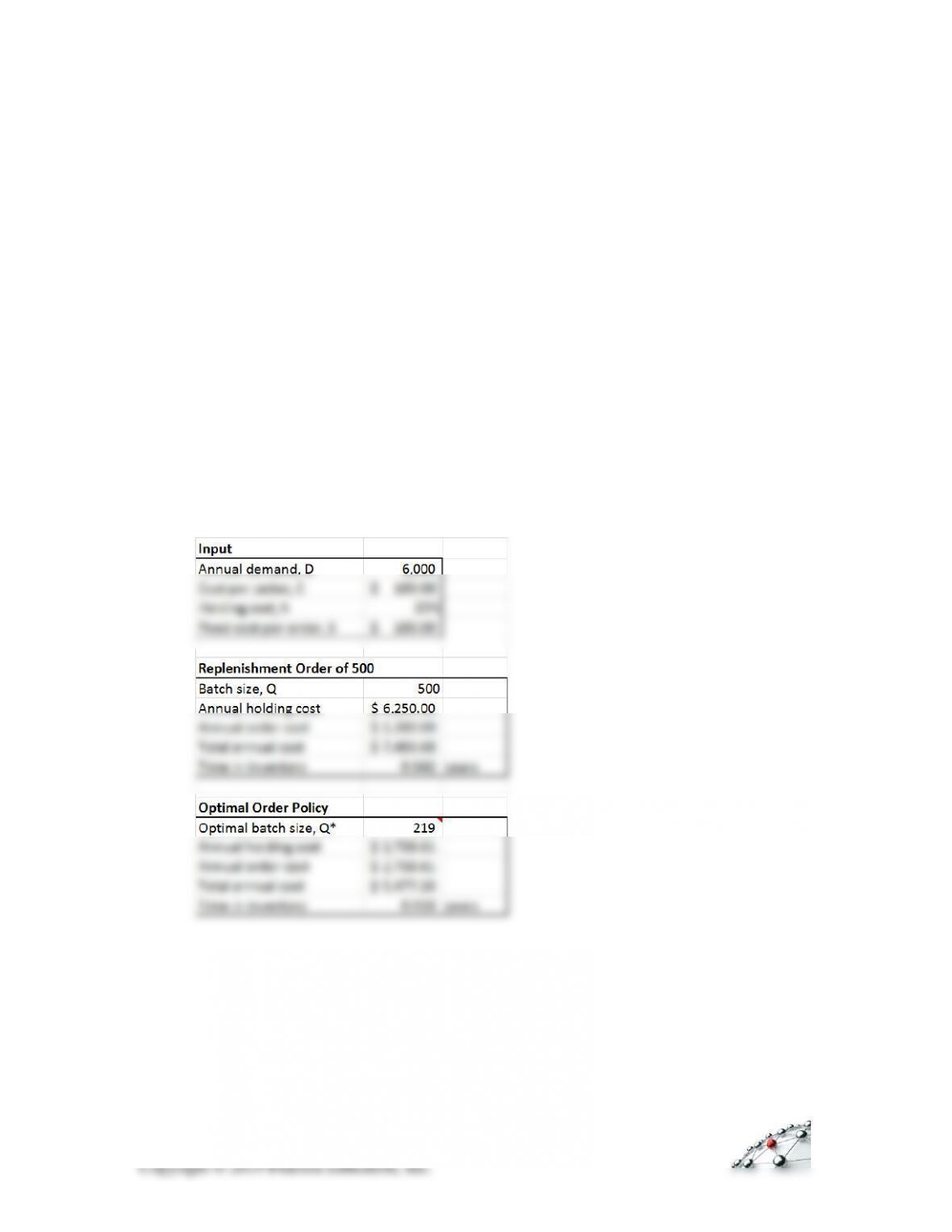
3. A North Face retail store in Chicago sells 500 jackets each month. Each jacket costs
the store $100 and the company has an annual holding cost of 25 percent. The fixed
cost of a replenishment order (including transportation) is $100. The store currently
places a replenishment order every month for 500 jackets. What is the annual holding
and ordering cost? On average, how long does a jacket spend in inventory? If the retail
store wants to minimize ordering and holding cost, what order size do you
recommend? How much would the optimal order reduce holding and ordering cost
relative to the current policy?
This analysis is shown in worksheet Ex 11-3 as follows:
4
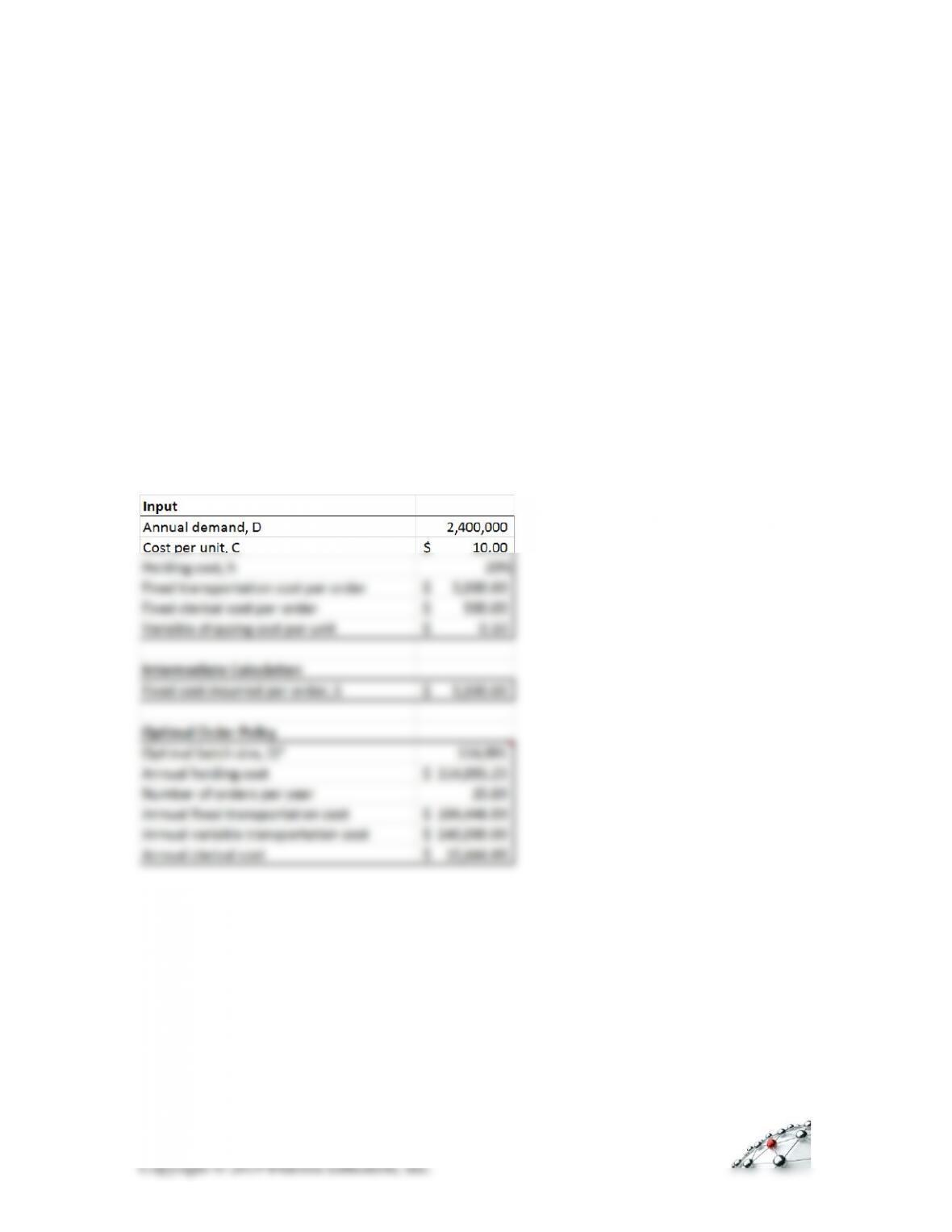
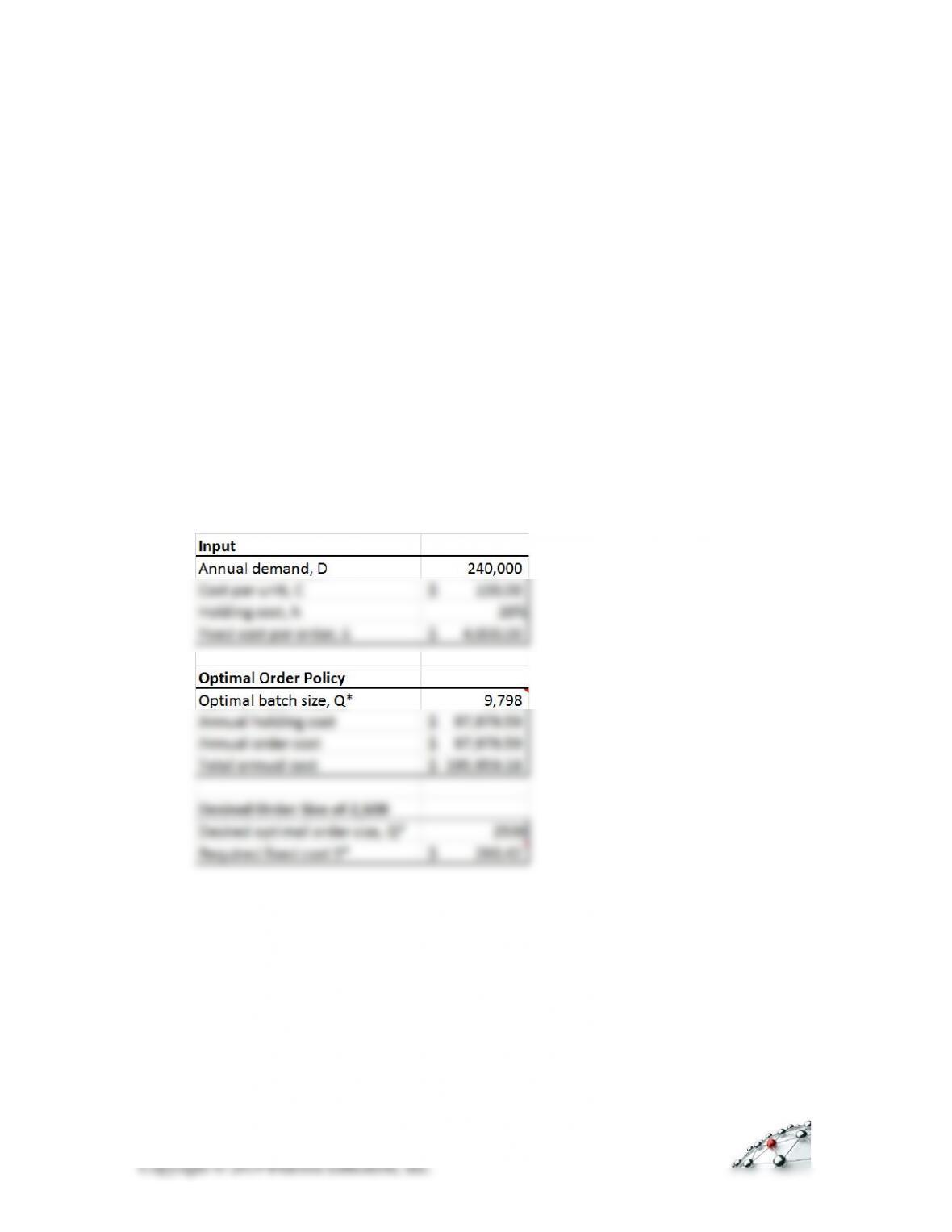
4. Target purchases home goods made by a supplier in China. Target’s stores in the
United States sell 200,000 units of home goods each month. Each unit costs $10 and
the company has an annual holding cost of 20 percent. Placing a replenishment order
incurs clerical costs of $500/order. The shipping company charges $5,000 as a fixed
cost per shipment along with a variable cost of $0.10 per unit shipped. What is the
optimal order size for Target? What is the annual holding cost of the optimal policy?
How many orders per year does Target place? What is the annual fixed transportation
cost? What is the annual variable transportation cost? What is the annual clerical cost?
This analysis is shown in worksheet Ex 11-4 as follows:
5
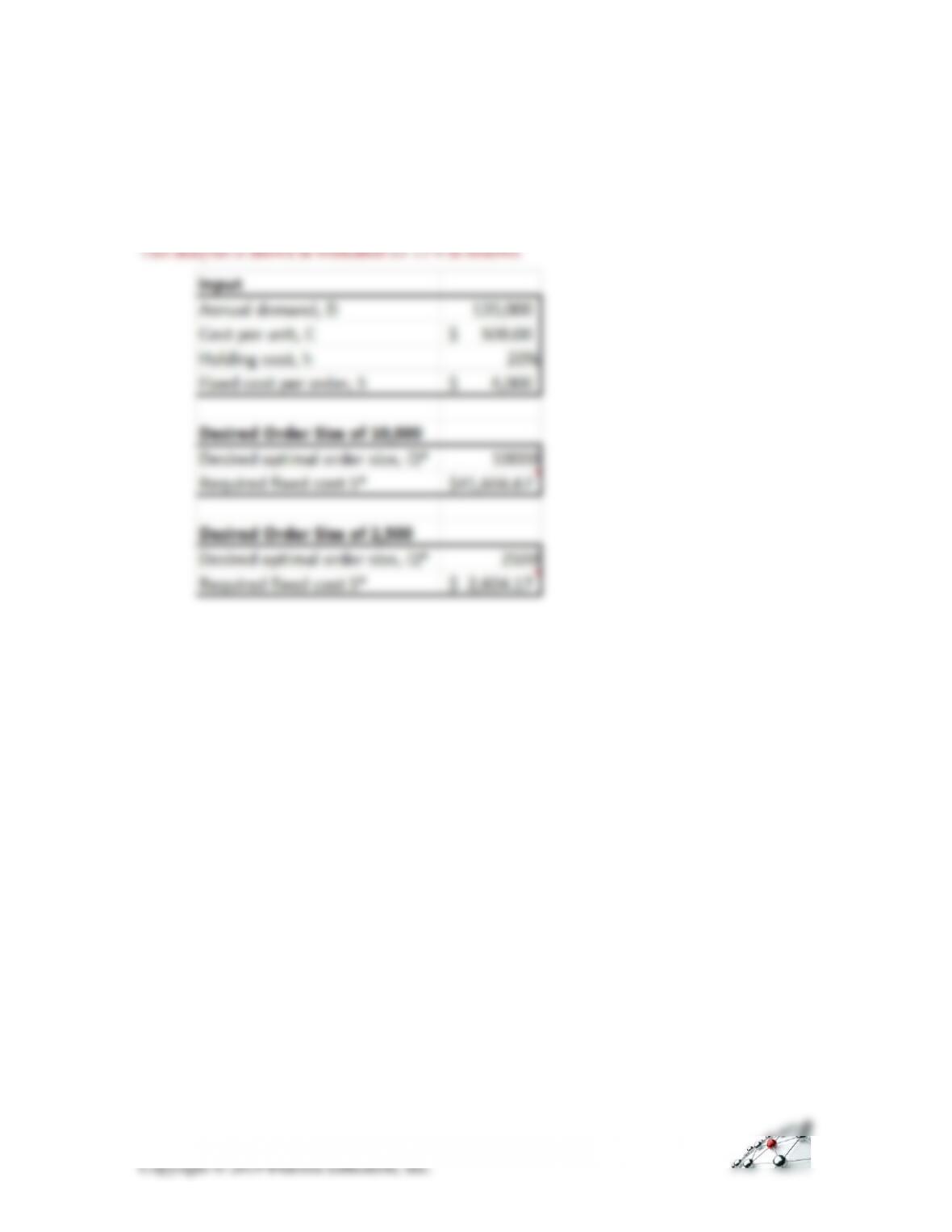
5. Amazon sells 20,000 units of consumer electronics from Samsung every month. Each
unit costs $100 and Amazon has a holding cost of 20 percent. The fixed clerical and
transportation cost for each order Amazon places with Samsung is $4,000. What is the
optimal size of the order that Amazon should place with Samsung? With the goal of
reducing inventories, Amazon would like to reduce the size of each order it places
with Samsung to 2,500 units (allowing it to get four replenishment orders every
month). How much should it reduce the fixed cost per order for an order of 2,500 units
to be optimal?
This analysis is shown in worksheet 11-5 as follows:
6
6. Amazon sells 10,000 Lenovo PCs every month. Each PC costs $500 and Amazon has
a holding cost of 20 percent. For what fixed cost per order would an order size of
10,000 units be optimal? For what fixed cost per order would an order size of 2,500
units be optimal?
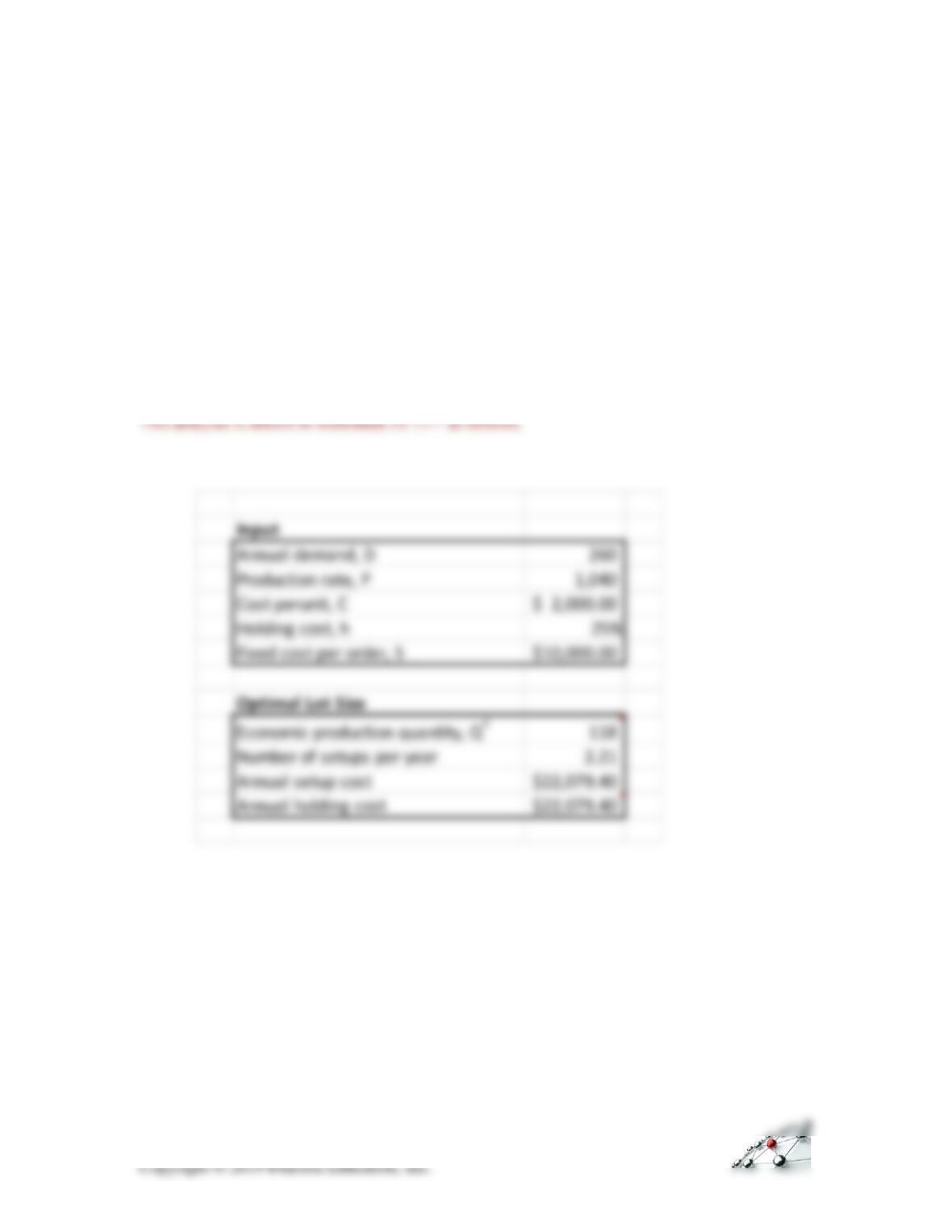
7. A steel rolling mill can produce I-beams at the rate of 20 tons per week. Customer
demand for the beams is 5 tons per week. To produce I-beams, the mill must go
through a setup that requires changing to the appropriate rolling patterns. Each setup
costs the mill $10,000 in labor and lost production. I-beams cost the mill $2,000 per
ton and the mill has a holding cost of 25 percent. What is the optimal production batch
size for I-beams? What is the annual setup cost of the optimal policy? What is the
annual holding cost?
8
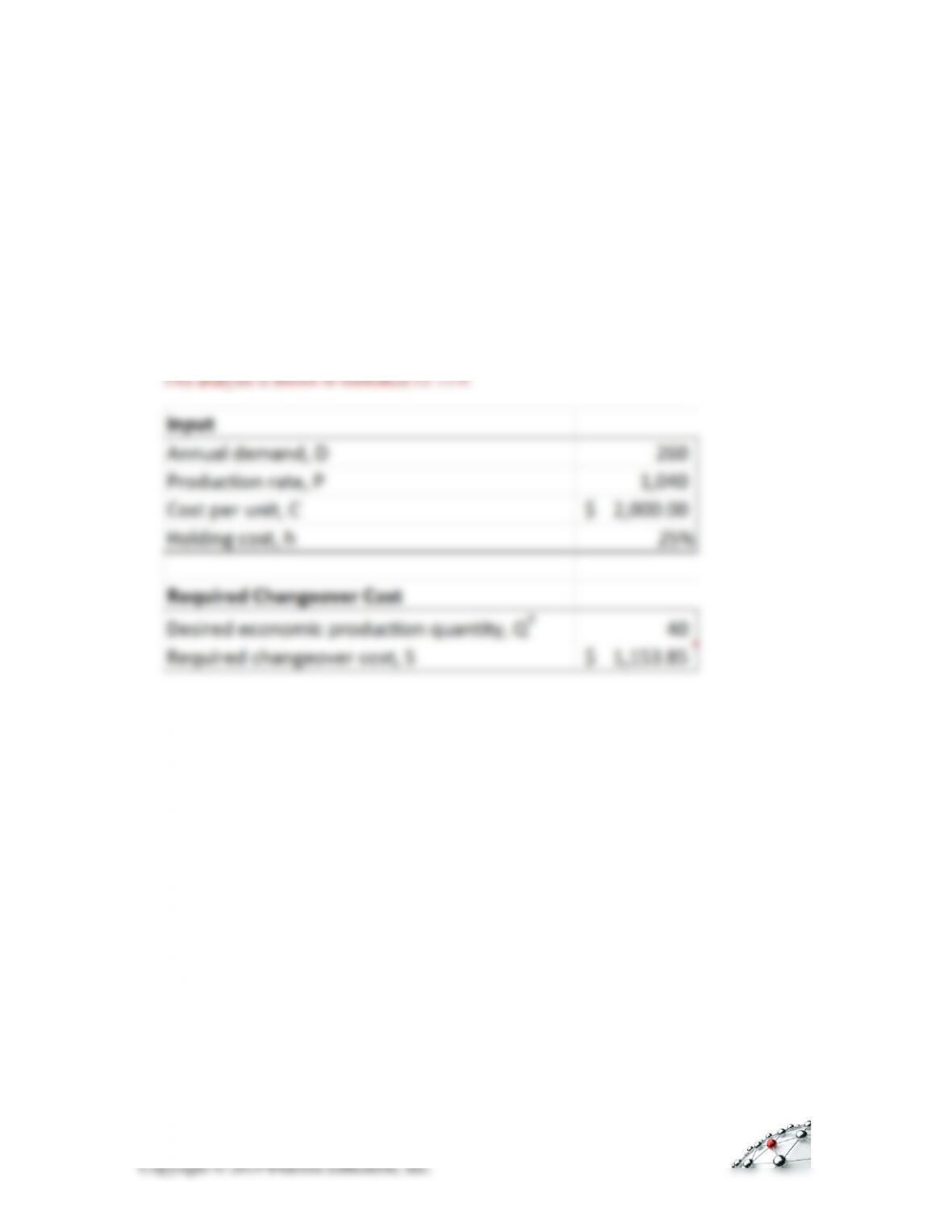
8. A steel rolling mill can produce I-beams at the rate of 20 tons per week. Customer
demand for the beams is 5 tons per week. I-beams cost the mill $2,000 per ton and the
mill has a holding cost of 25 percent. To produce I-beams, the mill must go through a
setup that requires changing to the appropriate rolling patterns. The mill would like to
produce I-beams in batches of 40 tons (resulting in a production batch every 8 weeks).
For what changeover cost would this batch size be optimal?
9. An electronics company has two contract manufacturers in Asia. Foxconn assembles
its tablets and smartphones while Flextronics assembles its laptops. Monthly demand
for tablets and smartphones is 10,000 units while that for laptops is 4,000. Tablets cost
the company $100 while laptops cost $400 and the company has a holding cost of 25
percent. Currently, the company has to place separate orders with Foxconn and
Flextronics and receives separate shipments. The fixed cost of each shipment is
$10,000. What is the optimal order size and order frequency with each of Foxconn and
Flextronics?
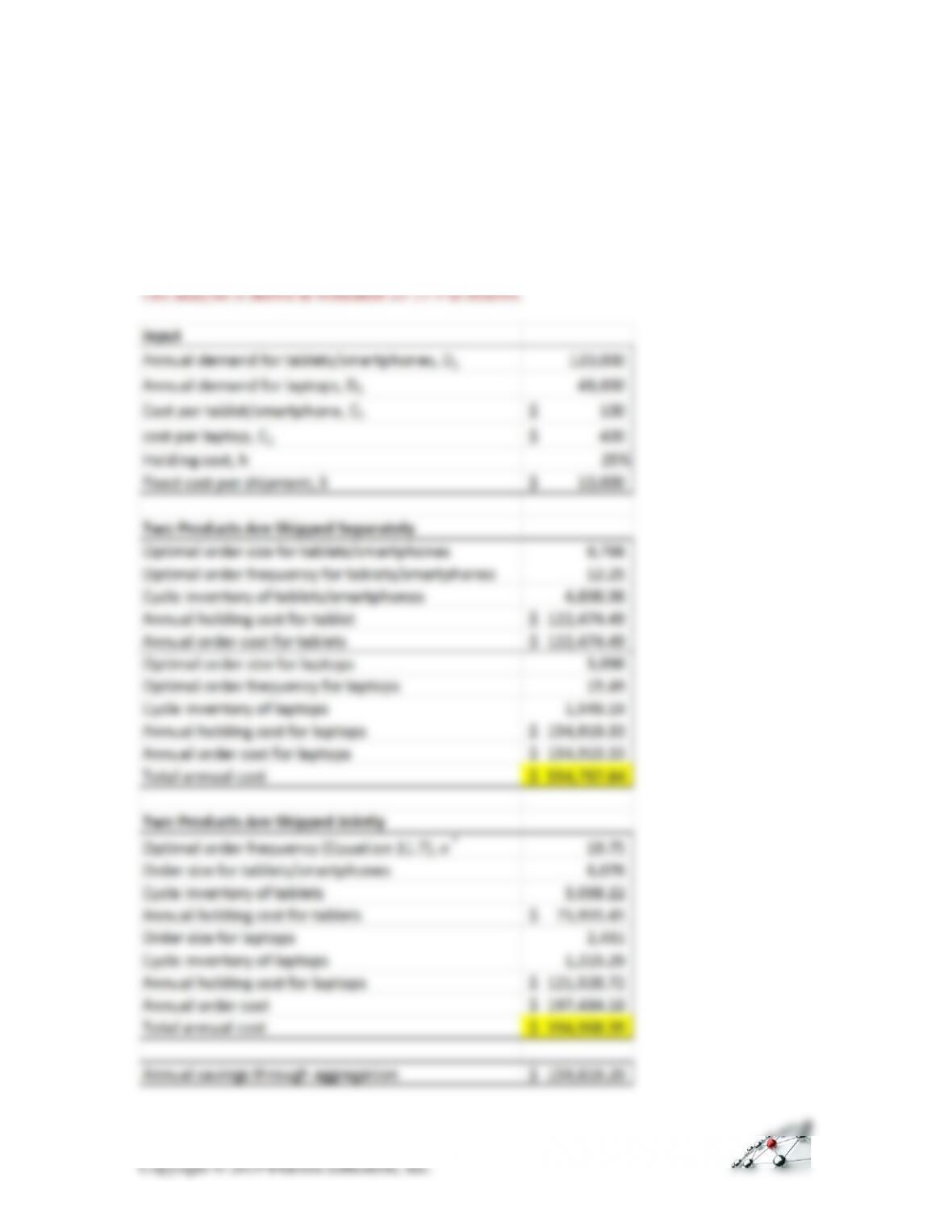
The company is thinking of combining all assembly with the same contract
9
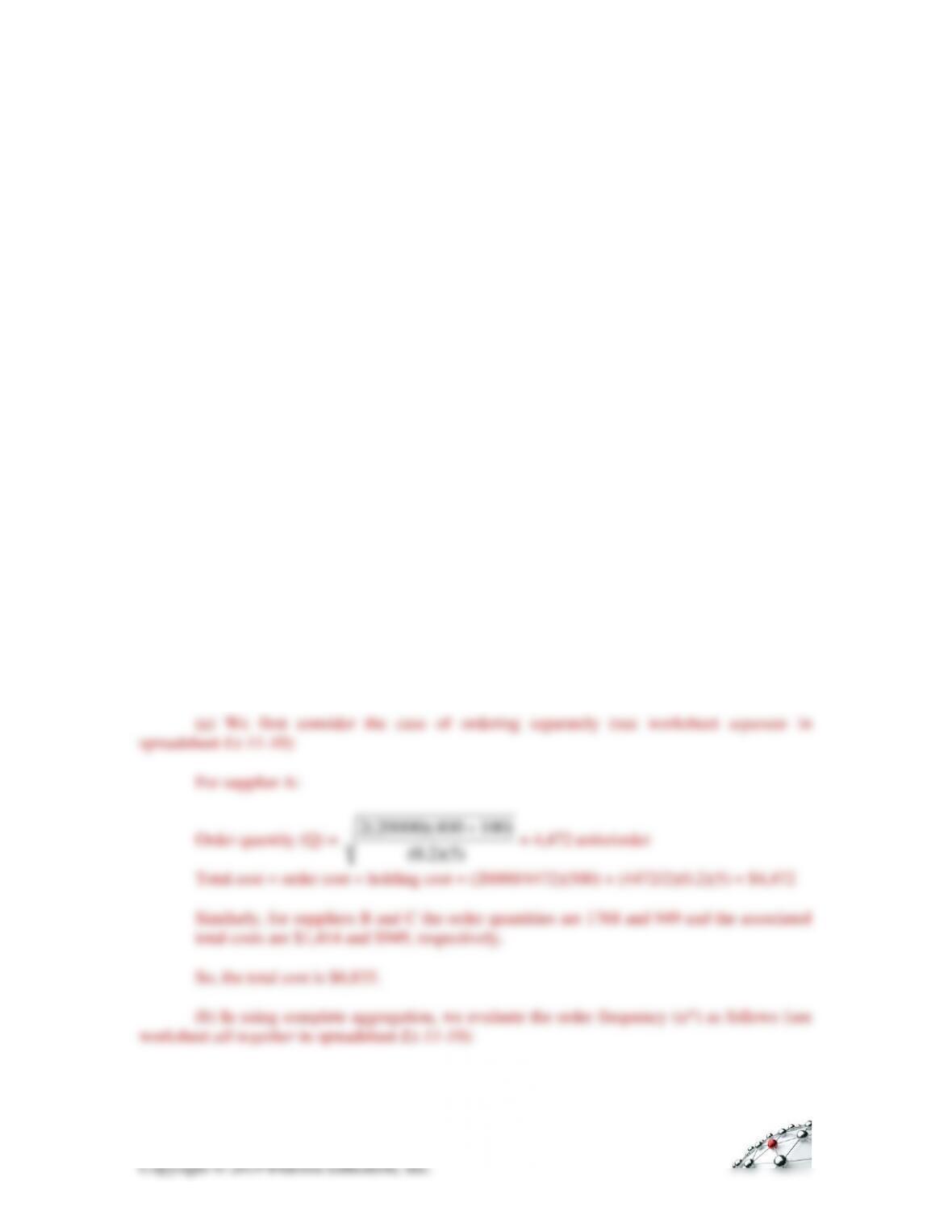
manufacturer. This will allow for a single shipment of all products from Asia. If the
fixed cost of each shipment remains $10,000, what is the optimal order frequency and
order size from the combined orders? How much reduction in cycle inventory can the
company expect as a result of combining orders and shipments?
10
10. Harley purchases components from three suppliers. Components purchased from
Supplier A are priced at $5 each and used at the rate of 20,000 units per month.
Components purchased from Supplier B are priced at $4 each and are used at the rate
of 2,500 units per month. Components purchased from Supplier C are priced at $5
each and used at the rate of 900 units per month. Currently, Harley purchases a
separate truckload from each supplier. As part of its JIT drive, Harley has decided to
aggregate purchases from the three suppliers. The trucking company charges a fixed
cost of $400 for the truck with an additional charge of $100 for each stop. Thus, if
Harley asks for a pickup from only one supplier, the trucking company charges $500;
from two suppliers, it charges $600; and from three suppliers, it charges $700. Suggest
a replenishment strategy for Harley that minimizes annual cost. Assume a holding cost
of 20 percent per year. Compare the cost of your strategy with Harley’s current
strategy of ordering separately from each supplier. What is the cycle inventory of each
component at Harley?
Copyright © 2019 Pearson Education, Inc.
11
So, n* of the case is =
*2S
hCDhCDhCDCCBBAA ++
S* = 400 + 3(100) = $700
So, n* =
)700(2
)5)(2.0(9000)4)(2.0(2500)5)(2.0(20000 ++
= 4 orders/year
For supplier A:
Q = D/n = 20000/4 = 5000 units/order
Total cost = order cost + holding cost = 4(500) + (5000/2)(0.2)(5) = $4,500
Similarly, for suppliers B and C the order quantities are 625 and 225 and the associated
total costs are $650 and $513, respectively.
So, the total cost is $5,663.
11. Ford and GM carry spare parts for their dealers at a third party warehouse in the
Upper Peninsula (UP) of Michigan. Demand for Ford spare parts is 100 units per
month while demand for GM parts is 120 per month. Each spare part costs $100 and
both companies have a holding cost of 20 percent. Currently, each company uses a
separate truck to ship these parts. Each truck has a fixed cost of $500. What is the
optimal order size and frequency for Ford? For GM? What is the annual ordering and
holding cost for each company?
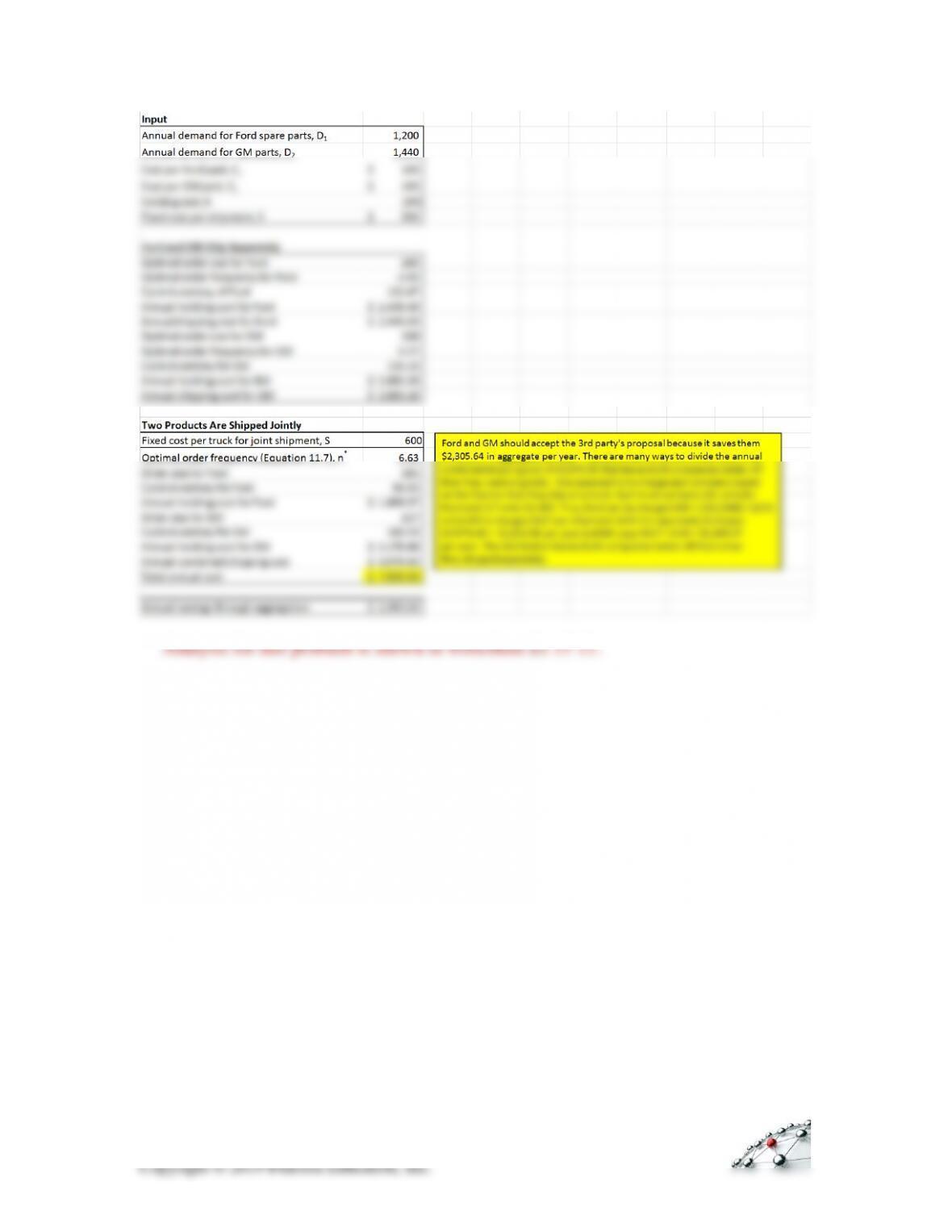
A 3rd party logistics provider has offered to combine shipments for each of the two
companies on a single truck. This will increase the cost of each truck to $600. If the
two companies agree to the joint shipment, what is the optimal order frequency and
size? What is the annual ordering and holding cost for the two companies combined?
Should Ford and GM accept the 3rd party’s proposal? How should they divide the
fixed cost per truck among themselves?
12
12. Prefab, a furniture manufacturer, uses 20,000 square feet of plywood per month.
Its trucking company charges Prefab $400 per shipment, independent of the quantity
purchased. The manufacturer offers an all unit quantity discount with a price of $1 per
square foot for orders under 20,000 square feet, $0.98 per square foot for orders
between 20,000 square feet and 40,000 square feet, and $0.96 per square foot for
orders larger than 40,000 square feet. Prefab incurs a holding cost of 20 percent. What
is the optimal lot size for Prefab? What is the annual cost of such a policy? What is the
cycle inventory of plywood at Prefab? How does it compare with the cycle inventory
if the manufacturer does not offer a quantity discount but sells all plywood at $0.96
per square foot?
Copyright © 2019 Pearson Education, Inc.
13
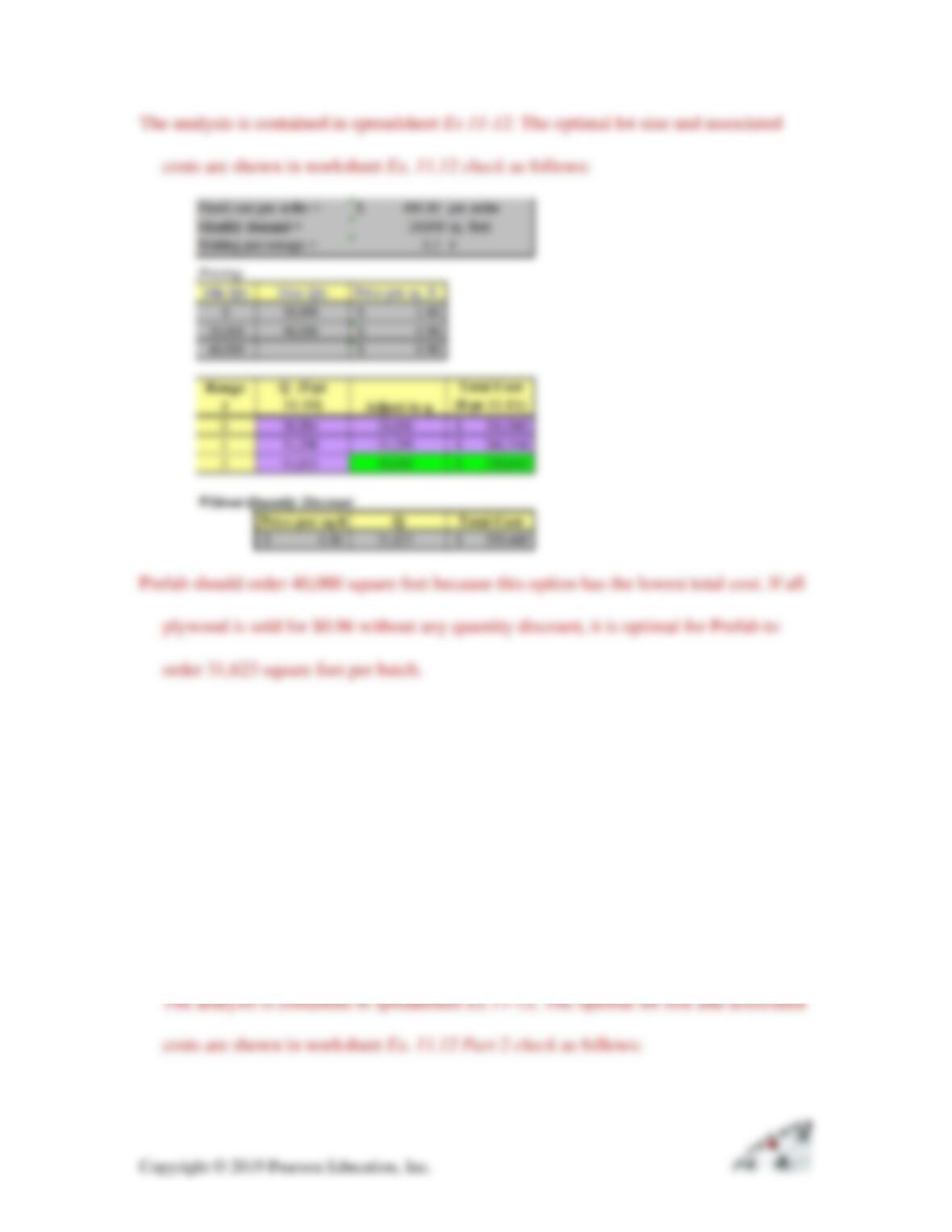
The analysis is contained in spreadsheet Ex 11-12. The optimal lot size and associated
costs are shown in worksheet Ex. 11.12 check as follows:
Prefab should order 40,000 square feet because this option has the lowest total cost. If all
plywood is sold for $0.96 without any quantity discount, it is optimal for Prefab to
order 31,623 square feet per batch.
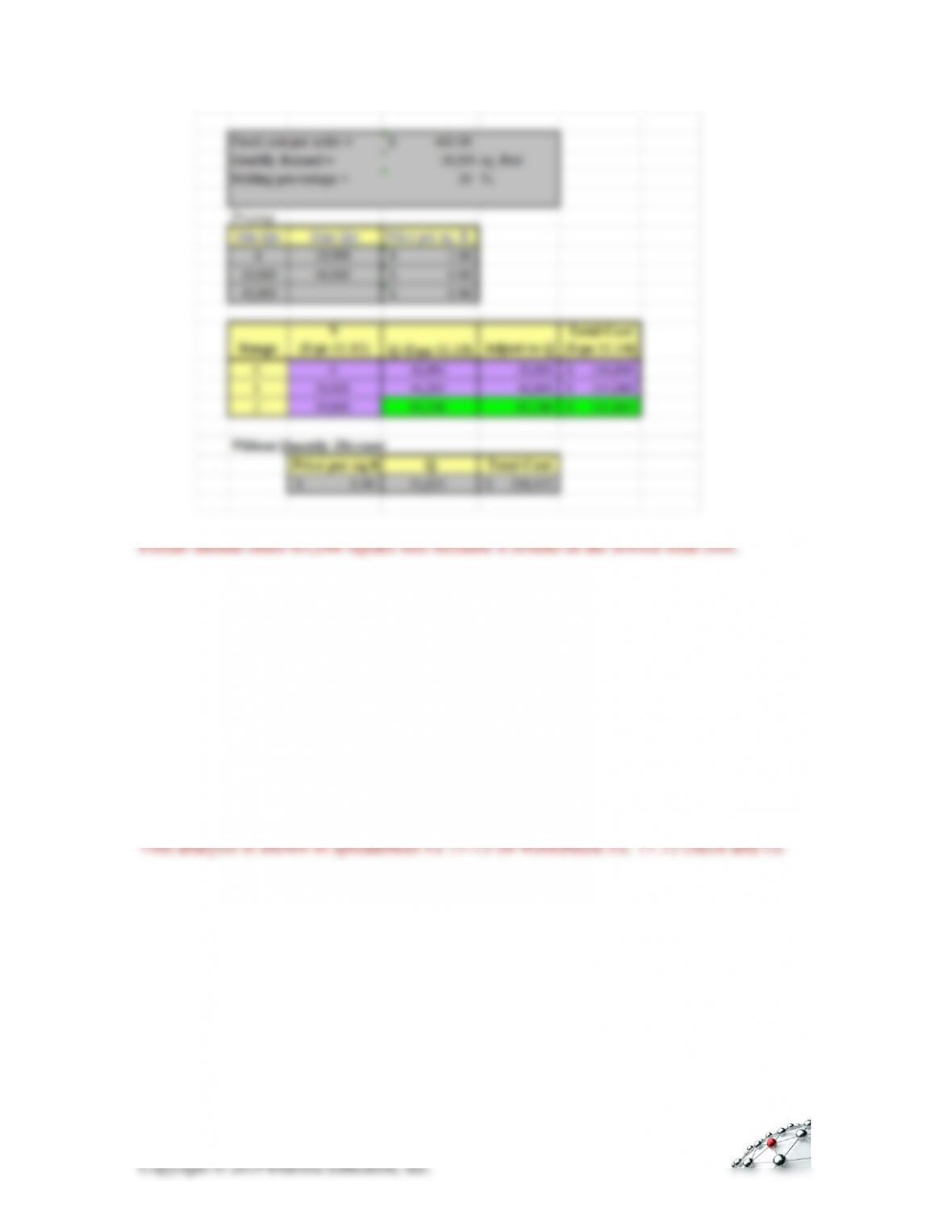
12b. Now consider the case where the manufacturer now offers a marginal unit
quantity discount for the plywood. The first 20,000 square feet of any order are sold at
$1 per square foot, the next 20,000 square feet are sold at $0.98 per square foot, and
any quantity larger than 40,000 square feet is sold for $0.96 per square foot. What is
the optimal lot size for Prefab given this pricing structure? How much cycle inventory
of plywood will Prefab carry given the ordering policy?
14
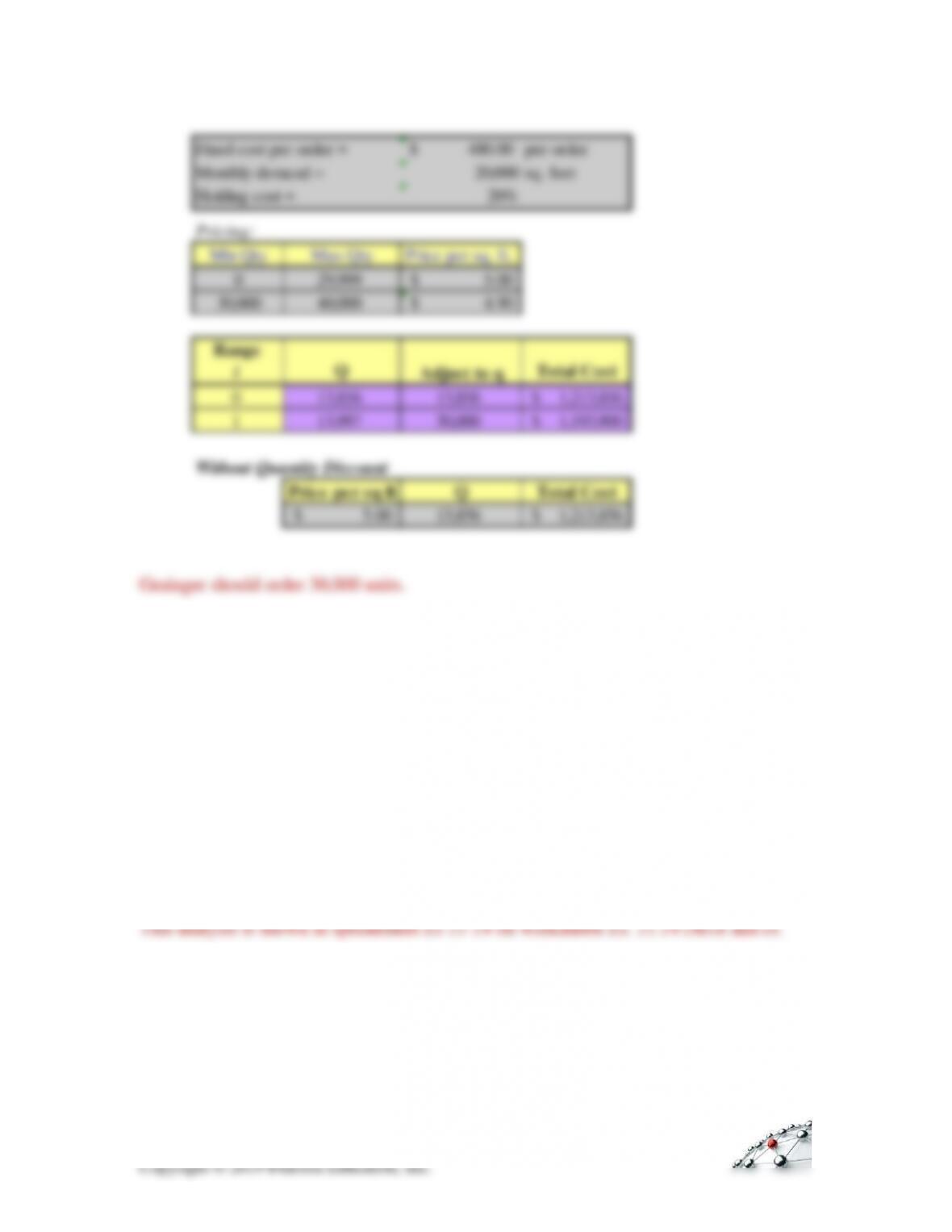
13. Demand for fasteners at W.W. Grainger is 20,000 boxes per month. Holding cost
at Grainger is 20 percent per year. Each order incurs a fixed cost of $400. The supplier
offers an all unit discount pricing scheme with a price of $5 per box for orders under
30,000 and a price of $4.90 for all orders of 30,000 or more. How many boxes should
Grainger order per replenishment?
11.13.
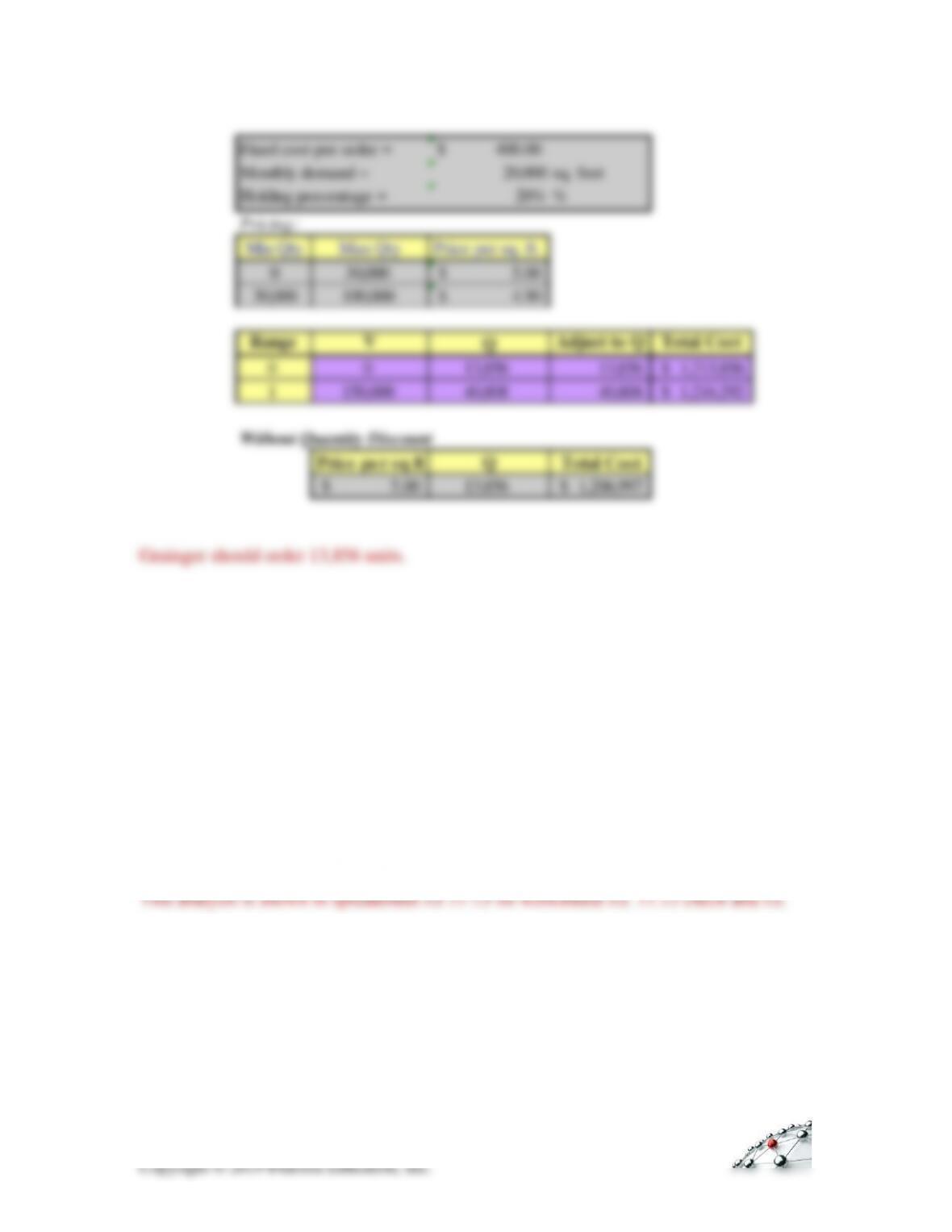
14. Now consider Exercise 13 with a marginal unit quantity discount. Demand for
fasteners at W.W. Grainger is 20,000 boxes per month. Holding cost at Grainger is 20
percent per year. Each order incurs a fixed cost of $400. The supplier offers a
marginal unit discount pricing scheme with a price of $5 per box for the first 30,000
Fixed cost per order = 400.00$ per order
Monthly demand = 20,000 sq. feet
Holding cost = 20%
Pricing:
Min Qty Max Qty Price per sq. ft.
0 29,999 5.00$
30,000 40,000 4.90$
Range
i QAdjust to q Total Cost
0 13,856 13,856 1,213,856$
1 13,997 30,000 1,193,900$
Without Quantity Discount
Price per sq ft Q Total Cost
5.00$ 13,856 1,213,856$
15. Demand for phones at Amazon is 5,000 per month. Holding cost Amazon is 25
percent and the company incurs a fixed cost of $500 for each order placed. The
supplier offers an all unit quantity discount with a price of $200 per phone for all
orders under 10,000, a price of $195 for all orders of 10,000 or more but under 20,000
and a price of $190 for all orders of 20,000 or more. How many phones should
Fixed cost per order = 400.00$
Monthly demand = 20,000 sq. feet
Holding percentage = 20% %
Pricing:
Min Qty Max Qty Price per sq. ft.
0 30,000 5.00$
30,000 100,000 4.90$
Range V QAdjust to Q Total Cost
0 0 13,856 13,856 1,213,856$
1 150,000 40,808 40,808 1,216,292$
Without Quantity Discount
Price per sq ft Q Total Cost
5.00$ 13,856 1,206,997$
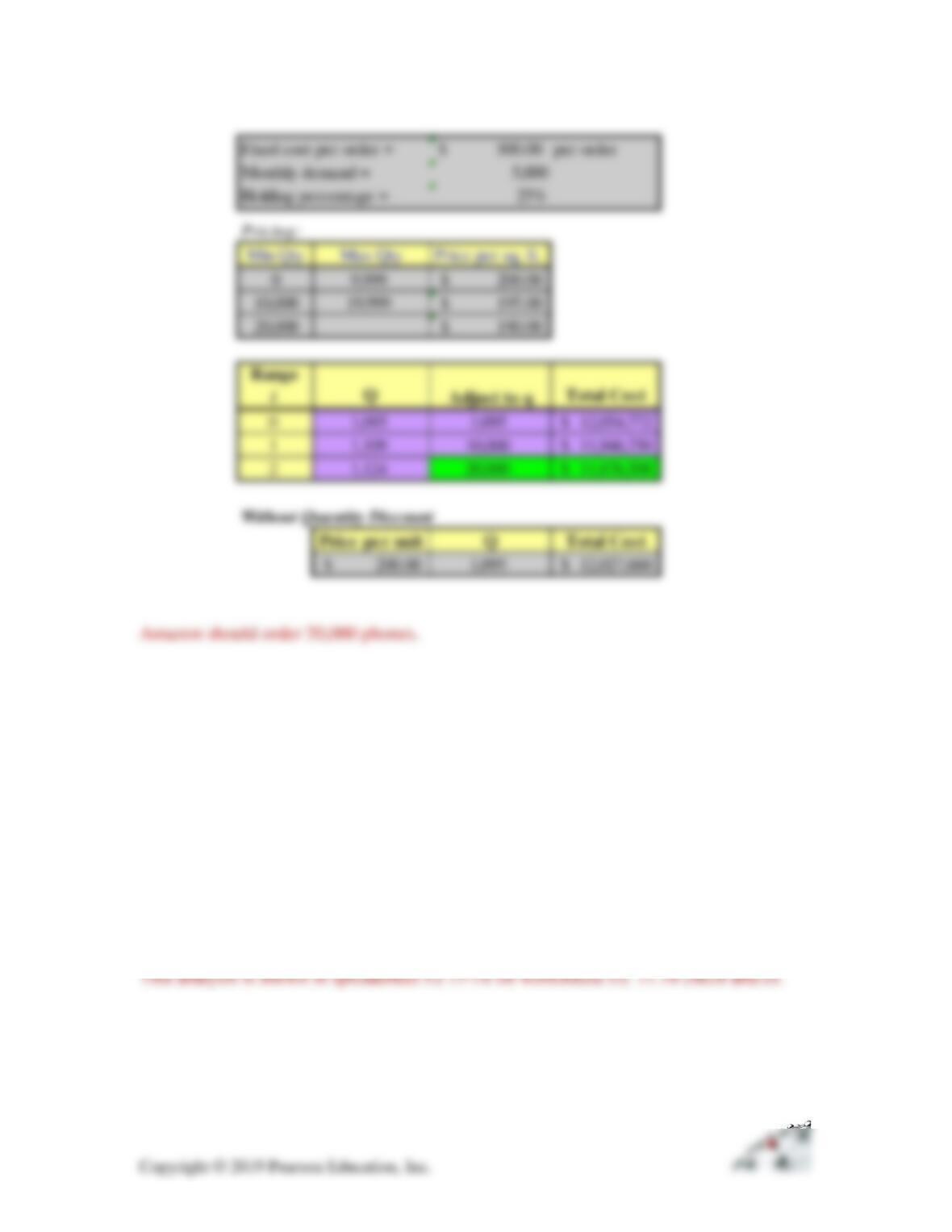
Amazon should order 20,000 phones.
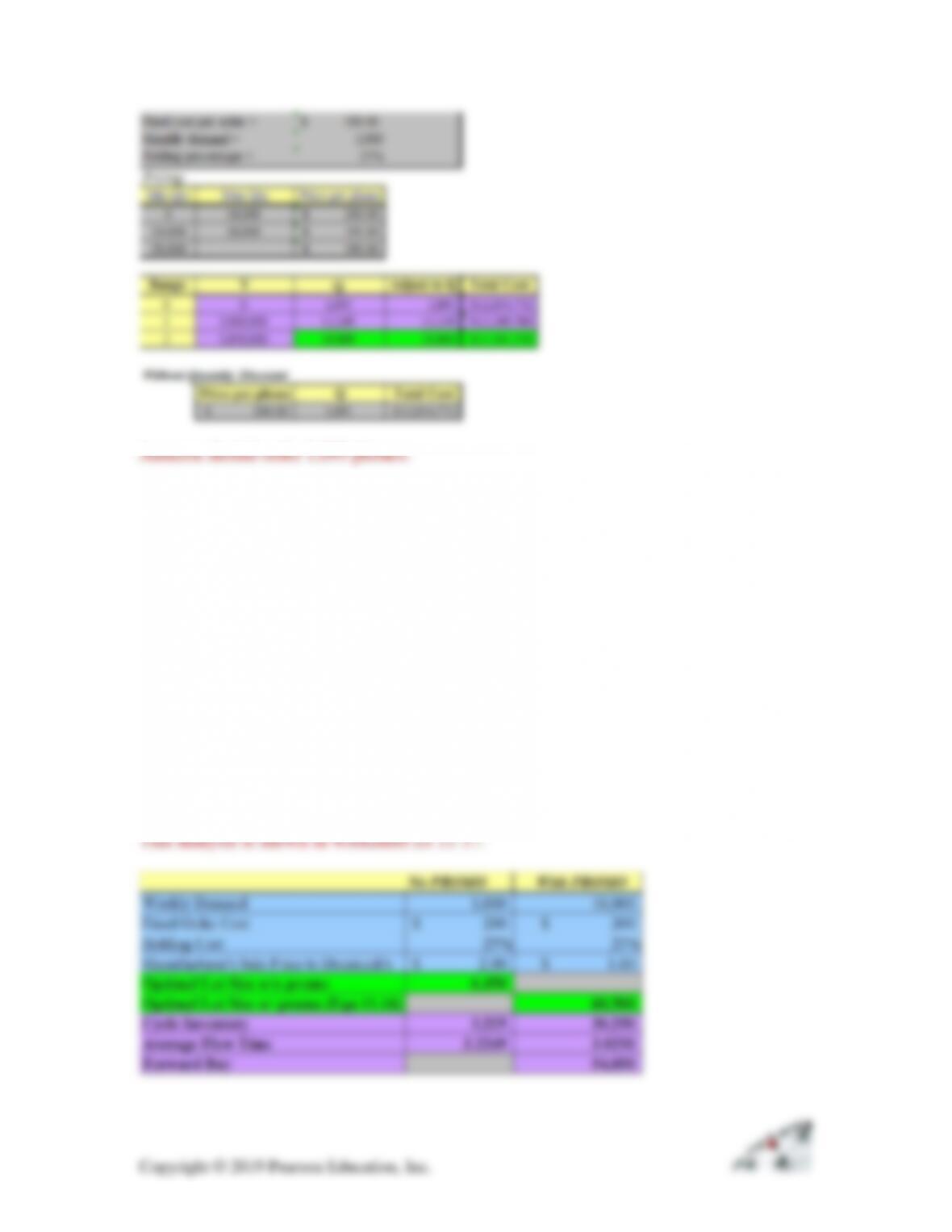
16. Demand for phones at Amazon is 5,000 per month. Holding cost Amazon is 25
percent and the company incurs a fixed cost of $500 for each order placed. The
Fixed cost per order = 500.00$ per order
Monthly demand = 5,000
Holding percentage = 25%
Pricing:
Min Qty Max Qty Price per sq. ft.
0 9,999 200.00$
10,000 19,999 195.00$
20,000 190.00$
Range
i
QAdjust to q Total Cost
0 1,095 1,095 12,054,772$
1 1,109 10,000 11,946,750$
2 1,124 20,000 11,876,500$
Without Quantity Discount
Price per unit Q Total Cost
200.00$ 1,095 12,027,660$
Copyright © 2019 Pearson Education, Inc.
18
Amazon should order 1,095 phones.
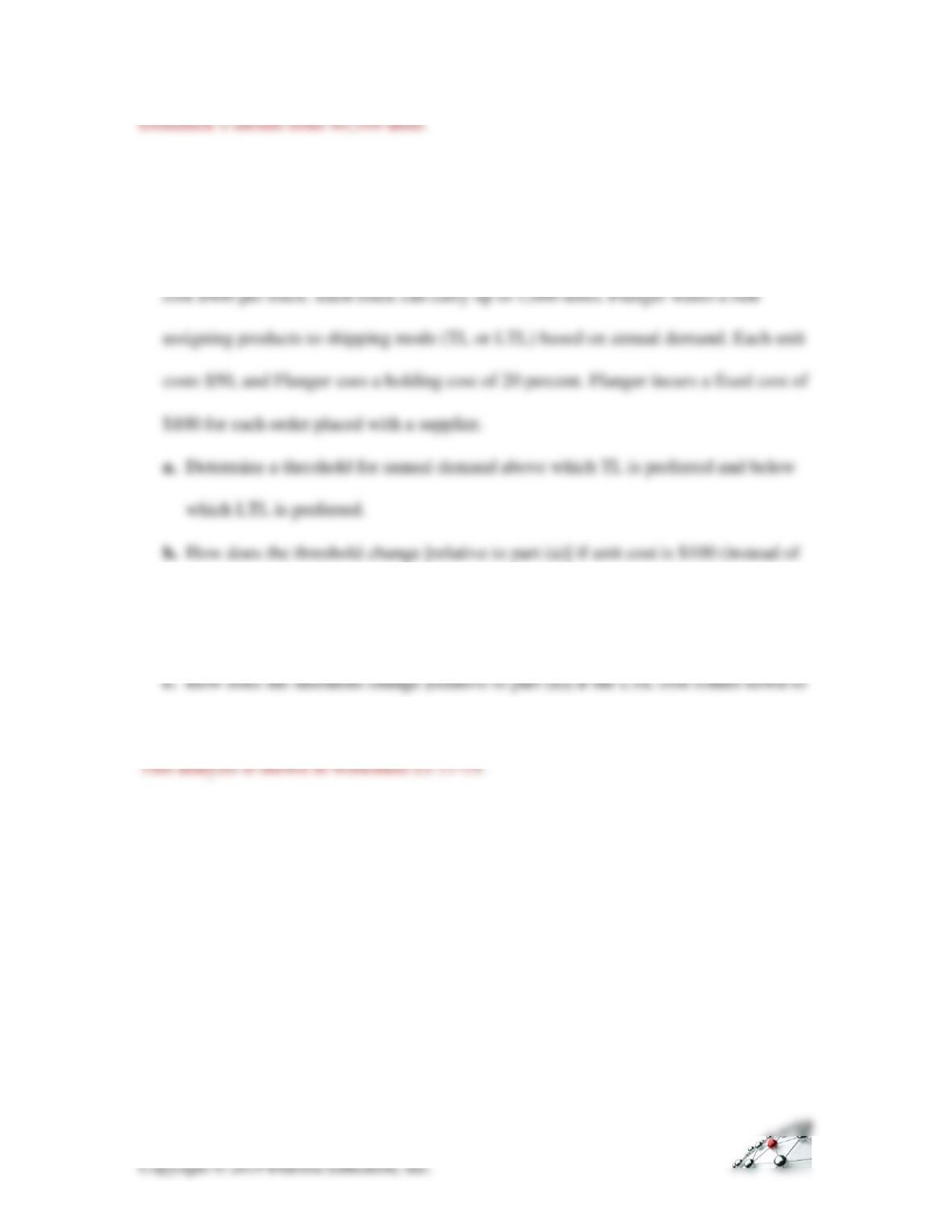
17. Dominick’s supermarket chain sells Nut Flakes, a popular cereal manufactured by
the Tastee cereal company. Demand for Nut Flakes is 1,000 boxes per week.
Dominick’s has a holding cost of 25 percent and incurs a fixed trucking cost of $200
for each replenishment order it places with Tastee. Given that Tastee normally charges
$2 per box of Nut Flakes, how much should Dominick’s order in each replenishment
lot? Tastee runs a trade promotion, lowering the price of Nut Flakes to $1.80 for a
month. How much should Dominick’s order be, given the short-term price reduction?
Copyright © 2019 Pearson Education, Inc.
19
Dominick’s should order 60,500 units.
18. Flanger is an industrial distributor that sources from hundreds of suppliers. The
two modes of transportation available for inbound shipping are LTL (less than
truckload) and TL (truckload). LTL shipping costs $1 per unit, whereas TL shipping
$50) with all other data unchanged? Which mode becomes preferable as unit cost
grows?
$0.8 per unit (instead of $1 per unit)?