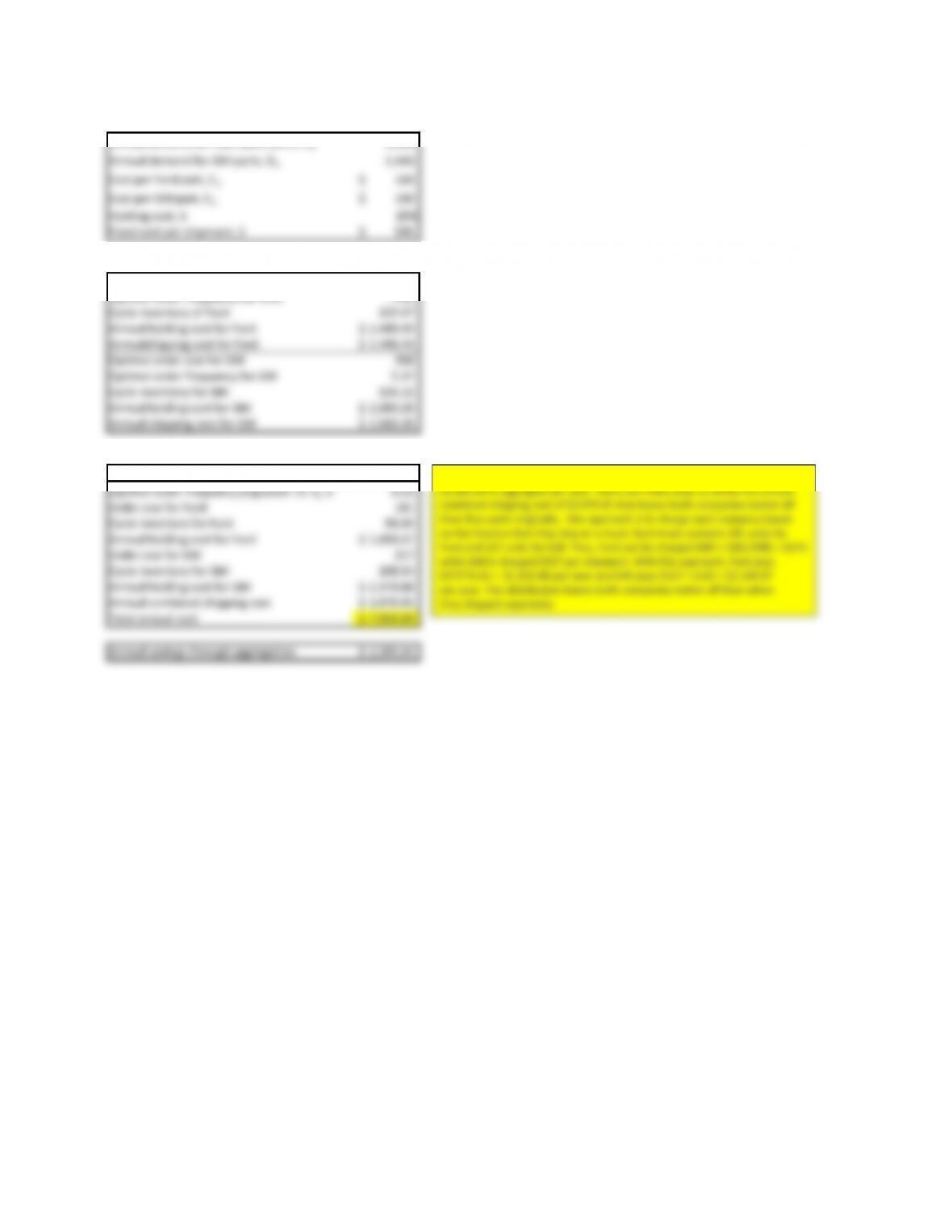
Exercise 11-11
Input
Annual demand for Ford spare parts, D11,200
Annual demand for GM parts, D21,440
Cost per Ford part, C1100$
Cost per GM part, C2100$
Holding cost, h 20%
Fixed cost per shipment, S 500$
Ford and GM Ship Separately
Optimal order size for Ford 245
Optimal order frequency for Ford 4.90
Cycle inventory of Ford 122.47
Annual holding cost for Ford 2,449.49$
Annualshipping cost for Ford 2,449.49$
Optimal order size for GM 268
Optimal order frequency for GM 5.37
Cycle inventory for GM 134.16
Annual holding cost for GM 2,683.28$
Annual shipping cost for GM 2,683.28$
Two Products Are Shipped Jointly
Fixed cost per truck for joint shipment, S 600
Optimal order frequency (Equation 11.7), n*6.63
Order size for Ford 181
Cycle inventory for Ford 90.45
Annual holding cost for Ford 1,809.07$
Order size for GM 217
Cycle inventory for GM 108.54
Annual holding cost for GM 2,170.88$
Annual combined shipping cost 3,979.95$
Total annual cost 7,959.90$
Annual savings through aggregation 2,305.64$
Ford and GM should accept the 3rd party’s proposal because it saves them
$2,305.64 in aggregate per year. There are many ways to divide the annual
combined shipping cost of $3,979.95 that leaves both companies better off
than they were originally. One approach is to charge each company based
on the fraction that they ship on a truck. Each truck contains 181 units for
Ford and 217 units for GM. Thus, Ford can be charged 600 × (181/398) = $273
while GM is charged $327 per shipment. With this approach, Ford pays
$273*6.63 = $1,810.88 per year and GM pays $327 × 6.63 = $2,169.07
per year. This distribution leaves both companies better off than when
they shipped separately.